


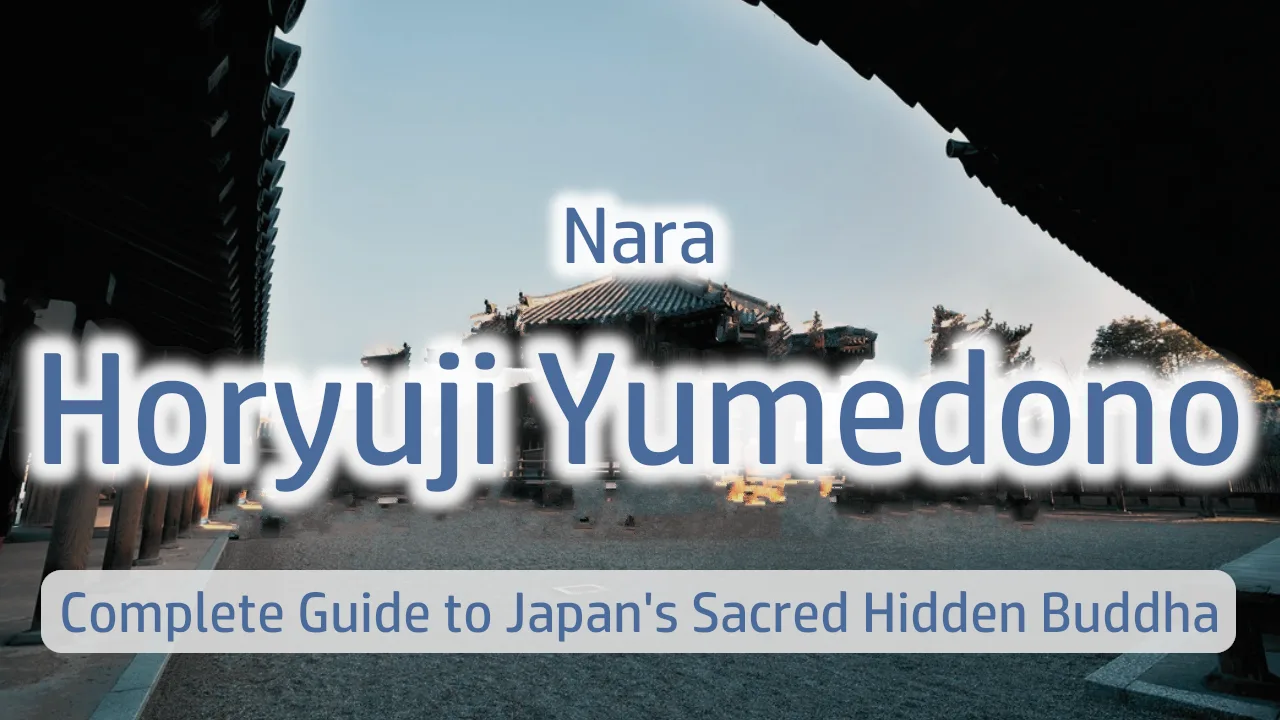
Nestled in the ancient town of Ikaruga in Nara Prefecture, Horyuji Temple stands as a testament to over 1,400 years of Buddhist heritage. As Japan’s first UNESCO World Heritage Site, this temple complex draws visitors from around the world. At its heart lies one of Buddhism’s most intriguing mysteries: the Guze Kannon, a sacred statue hidden from view for over a millennium.
The Yumedono, or Hall of Dreams, rises majestically within the Eastern Precinct of Horyuji. This octagonal sanctuary, built in 739 to honor Prince Shotoku’s memory, houses the enigmatic Guze Kannon statue. Standing 178.8 centimeters tall, this gilded wooden image is believed to be a life-sized representation of the prince himself. For centuries, this national treasure remained sealed away, wrapped in layers of white cloth and shrouded in mystery.
The Challenge of Viewing Japan’s Most Elusive Buddha
While Horyuji Temple welcomes visitors year-round, seeing the Guze Kannon presents unique challenges. The statue reveals itself only during limited spring and autumn periods, typically from mid-April through mid-May and late October through late November. Even during these opening periods, the sacred image remains enshrined within its protective cabinet, viewable only from outside the hall. This restriction means visitors cannot approach closely or examine the intricate details that make this sculpture so remarkable.
The limited viewing opportunities and the distance from which the statue must be observed make planning essential. The rarity of these openings, however, only heightens the significance of witnessing this cultural treasure. Special winter viewings occasionally occur on select weekends, offering additional opportunities for those who cannot visit during the regular seasons.
The Oldest Wooden Structures in the World
Horyuji Temple’s significance extends far beyond a single statue. The complex preserves the world’s oldest surviving wooden buildings, structures that have stood for over 1,300 years. Founded in 607 by Prince Shotoku and Empress Suiko, the temple fulfilled Emperor Yomei’s dying wish to create a place of Buddhist worship and healing.
A devastating fire in 670 destroyed much of the original complex, but the subsequent reconstruction, completed by 711, produced the buildings visitors admire today. These structures represent the pinnacle of Asuka-period architecture, incorporating influences from China’s Northern Wei dynasty and Korea’s Baekje kingdom. The Main Hall (Kondo) and Five-Story Pagoda exemplify this architectural fusion, featuring the distinctive entasis columns borrowed from ancient Greek design principles.
The temple complex encompasses 187,000 square meters—roughly equivalent to four Tokyo Domes—divided into two main areas. The Western Precinct (Saiin Garan) contains the famous pagoda and Main Hall (Kondo), while the Eastern Precinct (Toin Garan) centers on the Hall of Dreams (Yumedono). With 55 buildings designated as national treasures or important cultural properties, Horyuji demands adequate time for proper exploration.
The Mysterious Guze Kannon: Beauty Preserved Through Secrecy
The Guze Kannon’s origins remain uncertain. Art historians cannot definitively establish when, where, or by whom this masterpiece was created, though its completion predates the Yumedono’s construction in 739. The statue’s very name—”Guze,” meaning “savior”—lacks clear historical documentation.
Carved from a single piece of camphor wood, the statue displays characteristics typical of seventh-century Buddhist sculpture. Its almond-shaped eyes, enigmatic smile (known as an Archaic smile), and symmetrical form show strong Northern Wei influence, similar to the Shaka Triad in Horyuji’s main hall. The figure’s distinctive features include a prominent nose, full lips, and an emphasized philtrum, creating an exotic appearance that sets it apart from later Japanese Buddhist art.
What makes the Guze Kannon truly extraordinary is its remarkable preservation. Protected from light and environmental damage for over eleven centuries, the statue retains much of its original gold leaf. This exceptional condition gives the wooden sculpture a lustrous appearance resembling bronze, allowing modern viewers to appreciate the craftsmanship much as its creators intended.
Fenollosa’s Bold Unveiling of a Sacred Secret
The Guze Kannon might have remained hidden indefinitely without American art historian Ernest Fenollosa’s intervention. In 1884, the Meiji government commissioned Fenollosa and scholar Okakura Tenshin to catalog Japan’s cultural treasures during a period when Western influence threatened traditional arts. When they reached Horyuji, temple monks resisted opening the sealed statue, fearing divine punishment.
After persistent negotiation, Fenollosa finally gained permission to examine the mysterious object. He discovered the statue wrapped in 450 meters of white cloth, covered in centuries of dust. Historical records suggest people had glimpsed the statue during the Heian period, and restoration work occurred during the Edo era. The extensive cloth wrapping likely dates from this Edo-period restoration, remaining untouched until Fenollosa’s investigation.
Upon revealing the statue, Fenollosa proclaimed it an incomparable masterpiece. His documentation initiated a new era of public appreciation, though reverence for the statue’s sacred nature eventually led to the current system of limited seasonal viewings.
Viewing Schedule and Special Opening Periods
Regular Spring and Autumn Viewings
The Guze Kannon traditionally opens for public viewing twice annually. Spring viewings typically run from April 11 through May 18, while autumn viewings occur from October 22 through November 22. These dates remain relatively consistent year to year, though visitors should confirm exact schedules through Horyuji’s official channels several months before planning their trip.
Winter Special Openings
Horyuji occasionally offers special winter viewings on select dates. Recent schedules have included weekends in December, January, and February, providing alternatives for travelers unable to visit during the primary seasons. These winter openings typically concentrate on weekends and occur less frequently than the spring and autumn periods, making them particularly valuable opportunities.
Important Viewing Considerations
During opening periods, the statue remains within its shrine, requiring visitors to view it from outside the Yumedono. This arrangement, while preventing close examination, preserves the sacred atmosphere surrounding this revered image. The Gallery of Temple Treasures (Daihozoin) often hosts special exhibitions during opening periods, displaying additional artifacts normally kept in storage. These exhibitions enhance the visit, offering deeper insights into Horyuji’s extensive collection.
Exploring the Eastern Precinct Beyond the Yumedono
Shariden and Eden: Relics and Visual Biography
Near the Yumedono stand the Shariden (Relic Hall) and Eden (Picture Hall), important cultural properties built during the Kamakura period. The Shariden houses Buddhist relics said to have emerged from Prince Shotoku’s hands when he was two years old. The Eden displays painted screens depicting the prince’s life, providing visual narratives of his achievements and spiritual journey.
Dempodo and the Eastern Bell Tower
The Dempodo (Lecture Hall), designated a national treasure, presents an architectural puzzle. Unlike typical Nara-period halls built with earthen floors, this structure features wooden flooring, suggesting it originally served as a residence before conversion to religious use. Tradition holds that Empress Komyo donated the building, though historical evidence remains inconclusive. Inside, visitors can contemplate numerous Buddhist statues in peaceful surroundings.
The Eastern Precinct’s bell tower, built during the Kamakura period, displays a distinctive hakama-style base that flares outward. The bronze bell it houses dates to the Nara period and bears an inscription reading “Chugoji,” indicating connections to the neighboring nunnery.
Essential Sites in the Western Precinct
The Kondo (Main Hall): Repository of Ancient Buddhas
The Main Hall (Kondo) stands as one of world’s oldest surviving wooden buildings and serves as Horyuji’s spiritual center. Its nearly square floor plan and dramatically overhanging eaves create an impression of stability and permanence befitting a structure that has endured for thirteen centuries.
The hall’s columns demonstrate the entasis technique—gradual tapering from bottom to top—creating an optical illusion of perfect straightness when viewed from below. Decorative elements include the distinctive manji-kuzushi (swastika-derived) pattern on the upper railings and cloud-shaped bracket complexes supporting the eaves.
Three bronze Buddha triads occupy the hall’s interior. The central Shaka Triad (Shaka Sanzon-zo), completed in 623, shows the same Northern Wei stylistic influences as the Guze Kannon. Standing just 87.5 centimeters tall, the seated Buddha gains impressive presence through its elaborate platform and halo, reaching a total height of 382 centimeters. The eastern alcove houses a Yakushi Nyorai (Medicine Buddha), while the western section contains an Amida Triad.
The Five-Story Pagoda (Goju-no-To): Ancient Engineering Marvel
Rising 31.5 meters into the sky, Horyuji’s Five-Story Pagoda has survived more than 170 major earthquakes over its 1,300-year history. This remarkable resilience stems from its central pillar design, which absorbs and dissipates seismic forces. The pillar rests on a foundation stone buried 1.5 meters underground, which reportedly contains six Buddhist relics.
The pagoda’s five tiers symbolize the Buddhist elements: earth, water, fire, wind, and void. Each story decreases proportionally in size, creating visual harmony and structural stability. The dramatic eave extensions contribute to the building’s graceful appearance while serving important practical functions.
The pagoda’s ground floor houses four clay tableau scenes depicting events from Buddha’s life. The northern tableau, showing Buddha’s death (parinirvana), particularly moves visitors with its realistic portrayal of grieving disciples and attendants surrounding the reclining figure.
Central Gate (Chumon) and Covered Corridors (Kairo)
Despite serving as an entrance, the Central Gate (Chumon) features a column at its center—an unusual design that has sparked scholarly debate for centuries. This two-story structure displays the same decorative elements found on the Main Hall (Kondo), including manji-kuzushi patterns and anthropomorphic supports.
Long Covered Corridors (Kairo) connect the various buildings of the Western Precinct (Saiin Garan), creating sheltered walkways lined with entasis columns. The eastern corridor extends 76 meters while the western corridor measures 72 meters, a deliberate asymmetry designed to balance the visual weight of the Five-Story Pagoda and Main Hall (Kondo).
Treasures of the Gallery of Temple Treasures (Daihozoin)
The Ethereal Kudara Kannon
The Gallery of Temple Treasures (Daihozoin) provides climate-controlled display spaces for Horyuji’s most precious artifacts. The Kudara Kannon commands particular attention, standing apart in its own exhibition area. This 210-centimeter statue exemplifies Asuka-period sculpture with proportions approaching eight heads tall—remarkable for its time.
Unlike the Guze Kannon’s more rigid, symmetrical form, the Kudara Kannon displays naturalistic curves and softer features. Carved from camphor wood with separately attached arms, water bottle, and flowing scarves, the statue presents a feminine, graceful appearance. Its serene expression and elongated proportions create an otherworldly presence that captivates viewers.
The Tamamushi Shrine: Jewel Beetle Splendor
The Tamamushi Shrine ranks among Japan’s most important decorative arts from the Asuka period. This 233-centimeter miniature palace once housed Buddhist images for private devotion. Its name derives from the iridescent wings of jewel beetles (tamamushi) placed beneath pierced copper panels, creating shimmering visual effects.
While the beetle wings have largely degraded, the shrine’s painted scenes survive, offering invaluable insights into seventh-century painting techniques and Buddhist narratives. The panels depict jataka tales and other Buddhist stories with remarkable detail and sophisticated composition.
Additional Masterworks
The Yumetagae Kannon (Dream-Changing Kannon) earns its name from the belief that this gentle bodhisattva transforms nightmares into auspicious dreams. The statue’s soft, flowing forms contrast markedly with earlier, more rigid sculptural styles.
Visitors can also view fragments of the Hiten (flying celestial) murals that once adorned the Main Hall’s (Kondo) ceiling. These survived the devastating 1949 fire only because they had been removed for conservation, preserving crucial evidence of the original interior decoration’s colors and techniques.
The Tachibana Shrine, created during the Nara period, houses miniature Amida Triad figures within an exquisitely decorated cabinet. The shrine’s delicate metalwork and precise craftsmanship demonstrate the sophisticated artistic capabilities of eighth-century Japanese artisans.
Essential Visitor Information
Temple Facilities and Location
| Detail | Information |
|---|---|
| Official Name | Shotoku Sect Head Temple Horyuji |
| Address | 1-1 Horyuji Sannai, Ikaruga, Ikoma District, Nara Prefecture 636-0115 |
| Phone | 0745-75-2555 |
| Closure Days | None (Open year-round) |
| Official Website | https://www.horyuji.or.jp/ |
Hours and Admission
Opening hours vary by season:
- February 22 through November 3: 8:00 AM to 5:00 PM (last entry 4:30 PM)
- November 4 through February 21: 8:00 AM to 4:30 PM (last entry 4:00 PM)
Admission fees were revised in March 2025. The comprehensive ticket provides access to the Western Precinct (Saiin Garan), Gallery of Temple Treasures (Daihozoin), and Eastern Precinct (Toin Garan).
| Category | Fee |
|---|---|
| High school age and above | ¥2,000 |
| Middle school students | ¥1,700 |
| Elementary school students | ¥1,000 |
Special exhibitions at the Gallery of Temple Treasures (Daihozoin) require additional fees beyond the standard admission.
Transportation Access
By Train: From JR Nara Station, take the Yamatoji Line to Horyuji Station (approximately 13 minutes). From Horyuji Station, the temple is a 20-minute walk or a 5-minute bus ride on route 72 to “Horyuji Sando.”
Journey times from major cities:
- JR Nara Station: 13 minutes
- JR Osaka Station: 30 minutes by rapid train
- JR Kyoto Station: approximately 1 hour via Nara
Alternative Routes:
- From Kintetsu Tsutsui Station: Take Nara Kotsu bus toward JR Oji Station (12 minutes) to “Horyuji-mae,” then walk 5 minutes
- From JR Oji/Kintetsu Shin-Oji Stations: Take Nara Kotsu bus toward Kokudo Yokota/Horyuji-mae (10 minutes) to “Horyuji-mae,” then walk 5 minutes
By Car: From Nishi-Meihan Expressway, take the Horyuji exit (approximately 3 minutes to the temple). Horyuji does not maintain dedicated parking facilities. Visitors should use nearby commercial parking lots or facilities operated by local businesses. Public transportation remains preferable during peak seasons.
The Horyuji i-Center: Gateway to Understanding
Located a short walk from the temple’s main entrance, the Horyuji i-Center serves as an essential starting point for temple exploration. This facility provides:
- Information services in multiple languages
- Historical exhibits and architectural models
- Authentic reconstructions including a full-scale entasis column
- Display of excavated roof tiles from the Asuka and Hakuho periods
- Bicycle rental services for exploring the broader Ikaruga area
Volunteer Guide Program
The i-Center coordinates complimentary volunteer guide services for individuals and groups. Advance reservation allows visitors to benefit from approximately two hours of expert guidance through both Horyuji and neighboring Chugoji Temple. These guides share insights and stories unavailable in written materials, significantly enriching the temple experience.
| Detail | Information |
|---|---|
| Facility Name | Horyuji i-Center |
| Address | 1-8-25 Horyuji, Ikaruga, Ikoma District, Nara Prefecture 636-0115 |
| Phone | 0745-74-6800 |
| Hours | 9:00 AM to 5:00 PM |
Planning Your Visit
Time Allocation
Thorough exploration of Horyuji’s Western Precinct (Saiin Garan), Gallery of Temple Treasures (Daihozoin), and Eastern Precinct (Toin Garan) requires a minimum of two to three hours. Visitors attending during Guze Kannon viewing periods or special exhibitions should allocate additional time. The temple’s extensive grounds and wealth of artifacts reward unhurried observation.
Recommended Route
An efficient visiting sequence follows this pattern:
- Enter through the Nandaimon (South Great Gate)
- Explore the Western Precinct (Saiin Garan) – Main Hall (Kondo), Five-Story Pagoda (Goju-no-To), Covered Corridors (Kairo)
- Visit the Gallery of Temple Treasures (Daihozoin)
- Proceed through the Todaimon (East Great Gate) to the Eastern Precinct (Toin Garan)
- View the Hall of Dreams (Yumedono) – during opening periods
- Complete the circuit with Shariden, Eden, and Dempodo
Visitor Etiquette
Horyuji functions as an active religious site housing irreplaceable cultural properties. Appropriate behavior includes:
- Refraining from touching buildings or statuary
- Limiting food and drink to designated areas
- Maintaining quiet conversation levels
- Avoiding flash photography and tripod use in restricted areas
- Using only designated smoking areas
Seasonal Considerations
Spring (March through May) offers ideal weather conditions and cherry blossoms throughout the grounds. The spring Guze Kannon viewing period, particularly during Golden Week, attracts significant crowds. Early morning visits provide more peaceful experiences.
Summer (June through August) brings heat and humidity requiring sun protection and frequent hydration. The verdant temple grounds create striking contrasts with the ancient architecture. Early morning visits help avoid the most intense heat.
Autumn (September through November) ranks among the most popular visiting seasons. Autumn foliage peaks in November, coinciding with the Guze Kannon viewing period. The combination of colorful leaves and historic buildings creates spectacular photography opportunities.
Winter (December through February) sees fewer visitors, allowing contemplative exploration. Clear winter skies enhance visibility of architectural details. Snow-covered temple grounds present rare beauty, though visitors should exercise caution on potentially icy surfaces.
Crowd Management
Peak crowding occurs during:
- Spring Guze Kannon viewing, especially Golden Week (late April/early May)
- Autumn Guze Kannon viewing, particularly November weekends
- First and last days of viewing periods
Optimal visiting times include:
- Opening hour (8:00 AM)
- Late afternoon (after 4:00 PM, season dependent)
- Weekday mornings
- Mid-period dates (avoiding opening and closing days)
Neighboring Temples Worth Exploring
Chugoji Temple
Directly adjacent to Horyuji’s Eastern Precinct (Toin Garan), Chugoji Temple operates as a separate nunnery. Founded as a residence for Prince Shotoku’s mother, Empress Anahobe no Hashihito, the site later converted to a temple. The main object of worship—a seated Miroku Bosatsu—represents one of Japan’s most celebrated Buddhist sculptures. This contemplative figure, with its gentle smile and characteristic pose (right leg resting on left knee), has drawn comparisons to Leonardo da Vinci’s Mona Lisa.
The temple also preserves the Tenjukoku Shucho, an embroidered tapestry depicting the heavenly realm where Prince Shotoku was believed to reside after death. This national treasure provides rare evidence of seventh-century textile arts. Note that Chugoji requires separate admission beyond the Horyuji ticket.
Hokiji Temple
Hokiji Temple, approximately 20 minutes on foot from Horyuji, houses Japan’s oldest surviving three-story pagoda. According to tradition, Prince Shotoku’s son, Prince Yamashiro no Oe, established this temple in 706. The pagoda’s elegant proportions and remote setting amidst rice fields create a serene atmosphere distinct from Horyuji’s more visited grounds.
Deepening Your Understanding of Horyuji
Prince Shotoku’s Historical Legacy
Understanding Prince Shotoku’s (574-622) contributions helps contextualize Horyuji’s significance. As regent under Empress Suiko, Shotoku fundamentally shaped Japanese Buddhism and governmental structures.
His diplomatic initiatives included dispatching envoys to Sui Dynasty China, most famously the mission led by Ono no Imoko carrying the provocative message: “The sovereign of the land where the sun rises sends a letter to the sovereign of the land where the sun sets.” This assertion of equal status with China’s emperor marked a crucial moment in Japanese diplomatic history.
Domestically, Shotoku established the Twelve Level Cap and Rank System, creating merit-based advancement opportunities regardless of birth status—revolutionary for its time. His Seventeen-Article Constitution, beginning with the principle “Harmony is to be valued,” established ethical guidelines for government officials.
Shotoku’s promotion of Buddhism alongside traditional Shinto worship created the syncretic religious framework that characterizes Japanese spirituality. His temple-building program, of which Horyuji remains the crown jewel, established Buddhism’s institutional presence throughout Japan.
Asuka Period Artistic Styles
Horyuji’s sculptures exemplify the artistic conventions of the Asuka period (538-710), when continental influences profoundly shaped Japanese art. The Northern Wei style, visible in the Guze Kannon and Shaka Triad, features:
- Almond-shaped eyes creating a meditative gaze
- Archaic smiles conveying serene detachment
- Symmetrical, flattened body forms
- Formalized drapery with regular, geometric folds
Later works like the Kudara Kannon show transitional characteristics, incorporating more naturalistic proportions and fluid poses while retaining earlier stylistic elements. These evolutionary patterns allow visitors to trace Japanese sculpture’s development across decades.
Architectural Innovation and Earthquake Resistance
Horyuji’s longevity through centuries of earthquakes stems from sophisticated engineering principles. The five-story pagoda’s central pillar (shinbashira) functions as a massive damper, absorbing and dissipating seismic energy. This pillar, extending from underground foundations to the spire, hangs freely rather than rigidly connecting to the building’s frame, allowing independent movement that counteracts earthquake forces.
The entasis columns throughout the complex, though aesthetically pleasing, also serve structural purposes. Their slight convex curve distributes weight more evenly than straight pillars, reducing stress concentration points. The elaborate bracket systems (kumimono) supporting the massive roofs function as flexible joints, permitting movement during seismic events while maintaining overall stability.
Making the Most of Your Horyuji Experience
Photography Opportunities
While interior photography faces restrictions, the temple grounds offer exceptional outdoor photography subjects. The Five-Story Pagoda (Goju-no-To) provides dramatic compositions from numerous angles, particularly when framed by cherry blossoms or autumn leaves. The Covered Corridors’ (Kairo) repeating columns create compelling perspective studies. Morning light illuminates the eastern facades most favorably, while afternoon sun highlights western structures.
Combining with Broader Nara Exploration
Horyuji’s location in western Nara Prefecture positions it conveniently for various itineraries. Visitors based in Nara city can reach Horyuji in under 30 minutes, making half-day visits practical. Those exploring the broader Kansai region can easily incorporate Horyuji into routes between Osaka, Kyoto, and Nara.
A full day might combine Horyuji with Nara Park’s attractions—Todaiji Temple, Kasuga Taisha Shrine, and Kofukuji Temple—though this requires early starts and efficient time management. Alternatively, focusing exclusively on the Ikaruga area allows leisurely exploration of Horyuji, Chugoji, and Hokiji with time for the rural landscapes that frame these ancient structures.
Accessibility Considerations
Horyuji’s main pathways accommodate wheelchair users, with accessible routes to the Western Precinct (Saiin Garan), Gallery of Temple Treasures (Daihozoin), and Eastern Precinct (Toin Garan). Some buildings have stairs limiting interior access, making advance planning beneficial for visitors with mobility challenges. The extensive grounds involve considerable walking, so comfortable footwear proves essential for all visitors.
Weather Preparedness
Japan’s climate varies dramatically by season. Summer visitors should carry sun protection, hats, and water. Winter exploration requires warm layers, though outdoor viewing predominates. Umbrellas prove necessary during rainy periods, particularly June’s rainy season. The covered corridors provide some shelter, but much of the site involves outdoor walking.
The Sacred Privilege of Witnessing the Guze Kannon
Horyuji Temple’s Yumedono and its enigmatic Guze Kannon represent more than historical artifacts—they embody Japan’s spiritual and artistic heritage across fourteen centuries. The limited viewing opportunities for this sacred statue, while potentially frustrating for travelers, enhance the encounter’s significance. Each glimpse of the golden figure standing within its shrine connects visitors to countless generations who have stood in the same spot, seeking the same enlightenment and peace.
The broader Horyuji complex rewards extended exploration. From the world’s oldest wooden structures in the Western Precinct (Saiin Garan) to the intimate beauty of the Eastern Precinct (Toin Garan) temples, every corner reveals new insights into ancient Japanese Buddhism, architecture, and artistry. The Gallery of Temple Treasures (Daihozoin) houses masterworks that alone justify the journey, while the serene temple grounds provide respite from modern life’s rush.
Planning a visit around the Guze Kannon viewing periods transforms a remarkable temple tour into an extraordinary spiritual and cultural experience. Whether witnessing the spring or autumn openings, or securing one of the rare winter viewing opportunities, the encounter with this hidden Buddha remains among Japan’s most memorable travel experiences.
Enhancing Your Japan Journey with Professional Support
Navigating Japan’s complex temple culture, seasonal viewing schedules, and logistical challenges can overwhelm even experienced travelers. For those seeking deeper engagement with sites like Horyuji, professional tour conductor services offer invaluable advantages.
A dedicated tour conductor manages your itinerary, ensuring optimal timing for limited-access experiences like the Guze Kannon viewing. They handle transportation logistics, coordinate with temple schedules, and provide real-time adjustments when unexpected situations arise. Beyond practical support, experienced conductors offer cultural context that transforms sightseeing into genuine understanding.
During emergency situations—from natural disasters to medical needs—tour conductors provide interpretation services and coordinate appropriate responses. They serve as your connection to local resources, ensuring safety and comfort throughout your journey while allowing you to focus on experiencing Japan’s remarkable heritage.
For travelers planning comprehensive Nara itineraries or multi-region journeys incorporating Horyuji, professional tour conductor services eliminate stress while maximizing the quality of each experience. Consider exploring dedicated tour conductor options to enhance your Japan adventure.
Learn more about professional tour conductor services: https://e-stay.jp/en/tour-conductor/