


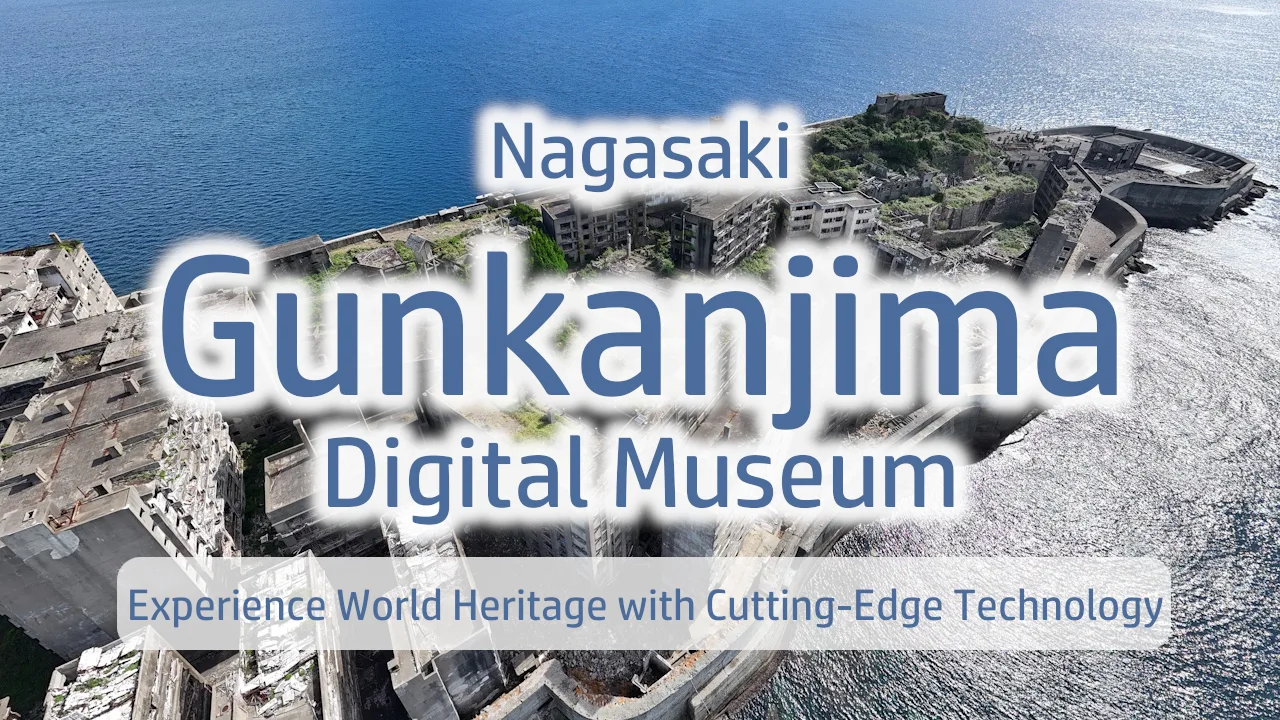
Travel information brought to you by a tour conductor writer. Today, we introduce the Gunkanjima Digital Museum in Nagasaki Prefecture, an innovative facility where you can experience the history and charm of Hashima Coal Mine, commonly known as “Gunkanjima” (Battleship Island), a UNESCO World Heritage Site, through state-of-the-art digital technology.
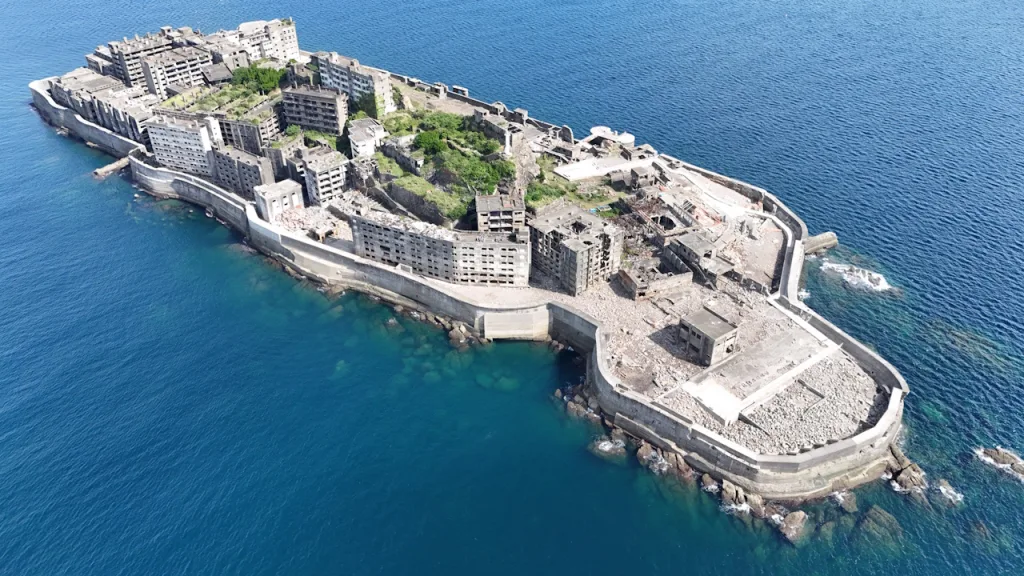
Hashima, located approximately 19 kilometers southwest of Nagasaki Port in the sea, is a small island called “Gunkanjima” because its appearance resembles a battleship. Registered as a component of the “Sites of Japan’s Meiji Industrial Revolution” UNESCO World Cultural Heritage in 2015, this island once boasted the world’s highest population density as an undersea coal mining island that supported Japan’s modernization.
However, landing on the actual Gunkanjima is highly dependent on weather conditions, and even if landing is possible, there are many restricted areas. For those who are prone to seasickness or families with small children, participating in a landing tour presents a high hurdle. In this context, the Gunkanjima Digital Museum has attracted attention as a place where anyone can experience the charm of Gunkanjima at any time, regardless of weather, using cutting-edge digital technology.
What is the Gunkanjima Digital Museum?
The Gunkanjima Digital Museum opened on September 17, 2015. Utilizing modern digital technologies such as the latest VR technology, projection mapping, and a massive 30-meter screen, the facility recreates the history of Gunkanjima and the lives of its former residents with vivid realism.
The greatest attraction is experiencing through virtual reality the interior of restricted areas that can never be entered on landing tours, and the vibrant appearance of the island at its peak. Based on footage of restricted areas captured by drones, testimonies from former islanders, and over 4,000 photos and video materials, visitors can relive the “reality” of Gunkanjima.
Former island residents who serve as guides are present in the museum to share the history of Gunkanjima, allowing visitors to hear firsthand accounts from people who actually lived on the island. It can be described as a new type of museum where digital technology and human warmth merge.
| Item | Details |
|---|---|
| Facility Name | Gunkanjima Digital Museum |
| Opening Hours | 9:00-17:00 (Last admission 16:30) |
| Closed | Irregular holidays |
| Address | 5-6 Matsugae-machi, Nagasaki City, Nagasaki 850-0921 |
| Access | 1-minute walk from Nagasaki Electric Tramway “Oura Cathedral” stop 30-second walk from Nagasaki Bus “Glover Garden Entrance” stop |
From Prosperity to Decline: The History of Hashima Coal Mine
From Coal Discovery to Full-Scale Mining
The history of Gunkanjima begins around 1810 when fishermen discovered coal exposed on rocks. Initially, fishermen extracted coal on a very small scale alongside their fishing activities.
In 1887, Watanabe Hajime from Fukahori excavated the first shaft on Gunkanjima, the 36-meter-deep “First Shaft.” At this time, stone walls that would form the prototype of Gunkanjima, a machinery depot, and a coal storage area were developed. Later in 1890, Mitsubishi purchased Hashima Coal Mine from the former Nabeshima clan lord, Nabeshima Magoroku, for 100,000 yen, and full-scale development began as a branch of Takashima.
Full-scale coal mining commenced in 1891, and with the excavation of the Second and Third Shafts, Hashima Coal Mine’s coal output grew to surpass that of Takashima Coal Mine. The coal produced on Gunkanjima was “strongly caking coal,” the highest heat-generating type among bituminous coals, used as a raw material for coke essential in iron manufacturing. The extracted coal was supplied to facilities such as the Yawata Steel Works in Kitakyushu, Fukuoka Prefecture, continuing to support Japan’s modernization.
Japan’s First High-Rise Reinforced Concrete Apartment
As the population increased, island expansion work proceeded in stages. Starting in 1897, land reclamation was carried out, and the island, originally a small rocky reef, eventually transformed into an artificial island covering approximately 6.3 hectares, about 160 meters from east to west and about 480 meters from north to south.
In 1916, Japan’s first reinforced concrete apartment building, “Building No. 30,” was constructed. This building was a groundbreaking event in Japanese architectural history, aimed at improving workers’ living conditions and effectively utilizing the island’s limited land. Around this time, the nickname “Gunkanjima” became established, and in 1921, the Nagasaki Nichinichi Shimbun called it “Gunkanjima” because it resembled the Japanese Navy battleship “Tosa,” which was under construction at Mitsubishi Heavy Industries Nagasaki Shipyard.
Peak Period with the World’s Highest Population Density
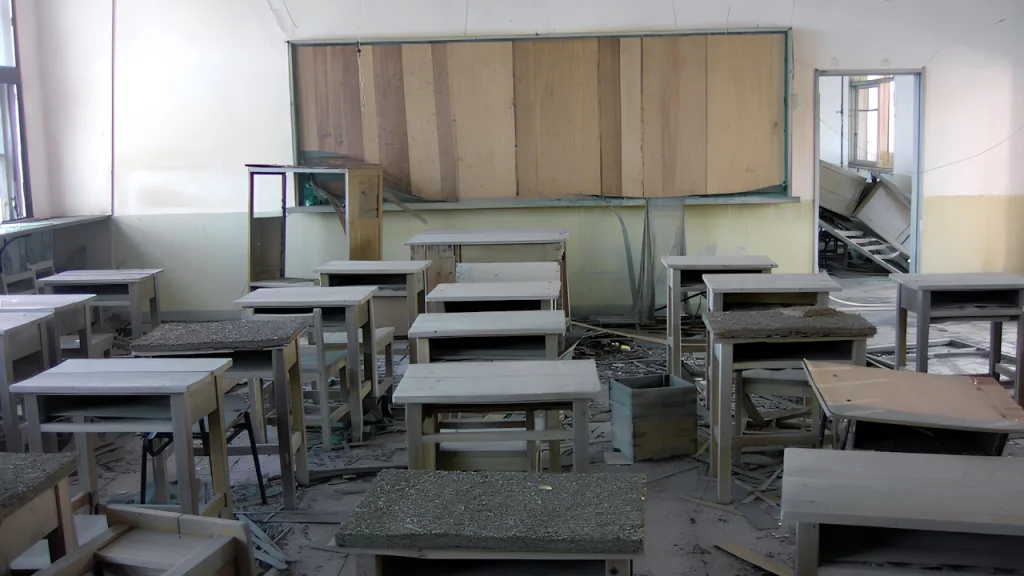
After World War II, with the formation of the Hashima Coal Mine Labor Union and the establishment of labor laws, working conditions improved, and the population surged along with wage increases. In the 1960s, approximately 5,300 people lived on the tiny 6.3-hectare island, with a population density about nine times that of Tokyo at the time, recording the world’s highest population density. This record remains unbroken today.
Life on the small island was unique, with creative use of space. The island had all the facilities necessary for daily life and entertainment, including shops, hospitals, barbershops, restaurants, movie theaters, swimming pools, and schools. The income of coal mine workers was high, and at a time when the national average color television ownership rate was 10 percent, 100 percent of households on the island owned one.
Many people sought greenery on the concrete island by purchasing soil and cultivating plants on balconies, and rooftop gardens were also established. Elevators utilizing cutting-edge technology were installed, and a very progressive and affluent lifestyle was maintained for its time.
Energy Revolution and Mine Closure
Entering the 1950s, as the primary energy source shifted from coal to oil, Gunkanjima fell into decline. The liberalization of crude oil imports in 1962 and the flooding of the deepest parts due to a spontaneous fire in the Kyuhen seam tunnel in 1964 dealt severe blows, causing the scale of the mine to shrink.
On Gunkanjima, where there was no industry other than coal mining, the population also rapidly decreased. Although mining continued in search of new coal seams, only waste rock other than coal was produced, and mining ended in 1972.
On January 15, 1974, Hashima Coal Mine, which had operated for approximately 100 years, closed, and on April 20 of the same year, the remaining approximately 2,000 island residents evacuated all at once, leaving Gunkanjima uninhabited. Afterward, general access was prohibited for safety reasons, but in 2009, viewing paths were developed, and landing tours began. In 2015, it was officially registered as part of the “Sites of Japan’s Meiji Industrial Revolution” UNESCO World Cultural Heritage.
Gunkanjima Revived Through Cutting-Edge Digital Technology
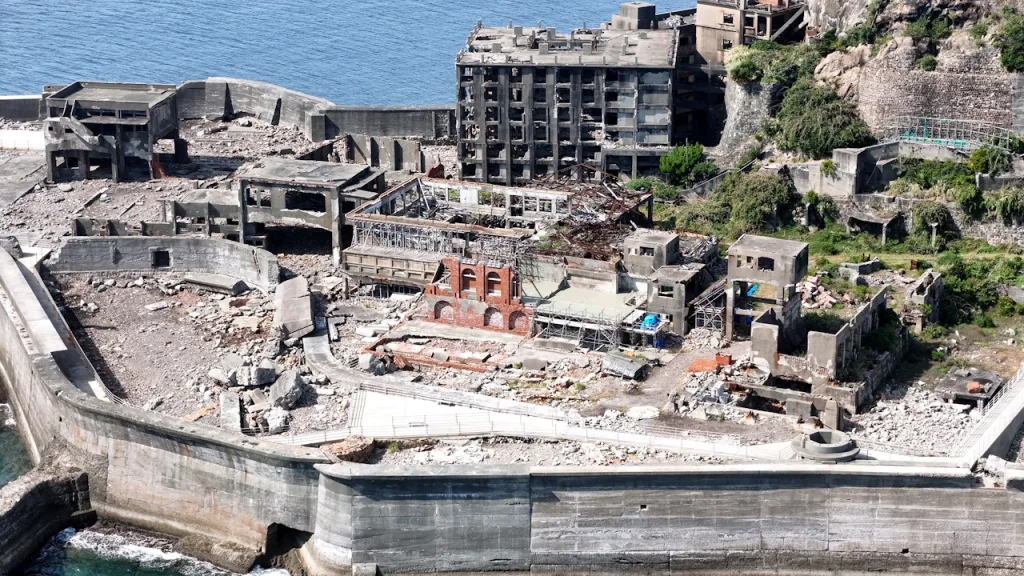
5-Sided 3D Theater
One of the highlight contents of the Gunkanjima Digital Museum is the “3D Theater” introduced in March 2024. With five 4K panels including the ceiling and floor, the entire room is enveloped in imagery, providing an immersive experience as if actually standing in the restricted areas of Gunkanjima.
The feature allows visitors to experience with their whole body even the interior of residential areas that can never be seen on landing tours. Through three-dimensional imagery, visitors can relive the state of collapsing buildings and the living spaces of the time.
VR and MR Experiences to Explore the Island
With “Gunkanjima VR,” visitors can virtually land in restricted areas filmed in 2021 by wearing VR goggles. Using footage captured by drones, visitors can explore Gunkanjima from angles that would normally be absolutely impossible to see.
Furthermore, with “Susumu VR,” which combines VR with an exercise bike, visitors can experience flying above Gunkanjima. By pedaling themselves, visitors can feel as if they are truly flying through the sky.
The “MR Experience” using Microsoft’s HoloLens allows visitors to experience a space where the real world and virtual world mix. When walking through the museum wearing HoloLens, people who lived on Gunkanjima and objects used at the time appear floating in the real world, and finally, visitors can enjoy competing in a coal mining game.
Gunkanjima Symphony
“Gunkanjima Symphony,” which projects approximately 3,000 photographs onto a 30-meter screen, is an exhibit using projection mapping technology. The special animation “Amazing Hashima,” shown once every 30 minutes, allows visitors to experience the island’s past with powerful imagery.
Gunkanjima 3D Walk
Visitors can freely manipulate Gunkanjima constructed as a 3D model with a mouse or controller, feeling as if walking around the island. The appeal is being able to explore every corner of the island at one’s own pace and observe places of interest closely.
Diorama with Projection Mapping
Using projection mapping on a 1/150 scale diorama, the exhibit recreates three days on the island, including events and daily life. Visitors can observe how Gunkanjima changed from morning to day to night from a bird’s-eye view. This exhibit helps understand the rhythm of islanders’ lives and how the entire island functioned.
Pit Experience
In a corner recreating the interior of mine tunnels that cannot be seen today, visitors can have a realistic experience as if riding in trolleys and elevators (cages). Through simulated experiences, visitors can understand the harsh working environment that miners actually experienced.
Recreation of Life at the Time
On Gunkanjima, where over 30 apartment buildings with various floor plans stood during its peak period, the museum recreates a room from the late 1950s, encapsulating life on Gunkanjima at that time. With furniture and daily necessities reproduced in detail from the period, visitors can concretely imagine what life was like for island residents.
Testimonies from Former Islanders
In a corner composed of comments and photographs from former islanders about the island, visitors can feel the affection for the island reflected in the expressions of residents. The firsthand accounts from people who actually lived on the island are precious testimonies that cannot be recreated by digital technology.
Current State and Issues of Gunkanjima
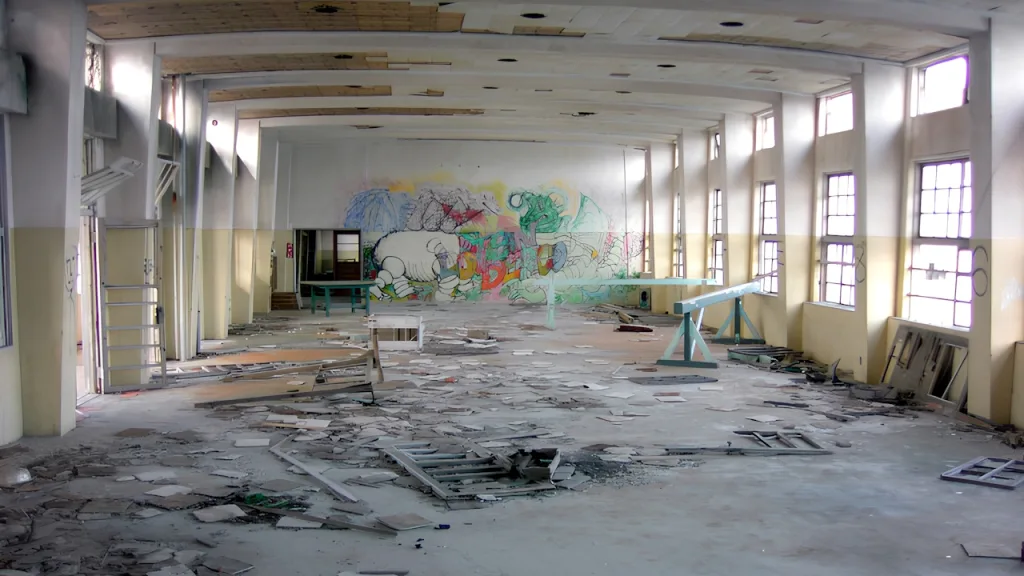
“Countdown Gunkanjima” expresses with numbers the countdown of the remaining lifespan of each building on Gunkanjima, calculated in collaboration with the Graduate School of Engineering at the University of Tokyo. The exhibit “Tears of Gunkanjima” expresses how a model of Gunkanjima made of special metal appears to shed “tears,” melting away as “droplets,” conveying the current state of the island in danger of collapse.
In the model exhibition from before the collapse of Building 71, which was the island’s gymnasium, to the present, the appearance of the gymnasium breaking apart due to strong winds and rough waves is vividly expressed, allowing visitors to feel the threat of nature and the difficulty of cultural property preservation.
Gunkanjima Digital Museum Admission Fees
| Category | Individual | Group (15 or more) |
|---|---|---|
| Adult | ¥1,800 | ¥1,500 |
| Junior/Senior High School | ¥1,300 | ¥1,000 |
| Elementary School | ¥800 | ¥600 |
| Preschool | ¥500 | ¥300 |
| Under 3 years | Free | Free |
*50% discount for visitors with disability certificate and one companion
*50% discount for Nagasaki Prefecture residents
Nearby Tourist Spots Worth Visiting
Glover Garden
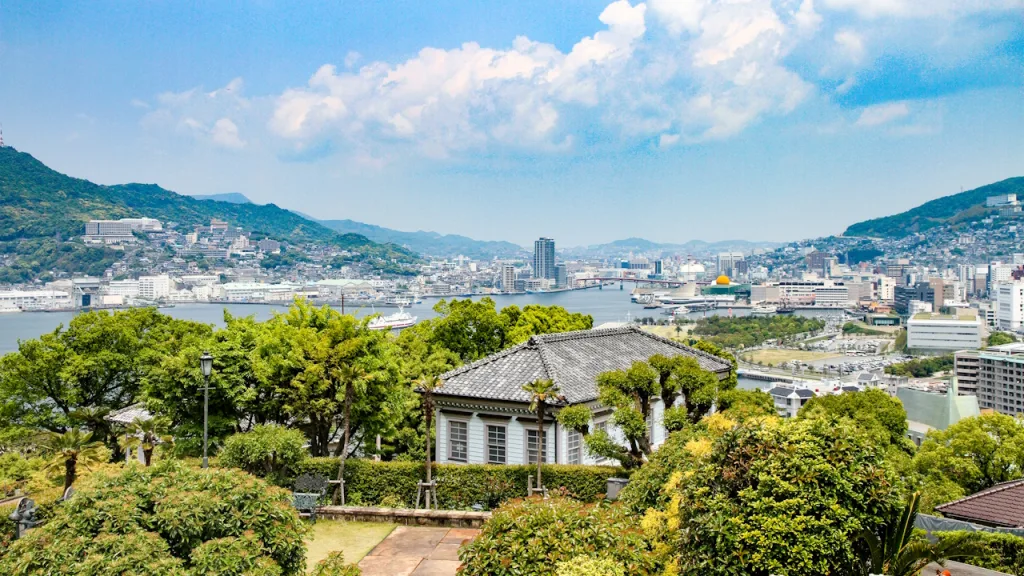
Glover Garden, located about a 3-minute walk from the Gunkanjima Digital Museum, is a representative tourist spot in Nagasaki. Centered on the nationally designated Important Cultural Properties of the former Glover Residence, Ringer Residence, and Alt Residence, six Western-style buildings from the Meiji period that were scattered throughout the city have been relocated and restored.
Located on a hill in Minami-Yamate overlooking a grand panorama of Nagasaki Port, the garden offers an exotic atmosphere. Adorned with flowers throughout, it presents picturesque scenery wherever you look. Additionally, heart-shaped stones embedded in the stone pavement at one location in the garden are said to bring about romantic fulfillment if touched while making a wish, making them popular as a power spot for love.
Oura Cathedral
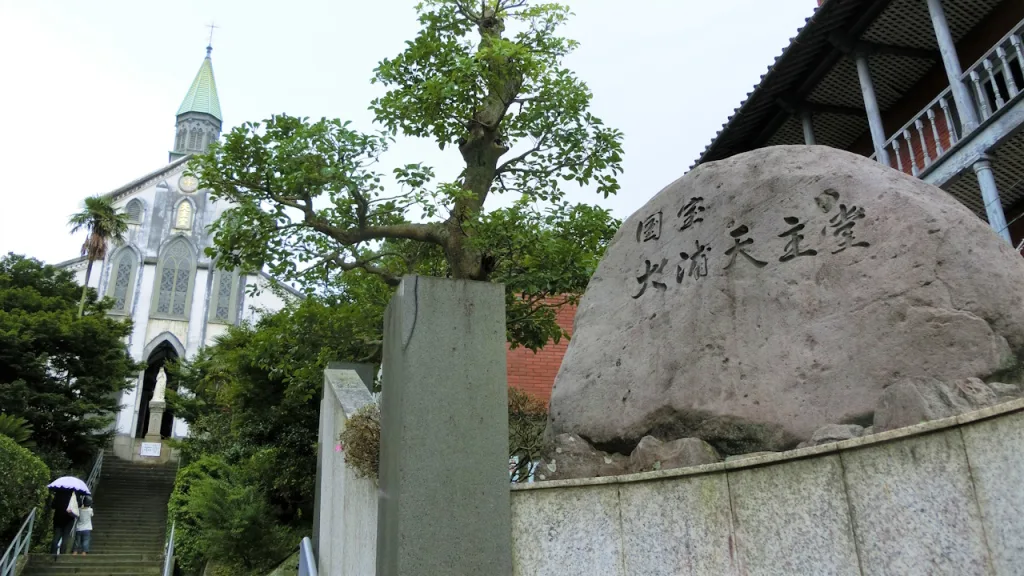
Oura Cathedral, located about a 1-minute walk from the Gunkanjima Digital Museum, is the oldest existing church in Japan, built in the Nagasaki foreign settlement created following the opening of the country at the end of the Edo period. It is a Gothic-style church representing medieval European architecture, and some of the stained glass decorating the sanctuary are about 100 years old.
It was the site of the “Discovery of Christians,” where hidden Christians from Urakami confessed their faith to Father Petitjean less than a month after the consecration ceremony in February 1865, a historical moment unprecedented in world religious history. Designated as a National Treasure in 1953, it was registered as a component of the “Hidden Christian Sites in the Nagasaki Region” UNESCO World Cultural Heritage in 2018.
Former Hong Kong and Shanghai Bank Nagasaki Branch Memorial Hall
The Former Hong Kong and Shanghai Bank Nagasaki Branch Memorial Hall, located about a 1-minute walk from the Gunkanjima Digital Museum, is open to the public as a museum of Nagasaki’s modern exchange history and Sun Yat-sen and Umaya Shokichi. The stone Western-style building constructed in the Meiji period is a precious architectural structure that tells of Nagasaki’s internationality at that time.
Inside the museum, visitors can learn about the history of exchange between Sun Yat-sen, a Chinese revolutionary, and Umaya Shokichi, a Nagasaki businessman who supported him. It is an ideal facility for deeply understanding the history of the exotic Minami-Yamate area.
Recommended Accommodation Nearby
ANA Crowne Plaza NAGASAKI GLOVERHILL by IHG
ANA Crowne Plaza Nagasaki Glover Hill, located about a 1-minute walk from the Gunkanjima Digital Museum in an excellent location, is a large city resort hotel in the exotic Minami-Yamate district. With Glover Garden and Oura Cathedral within walking distance, it serves as an ideal base for sightseeing.
Characterized by a refined atmosphere and quality service, guests can enjoy Japanese, Western, and Chinese cuisine using fresh Nagasaki ingredients. Rooms offer views of Nagasaki Port, promising a higher-grade hotel stay.
Hotel Monterey Nagasaki
Hotel Monterey Nagasaki, located about a 5-minute walk from the Gunkanjima Digital Museum, is an exotic hotel imagining Portugal’s Age of Discovery, which has deep ties with Nagasaki. Unified with romantic designs against the backdrop of the shining sun and medieval walled city culture.
Located close to Oura Cathedral and Glover Garden, with Chinatown also within walking distance. With good access to the Gunkanjima cruise ship boarding area about 3 minutes away, it is conveniently located for both sightseeing and business. All rooms are equipped with Wi-Fi facilities and humidified air purifiers.
Hotel Indigo Nagasaki Glover Street by IHG
Hotel Indigo Nagasaki Glover Street, located about a 2-minute walk from the Gunkanjima Digital Museum, is a new hotel that opened in 2024 in Nagasaki’s Minami-Yamate. Positioned overlooking Nagasaki Port and the city in Minami-Yamate, it has been reborn in a new style while inheriting the elegance of the past.
As a hotel where guests can experience tasting the passage of time, touching vibrant culture, and “walking” through time and space, it offers stories of the “authentic Nagasaki” that even Nagasaki residents rarely have the opportunity to experience.
Planning Your Visit with a Personal Tour Conductor
For international travelers seeking a deeper understanding of Nagasaki’s rich history and culture, consider enhancing your experience with a personal tour conductor service. A dedicated tour conductor can provide comprehensive itinerary management, translation assistance, and invaluable local insights that bring destinations like the Gunkanjima Digital Museum to life.
Unlike standard guided tours, a personal tour conductor travels with you throughout your journey, managing logistics, coordinating transportation, and ensuring smooth communication at every stop. This service is particularly valuable when exploring complex historical sites where cultural context and detailed explanations significantly enhance the experience.
The tour conductor can arrange visits to the Gunkanjima Digital Museum along with other UNESCO World Heritage sites in Nagasaki, coordinate dining reservations at local restaurants, and handle unexpected situations that may arise during travel. Their expertise in Japanese history and culture allows for meaningful conversations that deepen your appreciation of the sites you visit.
For travelers who want to maximize their time in Nagasaki while gaining authentic insights into Japan’s industrial heritage and the fascinating story of Gunkanjima, a personal tour conductor service offers an invaluable layer of support and enrichment to your journey.
Learn more about personal tour conductor services to enhance your Nagasaki experience.
Summary
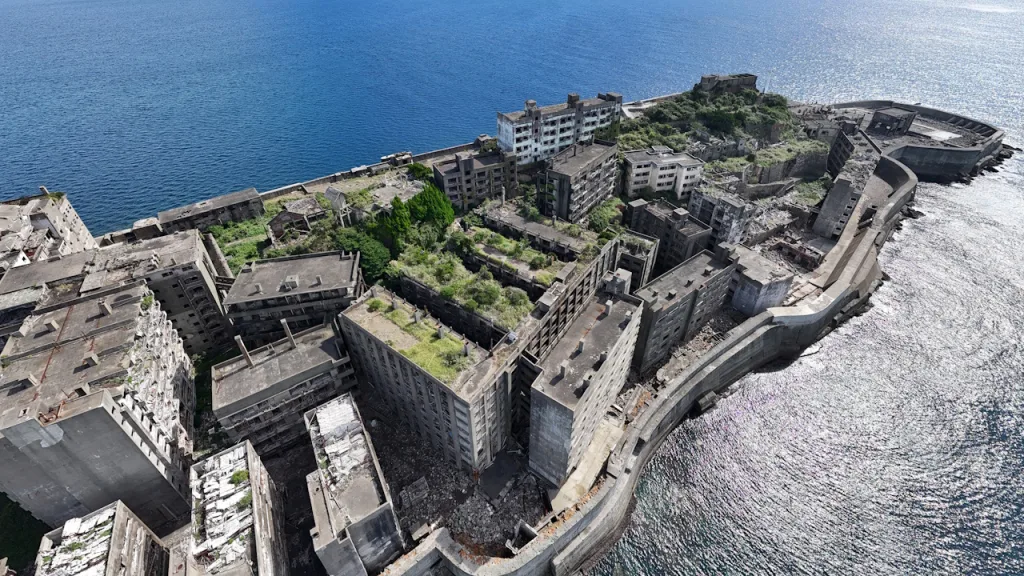
The Gunkanjima Digital Museum is an innovative facility where anyone can experience the charm of the World Heritage Site Gunkanjima through cutting-edge digital technology. Unaffected by weather conditions, visitors can learn in detail about restricted areas that cannot be seen on landing tours through VR and projection mapping.
Gunkanjima, the undersea coal mine island that supported Japan’s modernization from the Meiji to Showa periods. It is a precious place where visitors can relive its turbulent history, from the vibrant life at its peak when it boasted the world’s highest population density, through the mine closure due to the energy revolution, to its current state of ruins.
Exhibits that fuse testimonies from former island guides, over 4,000 photos and video materials, and cutting-edge digital technology provide deep emotion to visitors. When visiting Nagasaki, be sure to visit the Gunkanjima Digital Museum and reflect on Japan’s modernization history and the lives of the people who lived there.
The surrounding area also has other World Heritage sites such as Glover Garden and Oura Cathedral, and we recommend spending a full day leisurely exploring the exotic Minami-Yamate area.