


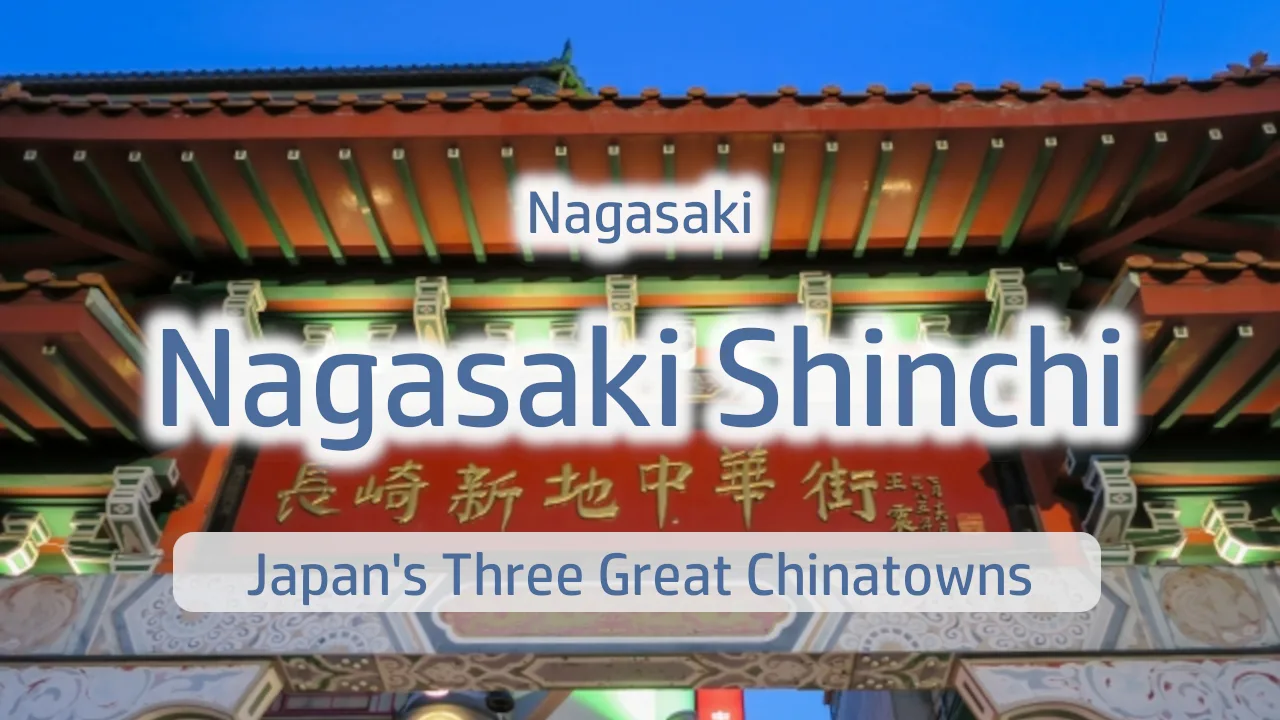
A tour conductor bringing you travel information for Japan. Today, we explore Nagasaki Shinchi Chinatown, one of Japan’s three great Chinatowns that Nagasaki Prefecture proudly showcases. Experience the traces of cultural exchange that have continued from the Edo period trading history to the present day, alongside streets filled with exotic atmosphere.
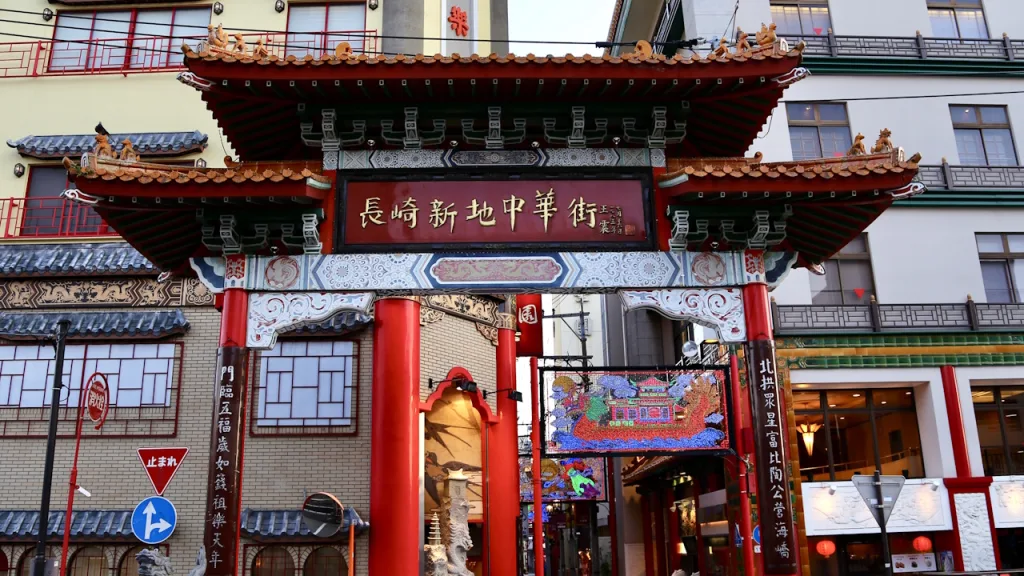
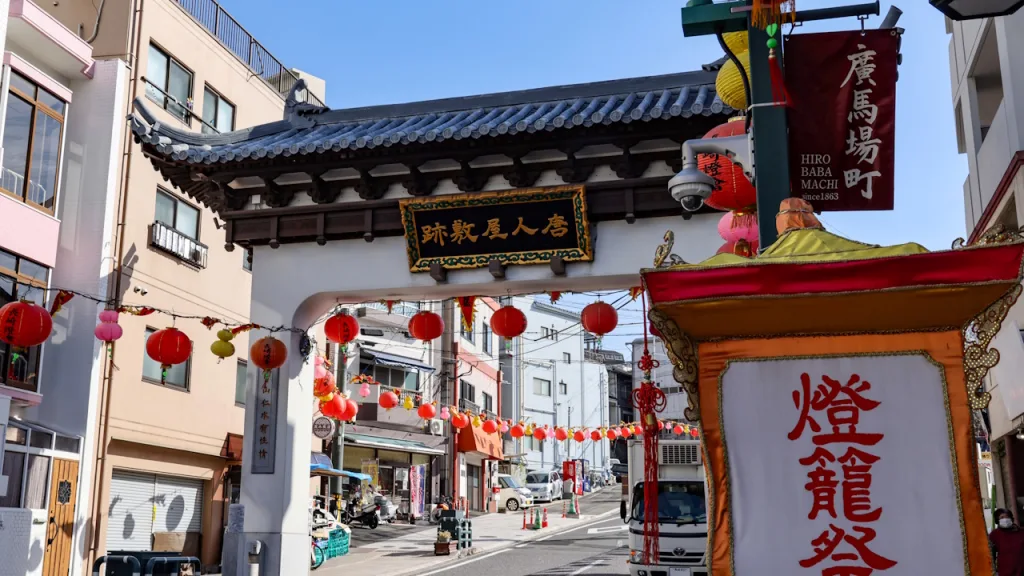
Nagasaki Shinchi Chinatown is recognized as one of Japan’s three great Chinatowns alongside Yokohama Chinatown and Kobe Nankinmachi. Located just 10 minutes by streetcar from JR Nagasaki Station with excellent access, approximately 40 Chinese restaurants and Chinese goods shops line the crossroads of about 250 meters running east-west and north-south. With vermillion Chinese gates standing in all four directions and colorful lanterns decorating the overhead space, the streetscape truly embodies exotic atmosphere. This place preserves the precious history of Japan’s connection with the world during the period of national isolation.
Points to Note When Visiting
Nagasaki Shinchi Chinatown is compact in scale compared to Yokohama Chinatown. Given the size of the crossroads totaling approximately 250 meters east-west and north-south, even a thorough exploration can be completed in 30 minutes to one hour. Researching target shops, food destinations, and historical points of interest in advance enables efficient enjoyment.
A stone monument reading “Shinchi Warehouse Site” stands in the center of the Chinatown. This monument indicates that this location was once a trading warehouse created by land reclamation, serving as an important historical site. Though easily overlooked, this represents an essential point for understanding Nagasaki’s history.
The area within Chinatown features stone pavement, making comfortable footwear advisable for visits. This stone pavement was installed with cooperation from Fuzhou City in Fujian Province, China, Nagasaki City’s sister city, utilizing authentic Chinese techniques. Particular caution is necessary on rainy days as the surface becomes slippery.
Role as Trading Window During National Isolation
Birth of Tojin Yashiki and Shinchi Warehouse
The history of Nagasaki Shinchi Chinatown connects deeply with the Edo period’s national isolation policy. In 1635, the shogunate strengthened its isolation policy, restricting trade with China to the single port of Nagasaki. While Dejima had been created for Dutch residents, Chinese people at that time resided freely throughout Nagasaki city.
However, as smuggling increased, the shogunate constructed “Tojin Yashiki” (Chinese Quarters) in Juzenji-go (present-day Kannai-cho) in 1689. This vast facility of approximately 9,400 tsubo (about three times the size of Dejima) could accommodate 2,000 Chinese people. Surrounded by walls and moats, the main gate featured a guardhouse with strictly controlled entry and exit. Japanese people could only enter as far as the second gate, with only courtesans permitted to enter the quarters—a rigorous management system.
Construction of Shinchi Warehouse and Trading Structure
Just nine years after the completion of Tojin Yashiki, a major fire struck Nagasaki in 1698. The Chinese ship warehouses in Goto-machi and Daikoku-cho were destroyed. The distance from Tojin Yashiki to the warehouses created management difficulties.
The shogunate therefore reclaimed approximately 3,500 tsubo (about 11,550 square meters) of sea surface in front of Tojin Yashiki over three years starting in 1702, creating an artificial island. The site measured approximately 70 ken (about 127 meters) east-west and 50 ken (about 91 meters) north-south in a roughly rectangular shape, with 12 buildings containing 60 warehouses constructed. This location was called “Shinchi Warehouse” or “Shinchi Warehouse Site,” marking the beginning of present-day Nagasaki Shinchi Chinatown.
When Chinese ships entered port, imported cargo including medicinal herbs, sugar, textiles, and ceramics were all received by Japanese officials at Shinchi Warehouse. After rigorous inspection, Chinese merchants entered Tojin Yashiki with only minimal personal belongings, remaining until their departure date. This system prevented smuggling and strictly managed trade.
Changes After Meiji Restoration and Evolution to Overseas Chinese District
In 1859, Japan opened its borders, and Nagasaki Port opened as an international trading port. This led to the abolishment of Tojin Yashiki, which burned down in 1870. Resident Chinese people relocated to the former Shinchi Warehouse site near the port, successively establishing trading companies there. Similar to Yokohama and Kobe, many Chinese people arrived in Nagasaki via Shanghai routes throughout the Meiji, Taisho, and Showa periods.
Present-day Nagasaki Shinchi Chinatown represents a tourist destination protected and developed by descendants of Nagasaki’s overseas Chinese community who have walked alongside this history. The stone monument standing at the crossroads in the center of Chinatown serves as a precious historical witness conveying that “Shinchi Warehouse” once existed here.
Chinese Gates Where Feng Shui Philosophy Lives
1986 Gate Construction Project
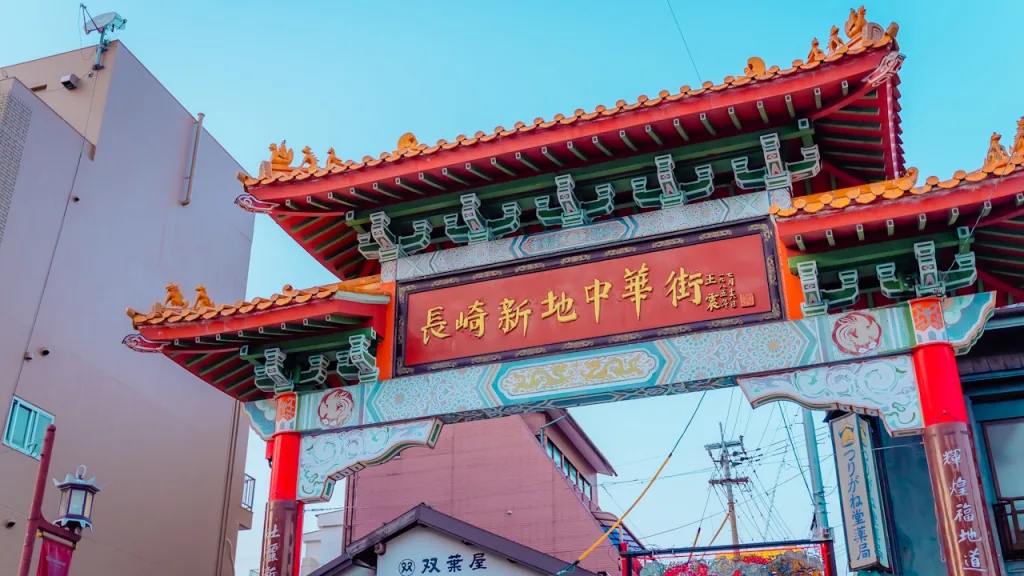
One of Nagasaki Shinchi Chinatown’s greatest features comprises the vermillion Chinese gates standing at the four cardinal direction entrances. These gates were constructed in April 1986 by the Shinchi Chinatown Shopping District Promotion Association, which invited materials and craftsmen from mainland China with hopes of developing into a Chinatown rivaling Yokohama and Kobe.
Materials were procured from Fuzhou City in Fujian Province, China, Nagasaki City’s sister city. Nagasaki Prefecture and Fujian Province established friendly prefecture-province relations in 1982, and this deep connection enabled the construction of authentic Chinese gates. The east, north, and south gates stand 9 meters in both height and width, while the west gate stands 9 meters high and 4 meters wide—an impressive structure with all roof tiles manufactured in China. Many tourists taking commemorative photographs can be seen in front of the gates.
Four Guardian Deities Philosophy and Feng Shui Principles
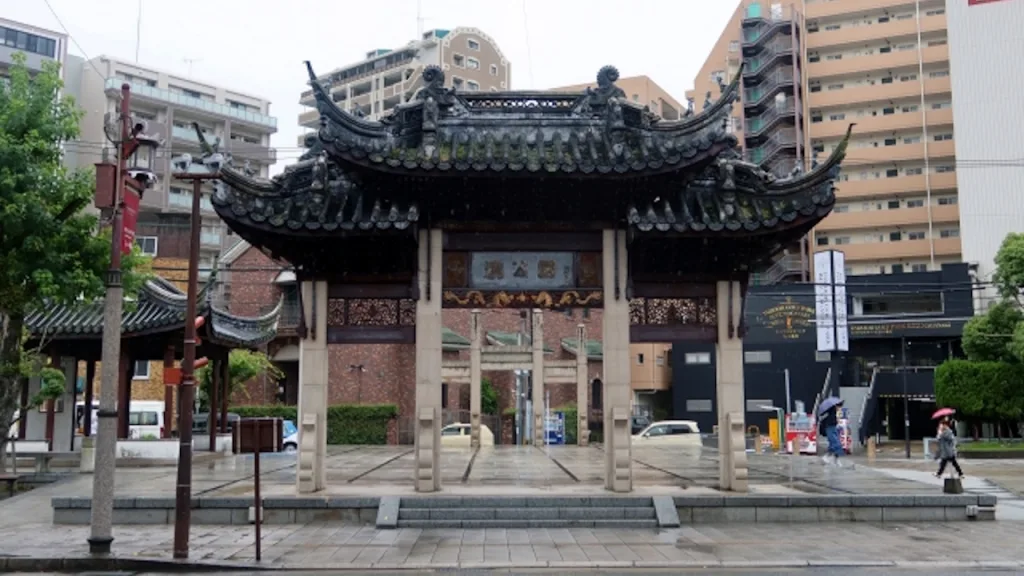
The gates’ greatest feature lies in their precise placement according to cardinal directions based on ancient Chinese feng shui philosophy. Mythical guardian beasts from Chinese mythology (the Four Symbols) are carved on the reverse side of the gates.
The east gate features the Azure Dragon, guardian of the eastern direction. The west gate features the White Tiger, guardian of the western direction. The south gate features the Vermillion Bird, guardian of the southern direction. The north gate features Genbu (a tortoise and snake as one entity), guardian of the northern direction.
In feng shui, the correct placement of these four guardians gathers auspicious energy at the location. The northern Genbu Gate facing Douza River channels “water” energy, while the southern Vermillion Bird Gate opening toward Minato Park channels “fire” energy. Furthermore, Sofukuji Temple, the family temple of overseas Chinese, stands in the northeast direction considered the demon’s gate, serving to seal evil spirits.
Five Elements Philosophy and Paving Stone Design
Attention should be paid to the gate foundations. The colors of the four guardians carved in the paving stones follow Chinese “Five Elements Philosophy.” This philosophy represents ancient Chinese natural philosophy holding that all things consist of five elements: wood, fire, earth, metal, and water.
The Azure Dragon represents the wood element (blue-green color), the Vermillion Bird represents fire (red color), the White Tiger represents metal (white color), and Genbu represents water (black color). The harmony of these colors maintains natural circulation and brings prosperity.
The calligraphy reading “Nagasaki Shinchi Chinatown” displayed at the front of the northern Genbu Gate was written by Wang Zhen, Honorary President of the China-Japan Friendship Association at the time of gate construction. The Chinese gates thus preserve the history of Sino-Japanese friendship.
Nagasaki’s Representative Food Culture
Story of Champon’s Origins
Nagasaki’s representative cuisine naturally centers on champon. This dish was reportedly devised by Chen Ping Shun, founder of “Shikairou” near Chinatown, during the Meiji period. Many Chinese students lived in Nagasaki at that time, and Chen Ping Shun created a noodle dish featuring pork bone and chicken stock soup filled with abundant vegetables and seafood, seeking to provide students with affordable, nutritious meals.
Various theories explain the name “champon,” with the leading explanation suggesting it derived from “shàfàn” (eat a meal) in Fujian dialect. Nagasaki Shinchi Chinatown hosts many champon restaurants, each offering distinctive flavors. Soup thickness and ingredient types vary by establishment, making taste comparisons one of Chinatown’s visiting pleasures.
Birth of Sara Udon
Sara udon ranks alongside champon as a Nagasaki specialty. Two types exist—crispy thin noodles and chewy thick noodles—both topped with sweet sauce-glazed vegetables and abundant seafood in hearty portions.
Sara udon originated as a takeout adaptation of champon. The style of frying noodles to reduce liquid and adding thick sauce was devised to prevent soup spillage during delivery. Thin noodles offer unique crispy texture, while thick noodles provide satisfying chewiness.
Kakuni Manju and Chinese Cuisine
The popular street food kakuni manju features tender braised pork belly seasoned with sweet-savory sauce wrapped in fluffy dough as bite-sized delicacies. Biting into steaming kakuni manju fresh from bamboo steamers reveals perfectly matched crumbling rich pork and soft dough.
Many shops display steaming bamboo steamers at storefronts, their enticing aromas drawing tourists to purchase. Each shop offers different seasonings and dough, making comparisons across multiple shops recommended.
Dim sum varieties including pork buns, xiaolongbao, and shrimp dumplings are abundant. Chinese confectionery shops sell mooncakes and “yoriyori” (called mahua—fried twisted pastries), ideal as souvenirs. Tea houses serving Chinese tea provide perfect rest stops during exploration.
Chinese Goods and Souvenir Selection
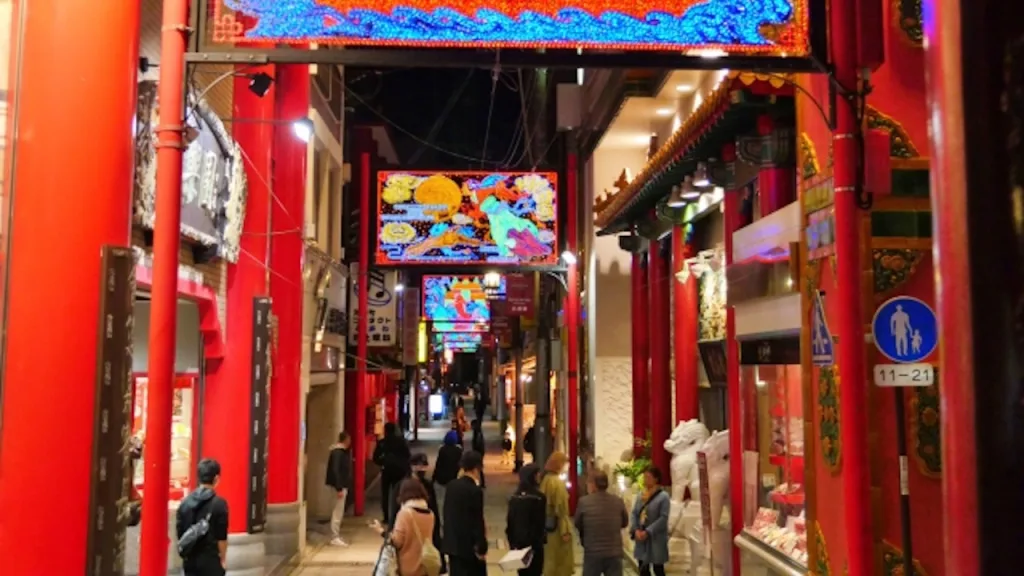
Nagasaki Shinchi Chinatown offers shopping for Chinese goods beyond cuisine. Specialty shops stocked with ingredients, seasonings, and Chinese teas directly imported from Shanghai and Hong Kong enable purchasing authentic mainland flavors difficult to obtain elsewhere in Japan.
Chinese goods shops display colorful merchandise including cheongsams, ornaments, and handcrafted items at reasonable prices. Traditional decorative items such as panda goods, Chinese knots (decorative knotting), and lanterns make appreciated souvenirs.
Popular Chinese sweets and beverages sold as Nagasaki souvenirs suit both homecoming gifts and presents. Vibrant storefront displays provide enjoyable viewing experiences.
Understanding Chinese Culture Through Annual Events
Origins of Nagasaki Lantern Festival
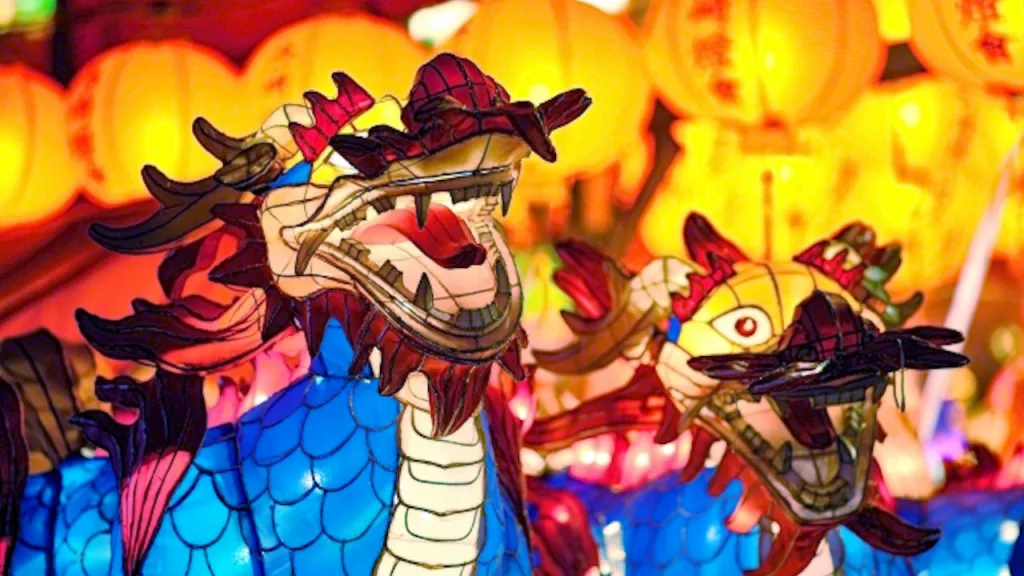
Nagasaki Shinchi Chinatown’s largest event comprises the Nagasaki Lantern Festival held annually in winter. This event originated from “Spring Festival” celebrations of Chinese New Year (Spring Festival) conducted by overseas Chinese in Shinchi Chinatown.
In China, the Spring Festival marking the lunar New Year represents the year’s most important festival. Families gather for grand celebrations, firecrackers sound throughout cities to ward off evil spirits, and Chinese lion dances perform. The final day of Spring Festival, “Lantern Festival,” features the tradition of walking through streets holding Chinese lanterns to help heavenly spirits locate people.
In 1987, Spring Festival was held in Nagasaki Shinchi Chinatown celebrating the first anniversary of the Chinese gates’ completion. The brilliantly colored Chinese lanterns displayed garnered acclaim, and from 1994 the event expanded as “Nagasaki Lantern Festival,” now attracting many tourists from across and beyond the prefecture as a major winter tradition.
During the festival period, approximately 15,000 lanterns decorate Nagasaki Shinchi Chinatown and city center areas including Megane Bridge, Maruyama Park, and the tourist street, bathing Nagasaki in brilliantly colored illumination. Beyond standard lanterns, artistic large-scale lantern objects are displayed offering substantial viewing pleasure. Special venues host Chinese dances and traditional instrument performances presenting richly Chinese-flavored events.
Mazu Procession and Maritime Deity
One Lantern Festival highlight comprises the “Mazu Procession.” Mazu represents a goddess worshipped in China as protector of maritime safety.
During the Edo period, Chinese merchants crossed seas aboard Chinese ships riding seasonal winds to reach Nagasaki. To pray for voyage safety, Mazu statues were enshrined aboard ships, then transported to Tenkodo within Tojin Yashiki upon arrival in Japan. The Mazu Procession recreates this historical scene through parade.
Currently, Mazu is enshrined at Tenkodo and Fukken Kaikan remaining at the Tojin Yashiki site. During Lantern Festival, a procession transporting the Mazu statue from Fukken Kaikan to Kofukuji Temple walks through streets, conveying the faith of that era to the present.
Mid-Autumn Festival Yellow Lanterns
During the Mid-Autumn Festival period corresponding to the 15th day of the 8th lunar month, approximately 1,000 yellow lanterns evoking the full moon decorate Chinatown, creating a fantastical atmosphere. In China, the full moon symbolizes family reunion, and some shops introduce Mid-Autumn limited menus during this period.
Historical Structures Demonstrating Sino-Japanese Exchange
Stone Pavement Installed from Fuzhou City
Attention should be paid to Chinatown’s stone pavement. This pavement was installed through cooperation with Fuzhou City in Fujian Province, Nagasaki City’s sister city. Nagasaki Prefecture and Fujian Province established friendly prefecture-province relations in October 1982, and this pavement was created as evidence of that friendship.
Most Nagasaki overseas Chinese originate from Fujian Province, reflecting the historical context of many merchants from Fujian Province traveling to Nagasaki. The pavement installation represented a project symbolizing this deep historical connection.
Shinchi Bridge and Douza River Restoration
The vermillion “Shinchi Bridge” spans before the northern Genbu Gate. Douza River flows beneath this bridge. Douza River had long been covered as an underground waterway but was recently restored, revealing the river flowing into Nagasaki Port. This made the feng shui “water” element clearer, enabling visual understanding of the philosophy that Genbu Gate channels water.
Seawall Remains at Hotel JAL City Nagasaki
Deep within the lobby of Hotel JAL City Nagasaki at a Chinatown corner, part of the “Shinchi Warehouse Seawall” from the Edo period Genroku era (1699-1702) is relocated and displayed. This represents part of stone walls built during the sea reclamation creating Shinchi Warehouse.
This seawall stonework demonstrates the high level of civil engineering technology of that era. Viewing approximately 320-year-old stonework up close enables experiencing how important a trading hub Edo period Nagasaki was. Viewing is possible for non-hotel-guests.
Historical Spots Worth Visiting Together
Dejima – Trading Window with Netherlands
Dejima, located approximately 5 minutes’ walk from Nagasaki Shinchi Chinatown, functioned as the sole window open to the West in Japan for 218 years during the Edo period as a fan-shaped artificial island. Dejima, created in 1636, was constructed to confine Portuguese people, but from 1641 housed the Dutch trading post.
Currently maintained as an open-air museum with restoration progressing, visitors can tour reconstructed Dutch trading post buildings and lifestyle displays. The “Kapitan’s Room,” residence of the Dutch trading post chief, recreates unique Japanese-Western hybrid interiors with tatami mats and chandeliers, offering glimpses of international exchange of that era.
While Shinchi Chinatown served as the trading window with China, Dejima served as the trading window with the Netherlands. Visiting both locations enables three-dimensional understanding of how isolated Japan connected with the world.
Tojin Yashiki Remains – Chinese Residential Quarter Ruins
The Tojin Yashiki site remains in Kannai-cho, approximately 8 minutes’ walk from Nagasaki Shinchi Chinatown. This location once housed 2,000 Chinese people in a vast 9,400-tsubo site.
Currently four halls remain—Dojindo, Kannondo, Tenkodo, and Fukken Kaikan—all designated as Nagasaki City Important Cultural Properties. Dojindo, founded in 1691, represents the oldest Tojin Yashiki building, enshrining deities of agriculture and commerce. The arched stone gate at Kannondo’s entrance is traditionally attributed to the Tojin Yashiki period.
The “Warehouse Materials Museum” opened in 2015, enabling detailed learning about Chinese trade and life of that era. Visiting the Tojin Yashiki site enables deeper understanding of Shinchi Chinatown’s origins.
Glover Garden – Industrial Revolution Heritage of Meiji Japan
Glover Garden, approximately 10 minutes by streetcar from Nagasaki Shinchi Chinatown, represents Nagasaki’s signature tourist destination. This outdoor museum features nationally designated Important Cultural Properties including Former Glover House, Former Ringer House, and Former Alt House, plus six Meiji-period Western-style buildings relocated from throughout the city.
Former Glover House, Japan’s oldest existing wooden Western-style architecture, was registered as a component of the World Cultural Heritage “Sites of Japan’s Meiji Industrial Revolution” in 2015. Thomas Glover was a Scottish merchant who greatly contributed to Japan’s modernization from the late Edo period through Meiji.
The excellent location overlooking Nagasaki Port enables imagining trading scenes once conducted through Shinchi Chinatown and Dejima. Finding “Heart Stones” within the garden adds to the enjoyment.
Recommended Nearby Accommodations
Dormy Inn Nagasaki Shinchi Chinatown Premier
This hotel stands approximately 2 minutes’ walk from Nagasaki Electric Railway’s “Shinchi Chinatown” stop with excellent location. The third-floor “Dejima-no-Yu” separate gender large public baths enable leisurely recovery from sightseeing fatigue. The walkable distance after dining in Nagasaki Shinchi Chinatown provides charm. Fine services characteristic of the Dormy Inn chain including midnight ramen service and post-bath ice candy receive favorable reviews.
Candeo Hotels Nagasaki Shinchi Chinatown
Located approximately 3 minutes’ walk from Nagasaki Electric Railway’s “Shinchi Chinatown” stop, this hotel features open-air baths on the top floor closest to the stars. The top-floor open-air bath enables bathing while viewing Nagasaki nightscapes. Guest rooms combine functional design with comfort, suitable for both business and tourism purposes.
Hotel JAL City Nagasaki
Approximately 10 minutes’ walk from “Nagasaki Shinchi Terminal” after roughly 35 minutes by limousine bus from Nagasaki Airport, this hotel adjoins Nagasaki Shinchi Chinatown. Deep within the lobby, part of the Shinchi Warehouse seawall from the Edo period Genroku era (1699-1702) is relocated and displayed. Special experiences viewing precious historical materials while staying are possible, feeling Nagasaki Shinchi Chinatown’s history.
Experience Nagasaki with a Private Tour Conductor
For those considering travel to Japan, exploring Nagasaki’s rich history and cultural heritage becomes even more rewarding with professional support. A private tour conductor service offers comprehensive assistance throughout your journey, enabling you to fully immerse yourself in attractions like Nagasaki Shinchi Chinatown without concerns about navigation, communication, or logistics.
Professional tour conductors accompany your travels, managing complex itineraries and coordinating all aspects of your trip. They provide interpretation assistance when needed, help with arrangements at restaurants and shops, and offer support during unexpected situations. This enables travelers to concentrate on experiencing Japanese culture and history with complete peace of mind.
While tour conductors focus on itinerary management as their primary responsibility rather than providing guided tours, their comprehensive support ensures you can fully appreciate Japan’s unique charm. From navigating the historic streets of Chinatown to discovering hidden local restaurants, having dedicated assistance allows you to experience authentic Japanese culture without language barriers or logistical challenges.
Consider enhancing your Nagasaki journey with the private tour conductor service, designed specifically for international travelers seeking a deeper, more comfortable exploration of Japan’s historical and cultural treasures.
Conclusion
Nagasaki Shinchi Chinatown represents one of Japan’s three great Chinatowns that developed from Edo period trading warehouses. Originating from Shinchi Warehouse created by sea reclamation in 1702, it performed an important role as the trading window between Japan and China during national isolation.
Though compact at approximately 250 meters totaling east-west and north-south, approximately 40 Chinese restaurants and goods shops line the area, enabling enjoyment of exotic atmosphere. Each structure holds historical significance—Chinese gates placed according to feng shui philosophy, stone pavement installed from Fuzhou City in Fujian Province, and Edo period seawall remains.
Authentic champon, sara udon, and kakuni manju represent cultural heritage born from fusion of Chinese culinary techniques and Japanese ingredients. The winter Nagasaki Lantern Festival and Mazu Procession demonstrate Chinese traditional culture still living today, presenting different expressions depending on visiting season.
As a base for Nagasaki sightseeing, visiting together with nearby Dejima, Glover Garden, and Tojin Yashiki site enables deeper experience of Nagasaki’s history and culture. Streetcar transportation provides convenience, enabling touring multiple historical spots in one day.