



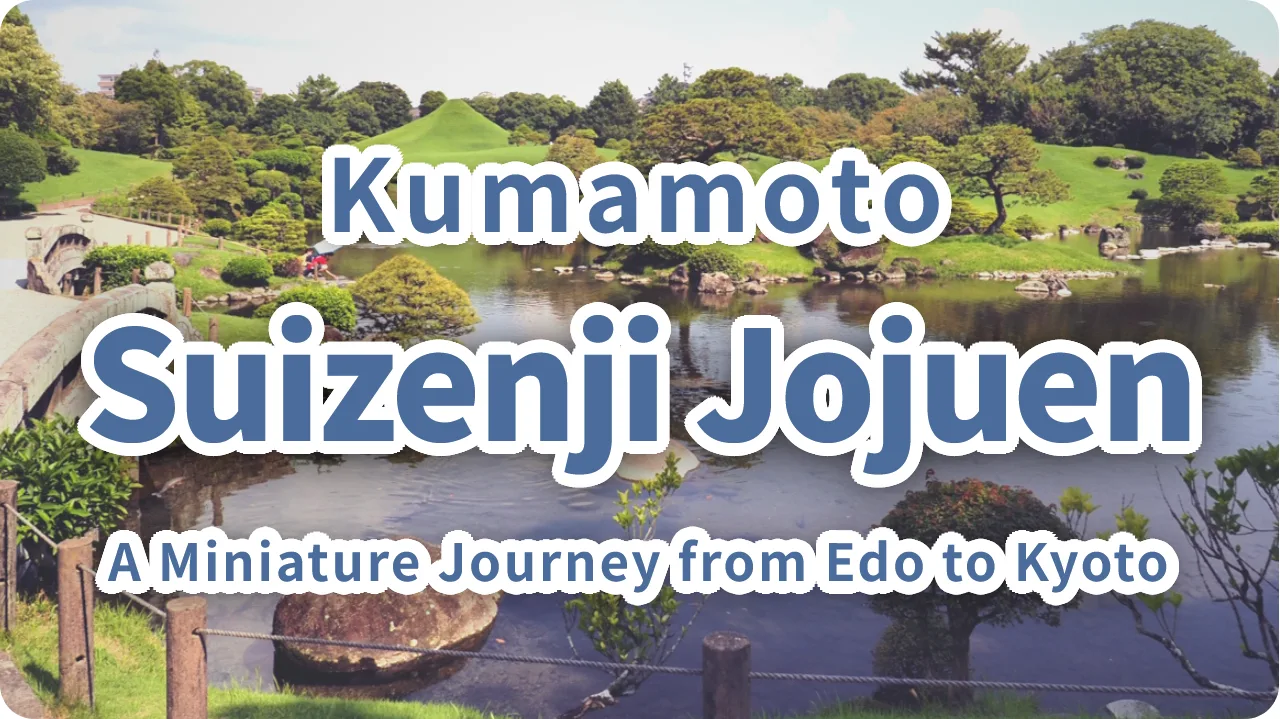
Travel insights from a tour conductor — today’s destination: Suizenji Jojuen Garden (水前寺成趣園, Suizenji Jōjuen), a nationally designated scenic site and historic landmark in central Kumamoto City. Fed entirely by spring water rising from the volcanic aquifer beneath Mount Aso, the garden reproduces the great highway of feudal Japan — the Tokaido Road — in miniature, compressing Mount Fuji, Lake Biwa, and the Nihonbashi bridge of Edo into a single strolling circuit. Three generations of the Hosokawa clan shaped it across the early Edo period, and a relocated imperial teahouse from Kyoto still occupies its southern corner. Few gardens in Japan pack so much cultural weight into so compact a space.
| Item | Details |
|---|---|
| Name | Suizenji Jojuen Garden (水前寺成趣園) |
| Address | 8-1 Suizenji Koen, Chuo Ward, Kumamoto City, Kumamoto |
| Opening Hours | 8:30 AM – 5:00 PM (last entry 4:30 PM) |
| Closed | Open year-round |
| Access (tram) | 3-minute walk from Suizenji-Koen stop, Kumamoto City Tram |
| Access (bus) | Kumamoto Airport limousine bus, alight at Suizenji-Koen-mae |
| Tel | +81-96-383-0074 |
| Official Website | https://www.suizenji.or.jp/ |
One Blind Spot Worth Knowing Before You Arrive
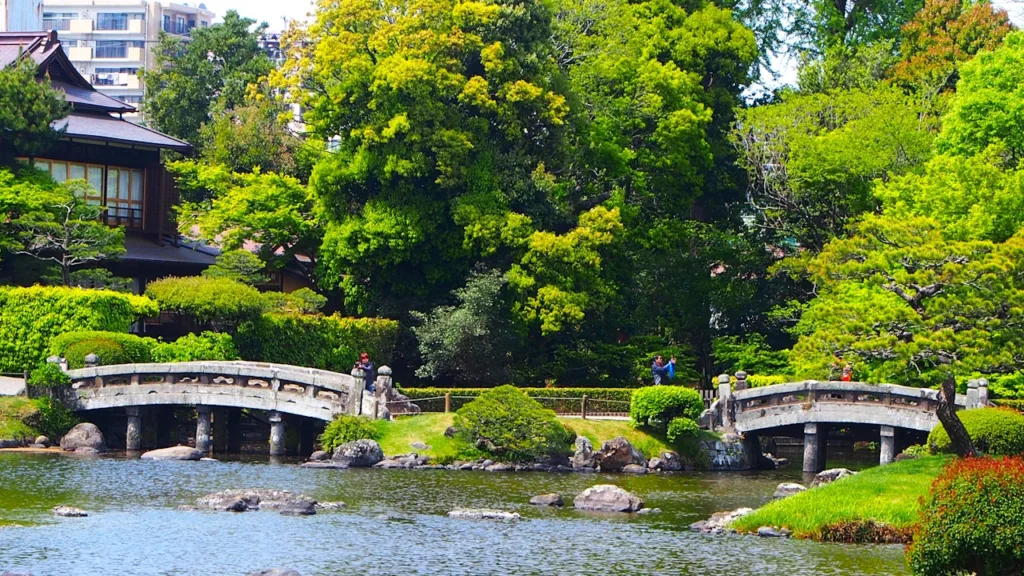
Suizenji Jojuen is a masterwork of Momoyama-period garden design — but it sits inside a modern city, and that tension shows. From certain angles, particularly when you’re trying to frame the cone-shaped artificial Mt. Fuji across the pond, the upper floors of residential towers creep into the shot. It’s an inherent limitation of any urban garden, and Suizenji is no exception.
The fix is straightforward. The Kokin Denju no Ma — the relocated imperial pavilion at the garden’s south end — has a veranda facing west that frames the garden through its open doorways. This is traditionally cited as the finest viewpoint in the entire garden, and it holds up: the layering of pine, pond, and distant artificial hills reads as a natural composition from here, with the building itself cropping out the modern skyline. Arriving at opening time, around 8:30 AM, also helps — the water surface is still, the light is low and lateral, and you’ll likely have the circuit to yourself.
Three Generations, One Garden — How the Hosokawa Clan Built Suizenji Jojuen
The garden’s origins trace to 1632, when Hosokawa Tadatoshi, the first feudal lord (daimyo) of the Higo domain, built a teahouse on this site. He chose the spot because of its remarkable springs — groundwater from the Aso volcanic system rising naturally to the surface, clear and cold. The teahouse became the seed of what would eventually be one of Japan’s great daimyo gardens.
It was Tsunatoshi, the third lord of the Hosokawa line, who transformed the site into the large-scale strolling garden it is today, completing the work in 1671. The garden’s name — Jojuen, or “Garden of Daily Pleasures” — comes from a line in the Chinese poet Tao Yuanming’s 5th-century poem Gui Qu Lai Ci (“Returning Home”): roughly, “walking the garden daily, pleasure deepens.” It’s the kind of name a scholar-lord gives a garden he intends to walk in.
A Miniature Tokaido — The Hidden Map Inside the Garden
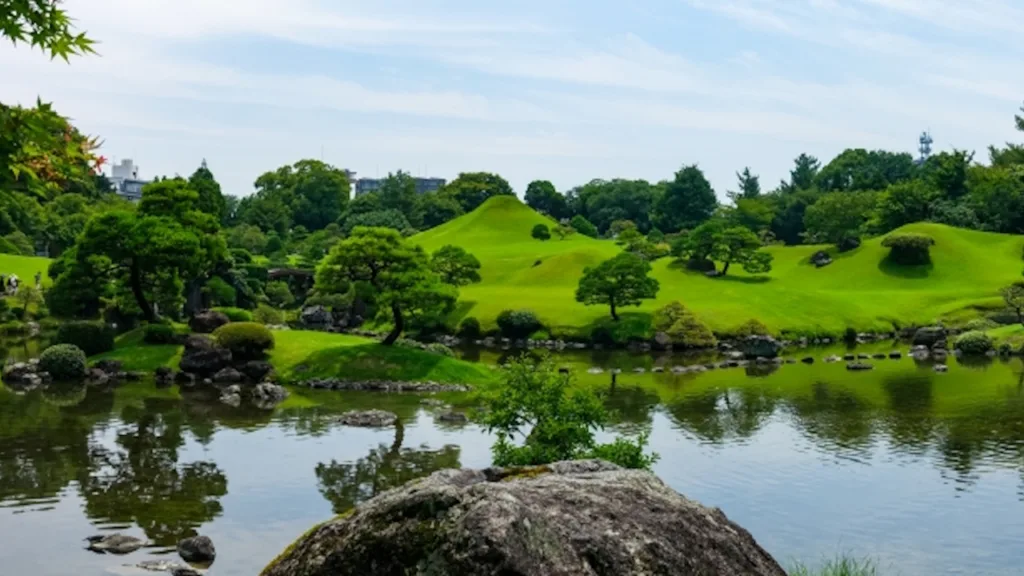
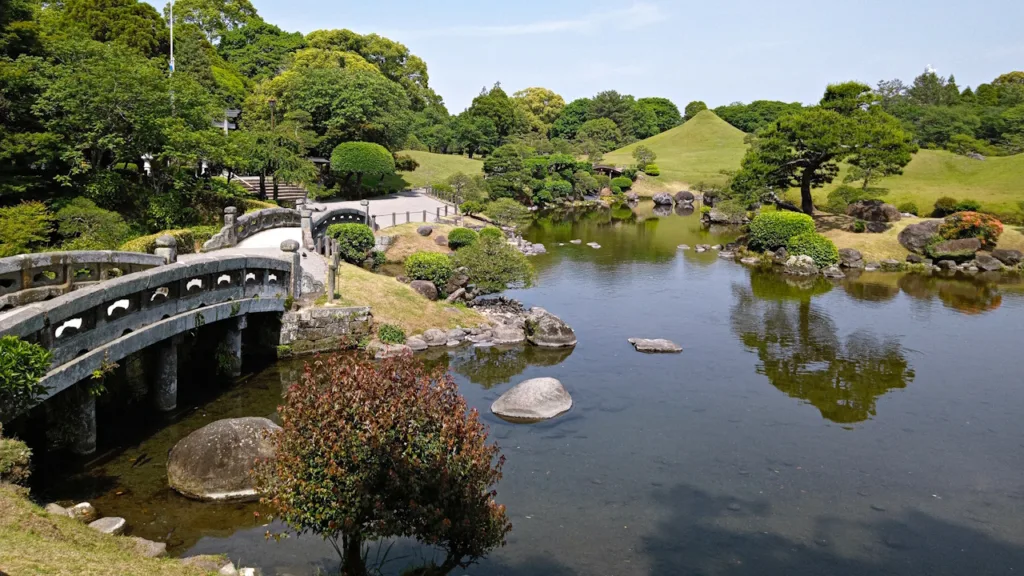
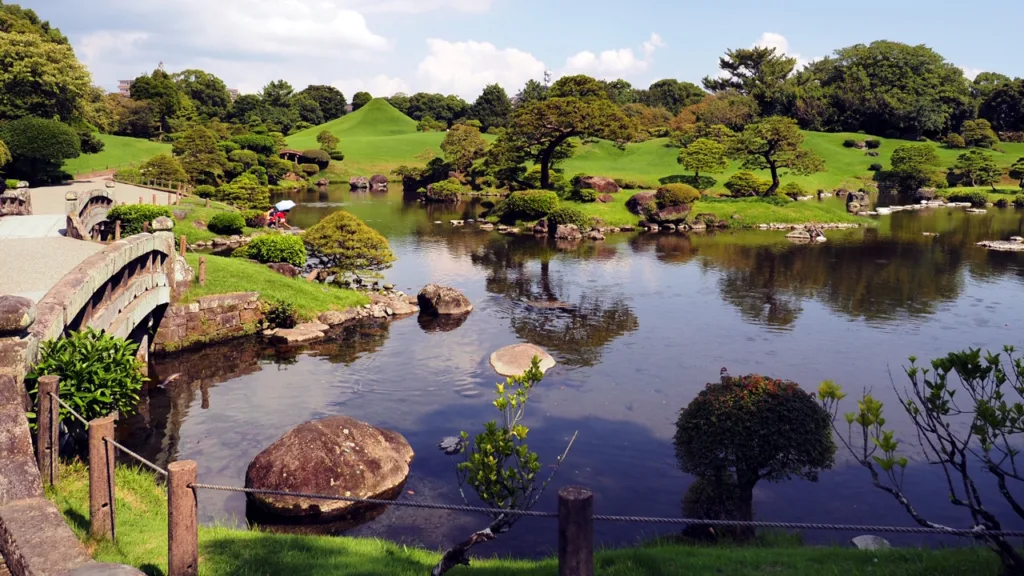
What makes Suizenji Jojuen unusual among Japanese strolling gardens is its explicit representational ambition. It’s a shukkeien — a “condensed-scenery garden” — modeled on the fifty-three post stations of the Tokaido Road, the great highway linking Edo (present-day Tokyo) to Kyoto. Every major element corresponds to a landmark along that route:
- The pond represents Lake Biwa, Japan’s largest lake, lying just east of Kyoto
- The central island in the pond represents Chikubushima, the sacred island floating in Lake Biwa
- The two stone bridges connecting the island to the shore represent the Nihonbashi bridge in Edo — the Tokaido’s eastern starting point
- The artificial hill at the garden’s center represents Mount Fuji
Walking the circuit, you’re enacting the journey from Edo to Kyoto in compressed form: cross the Nihonbashi (stone bridges), pass Mount Fuji (the artificial hill), and arrive at Lake Biwa (the pond) with Chikubushima (the island) in the middle distance. The spring water filling the pond plays the role of Lake Biwa itself — and knowing this, the garden reads entirely differently. It’s not a decorative garden. It’s a journey.
The Kokin Denju no Ma — An Imperial Pavilion Transplanted from Kyoto
The thatched-roof shoin (study-hall pavilion) at the garden’s southern edge has a separate origin entirely. Known as the Kokin Denju no Ma, or “Hall of the Ancient Poetry Transmission,” this building once stood within the Kyoto Imperial Palace. In 1600, the warlord-poet Hosokawa Fujitaka (also known as Yusai) used it as the setting to transmit the secret interpretive tradition of the Kokinwakashū — Japan’s 10th-century imperial poetry anthology — to Prince Hachinoiya Toshihito. It was relocated to Suizenji in 1912, where it has served ever since as both a designated cultural property and the garden’s prime vantage point.
The building is a rare meeting of warrior culture and court culture on a single site. Hosokawa Fujitaka was a field commander who also happened to be one of the foremost waka poets of his generation. The transmission of the Kokinwakashū secrets was considered of such cultural importance that the Imperial Court sent an emissary to protect Fujitaka during the Battle of Sekigahara in 1600 — the decisive battle that shaped the Edo period — simply to ensure the tradition wouldn’t die with him.
The 2016 Earthquake and the Garden’s Recovery
Suizenji Jojuen was damaged in the April 2016 Kumamoto Earthquake — a pair of major seismic events that caused widespread destruction across the city and surrounding region. Parts of the garden required extended restoration work. The admission fee, unchanged for thirty years, was revised in April 2026, partly reflecting the accumulated costs of restoration and ongoing maintenance.
The Garden Itself — Spring Water, Seasonal Shifts, and How Long to Stay
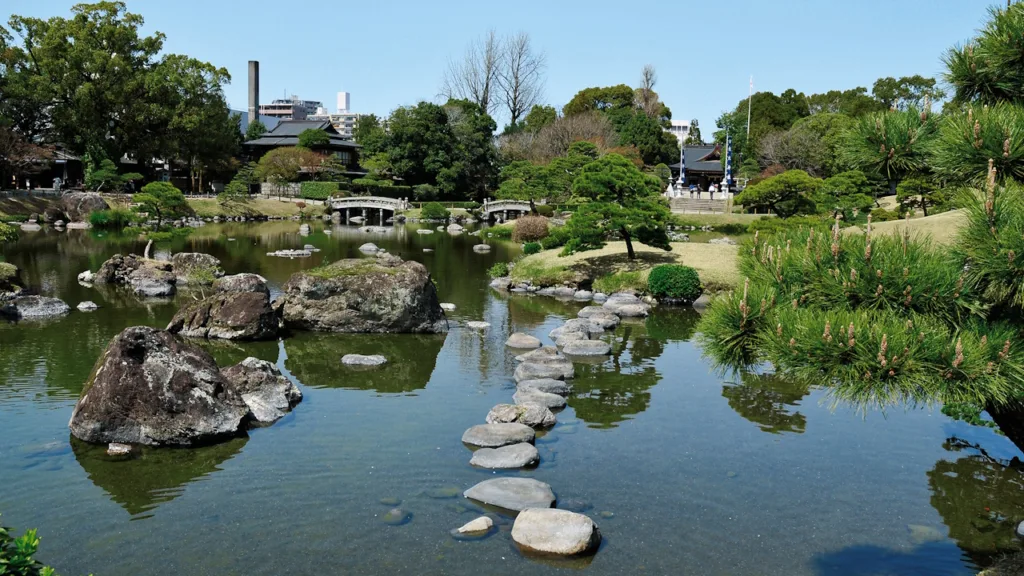
The garden’s most unusual feature is also its most invisible: the water in the pond is entirely natural spring water, rising from the Aso volcanic aquifer without pumping or recirculation. Gardens fed by living springs are rare in Japan, and the clarity and temperature consistency of the water — it barely changes across seasons — gives the pond a distinctive quality. Carp move slowly through it; egrets and ducks visit regularly.
The strolling circuit is designed so that every few steps reframes the garden entirely. Moving from the stone bridges to the base of the artificial hill to the pine grove along the far bank, the composition shifts — mountain behind water, water in front of mountain, mountain and pavilion aligned. A full circuit without stops takes about 30 minutes. Add the pavilion tea service and you’re looking at an hour. If you include Izumi Shrine and the Nohgaku-den (Noh stage), budget around 90 minutes.
Seasonally, the garden shifts dramatically. Late March to early April brings cherry blossom along the path — this is peak season, and crowds reflect it. August brings Takigi Noh, torch-lit Noh theater performed on the garden’s outdoor stage, one of Kumamoto’s signature summer events. Autumn foliage in October and November layers colour across the pond reflections. Winter is quiet and uncrowded — the garden’s proportions read more clearly without seasonal distractions.
Izumi Shrine and the Noh Stage — The Hosokawa Family’s Spiritual Core
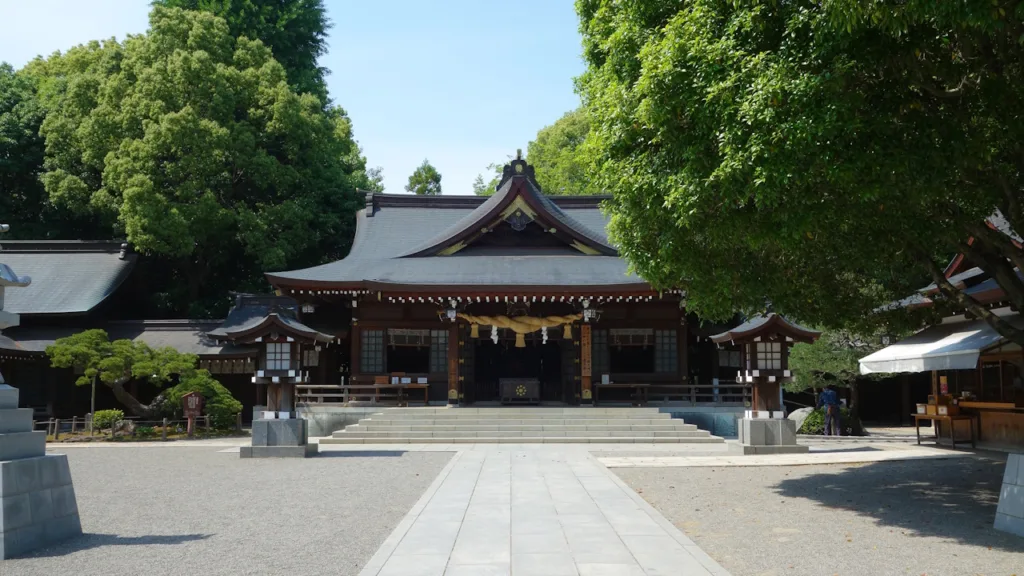
The northern section of the garden is occupied by Izumi Shrine, established in 1878 by former retainers of the Higo domain following the Satsuma Rebellion. The shrine is dedicated to Hosokawa Fujitaka (Yusai), founder of the clan’s Higo line, along with subsequent lords and family members. Among those enshrined is Hosokawa Gracia, the wife of Fujitaka’s son — a Christian convert whose dramatic life and death during the turbulent years of the warlord period made her one of the most written-about women of the Sengoku era.
Every spring and autumn, the shrine hosts yabusame — mounted archery performed at full gallop in the Takeda-ryu tradition. The archer rides along the track and releases arrows at stationary targets while in motion. It’s one of the more viscerally impressive ceremonial martial arts events still performed in Japan. The Takigi Noh in August uses the adjacent Nohgaku-den stage, where torch fires replace stage lighting and the performance extends into the night.
Admission to the shrine grounds, Noh stage, and treasury is covered by the garden entry fee. Visitors who receive a formal prayer at Izumi Shrine are admitted to the garden without charge.
The Kokin Denju no Ma Tea Service
Inside the Kokin Denju no Ma pavilion, a tea service offers matcha and wagashi (traditional Japanese confectionery) served on the west-facing veranda. The tea service runs daily except Tuesdays. Sitting on the veranda with the garden framed through the open bay is the experience the building was designed for — the composition of pine, pond, and distant hills framed by the pavilion’s structural elements is precisely what centuries of visitors have cited as the garden’s finest view.
Nearby — What Else to See in the Suizenji Area
Ezu Lake (江津湖) — The Aso Aquifer’s Surface Expression
The same spring water that fills Suizenji Jojuen flows downstream and emerges as Ezu Lake (Ezuko), one of Japan’s most ecologically significant urban wetlands. The lake — divided into upper Kami-Ezuko and lower Shimo-Ezuko — covers roughly 50 hectares and receives between 400,000 and 580,000 tonnes of spring water daily. That rate makes it one of the most productive natural spring systems in Japan, and the entire Suizenji-Ezuko spring complex is designated as one of the Ministry of the Environment’s Heisei no Meisui Hyakusen (100 Famous Waters of the Heisei Era), ranking fourth nationally in a public tourism vote.
The constant water temperature year-round supports around 600 species of plants and animals, and over 100 species of birds have been recorded at the lake annually — roughly 3,000 migratory birds overwinter here each autumn and winter. The lakeside walking path is lined with haiku stone monuments to writers including Natsume Soseki and Nakamura Teijo, who both spent time in Kumamoto. A boathouse operating since 1877 still rents pedal boats, rowboats, canoes, and yakatabune (flat-bottomed pleasure boats). From Suizenji Jojuen, take the city tram to Hatchobaba stop and walk three minutes.
Former Residence of Natsume Soseki (Uchi-Tsuboi) — A Literary Landmark Four Minutes on Foot
About a four-minute walk from Suizenji Jojuen, the former Kumamoto residence of novelist Natsume Soseki (pen name of Natsume Kinnosuke) offers a look at where Japan’s most celebrated modern novelist lived during his years teaching in the city. Soseki lived in Kumamoto from 1896 to 1906, moving several times — this house, known as the Uchi-Tsuboi residence, was his third. The structure was originally built in the Oe-mura district and relocated here in 1971. A trip Soseki made with his wife Kyoko from this residence to Kotenbo hot spring resort became the source material for his 1906 novel Kusamakura (The Three-Cornered World).
Kumamoto City Zoological and Botanical Garden — At the Edge of Ezu Lake
On the southwestern bank of Ezu Lake, Kumamoto City’s zoological and botanical garden sits at the point where the spring-fed wetland meets managed parkland. The zoo houses Asian elephants, lions, and a wide range of wildlife in grounds that benefit from the lake’s natural environment. It’s accessible by city tram from Suizenji Jojuen — alight at the Dobutsu-Shokubutsuen-Iriguchi stop.
Kumamoto Castle — One of Japan’s Three Great Castles, Still Being Rebuilt
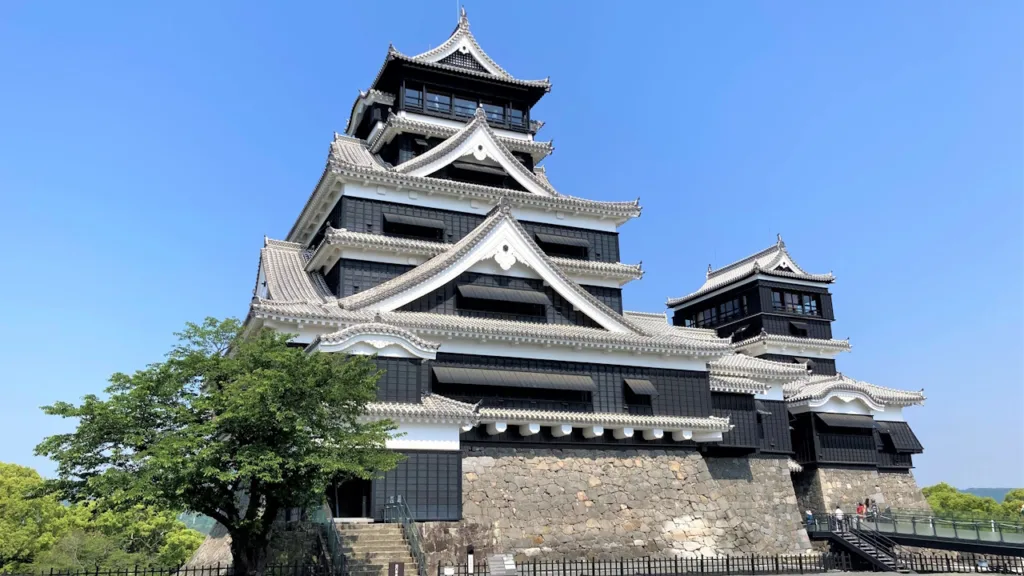
Alongside Himeji and Matsumoto, Kumamoto Castle is one of Japan’s three most celebrated castles — a designation backed by its sheer scale and its intricate stonework. Built by Kato Kiyomasa over seven years and completed in 1607, the castle complex covers roughly 76 hectares, with the moats, layered stone walls, and interlocking defensive structures reflecting Kiyomasa’s direct battlefield experience from the Korean campaigns of the 1590s. It’s long been known to locals by the nickname Ginnan-jo (“Ginkgo Castle”), after the ginkgo trees that once dominated the grounds.
The 2016 Kumamoto Earthquake caused serious damage — stone walls collapsed, turrets fell, and the restoration work that followed became one of Japan’s most ambitious post-disaster heritage projects. The main keep was fully restored and reopened with updated exhibits in 2021; full restoration of the entire castle complex is currently planned for 2052. What’s on offer right now is something rare: a Special Viewing Walkway elevated about six meters above ground lets you see collapsed stone walls and active reconstruction work up close. The combination of a restored keep and an ongoing reconstruction site within the same grounds is unusual anywhere in Japan, and won’t be possible to see once the work is complete.
From Suizenji Jojuen, take the city tram to Kumamoto-jo/Shiyakusho-mae stop — about twelve minutes. The castle opens daily from 9:00 AM (last entry 4:00 PM; extended to 7:00 PM with last entry 6:00 PM in July and August), and closes only on December 29.

Where to Stay Near Suizenji Jojuen
Ryotei Matsuya Honkan Suizenji
A 13-room Japanese inn (ryokan) three minutes on foot from the garden. The inn’s kaiseki multi-course dining draws on Kumamoto prefecture ingredients, the private family baths use artificial radon spring water, and the annex building houses a dedicated sauna and spa facility called Yuya Suizen. Guests check in in the traditional ryokan style — removing shoes on arrival — and the property’s consistently high ratings reflect the care taken across its small room count. Rated 8.8 on Booking.com (international guests).
Suizenji Comfort Hotel
Three minutes’ walk from the garden and two minutes from the Kofu tram stop, this business hotel is a practical base for the Suizenji area. It’s a short walk from the airport limousine bus stop, making it easy to arrive and depart without transferring in central Kumamoto. The breakfast buffet features locally sourced ingredients from Kumamoto, and mobile self check-in is available.
Extol Inn Kumamoto-Suizenji
One minute on foot from the Suizenji-Koen tram stop and four minutes from the garden. Free Wi-Fi throughout, complimentary coffee and tea in the guest lounge, and a locally focused breakfast put this business hotel above the standard for its category. The tram stop location makes getting around Kumamoto straightforward — Kumamoto Castle is about twelve minutes by tram.
Visiting with a Tour Conductor
Suizenji Jojuen rewards visitors who understand what they’re looking at — the Tokaido allegory encoded in the garden’s layout, the distinction between the 17th-century strolling garden and the 17th-century pavilion relocated from Kyoto, the significance of the Kokin Denju transmission within Japanese literary history. These layers are present but not obvious, and language is often a barrier: most interpretive signage is in Japanese.
A tour conductor handles the practical scaffolding of travel — flight connections, ground transfers, accommodation logistics, emergency rebooking if schedules change — freeing you to focus on what the garden actually means rather than how to get to it. For Kumamoto specifically, where the city is worth more than a single stop and where getting to and from the airport involves coordination, having someone manage the itinerary execution is a practical advantage, not a luxury.
For tours that include Suizenji Jojuen and Kumamoto, see tours.e-stay.jp.

Getting the Most from Suizenji Jojuen
Few urban gardens in Japan compress as much history into as small a space as Suizenji Jojuen. The Tokaido allegory gives the strolling circuit a narrative logic that most gardens lack. The Kokin Denju no Ma anchors the site to both the martial politics and the court poetry of early-modern Japan. The spring water keeps the whole thing alive without mechanical assistance.
The garden pairs naturally with Kumamoto Castle as a full-day itinerary — about twenty minutes apart by tram. Or you can treat it as the starting point of a longer water-themed route: garden to Ezu Lake follows the actual flow of the spring water downstream, tracing what residents of Kumamoto call the city’s defining feature. The garden is open year-round, but the timing of your visit will shape it: cherry blossoms in spring, Noh by torchlight in summer, foliage in autumn, solitude in winter. Any of them is reason enough to come.