



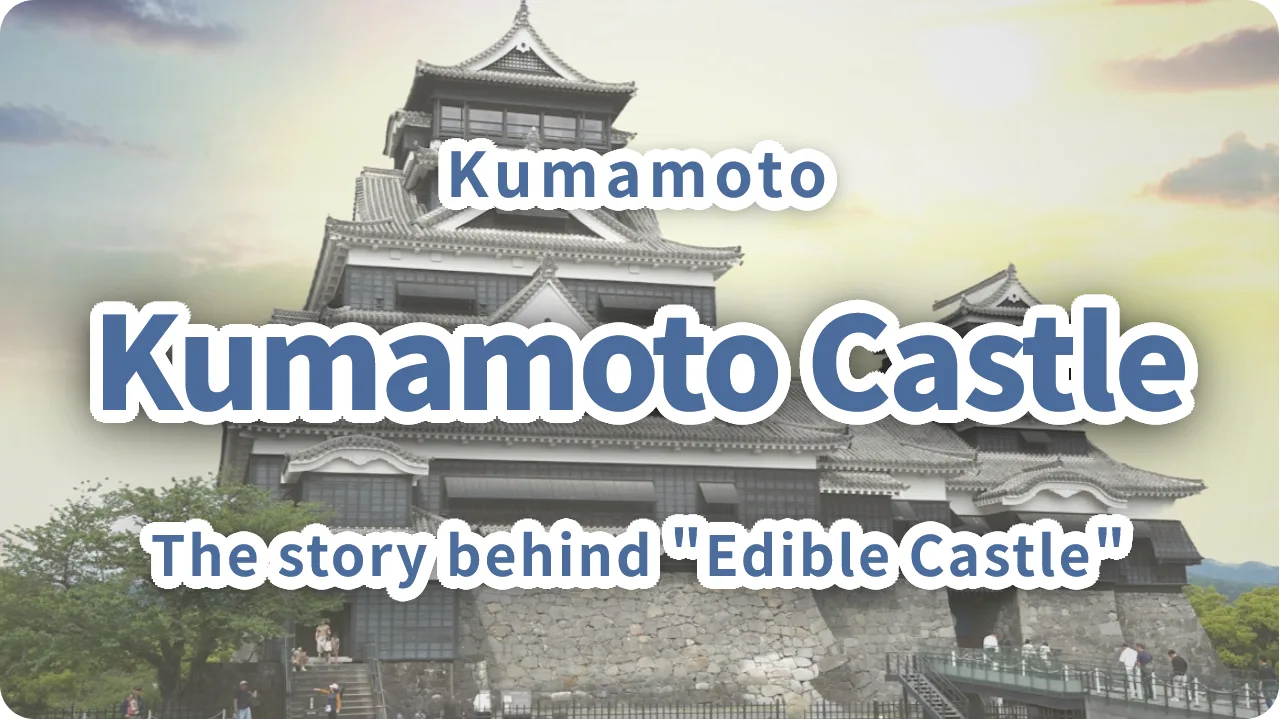
Travel insights from a tour conductor — today’s destination: Kumamoto Castle, one of Japan’s three great castles and a fortress that has outlasted samurai armies, devastating earthquakes, and the fires of civil war. More than 400 years of history are packed into this hilltop stronghold, including a design philosophy so radical it earned the castle an unusual nickname: the castle you can eat.
| Item | Details |
|---|---|
| Name | Kumamoto Castle (Special Public Opening) |
| Hours | 9:00 AM – 5:00 PM (last entry 4:00 PM; last keep entry 4:30 PM) |
| Closed | December 29 (and during severe weather) |
| Address | 1-1 Honmaru, Chuo-ku, Kumamoto City, Kumamoto Prefecture |
| Access (tram) | Approx. 7-minute walk from “Kumamoto-jo Mae / City Hall” tram stop / approx. 17 minutes from Kumamoto Station by tram |
| Access (bus) | Approx. 23 minutes from Kumamoto Station on the Shiro-Megurin castle loop bus |
What “Under Restoration” Actually Looks Like in 2026
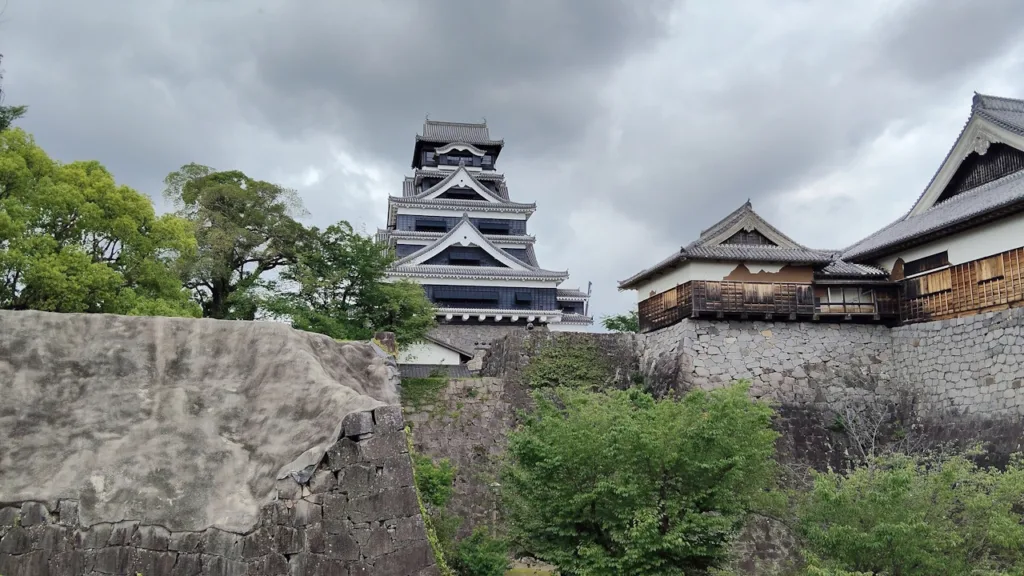
Ten years after the 2016 Kumamoto Earthquake, the castle is still very much a work in progress. The main keep was fully restored and reopened in 2021, but the stone walls and many of the surrounding structures are in the middle of a long reconstruction effort. The target date for full restoration is fiscal year 2052 — roughly 26 years away.
That’s a long time, and it’s natural to wonder whether the visit is worth it while so much is still under wraps. The honest answer is yes — but for reasons that don’t exist at most other castles.
The 2016 earthquake damaged all 33 of the castle’s designated structures, including 13 Important Cultural Properties, and caused roughly 23,600 square meters of stone wall to collapse or bulge outward. Restoring these walls isn’t a matter of piling stones back into place. Each stone must be removed individually, catalogued, stored, and then reset in its original position following strict cultural heritage protocols. That kind of precision takes decades, not years.
What makes Kumamoto Castle’s approach distinctive is what the Japanese call miseru fukkō — “recovery you can see.” Rather than hiding the work behind scaffolding and fences, the castle has built an elevated walkway that takes visitors right alongside collapsed walls and active repair sites. The restoration itself has become the exhibit. You’re not watching from the outside; you’re walking through history being rewritten.
Why This Castle Was Designed to Be Eaten
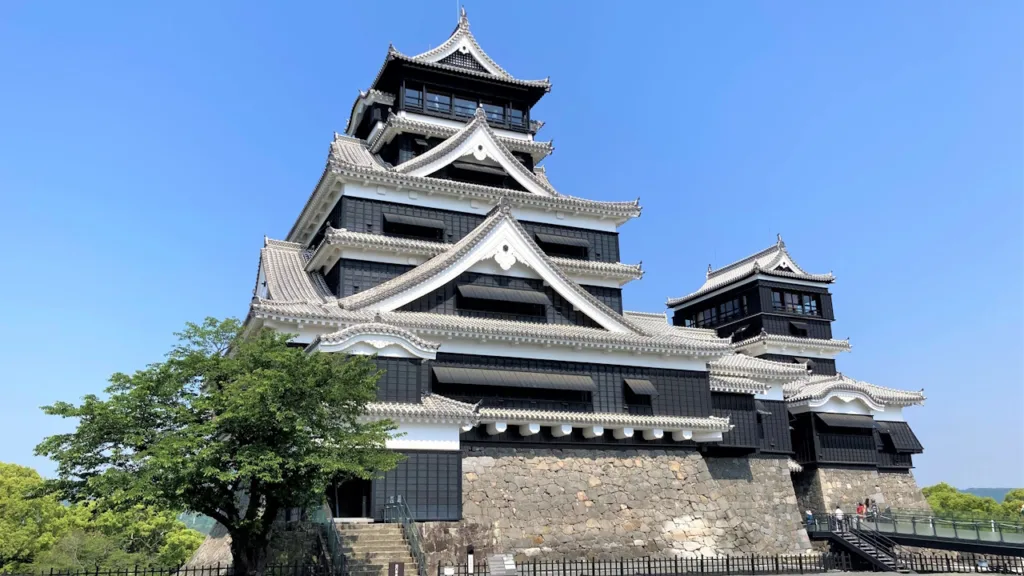
Kumamoto Castle carries an unusual reputation: it’s known as the castle you can eat. That nickname comes directly from the obsessive siege-preparedness of its builder, master castle architect Kato Kiyomasa (1562–1611).
Kiyomasa’s logic was shaped by personal trauma. He fought in Toyotomi Hideyoshi’s Korean campaigns (1592–1598) and experienced firsthand the agony of prolonged sieges with dwindling food supplies. When he set out to build his ultimate fortress beginning in 1599, he was determined that no army would ever starve him out.
Tatami Mats Stuffed with Food
The tatami mats inside the castle weren’t made with ordinary straw. According to tradition, the cores were woven from zuiki — the dried stems of taro plant leaves. Rehydrated and cooked, they’re edible. Every floor of every room in the castle was, in effect, a hidden food store.
Walls Mixed with Dried Gourd
The plaster walls contained kanpyō — dried strips of calabash gourd mixed directly into the clay. Add water, peel it out, and you have a food source. The walls of the castle weren’t just structural; they were part of the emergency pantry.
120 Wells and Ginkgo Trees Planted for Their Fruit
Kiyomasa had 120 wells dug within the castle grounds so that water would never run short during a siege. He also planted ginkgo trees — fast-growing, with edible nuts — throughout the complex. The castle’s alternate name, Ginnan-jō (Ginkgo Castle), comes from these trees. The large ginkgo still standing in front of the main keep today isn’t the original; the first was consumed by the fires of the Satsuma Rebellion in 1877, and the current tree grew from new shoots that sprouted from the scorched roots.
All of this reflects Kiyomasa’s core philosophy: a castle isn’t a palace, it’s a weapon. Edo-era scholar Ogyū Sorai recognized it as such, listing Kumamoto Castle alongside Nagoya Castle and Osaka Castle as one of Japan’s three greatest fortresses.
Four Centuries of Trial — and Three Defining Moments
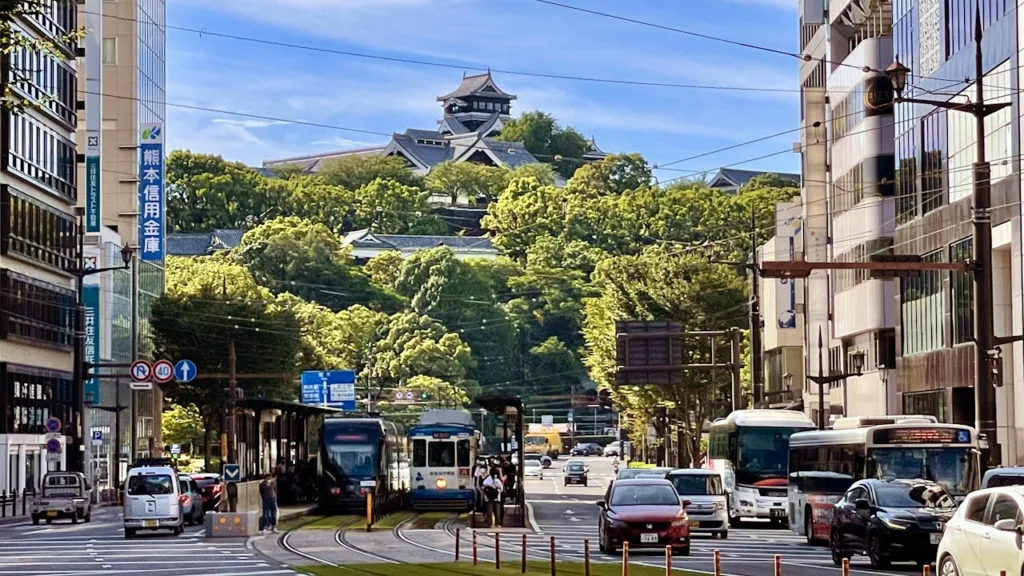
From the Kato Clan to the Hosokawa Era (1607–Meiji Period)
The castle was completed in 1607, and Kiyomasa renamed the city itself at the same time — changing the characters from Kumamoto (隈本) to a new combination (熊本) with a stronger, more fortuitous meaning. After his death in 1611, his son Kato Tadahiro inherited the domain, but suspicion of disloyalty to the Tokugawa shogunate led to the clan’s removal in 1632. The Hosokawa clan, who had served Nobunaga, Hideyoshi, and Ieyasu in turn, took control and held the castle until the Meiji Restoration. It was during the Hosokawa era that the swordsman and philosopher Miyamoto Musashi spent his final years in Kumamoto, composing The Book of Five Rings in a cave near the city known today as Reigando.
The Satsuma Rebellion (1877) and the Fire That Still Has No Explanation
In February 1877, the newly modernized Meiji government faced its most serious internal challenge: an armed uprising of former samurai from Kagoshima, led by the legendary Saigo Takamori. Saigo’s forces advanced northward, expecting to take Kumamoto Castle quickly. They didn’t.
The castle’s stone walls — curved at the base, dramatically steepening near the top in a profile called musha-gaeshi — turned out to be impervious to assault even by experienced fighters. Saigo’s men couldn’t scale them. After a siege of more than 50 days, the government forces held, and Saigo’s army was eventually defeated. The retreat from Kumamoto was described by Saigo himself in a phrase still repeated today: “I was not defeated by the government army. I was defeated by Kiyomasa.”
But here’s the historical irony. Before Saigo’s forces had fired a single shot, Kumamoto Castle was already burning.
On February 19, 1877, at 11:40 in the morning — two days before the planned assault — fire broke out inside the castle walls and spread rapidly in strong southwest winds, destroying the main keep, the Honmaru Palace, and much of the surrounding town. Three competing theories have never been resolved.
The Accidental Fire Theory
A kitchen mishap or other negligence caused the blaze. The official record of the Kumamoto Garrison, the Kumamoto Chindai Sentō Nikki, records the fire with the phrase “the castle was lost to fire” — wording that implies accident rather than intention, though it doesn’t explicitly rule out either.
The Satsuma Sabotage Theory
An enemy agent infiltrated the castle and set it alight on the eve of battle. The timing certainly benefited Saigo’s forces, but no physical evidence has ever been found.
The Deliberate Self-Burning Theory
The most provocative of the three holds that the Meiji government garrison burned its own castle. The reasoning goes that Kumamoto Castle’s towering keep would have made an ideal artillery target for Saigo’s forces, and that destroying it preemptively — along with the surrounding town, to deny cover to advancing troops — made strategic sense. Two near-contemporary sources support this reading. Seinan Sensō Kiji, a chronicle published in August 1877 while the war was still being fought, describes government forces announcing to civilians the day before that the town would be burned, firing three cannon shots as a signal, then setting the keep alight. The memoir Jōka no Hito by Ishimitsu Makiyo likewise states plainly that the burning of the town was “ordered by the garrison” — though the keep fire was officially attributed to accident.
The question remains officially unresolved more than 140 years later. A castle that proved impregnable to a samurai army is also, it turns out, a castle that keeps its secrets.
Showa-Era Reconstruction and the 2016 Earthquake
The castle ruins were designated a Special Historic Site in 1955. In 1960, the exterior of the main keep was reconstructed in reinforced concrete, based on photographs taken in the early Meiji period, with even the number of roof tiles matching the original. For the next several decades, the castle served as the main symbol of Kumamoto city.
The 2016 Kumamoto Earthquake — two major shocks on April 14 and 16 — changed that. All 33 structures were damaged, and the scale of destruction to the stone walls was unlike anything in the castle’s post-war history. Restoration of the main keep was prioritized as a symbol of recovery, completing in March 2021.
Inside the Restored Keep — What’s Changed
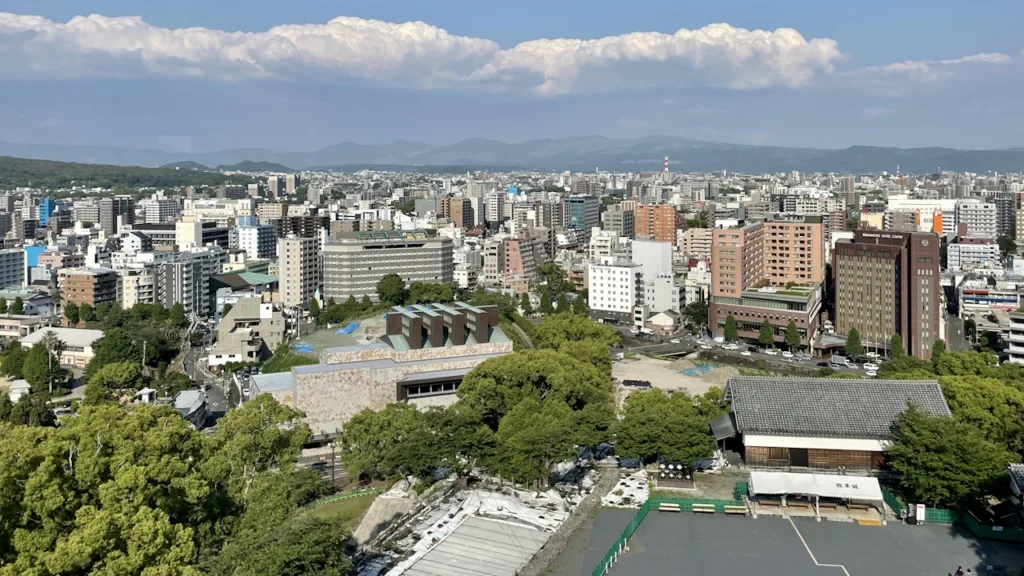
The 2021 restoration wasn’t just structural; the entire interior was redesigned. The keep is a 6-story structure above ground with one basement level, and the new exhibition layout traces the castle’s full story — from Kiyomasa’s original construction through the Satsuma Rebellion fire, the Showa reconstruction, and the 2016 earthquake — using scale models, video, and hands-on displays accessible to visitors with no prior knowledge of Japanese history.
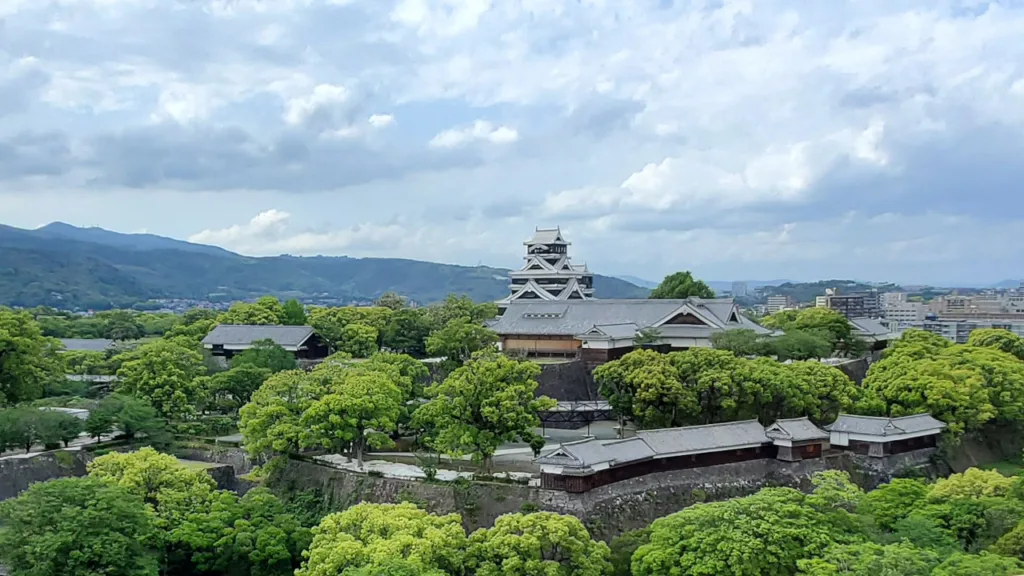
The elevated Special Viewing Walkway — a sky corridor about 6 meters above ground — is a separate experience. Walking along it, visitors can look directly at collapsed stone walls and active repair work at close range. It’s one of the few places in Japan where heritage conservation is happening in real time in plain sight.
From the top floor of the main keep, on a clear day, the skyline stretches to the mountains of the Aso volcanic range.
The 35-Year Plan: Restoration Through 2052
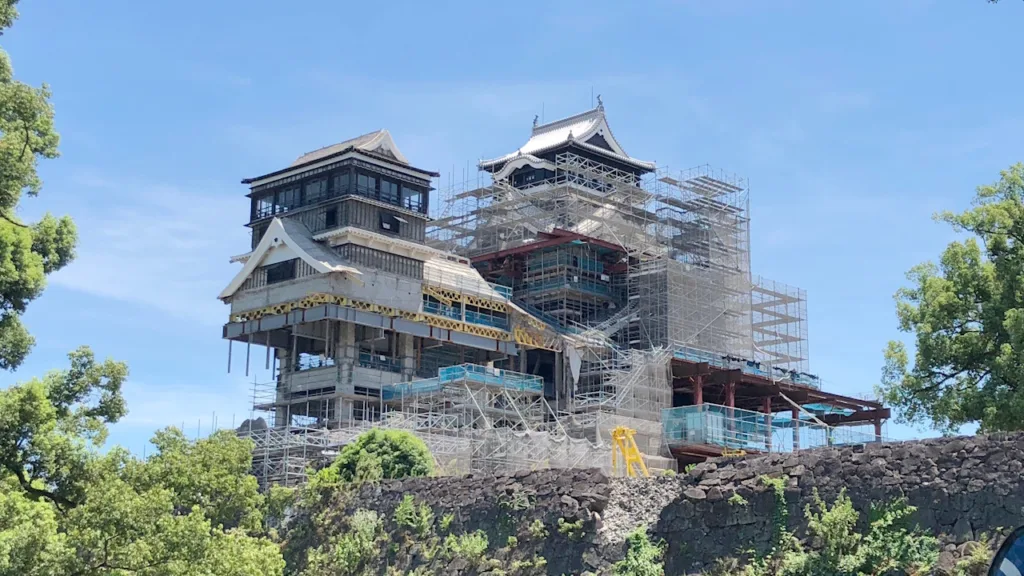
The revised restoration master plan, updated in March 2023, sets 2052 as the target for full completion. Stone walls are being addressed according to priority, with cultural preservation taking precedence over speed. Each section must be documented, stabilized, dismantled stone by stone, and rebuilt using traditional techniques in combination with modern engineering knowledge.
The Kumamoto Castle Research Center plays a long-term role that goes beyond this particular restoration: it’s building a body of knowledge about castle conservation that doesn’t currently exist anywhere else in Japan at this scale. The methods being developed here will inform how future generations care for historic structures.
2026 marks the 10th anniversary of the earthquake, and a special edition of the Oshiro EXPO in Kumamoto 2026 castle studies event has been organized to mark the occasion.
Nearby Spots
Kato Shrine
A two-minute walk from the castle’s Ninomaru Plaza, Kato Shrine is dedicated to Kiyomasa himself. Its grounds offer one of the best direct views of the main keep, the smaller keep, Uto Turret, and the reconstructed stone walls — a combination that makes it one of the most photographed spots in the city. The annual Seishōko Festival, held on the fourth Sunday of July, features a procession of children dressed as Kiyomasa parading through the surrounding streets.
Sakura-no-Baba Johsaien (Wakuwaku-za Museum)
At the foot of the castle hill sits this visitor and dining complex. The centerpiece is Wakuwaku-za, an immersive museum where an Edo-period reconstruction of the castle is presented through large-scale VR footage and live staff commentary. A projection mapping display re-creates the scale of the 2016 earthquake damage. The attached Sakura-no-Koji shopping arcade brings together food and souvenir shops from across Kumamoto Prefecture.
Suizenji Jojuen Garden (Suizenji Park)
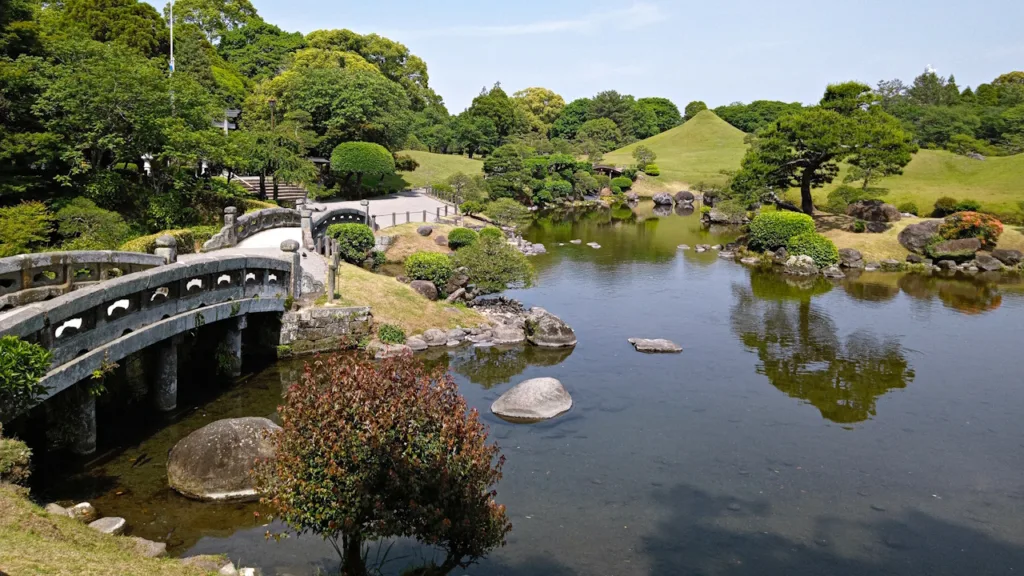
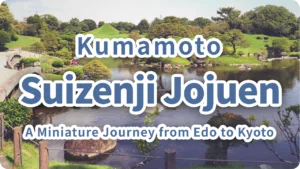
About 15 minutes from the castle by tram, this nationally designated Site of Special Scenic Beauty was created by the Hosokawa clan in the 17th century. The garden’s central spring-fed pond is surrounded by miniaturized landscapes representing Mount Fuji and the 53 stations of the Tokaido highway. Izumi Shrine, dedicated to successive Hosokawa lords, stands within the grounds.
Recommended Hotels Near Kumamoto Castle
Hotel Nikko Kumamoto (Okura Nikko Hotels)
A member of the Okura Nikko Hotels group, Hotel Nikko Kumamoto sits about a 10-minute walk from the castle, directly adjacent to the Torichosuji tram stop on the main city line. The hotel houses five dining options spanning Japanese, French, Cantonese, and café concepts. Castle-view rooms on the upper floors look out toward the keep. Guest reviews consistently highlight the high standard of cleanliness and service.
ANA Crowne Plaza Hotel Kumamoto New Sky by IHG (IHG Hotels & Resorts)
A 25-story tower standing beside the Shirakawa River and part of IHG Hotels & Resorts’ Crowne Plaza brand, this hotel is an 8-minute walk from JR Kumamoto Station and about 15 minutes on foot from the castle. An airport limousine bus stops directly outside. The hotel’s Japanese restaurant Kohrin features Kumamoto Akaushi beef and local sake. Guests on the Premier Floors (18th story and above) have access to a dedicated lounge. The hotel’s breakfast buffet draws consistently strong reviews.
Mitsui Garden Hotel Kumamoto
Seven minutes on foot from Sakuramachi Bus Terminal and roughly 10 minutes from the castle, this 226-room hotel is within easy reach of the Sakuramachi Kumamoto shopping complex. The hotel is known for its Kumamon-themed concept rooms, a signature local breakfast buffet featuring dago soup and karashi renkon (mustard lotus root), and an overall guest rating that regularly sits above 8 on major booking platforms.
Planning Your Visit with a Licensed Tour Conductor
Japan’s castle towns carry layers of history that aren’t always visible from the path. A licensed tour conductor doesn’t act as a tour guide — the professional role covers itinerary management, emergency re-routing, and logistics coordination — but traveling with one changes the texture of a trip. Details that might otherwise get lost, connections between sites that don’t appear on any sign, the rhythm of a well-managed day in an unfamiliar city: these are the things a conductor handles quietly in the background.
Tours.e-stay.jp offers group travel to Kumamoto and across Kyushu with a licensed tour conductor accompanying each departure. For travelers who want the depth of a well-structured itinerary without managing every piece themselves, it’s worth a look.

Final Notes
Kumamoto Castle is what happens when a brilliant, war-scarred general designs a building to survive the worst scenarios he could imagine — and then history obliges with a series of tests he didn’t anticipate. Kiyomasa’s walls turned back a modern army in 1877. An earthquake in 2016 brought sections of those same walls to the ground. The 35-year plan to rebuild them stone by stone is, in its own way, as ambitious as the original construction.
The castle in 2026 is not the version that existed before the earthquake. It’s something else: a working reconstruction site that doubles as a museum of its own repair. The restored keep documents the history; the walkway along the ruins documents the present. Together, the two experiences give Kumamoto Castle a quality that few reconstructed sites can match.
For accommodation near the castle, Hotel Nikko Kumamoto is within walking distance of both the grounds and the city’s main tram line. ANA Crowne Plaza Hotel Kumamoto New Sky by IHG is a short walk from JR Kumamoto Station, with direct access to onward routes toward Aso.