




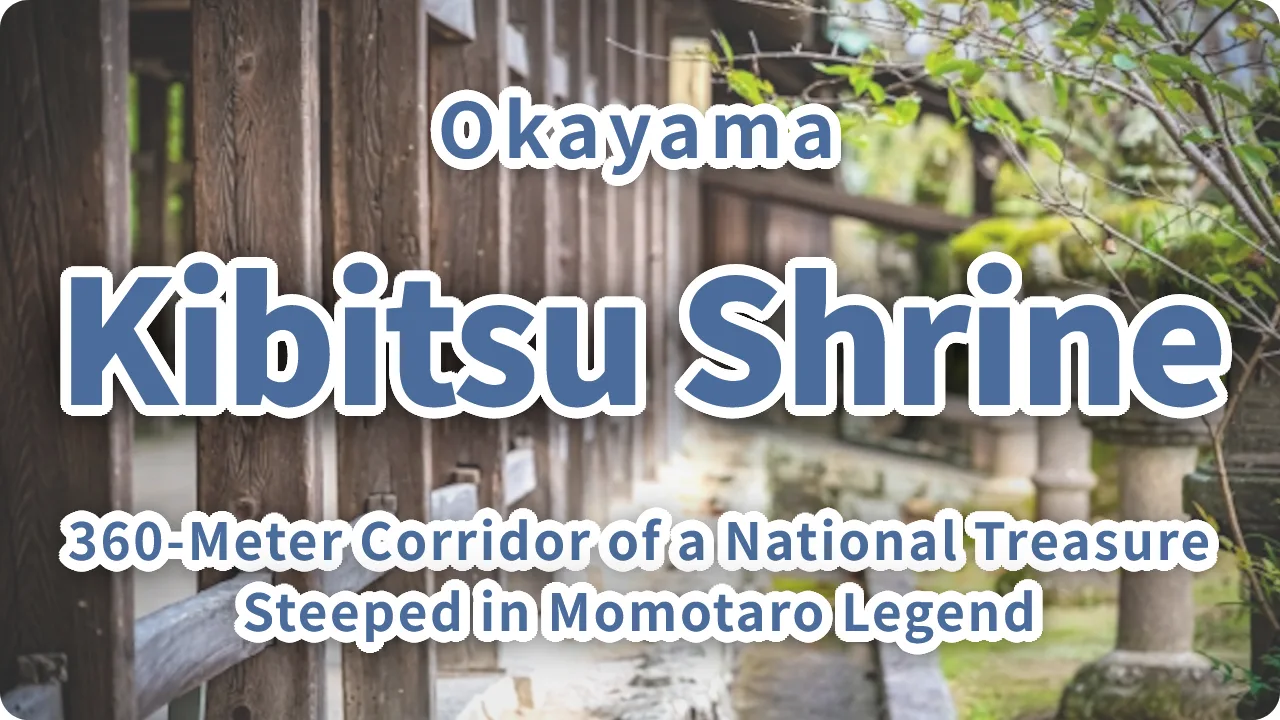
Brought to you by a licensed tour conductor with firsthand knowledge of Japan’s sacred sites. This time, we turn our attention to Kibitsu Shrine (吉備津神社, Kibitsu Jinja), one of the most distinguished grand shrines along the ancient San’yō Road in Okayama City, Okayama Prefecture. This remarkable place carries the living legend that inspired Japan’s most beloved folktale, Momotaro (the Peach Boy), houses a National Treasure main hall built in an architectural style found nowhere else in the country, and draws visitors from history enthusiasts to flower lovers across the four seasons. A main hall that has stood for more than 600 years since the Muromachi period, and a covered corridor extending roughly 360 meters through the surrounding landscape—if you’re traveling to Okayama, this is a site that should not be missed.
| Item | Details |
|---|---|
| Name | Kibitsu Shrine (吉備津神社) |
| Address | 931 Kibitsu, Kita-ku, Okayama City, Okayama Prefecture |
| Visiting Hours | 5:00 AM – 5:30 PM |
| Office / Amulet Counter | 9:00 AM – 4:00 PM |
| Prayer Reception | 8:30 AM – 2:30 PM (Narukama Ritual: 9:00 AM – 2:00 PM) |
| Narukama Ritual Closed | Every Friday, 2nd Sunday of May & October, December 28 |
| Closed | Open year-round |
| Admission | Free |
| Parking | Free (approx. 400–450 spaces) *Fee applies Jan. 1–5 |
| Access (Train) | Approx. 10-min walk from Kibitsu Station, JR Kibi Line |
| Access (Car) | Approx. 15 min from Okayama IC or Okayama-Sōja IC |
Getting There Takes a Little Planning
Kibitsu Shrine sits about 30 minutes by train from JR Okayama Station—take the Kibi Line (nicknamed the Momotaro Line) to Kibitsu Station, then walk roughly 10 minutes. That said, the Kibi Line runs only one to two trains per hour, so missing a connection can mean a long wait. Traveling by rental car or taxi from Okayama IC or Okayama-Sōja IC takes about 15 minutes, though roads around the shrine can become congested during the New Year period and during the spring peony and hydrangea seasons.
There is also one important name to watch out for: Kibitsu Shrine and the nearby Kibitsuhiko Shrine (吉備津彦神社) are two separate shrines, and their names are frequently confused. Kibitsuhiko Shrine is located about a 30-minute walk away. Additionally, the Narukama Ritual—one of the shrine’s signature experiences—is not performed on Fridays, so travelers wishing to participate should plan their visit dates carefully.
The Shrine Born from a Legend of Demon-Slaying
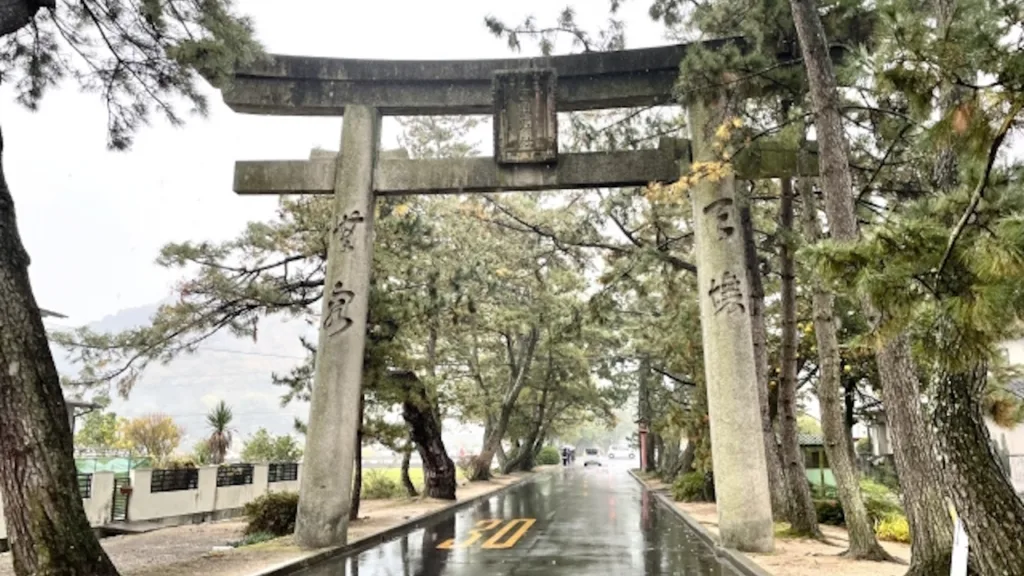
The exact founding of Kibitsu Shrine is unknown, but according to shrine tradition, it was established when Emperor Nintoku visited this land and enshrined the divine feats of the great deity worshipped here. By 927 AD, when the Engishiki was compiled, the shrine was already listed as a Myōjin Taisha (a shrine of the highest ritual status), and it later received the highest divine rank of ippin. Originally the general guardian shrine of all of Kibi Province, the shrine became the ichinomiya (highest-ranked shrine) of Bichū Province when Kibi was divided into three provinces—Bizen, Bichū, and Bingo. Because the founding shrine’s divine spirit was later enshrined in Bizen (at Kibitsuhiko Shrine) and Bingo (at Kibitsu Shrine in Fukuyama, Hiroshima), Kibitsu Shrine in Okayama claims the titles of “Sanbi Ichinomiya” (First Shrine of All Three Kibi Provinces) and “Kibi Sōchinushi” (General Guardian of Kibi).
The mythology preserved at this site is widely recognized as the original source of the Momotaro legend. The principal deity, Ōkibitsu Hiko no Ōkami, was dispatched as one of the Shidō-Shōgun (generals sent in four directions) during the reign of Emperor Sujin to pacify the Kibi region. At that time, a figure known as Ura—said to be of Baekje origin—had built a fortress on a mountain along the Ashimori River and was preying on ships and abducting people. The pursuit of Ura became the template for the entire tale: Ura transformed into a pheasant and fled, the great deity took the form of a hawk and gave chase; when Ura changed into a carp and dove into the river, the deity became a cormorant and plunged in after him. These transformations live on today in local place names—the Chisui River (blood-sucking river) and Koikui Shrine (carp-devouring shrine), both northwest of Kibitsu. When Ura was finally captured and beheaded, his head continued to roar for years. According to legend, Ura appeared in a dream to the great deity and declared: “Have my wife, Aso-hime, tend the fire in the sacred kitchen. If the cauldron rings full and clear, it is a good omen; if it rings rough and broken, it foretells misfortune.” From this dream, the Narukama Ritual was born.
In this legend, Ura plays the role of the “demon” (oni) while Ōkibitsu Hiko is the demon-slaying hero—the foundation on which the Momotaro story was built. The accompanying retainers—Inukai Takeru (dog), Rara Morihiko (monkey), and Tomitama-omi (pheasant)—mirror the iconic trio of the dog, monkey, and pheasant in the Momotaro tale.
Ordered by a Shogun, Built over 25 Years
The current main hall and worship hall were completed in 1425 (Ōei 32). The previous structures had been destroyed twice by fire, and reconstruction was ordered under imperial decree by Ashikaga Yoshimitsu, the third shogun of the Muromachi shogunate. The project took roughly 25 years to complete and stands as a masterpiece of early Muromachi-period architectural craftsmanship. Remarkably, the buildings have survived for approximately 600 years without any full disassembly or reconstruction—a testament to the extraordinary quality of their original construction. The year 2025 marked the 600th anniversary of the completion of these National Treasure structures.
The shrine also holds connections to the modern era: the statesman Inukai Tsuyoshi revered Kibitsu Shrine deeply, and a bronze statue in his likeness stands beside the sacred pond. The stone pillar bearing the shrine’s name was inscribed in Inukai’s own hand.
The Only Shrine of Its Kind: The Overwhelming Presence of the Kibitsu-Zukuri National Treasure Hall
A “Double Hip-and-Gable” Roof Forming the Shape of an “H” from Above
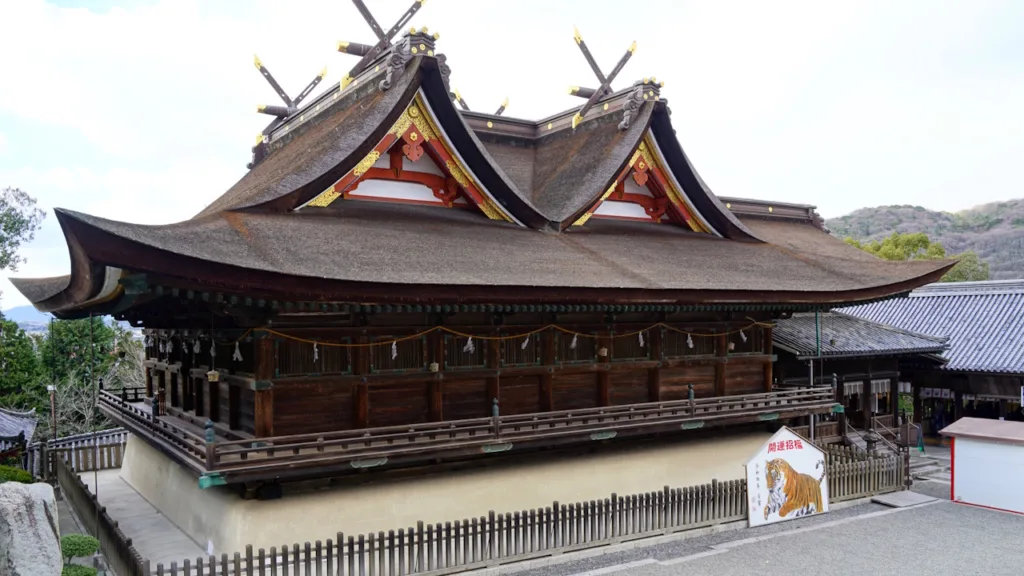
What makes the main hall and worship hall of Kibitsu Shrine unique in all of Japan is their architectural style: the hiyoku-irimoya-zukuri (double hip-and-gable construction), commonly known as Kibitsu-zukuri. This style involves two irimoya (hip-and-gable) roof structures placed front to back and connected at the same ridge height beneath a single large sheet of cypress-bark (hiwada) roofing. Viewed from above, the ridgeline forms the shape of the katakana character “エ” (resembling the letter “H”), an audacious design found nowhere else in Japan.
The main hall is a monumental structure—approximately 14.6 m wide, 17.7 m deep, 12 m to the ridge, and covering about 255 ㎡. It ranks second in scale only to Yasaka Shrine in Kyoto and is more than twice the floor area of Izumo Grand Shrine. The hall is supported by 68 cylindrical columns, each roughly 48 cm in diameter and 6 m tall. The eaves and galleries are supported without posts by a bracketing technique called sashi-hijiki, a style introduced from the continent by the monk Chōgen during his work rebuilding Tōdai-ji Temple—elements of both Buddhist and Shinto architectural traditions coexist within one extraordinary structure.
The interior is divided into five zones progressing inward—outer sanctuary, vermilion dais, middle sanctuary, inner sanctuary, and innermost sanctuary—with the floor and ceiling rising progressively higher toward the center. Decorative finishes of vermilion lacquer, red ochre, and gofun (white pigment) create an atmosphere rich with history.
The worship hall connects directly to the front of the main hall, covering approximately 78.5 ㎡, with a double-layered exterior and an unobstructed interior that opens all the way to the exposed roof structure. Designated together in the national treasure registry as “Kibitsu Shrine Main Hall and Worship Hall,” the two buildings were conceived and built as a single unified whole.
The 360-Meter Corridor and the Flowers of Every Season
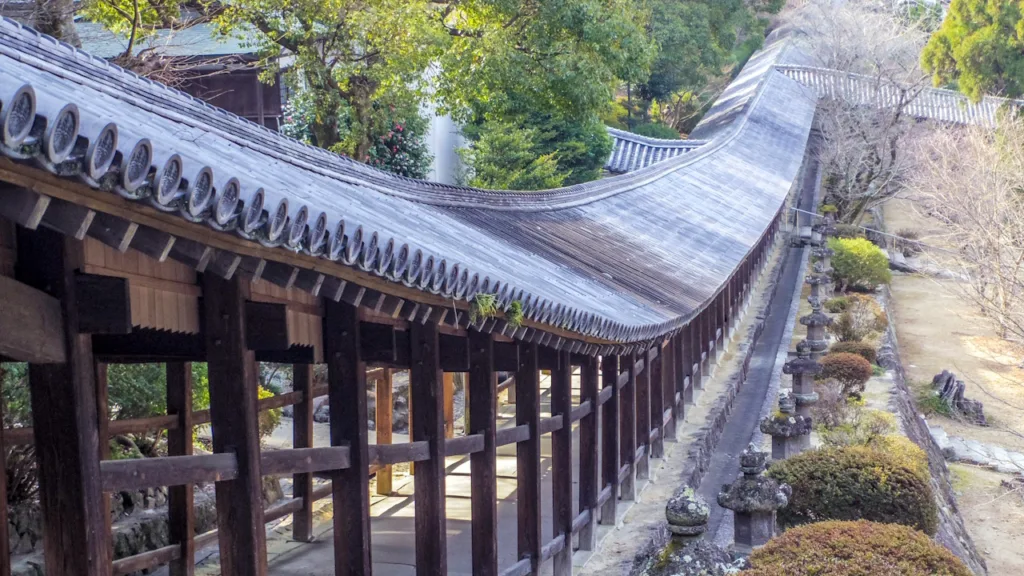
The covered walkway connecting the main hall to Honmiya-sha to the south stretches roughly 360 meters (some sources cite approximately 400 meters) and is designated as an Important Cultural Property of Okayama Prefecture. The corridor follows the gentle undulations of the terrain, creating a scene that captivates photographers and visitors alike throughout the year. In spring, cherry blossoms line the path; in early summer, a peony garden with around 350 plants comes into full bloom; June brings vivid hydrangeas in the ajisai garden; and in autumn, a great ginkgo tree—said to be some 600 years old—turns the grounds a deep shade of gold.
Beyond the corridor, the south and north Zuijin-mon gates, the Okamaden (sacred kitchen hall), and the wooden guardian lion and komainu are all designated as Important Cultural Properties of Japan. Six further structures—the Watari-den, Tsuri-den, Saimon-den, Konrō, Haiden, and Shinsen-den—are designated as Important Cultural Properties of Okayama Prefecture.
The Narukama Ritual: A Sacred Ceremony That Reads Your Fate in Sound
The Okamaden is said to be the place where the severed head of Ura was buried. In this building, the head lies beneath the earth, with a great iron cauldron placed above and a fire lit below. The way the cauldron sounds determines the questioner’s fortune—this is the Narukama Ritual (鳴釜神事), a ceremony whose miraculous reputation has been passed down since at least the Muromachi period. It even appears in the Edo-period collection of supernatural tales Ugetsu Monogatari (by Ueda Akinari) in the chapter titled “Kibitsu no Kama” (The Cauldron of Kibitsu).
The ritual is received at the shrine office (an hatsuhoryo offering is required). A cauldron that rings full and resonant signals good fortune; one that sounds rough and irregular foretells misfortune. The ritual is not performed on Fridays, the second Sunday of May and October, or on December 28—visiting on any of these days means missing the experience entirely.
Beyond the Cauldron: Prayer Rituals and the Kiyoharai-sho
In addition to the Narukama Ritual, Kibitsu Shrine holds regular prayer ceremonies every day for a wide range of wishes—household safety, warding off misfortune, traffic safety, a child’s first shrine visit, and business prosperity, among many others. The shrine office accepts petitions from 9:00 AM to 2:30 PM daily, and online applications are also available up to three days in advance.
One particularly interesting feature is the Kiyoharai-sho (清祓所)—a dedicated vehicle purification area located beside the North Zuijin-mon gate. To receive a traffic safety blessing for a vehicle, the worshipper first undergoes the prayer ceremony inside the main hall, after which a priest comes down to the Kiyoharai-sho and performs a thorough purification of each vehicle—including opening the doors to purify the interior. When submitting the application, the vehicle’s license plate number is required. The official FAQ provides the example plate “Okayama 111 a 1425“—a number that quietly encodes the year the National Treasure hall was completed (1425), weaving the shrine’s deep history into a modern-day procedure.
The number of worshippers permitted to ascend to the inner sanctuary varies according to the amount of the hatsuhoryo offering, so groups planning to visit together should check the current guidelines in advance.
Designated as a Japan Heritage Component
Kibitsu Shrine is one of the constituent cultural properties of the Japan Heritage story “The Town Where the Momotaro Legend Was Born: Okayama,” certified by the Agency for Cultural Affairs. Eight of the story’s 27 component properties belong to this shrine. The Yaokinishi (矢置石), located beside the temizuya (water ablution basin) at the north approach, is a rock where the great deity is said to have rested his arrow during the battle with Ura—a tangible point of contact with the legend. The sacred mountain of Kibi no Nakayama rising behind the shrine (highest peak: Ryūōzan at 175 m) retains numerous ancient burial mounds and ritual sites, reflecting a history of veneration as a divine mountain since antiquity.
Each spring (second Sunday of May) and autumn (second Sunday of October), the shrine holds its Grand Festival featuring the Shichijūgo-zen Sue Shinji—a ceremony in which 75 trays of offerings are carried and presented before the main hall. This is counted as one of Okayama Prefecture’s three great festivals.
An Ancient King Sleeping in the Mountain: Nakayama Chausuyama Kofun and the Sacred Rocks
The Kibi no Nakayama rising behind Kibitsu Shrine is far more than a patch of woodland. The entire mountain has been a sacred precinct since the Kofun period, and ancient burial mounds and ritual sites are scattered throughout its forests.
At the center of it all is the Nakayama Chausuyama Kofun, a keyhole-shaped burial mound (zenpo-koen-fun) on the summit of Chausuyama (elevation 160 m). Estimated to have been built during the early Kofun period (roughly the late 3rd to early 4th century), the mound measures approximately 120 meters in total length. The Imperial Household Agency has designated it as the tomb of Ōkibitsu Hiko no Mikoto, and the site remains under agency management with access restricted. According to Kibitsu Shrine tradition, the great deity lived out an extraordinarily long life of 281 years at the foot of this mountain after pacifying the region and was buried on the summit.
While the identity of the actual interred person cannot be confirmed archaeologically, one detail stands out: a type of clay cylinder known as the miyatsuki-gata haniwa, a style unique to the Kibi region, has been preserved at Kibitsu Shrine as a relic associated with this mound. These distinctly local burial objects suggest that ancient Kibi was a domain powerful enough to stand on equal footing with the Yamato court in the Nara basin. It is also telling that the boundary line between the old provinces of Bizen and Bichū passes directly over this burial mound—Kibi no Nakayama was not only a religious boundary but a political one.
Further into the mountain, near the highest peak of Ryūōzan (175 m) on the Kibitsuhiko Shrine side, stand the Motomine-iwakura (original sacred rock) and the Okumiya-iwakura (“Hachijō-iwa” and other large standing stones), with many shards of haji-ki pottery excavated from the surrounding soil. These iwakura are rock-altar sites where deities were believed to descend—their existence demonstrates that long before any shrine building was ever erected, this mountain drew the devotion of the people. Kibi no Nakayama is a rare “living sacred precinct” where three distinct ages—kofun burial mound, iwakura rock altar, and formal shrine—overlap in one place.
Fortune-Telling the Momotaro Way: Omikuji at Kibitsu Shrine
Kibitsu Shrine offers a variety of omikuji (fortune slips). According to the official FAQ, the standard option is the Inishie Mikuji (古風おみくじ). Additional varieties include the Yorokobi Mikuji, Hana Mikuji, Kodomo Mikuji, and English Mikuji, allowing visitors to choose whichever speaks to them. A QR code printed on each slip connects to an audio reading, so the deity’s message can be heard aloud. After completing your visit to the main hall, head to the omikuji area and let the spirit of Kibitsu add a little wonder to your journey.
Uga Shrine and Fugen-in: A Deity and a Temple That Grew Up Alongside Kibitsu
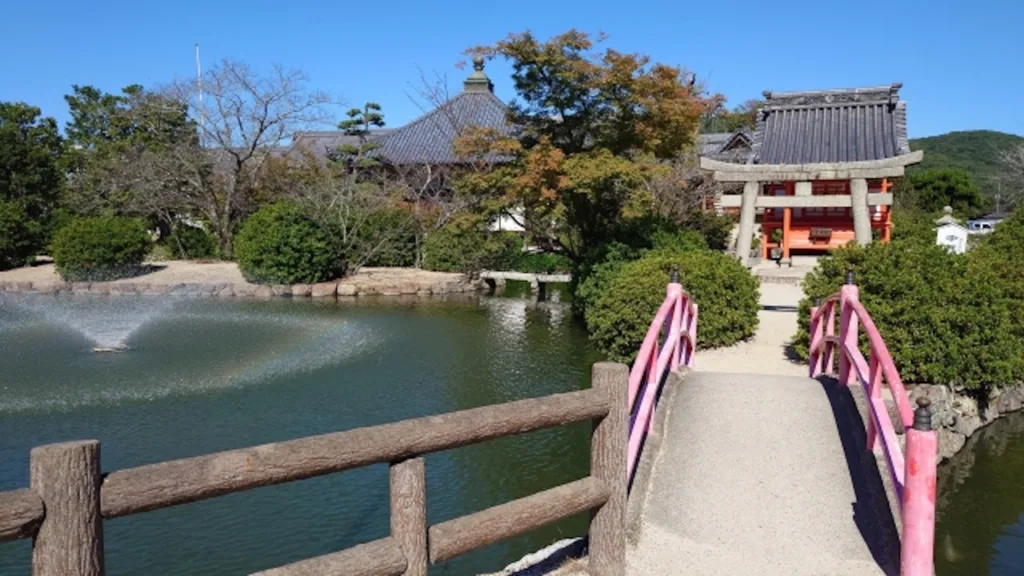
Uga Shrine (宇賀神社)
Located on a small island in the sacred pond adjacent to Kibitsu Shrine’s parking area, Uga Shrine is one of Kibitsu Shrine’s keidai-sha (affiliated outer shrines). A graceful vermilion arched bridge leads across the water to an island where an exquisitely carved and painted shrine building—decorated with dragons, elephants, and fish—awaits. Venerated as the oldest Kibi deity in the region and associated with prosperity in business and commerce, this compact shrine is well worth a visit alongside the main hall. The great pine trees leaning over the pond give the spot a mood of quiet contemplation quite distinct from the main shrine precinct.
Fugen-in Temple (普賢院)
Almost next to Uga Shrine, beside Kibitsu Shrine’s parking area, stands Fugen-in—the only surviving temple of the six shasō-ji (guardian temples) that once protected Kibitsu Shrine. Belonging to the Kōyasan Shingon sect, with Fugen Emmei Bosatsu (Bodhisattva Samantabhadra) as its principal icon and traditionally attributed to the 8th-century monk Gyōki, the temple preserves a Niō-mon (Deva gate) said to have been relocated to the site during the Bunka era (1804–1817). The compact precinct contains the main hall, a bell tower, a Kangiten hall, and a Tenjin shrine, quietly conveying the history of a time when shrine and temple stood as one in protecting the sacred land of Kibi. Fugen-in is also a pilgrimage site on the Bichū Saigoku 33 Kannon Circuit.
Nearby Attractions
The Kibi Plain region is home to numerous historical sites that share the same legendary stage as Kibitsu Shrine.
Kibitsuhiko Shrine (吉備津彦神社)
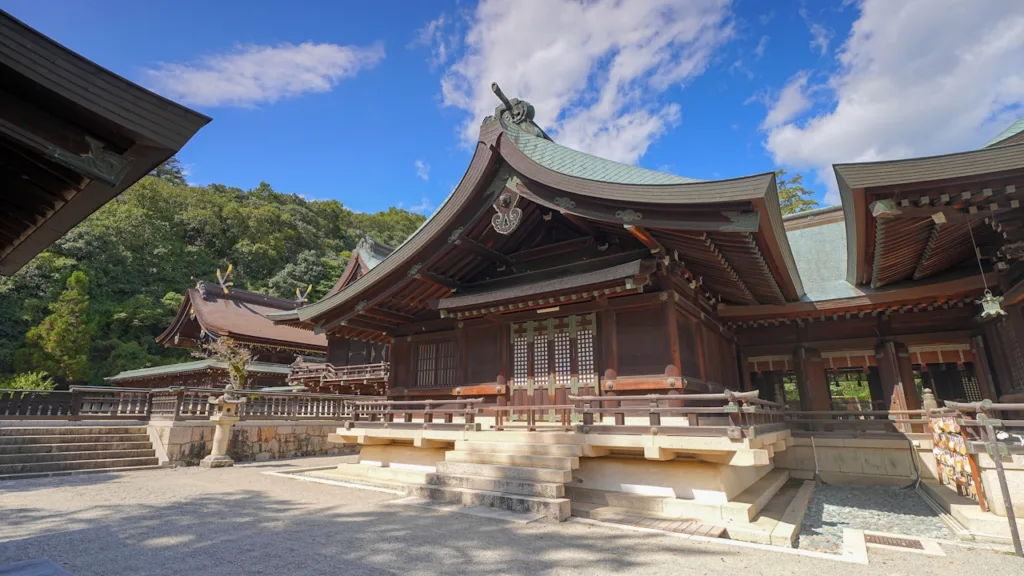
The ichinomiya of former Bizen Province, enshrining the same deity as Kibitsu Shrine, sits at the northeastern foot of Kibi no Nakayama—about a 30-minute walk or a 10-minute cycle ride away. On the summer solstice, the morning sun rises directly through the front torii gate, earning the shrine its epithet “Asahi no Miya” (the Sunrise Shrine). The main hall is a designated Important Cultural Property of Okayama Prefecture. Visiting both shrines in a single trip—known locally as the “twin pilgrimage”—is the standard course in this area.
Yagui-no-Miya (矢喰宮)
A small shrine roughly midway between Kibitsu and Kibitsuhiko shrines, Yagui-no-Miya marks the legendary spot where the deity’s arrow and Ura’s thrown boulder clashed in midair and fell to earth. It is a component of the Japan Heritage story and stands as one of the most viscerally evocative sites of the Ura legend.
Bitchū Takamatsu Castle Ruins (備中高松城跡)
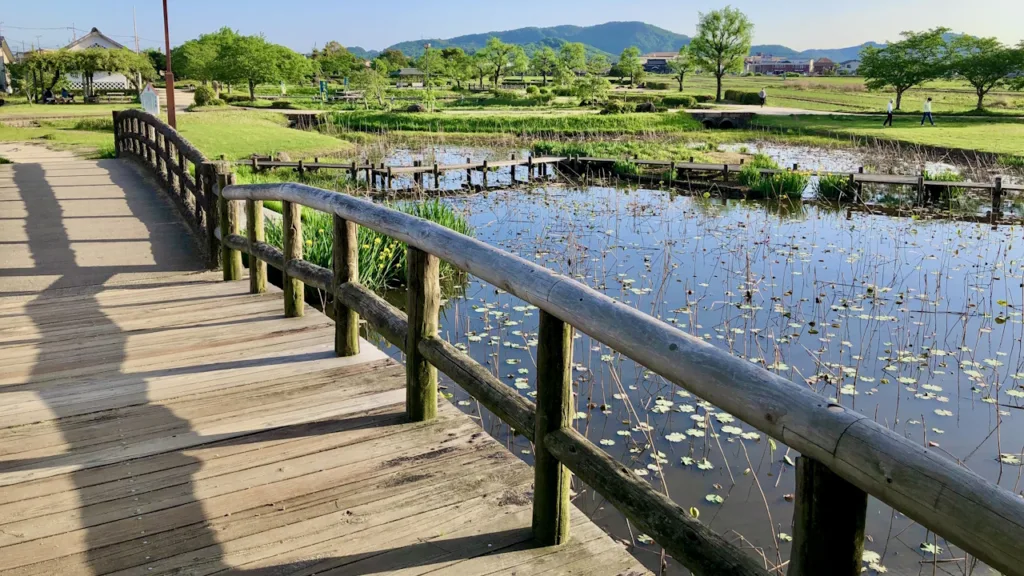
About a 10-minute drive from Kibitsu Shrine, this castle site is famous for the 1582 “water siege” carried out by Toyotomi Hideyoshi (then Hashiba Hideyoshi)—one of the most strategically ingenious campaigns in Sengoku-era warfare. The site has been developed as a park, and the nearby Renkō-ji Temple honors the memory of the castle’s last lord, Shimizu Muneharu.
Recommended Accommodation
There are no large hotels within walking distance of Kibitsu Shrine; the practical base for exploring the Kibi Plain is a hotel near Okayama Station.
ANA Crowne Plaza Okayama by IHG
A flagship property of IHG’s Crowne Plaza brand, directly connected by a covered bridge to JR Okayama Station West Exit—a walk of about two minutes. The 20th-floor Sky Bar & Lounge “Sen” and the Japanese dining venue “Kuriya Sen” make excellent use of Okayama’s seasonal produce. The hotel’s central location makes it equally convenient for visiting Okayama Castle and Kōraku-en Garden.
Hotel Granvia Okayama
Directly connected to JR Okayama Station, Hotel Granvia Okayama belongs to the Hotel Granvia brand operated by the JR West Group, and has earned a Michelin Guide three-pavilion rating. The 19th-floor dining and bar venue “Applause” offers sweeping views over Okayama city, while the property also features an indoor heated pool and sauna. International guests are well supported by multilingual staff.
Purity Makibi
A public-sector hotel about a 7–8 minute walk from JR Okayama Station East Exit, Purity Makibi is equipped with a large communal bath with sauna—a welcome retreat after a day of sightseeing. Free on-site parking makes it a practical base for travelers exploring the Kibi Plain by car.
Explore Kibitsu Shrine with a Dedicated Tour Conductor
Traveling through a region as historically layered as the Kibi Plain—visiting a National Treasure shrine, reading ancient battlefield landscapes, and stepping into the world of a 1,600-year-old legend—is a profound experience. But for international visitors, the journey can present real practical challenges: navigating low-frequency rural train lines, interpreting Japanese-only signage and shrine rituals, and managing the unexpected.
This is where having a dedicated tour conductor makes a tangible difference. A tour conductor’s role centers on itinerary management: keeping schedules on track, providing interpretive assistance between visitors and local staff, coordinating with transportation and accommodation providers, and handling logistical issues if they arise. At Kibitsu Shrine, a conductor can help visitors understand the significance of each ritual space, assist with the Narukama Ritual reception process, and ensure that the Kiyoharai-sho purification experience is accessible—logistics that can easily be lost in translation.
Beyond the shrine itself, the Kibi Plain itinerary—Kibitsu Shrine, Uga Shrine, Fugen-in, the ancient burial mound trail on Kibi no Nakayama, Yagui-no-Miya, and Kibitsuhiko Shrine—holds depths that reward time and guidance. A tour conductor helps visitors move through these sites with purpose and confidence, transforming what could be a series of hurried stops into a coherent narrative journey through one of Japan’s oldest sacred landscapes.
For inquiries about traveling with a dedicated tour conductor and private travel arrangement services throughout Japan, visit tours.e-stay.jp.

Conclusion
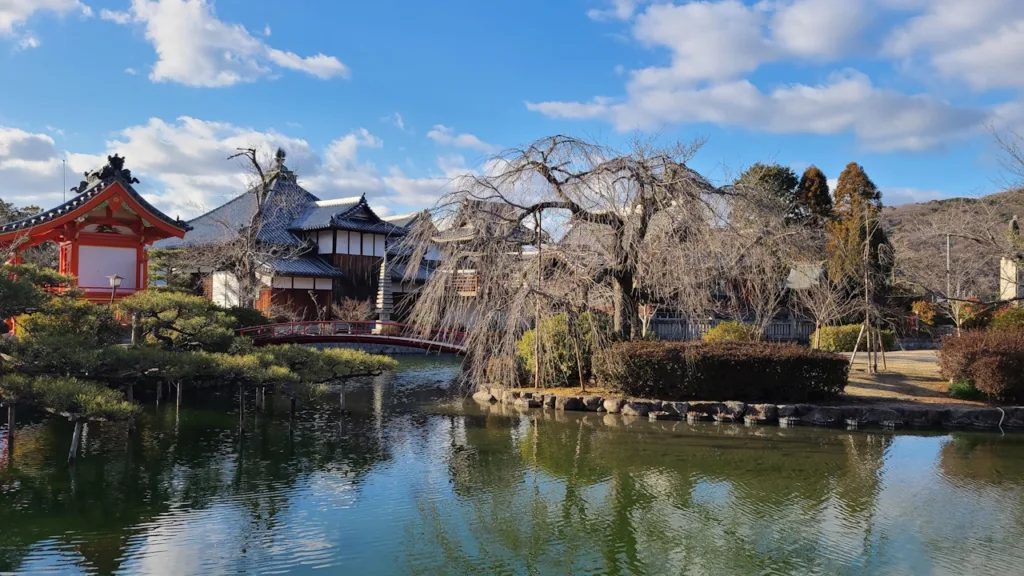
Kibitsu Shrine brings together, within a single precinct, the country’s only National Treasure built in the Kibitsu-zukuri style, a 360-meter covered corridor, the legend that gave birth to Japan’s most famous folktale, a cauldron ritual that foretells the future in sound, an ancient royal tomb, and sacred rock altars predating recorded history. No other shrine in Japan concentrates so many layers of significance in one place. Flowers fill the grounds in every season, and each visit reveals new aspects of a landscape shaped across thousands of years.
Starting from Kibitsu Shrine and moving through the Kibi Plain—east across Kibi no Nakayama to Kibitsuhiko Shrine, pausing at the legendary battlefield of Yagui-no-Miya, then continuing to the water-siege site of Bitchū Takamatsu Castle—is to travel through an arc of Japanese history from the ancient Kofun period to the Sengoku era, all within a compact and walkable area. Walking the Japan Heritage trail of “The Town Where the Momotaro Legend Was Born: Okayama” is one of the most immersive ways to encounter the depth of Japan’s ancient world.
For a stay in Okayama, Hotel Granvia Okayama—directly connected to Okayama Station—puts the Kibi Plain, Kōraku-en Garden, and Okayama Castle all within easy reach and makes a seamless base for the full journey.