



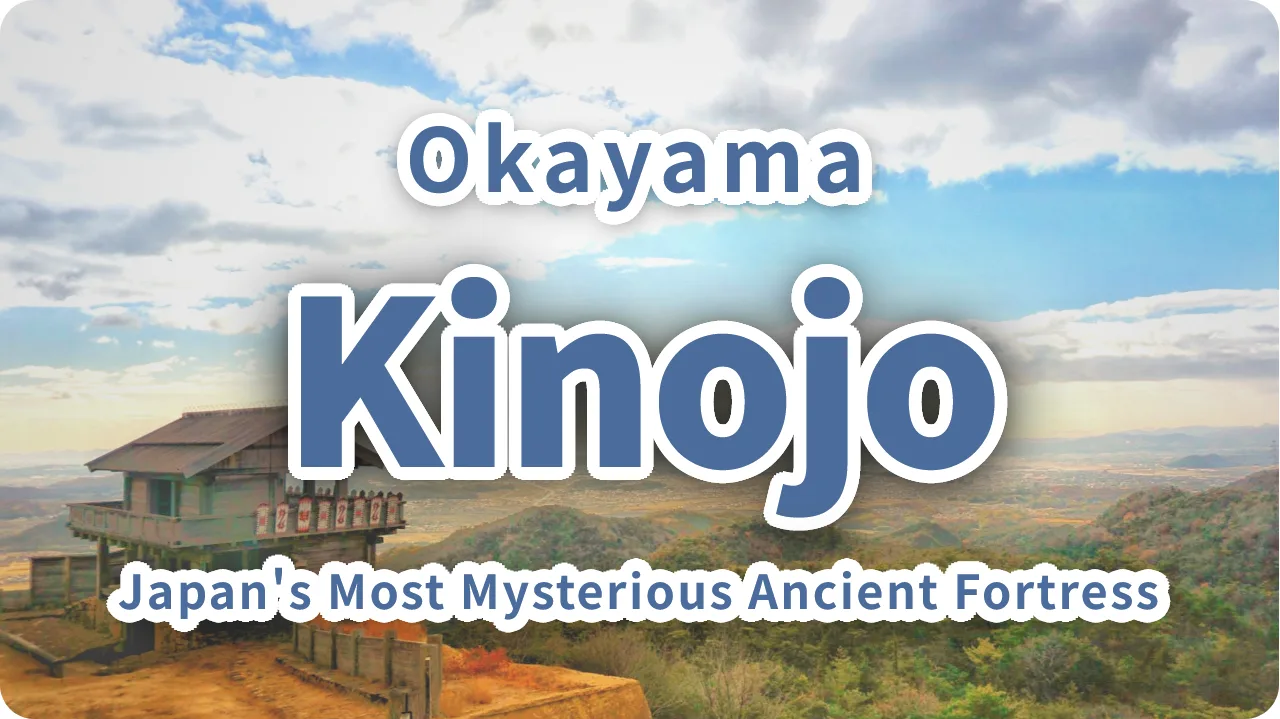
Travel insights from a tour conductor — today’s destination: Kinojo (鬼ノ城, Kino-jo), a ghostly ancient mountain fortress rising above the plains of Soja City, Okayama Prefecture, where the legend of Momotaro — Japan’s beloved Peach Boy — first took shape more than a thousand years ago.
| Item | Details |
|---|---|
| Site Name | Kinojo (Kino-jo) / Soja City Kinojosan Visitor Center |
| Address | 1101-2 Kuroo, Soja City, Okayama Prefecture (Visitor Center) |
| Visitor Center Hours | 9:00 AM – 5:00 PM (last entry 4:30 PM) |
| Closed | Mondays (or the following weekday if Monday falls on a holiday); Dec 29 – Jan 3 |
| Fortress Ruins | Open at all times (night visits not recommended) |
| Access by Car | Approx. 20 min from Okayama-Soja IC (Okayama Expressway) to Visitor Center |
| Access by Train | Taxi approx. 15–20 min from JR Soja Station or JR Hattori Station |
| Parking | Approx. 70 spaces (free) |
| Phone | +81-866-99-8566 |
Getting There Takes Planning
Kinojo isn’t the kind of place you can simply hop a train and stumble upon. The nearest railway stations — JR Soja and JR Hattori on the Kibi Line — are both a 15-to-20-minute taxi ride from the Visitor Center, and the local bus routes that once connected the area have since been discontinued. In practical terms, a rental car is by far the most convenient option.
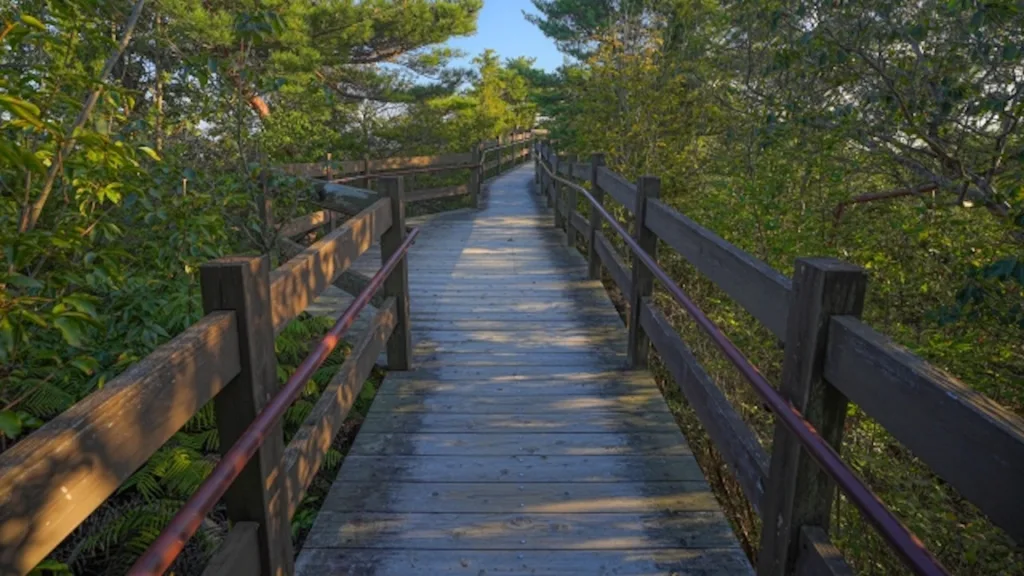
Once you’ve reached the Visitor Center, the restored West Gate is a 5-to-15-minute walk depending on your route. From there, the full circuit trail along the ancient walls runs roughly 2.8 km and takes between 90 minutes and two hours to complete. The terrain is uneven in places, so proper footwear matters — and there are no restroom facilities inside the fortress itself, so use the Visitor Center before heading up. Summer visitors should carry adequate water.
A Castle That Doesn’t Exist — In Any History Book
What sets Kinojo apart from Japan’s other famous castles is a striking absence: it appears in no official historical record. The Nihon Shoki (Chronicles of Japan), the Kojiki, and the other great early texts that document the ancient Yamato state are silent on the subject. No construction order, no record of its builders, no date.
That silence has made Kinojo one of Japan’s most compelling archaeological puzzles. Excavations conducted by the Okayama Prefectural Center for Ancient Kibi Cultural Properties between 2006 and 2011 turned up pottery assemblages pointing to construction in the latter half of the 7th century — approximately 1,300 years ago. Those same findings suggest the fortress evolved: built initially as a military installation, it later shifted function toward a fortified granary and supply depot. A place designed to endure, adapted by the people who lived with it.
In 1986, the site was designated a National Historic Site. In 2006, it was named one of Japan’s 100 Greatest Castles (No. 69) by the Japan Castle Foundation.
The Battle of Hakusukinoe and the Shadow of the Korean Peninsula
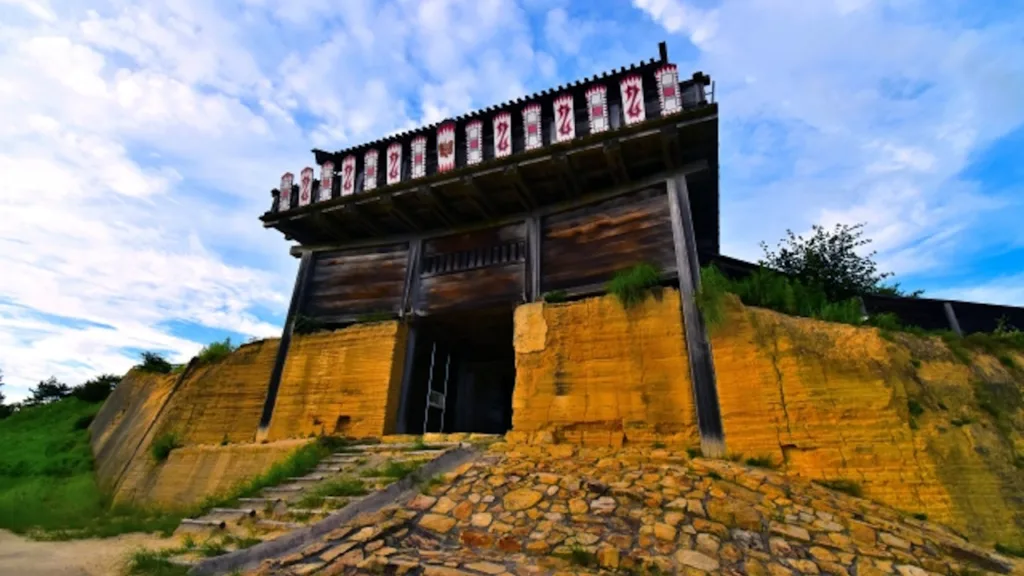
The leading theory for why Kinojo was built at all points to a catastrophic naval defeat. In 663 AD, a combined Japanese and Baekje (Korean kingdom) force was routed by Tang Chinese and Silla forces at the Battle of Hakusukinoe (also read Haksonko). The Yamato court, fearing an invasion that never came, responded by constructing a chain of mountaintop fortresses across western Japan. Kinojo is believed to be one of them.
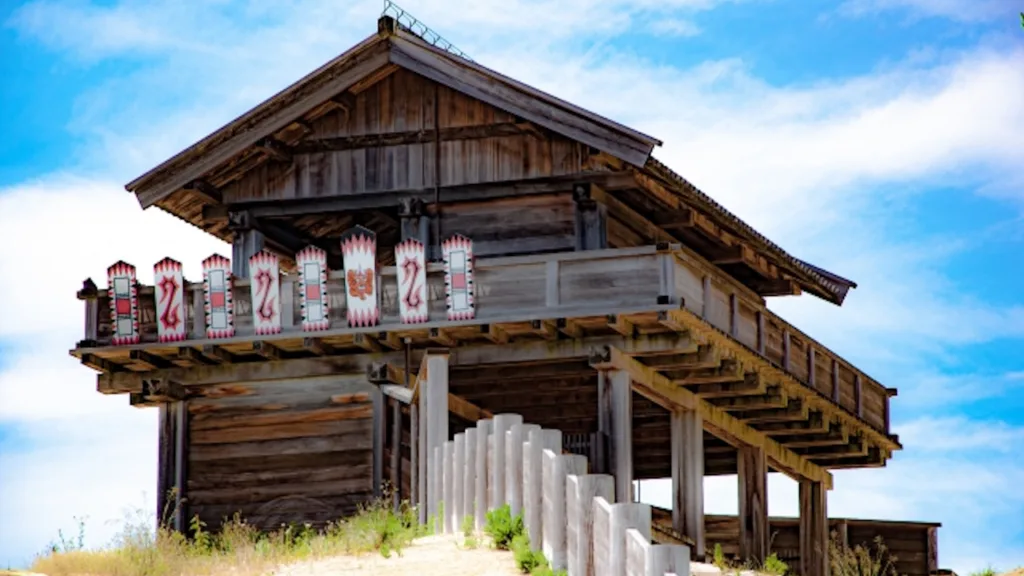
The fortress walls were built using a technique called hanchiku (rammed earth construction): layers of soil compressed between wooden boards, then stacked to form ramparts averaging 7 meters wide and an estimated 6 meters high. Nearly the entire 2.8-km perimeter survives in some form, wrapping the mountain like a headband just below the summit. Inside the roughly 30-hectare enclosure, excavations have revealed four gateways, six water channels, signal fire platforms, cisterns, and the stone foundations of what were likely storehouses. The West Gate and a corner watchtower (kakurō) have been partially reconstructed based on the excavation findings.
The Legend That Became Momotaro — A Deep Dive
Kibitsuhiko-no-Mikoto vs. Ura: The Original Story
Kinojo sits at the center of the Ura Legend — a mythological cycle believed by many to be the original source material for the Momotaro fairy tale. According to the Kibitsu-miya Engi, a later chronicle held at Kibitsu Shrine, a prince named Ura arrived from Baekje during the reign of Emperor Sujin. He was enormous — some accounts place his height at over four meters — with blazing eyes and wild red hair. He built a fortress at Kinojo, raided passing caravans, abducted villagers, and terrorized the surrounding lands until the people appealed to the Yamato court for help.
The court’s response was to dispatch a warrior-hero named Kibitsuhiko-no-Mikoto. In the Momotaro framework, Kibitsuhiko-no-Mikoto is Momotaro — the hero sent from the capital to defeat the demon. Ura is the oni. And Kinojo is the demon’s fortress.
This “Kibi origin theory” was first proposed by a local sculptor and amateur historian in the early Showa period and remains popular locally, though it is not accepted as established fact by mainstream academic scholarship. What makes it remarkable, however, is that the battle doesn’t just survive as a story — it survives as geography.
Where the Arrows Landed — Landmarks of the Legend
The fight between Kibitsuhiko-no-Mikoto and Ura unfolded across a landscape still legible today. The hero positioned himself on the hilltop of Kibi-no-Nakayama and fired arrows toward Kinojo; Ura hurled boulders back from the fortress walls. Where their projectiles collided in mid-air and fell to earth, a shrine now stands: Yagui-no-Miya (矢喰宮, “Arrow-Eating Shrine”) in Kita Ward, Okayama City.
When Kibitsuhiko-no-Mikoto finally fired two arrows simultaneously, one found its mark in Ura’s left eye. The blood that poured from the wound ran so thickly it turned the river red — and that river, Chisui-gawa (血吸川, literally “Blood-Drinking River”), still flows through the area today.
Wounded and retreating, Ura transformed first into a pheasant and fled into the mountains. Kibitsuhiko-no-Mikoto became a hawk and pursued. Ura then changed into a carp and plunged into the blood-reddened river. Kibitsuhiko-no-Mikoto became a cormorant and seized him. The spot where the cormorant caught the carp is now the site of Koikui Shrine (鯉喰神社, “Carp-Eating Shrine”) in Mabi, Kurashiki — still a functioning place of worship.
The transformation chase — demon becomes animal, hero becomes predator, demon escapes as something else — is the most mythologically layered section of the legend, echoing similar motifs found in folktales across Asia.
The Demon’s Head That Wouldn’t Stay Quiet — The Narukama Ritual
The story doesn’t end with Ura’s capture. His severed head was buried beneath the cauldron at the Okamaden (御竈殿), a sacred cooking hall on the grounds of Kibitsu Shrine. And yet the head continued to howl — for years. No amount of ritual could silence it.
One night, Kibitsuhiko-no-Mikoto dreamed that Ura’s spirit appeared to him with a request: “Have my wife, Azohime, tend the sacred cauldron. The sound the cauldron makes will reveal the fortunes of those who ask.”
From that compact came the Narukama Shinto (鳴釜神事) — the Sounding Cauldron Ritual. Still performed at Kibitsu Shrine today, it involves a priestess (the azome) heating a cauldron of water beneath a cedar steamer. As a priest recites prayers, the cauldron produces a sound — a rich, rumbling resonance — whose nature (long or short, loud or quiet) is interpreted as an omen. Written records of the ritual date to at least 1568, making it one of the oldest documented divination ceremonies in western Japan.
That the defeater and the defeated are locked together in this ongoing ritual — the demon’s voice still speaking through the shrine — says something about how deeply ambiguous this legend really is.
Ura as Technologist, Not Monster
There’s a counter-reading of the legend worth knowing. Some scholars and local historians argue that Ura was not a demon at all, but a continental immigrant — possibly a metallurgist or salt-production expert who brought advanced Korean or continental technology to the Kibi region. Ancient Kibi was a center of iron production; those skills had to come from somewhere. In some versions of the legend, Ura was not killed but absorbed — he became one of Kibitsuhiko-no-Mikoto’s retainers, and his expertise was put to use by his conquerors.
In this reading, what the legend records is not good defeating evil but a powerful local culture being absorbed by the expanding Yamato state. The “demon” is the foreigner whose technology was too valuable to waste. The azome priestesses who tend Ura’s cauldron in perpetuity — drawn from the Azo village at the foot of Kinojo, said to be Azohime’s ancestral home — represent the conquered side’s memory preserved within the conqueror’s shrine.
Kibidango, Peaches, and the Three Animal Companions
The Momotaro fairy tale’s props connect back to Kibi in ways that feel almost too neat. Kibidango — the millet dumplings Momotaro distributes to his animal companions — take their name from kibi, the ancient millet crop that gave the Kibi region its name. The peach, Momotaro’s birthplace, was a traditional symbol of magical protection in Japan, and Okayama has been a major peach-growing region for centuries. The dog, monkey, and pheasant of the fairy tale are sometimes matched to three named retainers in the original legend: Inukai-Takeru, Sasa-morihiko, and Tometama-omi.
None of these correspondences is ironclad. But walking the walls of Kinojo with them in mind turns a hiking trail into a palimpsest — a landscape where myth and landscape and geopolitics from thirteen centuries ago have been written on top of each other, layer by layer.
What to See Inside Kinojo — A Spot-by-Spot Guide
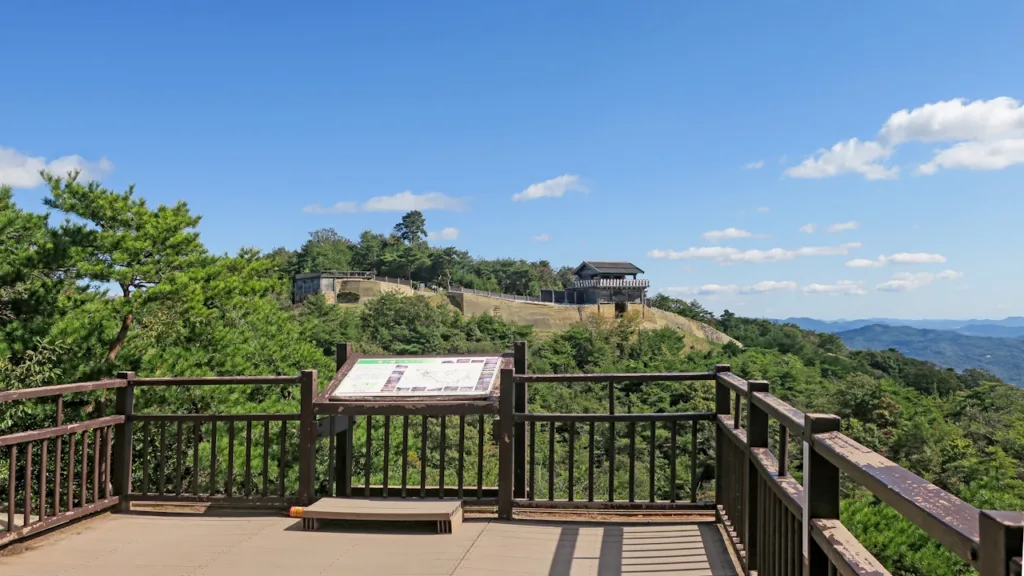
The full 2.8-km loop circuit passes through a remarkable density of archaeological and legendary sites. Walking clockwise from the West Gate, here is what you’ll encounter and what each place means.
Learning Plaza (Observation Deck)
Five minutes from the Visitor Center along the gentler right-hand path, the Learning Plaza provides the first panoramic view of the Soja Plain before you enter the fortress proper. Interpretation panels here explain the reconstruction philosophy behind Kinojo — every gate, wall, and rampart has been rebuilt based on physical evidence from excavation, not speculation. This is the place to understand the layout before you’re inside it. The view alone, across the ancient agricultural plain to the distant shimmer of the Seto Inland Sea, justifies the walk.
West Gate (Reconstructed) — Rammed-Earth Walls and Stone Paving
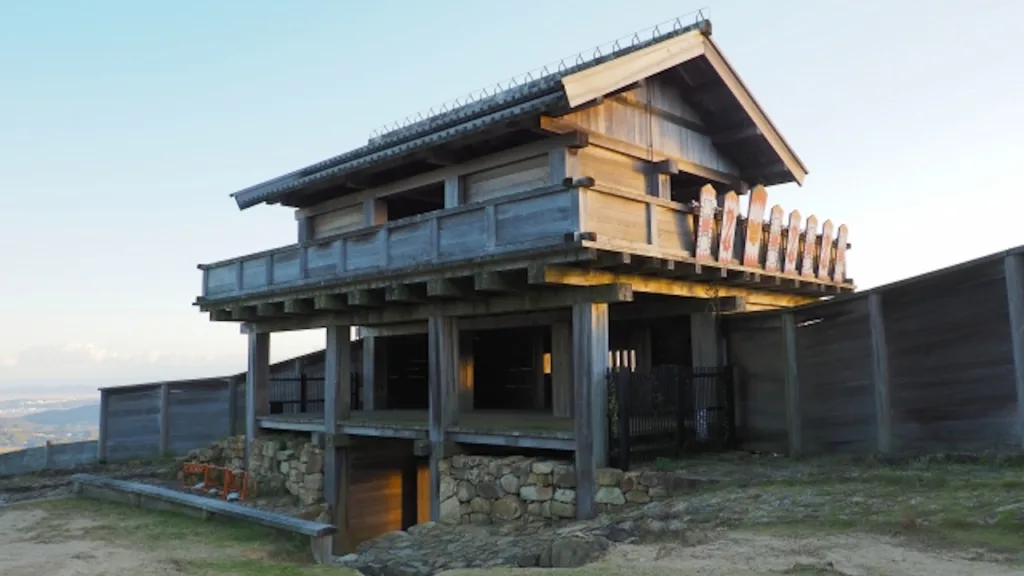
The West Gate, with its 12-meter span, is the largest of Kinojo’s four gateways and the only one reconstructed to full three-story height. Its survival in the archaeological record was unusually good, allowing a high-confidence reconstruction. Approaching from outside, the gate produces what historical sources describe as a deliberate psychological effect — a structure designed to overwhelm before combat even begins. A paved, accessible path connects the Visitor Center to the West Gate, making it the only ancient mountain fortress in Japan reachable by wheelchair.
Beyond the gate, the reconstructed rammed-earth ramparts (hanchiku dōrui) rise nearly vertically on either side — layer upon compacted layer of soil, each pressed individually before the next was added. More unusual still are the stone-paved aprons (shikishi iseki) laid against the inner and outer base of the walls: flat stones set flush with the ground to prevent erosion and manage rainwater runoff. No other ancient mountain fortress in Japan has yielded this feature. Watch your step on the uneven paving — it’s original.
Oni no Kama — The Demon’s Cauldron
Along the trail between the Visitor Center and the West Gate, a large iron cauldron rests at the trailside. Local tradition holds this was the vessel in which Ura (the demon of the legend) boiled his captives. The cauldron is a folk exhibit rather than an excavated artifact, but it anchors the legendary geography of the site in a way that resonates. Interpretive signage around the area covers the Ura legend and its connection to this specific mountainside.
South Gate Ruins
Following the wall south from the West Gate, the South Gate is the second-largest of the four entrances and has been cleared and interpreted after excavation. The approach from outside funnels through narrowing stone walls that would have forced any intruder into single file — a deliberate design for defensive fire from above. The south-facing approach offers open views across the plain, and the wall walk here, with the valley dropping steeply to one side, gives the most visceral sense of what it meant to hold this position.
Ura Kyūseki — The Stone Monument to Ura’s Former Domain
In the vicinity of the byōbu-ore stone wall on the eastern circuit stands a carved stone monument bearing the inscription Ura Kyūseki (温羅舊跡, roughly “the former domain of Ura”). Erected in later centuries to mark the legendary associations of the site, this modest stone column draws visitors who approach Kinojo as a pilgrimage through the Ura/Momotaro tradition rather than (or alongside) an archaeological visit. It marks the point where archaeological site and sacred legend most explicitly overlap.
East Gate Ruins
Smaller in scale than the West and South Gates, the East Gate nevertheless holds a distinctive feature: immediately inside the gate, a massive natural boulder sits directly in the path of entry, as if the rock itself were a guardian. The stone walls flanking the gate spread outward in a fan shape, designed to allow defenders above to direct fire at any angle across the entrance corridor. The East Gate was the first to be excavated at Kinojo — it was originally labeled the “First Gate Site” — and its discovery triggered the broader systematic investigation of the fortress.
Hyakujō-iwa — The Hundred-Mat Rock
Near the East Gate, the trail passes across a vast expanse of exposed granite bedrock known as Hyakujō-iwa (百畳岩, “Hundred-Mat Rock”), a reference to the old Japanese floor-area measurement: the surface area is equivalent to roughly 165 square meters, or about 100 tatami mats. The rock forms a natural platform on the sharply sloping east face of the mountain, and the views from here are among the most dramatic on the circuit. It is also a popular photography point: the angle from the rock across the Soja Plain, with the ancient walls in the foreground, is one of Kinojo’s signature images.
Byōbu-ore Ishigaki — The Folded Stone Wall
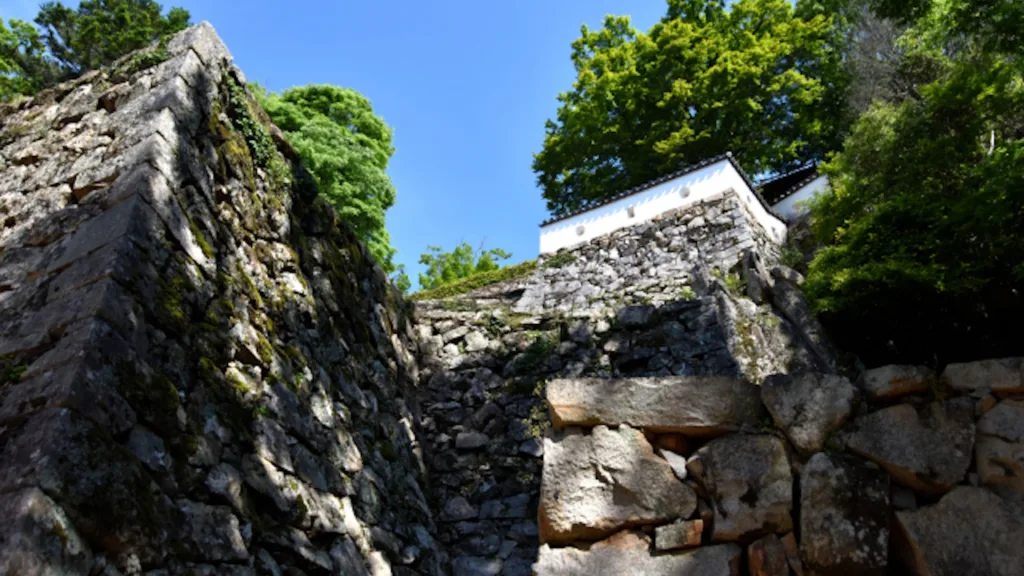
The byōbu-ore (“folded screen”) stone wall is the site’s most admired piece of ancient engineering, and the point at which the largest number of hikers stop longest. Located on the eastern promontory, the wall bends in a series of sharp obtuse angles along the ridge — the term byōbu-ore describes the way a folding screen opens at irregular angles rather than in a straight line. Stone was used here rather than rammed earth because the terrain demanded it: the outer face drops off precipitously, and the high stone wall would have been visible from the plain below, presenting a sheer, forbidding face to anyone approaching from the east. The Ura Kyūseki monument stands in this vicinity. From this vantage point, you are roughly at the halfway mark of the loop — the views back toward the West Gate and forward toward the North Gate are both excellent.
North Gate Ruins
The North Gate, reached via a relatively gentle descent through the northern forest, holds one structural distinction that separates it from all other gates at Kinojo: a drainage channel running down the center of the gate corridor. This was the first such feature ever discovered in a Japanese ancient mountain fortress. (A second example was later found at Yashima Castle in Shikoku.) The precision of engineering implied by a built-in drainage system in a 7th-century mountain fortification continues to surprise archaeologists.
Foundation Stone Buildings — The Granary and Administrative Complex
At the center of the level plateau inside the fortress, a field of stone foundation blocks (soseki) marks where the internal buildings once stood. Excavation identified seven structures in total: five large raised-floor storehouses on a grid of close-set foundation stones (the configuration associated with grain storage above the damp ground) and two side-post buildings interpreted as administrative or management facilities. Nothing of the structures themselves survives above ground — just the stones, spaced and oriented with a logic that becomes readable once you understand what you’re looking at. This is the evidence that Kinojo was not a temporary combat position but a sustained logistical base.
Blacksmith’s Workshop Ruins (Kaji Kōbō Ato)
Adjacent to the building complex, excavators found 12 smelting furnace pits — the remains of an ironworking workshop (kaji iseki) that operated within the fortress walls. Among the finds: air nozzles (hamasaki) used to stoke the fire, iron slag, nails, a blade tool (yari no kanna), and grinding stones. The presence of an active weapons forge inside an ancient fortress is striking enough; read alongside the tradition that Ura was himself a metalworker who brought iron technology from the Korean peninsula, and this ruin becomes one of the most layered spots on the entire trail. The legend and the physical evidence do not contradict each other here — they rhyme.
Corner Watchtower (Kakurō) — Reconstructed
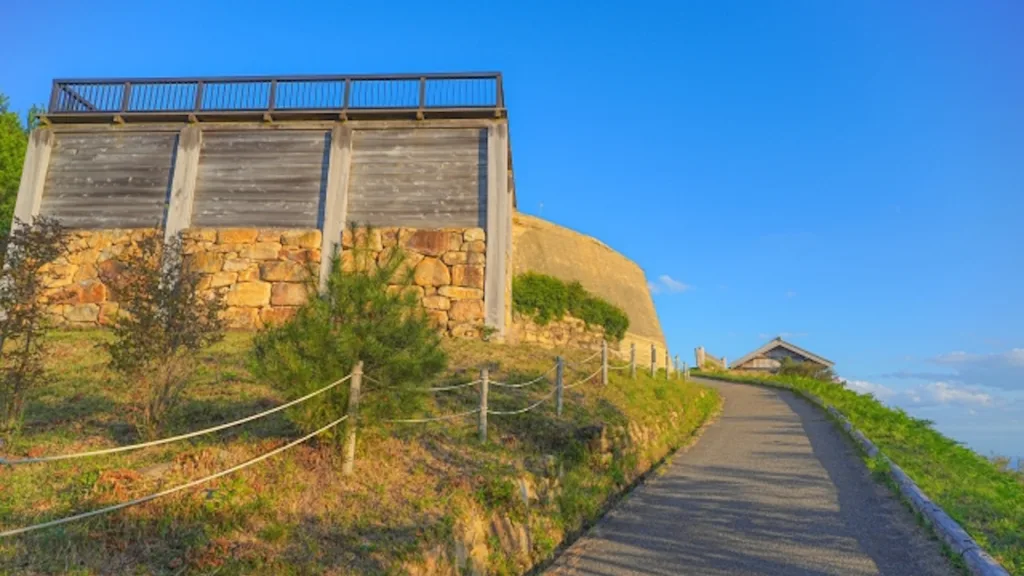
The loop ends (or nearly ends) at the kakurō, the corner watchtower reconstructed beside the West Gate as the final major defensive element of the fortress. Projecting outward from the wall in a rectangular promontory, the structure measures approximately 13 meters wide by 4 meters deep, with a stone base rising over 3 meters and timber posts set at roughly 4-meter intervals between the stones. A stone-paved apron runs along the base of the outer walls.
The kakurō form is known in Korean military architecture as jiseong (雉城, “pheasant wall”) — a term reflecting the way a pheasant can see in multiple directions from a hilltop position. Comparable structures survive at Kaneda Castle on Tsushima Island and at Yashima Castle in Kagawa, connecting Kinojo to a specific Korean design tradition introduced to Japan in the 7th century. From the top (where it was accessible), defenders would have had clear lines of fire against anyone approaching the West Gate from any direction. Standing beside it now, looking back at the gate you entered through a circuit ago, the geometry of the defense becomes clear.
The Sea of Clouds — When the Ancient Walls Rise Above the Fog
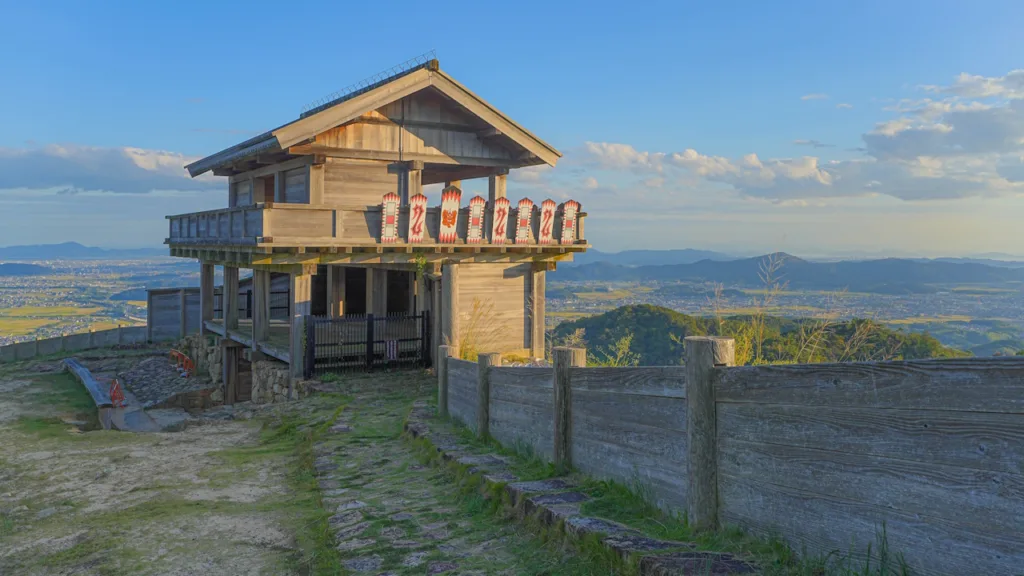
Kinojosan sits at roughly 400 meters on the southern edge of the Kibi Plateau, looking out over a wide inland basin. On the right mornings — still air, high humidity, a clear night following recent rain, and a day-to-night temperature swing of around 10°C — the Soja Plain and Okayama Plain below fill with radiation fog overnight, and by dawn the mountain stands above a white sea. From the Learning Plaza or the West Gate at sunrise, the reconstructed stone walls and ancient ramparts rise from the clouds, the plain below has vanished, and the fortress appears to float in mid-air.
The window for this phenomenon runs from late October through early December, with November offering the most consistent conditions. The best light lasts for about 30 minutes after sunrise, when low-angle rays turn the fog surface gold. By mid-morning the air warms and the clouds dissolve.
For those willing to plan around it: the Visitor Center opens at 9:00 AM, but the trail and parking area are accessible before dawn. Drive up in darkness, bring a headlamp for the path, and layer up — the mountain is noticeably colder than the valley temperatures in your forecast. Cloud formation is never guaranteed; the criteria to check the night before are clear skies, weak winds, and prior-day rainfall. Standing above the clouds on a 1,300-year-old fortress, with the plain of the demon’s legend submerged beneath white fog — if it happens, it is not easily forgotten.
Before You Climb — The Visitor Center
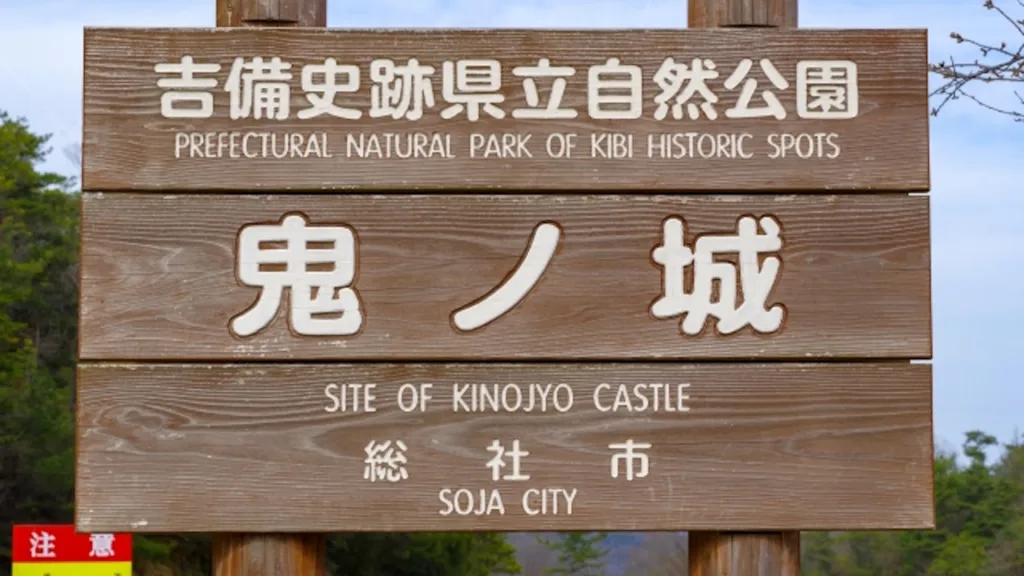
Admission to both the ruins and the Visitor Center is free. The Visitor Center is worth at least 30 minutes before your ascent. It holds a 1:1,000-scale model of the entire fortress (useful for understanding the layout before you’re inside it), a cross-section of original rammed-earth wall removed during excavation, and finds from the dig including pottery and structural remnants. The Japan 100 Greatest Castles stamp is available here — if the center is closed, the stamp can be used at the Soja City Buried Cultural Property Study Hall instead.
Nearby Sites Along the Kibi Road
Bicchu Kokubunji Temple
About 20–25 minutes by car from Kinojo, Bicchu Kokubunji is one of the provincial temples established across Japan by Emperor Shomu in the Nara period (8th century). Its five-story pagoda — the only one in Okayama Prefecture, standing roughly 34 meters tall — is a Nationally Designated Important Cultural Property. The current structures date to the Edo period reconstruction, but the surroundings retain their ancient character: spring fields of rapeseed flower and autumn cosmos against the stone-and-tile backdrop create what many consider the signature image of the Kibi Road.
Hofukuji Temple (Hojusan)
A Zen temple associated with Sesshu Toyo, the 15th-century master of ink wash painting who trained here as a boy. Legend says the young Sesshu, confined for misbehaving, painted a mouse so convincing it came to life and gnawed through the ropes binding him. The grounds are quiet and reflective — a strong contrast to the raw history of Kinojo.
Kibiji Fudoki-no-Oka Archaeological Park
Surrounding Bicchu Kokubunji is a broad archaeological park dotted with ancient burial mounds, including Tsukuyama Kofun and Sakuyama Kofun — two of the largest keyhole-shaped tombs (zenpō-kōen-fun) in western Japan. Rental bicycles are available in the area for a leisurely circuit of the mounds and fields.
Where to Stay
Hotel Granvia Okayama
Connected directly to JR Okayama Station via an indoor walkway on the second floor, Hotel Granvia Okayama is the natural base for anyone exploring the wider Kibi region by car or rail. The hotel offers multiple restaurants, an indoor pool with sauna, and rooms ranging from compact singles to higher-floor rooms with panoramic views over the city. It’s a 30-to-40-minute drive from Kinojo, making it a practical choice for a two-day itinerary that pairs the fortress with Okayama’s other sights.
Suntopia Okayama Soja
A resort hotel built into the hillside terrain of the Kibiji district — roughly 20 minutes by taxi from JR Soja Station — Suntopia Okayama Soja is the closest full-service accommodation to Kinojo itself. The hotel features a large communal bath (artificial mineral spring), summer pool facilities, tennis courts, and a restaurant. It positions itself squarely within Kibi ancient history country, with the major burial mounds and Bicchu Kokubunji all accessible within a short drive. For travelers who want to explore the Kibi Road at a slower pace across two days, this is the logical choice.
Kurashiki Ivy Square
Originally constructed in 1889 as a red-brick cotton mill, Kurashiki Ivy Square is one of western Japan’s most distinctive heritage hotels — the ivy-covered brick walls alone make it worth seeking out. It sits a short walk from Kurashiki’s Bikan Historical Quarter, with its willow-lined canal, Ohara Museum of Art, and craft galleries. The hotel underwent a full renovation in 2020 and is about 30 minutes from Kinojo by car — an ideal base for combining ancient history with Kurashiki’s more recent cultural layers.
Travel with a Tour Conductor
Coordinating logistics between sites like Kinojo, Bicchu Kokubunji, and Kurashiki — each with their own access challenges and timing considerations — is exactly where a licensed tour conductor adds real value. Itinerary management, on-the-ground adjustments, and language support are what the role is built for. For travelers looking to cover the Kibi region without the friction of figuring it out independently, the specialists at tours.e-stay.jp can help build and manage the full journey.
A Fortress With No Name in the History Books
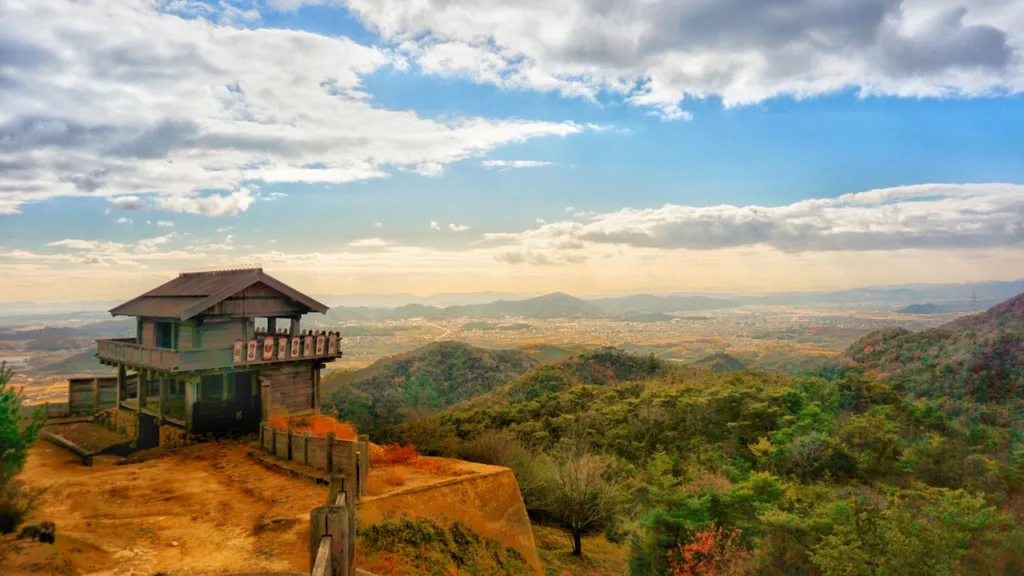
Kinojo is free to visit, it’s on Japan’s 100 Greatest Castles list, and on a clear day it offers one of the finest views in Okayama Prefecture. But what it really offers is something rarer: a place where a story you already know — Momotaro, the peach boy, the demon’s island — dissolves back into the complicated, violent, and surprisingly moving history that generated it.
The demon had a name. The demon had a wife. The demon’s voice still echoes inside a shrine cauldron in the valley below. Walk the walls and listen.