




Travel information brought to you by a professional tour conductor. This time, we explore Kyū-Shizutani Gakkō (旧閑谷学校), a Special Historic Site tucked into the hills of Bizen City, Okayama Prefecture. The school’s lecture hall — a National Treasure standing for more than 350 years — remains intact to this day, and in autumn the grounds blaze with color as century-old Chinese Parasol Trees (kai no ki) turn brilliant gold and crimson against its ancient roofline. Whether you are drawn by history, architecture, or the search for extraordinary autumn foliage, this is one of Okayama’s most remarkable cultural sites.
| Item | Details |
|---|---|
| Site Name | Special Historic Site: Kyū-Shizutani Gakkō |
| Address | 784 Shizutani, Bizen City, Okayama Prefecture |
| Opening Hours | 9:00 – 17:00 |
| Closed | December 29 – 31 |
| Parking | Free (Lot 1: approx. 200 spaces) |
| Access by Train | Approx. 10 min by bus from JR Sanyo Main Line, Yoshinaga Station |
| Access by Car | Approx. 10 min from Wake IC / Approx. 15 min from Bizen IC (Sanyo Expressway) |
Getting There: Planning Ahead Is Essential
Kyū-Shizutani Gakkō sits in a quiet valley in the mountains of Bizen City, and public transport connections are limited. Traveling by train, the nearest station is Yoshinaga on the JR Sanyo Main Line; from there, a local bus takes approximately 10 minutes to the Shizutani Gakkō bus stop. Bus frequency is low, so checking the timetable in advance is essential. A taxi from Yoshinaga Station takes around 8 minutes; from Bizen-Katakami Station on the JR Ako Line, the ride is approximately 15 minutes.
Arriving by car is the most straightforward option. From Wake IC on the Sanyo Expressway, the drive takes about 10 minutes; from Bizen IC, approximately 15 minutes. Free parking for around 200 vehicles is available at Lot 1. On ordinary weekends this is rarely an issue, but during the peak autumn foliage season — particularly in early November when the kai no ki and Japanese maples reach peak color simultaneously — traffic congestion around the site can be significant. Setting out early in the morning is the most effective way to avoid delays.
The “Miracle School” of the Edo Period — A History of Kyū-Shizutani Gakkō
The Man Behind It: Ikeda Mitsumasa
Any account of Kyū-Shizutani Gakkō begins with its founder, Ikeda Mitsumasa (1609–1682), lord of the Okayama domain and one of the most celebrated administrators of the early Edo period. A devoted student of Confucian philosophy, Mitsumasa held the conviction that sound governance required an educated populace — not just the samurai class but the farmers, artisans, and merchants who formed the backbone of society. While domain schools educating the children of warriors were common enough, the idea of a domain-funded institution open to commoners was, at the time, without precedent in Japanese history.
1670: The School Opens Its Gates
In 1670 (Kanbun 10), Mitsumasa established a school for the common people on this serene valley site. The location was described as “a place of clear mountains and streams, ideal for study and scholarly discussion” — and the isolation from urban bustle was deliberate. Students ranging from roughly eight to twenty years of age were admitted, drawn not only from the Okayama domain but from other domains as well. Samurai and commoners learning side by side in the same hall was a genuinely radical proposition in a society structured around rigid class boundaries.
Tsuda Nagatada: The Genius Builder
The construction of the school was led by Nagashige Tsuda (津田永忠), one of Mitsumasa’s closest advisors and a man of extraordinary technical versatility — sometimes described in Japanese historical literature as “the Leonardo da Vinci of the Edo period.” Tsuda oversaw major engineering works across the Okayama domain, including the excavation of the Kurayasu River canal.
Construction of the school complex unfolded in two phases and spanned 32 years. Even after Mitsumasa’s death in 1682, Tsuda continued work in accordance with his lord’s final wishes: rebuilding the Seidō shrine and lecture hall, constructing the stone walls and gates, and replacing the roof tiles with Bizen-ware ceramics. By 1702, the campus was essentially complete — and the fact that these structures survive in their original form more than three and a half centuries later is a testament to Tsuda’s skill.
The Meiji Era and the School’s Second Life
When the domain system was abolished at the start of the Meiji period, Shizutani Gakkō closed in September 1870. Proposals to demolish the buildings surfaced, but local scholars and officials campaigned vigorously for preservation. In 1873, the Confucian scholar Yamada Hōkoku was invited to reopen the site as a private academy called the Shizutani Shōja. By 1884 it had been reorganized as the Shizutaniko, teaching English, Chinese classics, and mathematics. Among those who later studied there were the novelist Masamune Hakuchō and the poet Miki Rofū. The Shizutaniko closed in 1898, but the buildings were carefully maintained through the following century and remain standing today.
The National Treasure Lecture Hall — Architectural Beauty Across 350 Years
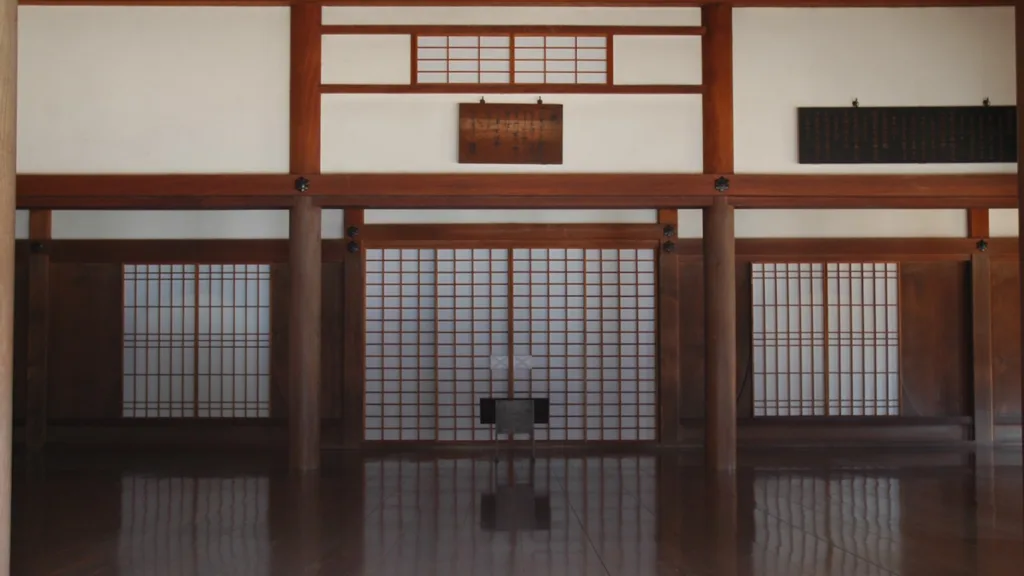
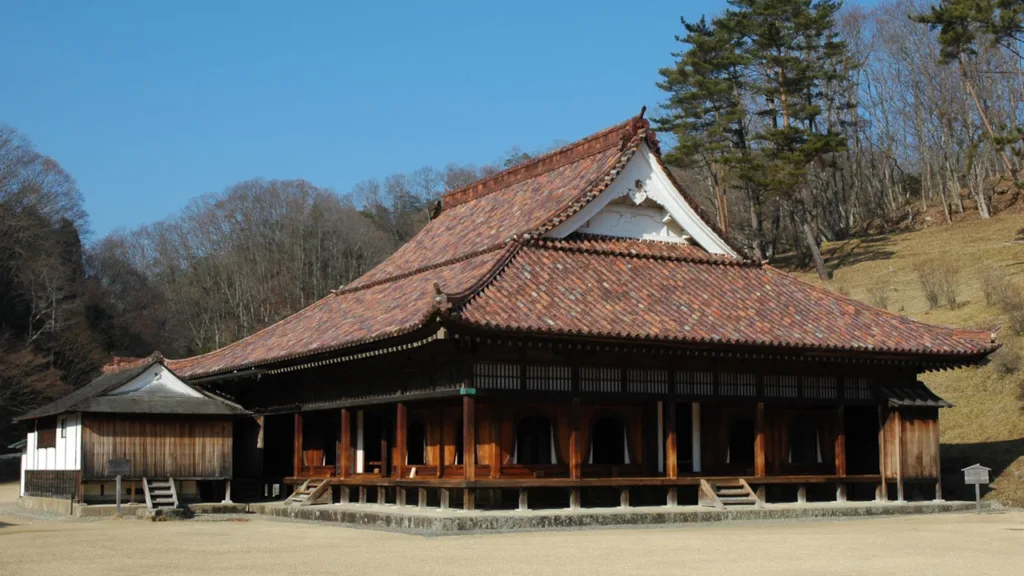
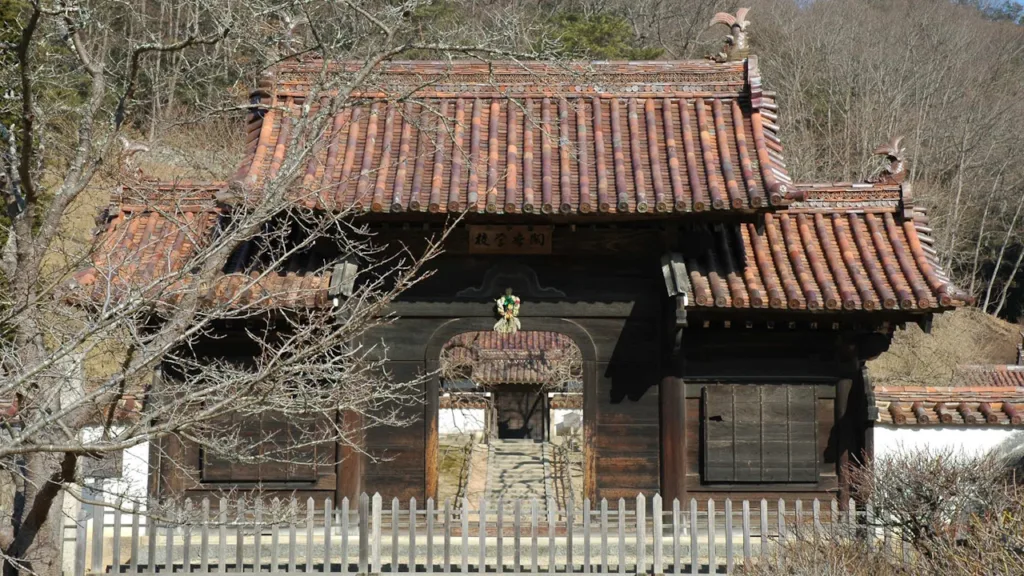
The heart of Kyū-Shizutani Gakkō is the lecture hall (kōdō), completed in 1701 during the Genroku era. Its imposing irimoya-zukuri (hip-and-gable) roof, clad entirely in Bizen-ware tiles, presents an image that is immediately unforgettable. Designated a National Treasure, this building is recognized as one of the oldest surviving school structures for commoners anywhere in the world.
Bizen-Ware Roof Tiles
Every tile on the lecture hall roof is Bizen ware — unglazed stoneware fired at high temperatures, prized for its density and its ability to shed water without deteriorating. Over 350 years later, the original tiles continue to do exactly that. Viewed up close, the natural kiln coloring and unpretentious texture of the tiles give the roof an earthy beauty that no glazed alternative could replicate.
The Lacquered Floor — Look, Don’t Touch
Visitors may step up onto the veranda of the lecture hall, though entry into the interior itself is not permitted. The floor is coated in lacquer and has been polished over centuries to a deep, lustrous sheen. Signs ask visitors not to touch it — the oils from human hands gradually degrade lacquer — and the combination of seeing this extraordinary surface up close while being unable to touch it creates a tension that is itself part of the experience.
The Kamaboko Stone Wall
Encircling the lecture hall is a stone wall with a distinctive semicircular cross-section — shaped, as the Japanese description puts it, like a kamaboko (fish-cake). The curved profile channels rainwater cleanly off both sides, a practical engineering solution that also reads as elegant design. This wall, stretching approximately 785 meters in total, is itself a designated Important Cultural Property. More than a boundary marker, it conveys the sense of a sacred precinct — a space set apart from the ordinary world for the purpose of learning.
The Seidō, Shizutani Shrine, and Other Highlights
Seidō (聖廟) — Confucius Shrine
At the far end of the campus from the main gate stands the Seidō, an Important Cultural Property enshrining a statue of Confucius. Its architectural style was modeled after the Confucius Temple in Qufu, China — the birthplace of the philosopher himself. A Confucian ceremony known as Sekiten (or Shakusai) is still held here annually, and on the day of this ceremony the interior of the lecture hall is opened to the public.
Shizutani Shrine
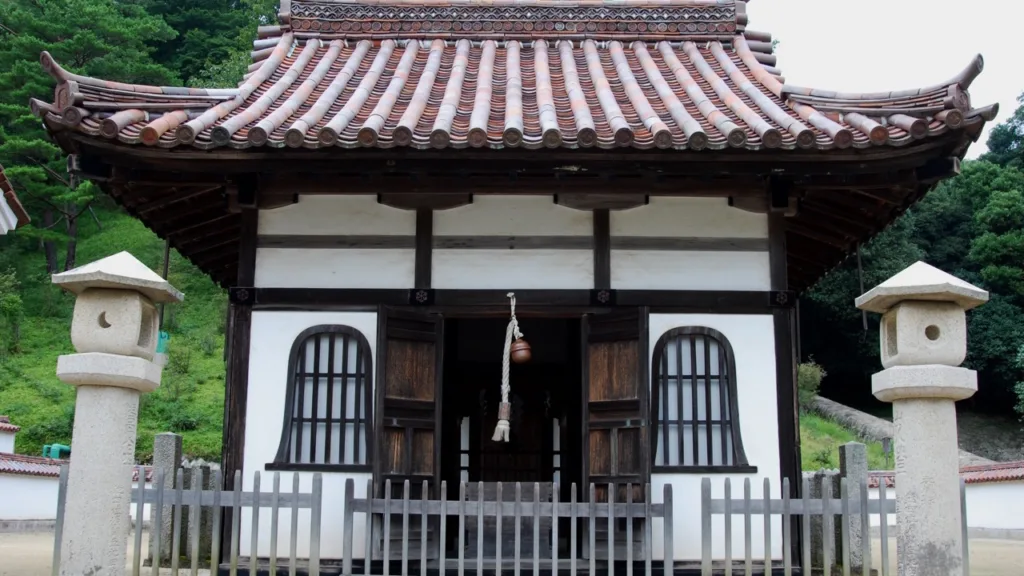
This small shrine commemorates the school’s founder, Ikeda Mitsumasa, originally built under the name Hōretsu-shi. It stands at the foot of the wooded Tsubakiyama hill, its quiet formality a fitting tribute to the man whose educational ideals shaped the site.
Inshitsu and Bunko
The inshitsu (dining room), where students and teachers took their meals, and the bunko (library), which housed the school’s collection of texts, are both Important Cultural Properties. Together they offer a window into what daily life at the school actually looked like.
Shizutani Gakkō Museum
Adjacent to the historic site, a museum presents the school’s history through documents, educational materials, and artifacts related to the study of the Analects of Confucius. Admission to the museum is included in the site entrance fee, making it a natural complement to the main campus visit.
Double Japan Heritage Recognition — Education and Bizen Ware
In 2015, Kyū-Shizutani Gakkō was designated as part of Japan Heritage Story No. 1: “The Educational Heritage of Pre-Modern Japan — The Origins of the Spirit of Learning and Propriety.” It was recognized alongside three other sites: Kōdōkan in Ibaraki, Ashikaga Gakkō in Tochigi, and Kangien in Oita. The designation honored the school’s role in transmitting the Edo-period ideal of education as a public good — a concept that crossed class lines and shaped the development of modern Japan.
In a remarkable additional distinction, the Bizen ware used in the school’s roof tiles was separately recognized as part of a different Japan Heritage Story — “Japan’s Six Ancient Kilns,” celebrating the country’s oldest continuously active ceramic traditions. As a result, Kyū-Shizutani Gakkō holds a dual Japan Heritage designation: one for its significance as an educational monument, another for the ceramic art embedded in its very structure.
The Kai no Ki Trees — A Spectacle Only Autumn Can Offer
Kyū-Shizutani Gakkō’s reputation as a destination for autumn foliage rests on two remarkable trees: kai no ki (Chinese Parasol Trees, Firmiana simplex) that are more than a century old. According to tradition, the seeds were brought from the forest surrounding the Confucius Temple in Qufu — the same site that inspired the Seidō on the school grounds. In autumn, these trees turn two entirely different colors simultaneously: one side blazes deep red, the other glows amber-yellow. Against the backdrop of the National Treasure lecture hall, the effect is breathtaking.
Peak color for the kai no ki typically falls between late October and early November — slightly ahead of the Japanese maples elsewhere on the grounds. As the kai no ki drop their leaves, the maples reach their own peak, extending the overall foliage season. Beyond autumn, the site is worth visiting in every season.
Spring (March – April)
Plum blossoms open first, followed by cherry blossoms. Visitor numbers are relatively low, and the atmosphere is calm and unhurried.
Summer (June – August)
The grounds are blanketed in deep green. Even in the heat of summer, the tree cover provides shade, and the valley setting keeps the site cooler than open city landscapes.
Autumn (October – November)
The kai no ki and maples put on their spectacular display. Evening illumination events are sometimes held during this period, offering a completely different view of the site after dark.
Winter (December – February)
Aside from the very end of February when early plum blossoms begin to appear, winter brings near-silence to the site. Visitor numbers are at their lowest, and for photography without crowds, it is genuinely ideal.
Rongo Rōshō: Reciting the Analects in the National Treasure Hall
One of the more unusual experiences available at Kyū-Shizutani Gakkō is the Rongo Rōshō program, in which participants recite passages from the Analects of Confucius inside the lecture hall itself. Groups of five or more can take part, from primary school age through adult. Reading aloud the words of Confucius — compiled more than 2,500 years ago — within a 300-year-old hall purpose-built for exactly this activity is an experience that sits entirely outside ordinary tourist itineraries. Advance booking through the adjacent Okayama Prefectural Youth Education Center Shizutani Gakkō is required, and a separate fee applies.
The site also features QR codes at key points throughout the grounds, accessible via smartphone, with multilingual audio explanations available in English, Korean, Simplified Chinese, and Traditional Chinese.
Nearby Attractions
Bizen Pottery Museum (Bizen City Municipal)
About 15 minutes by car, the newly rebuilt Bizen City Municipal Bizen Pottery Museum reopened in April 2025. Its collection traces the full arc of Bizen ware — one of Japan’s Six Ancient Kilns — from classical pieces through contemporary artists’ works. Given that the roof tiles of the lecture hall at Kyū-Shizutani Gakkō are themselves Bizen ware, visiting this museum deepens understanding of the material in a tangible way. The museum is also within walking distance of Imbe Station on the JR Ako Line, making it easy to combine with the pottery district of Imbe.
Amatsu Shrine (Amatsu-jinja)
About 15 minutes by car from Kyū-Shizutani Gakkō, near Imbe Station on the JR Ako Line, Amatsu Shrine has stood for over a thousand years. Bizen ware appears throughout: paving stones along the approach, roof tiles over the gates, ceramic komainu (guardian dogs) in the precincts, and ceramic panels embedded in the walls. For anyone interested in how deeply Bizen pottery is woven into local material culture, this shrine is a compelling stop.
Wake Wisteria Park (Wake Fuji Park)
About 10 minutes by car, Wake Fuji Park is one of Japan’s finest wisteria gardens, with approximately 4,000 plants representing around 100 varieties. The peak season runs from late April into early May, when cascades of purple, white, and pink bloom across the grounds in a display that draws visitors from across the country.
Recommended Accommodation
Wake Ugaidani Onsen
Located approximately 10 to 15 minutes by car from Kyū-Shizutani Gakkō, near Wake IC, this hot spring inn sits among forested hills and offers one of the few naturally occurring hot springs in Okayama Prefecture — a mildly alkaline simple spring at 40°C. The property consistently receives high marks for its baths, rooms, service, and dinner. A range of bathing options includes a large communal bath, open-air bath, herbal bath, and waterfall bath. Dinner showcases seasonal kaiseki cuisine using local ingredients, with a signature course centered on Kiyomaro beef, a Wagyu variety associated with the Wake region. An indoor heated swimming pool and outdoor tennis courts round out the facilities, making this a practical base for families as well as individual travelers exploring the Bizen area.

Bizen Hotel Sue (備前ホテル陶)
A short walk from Imbe Station on the JR Ako Line and about 15 minutes by car from Kyū-Shizutani Gakkō, Bizen Hotel Sue is a distinctive property built entirely from locally sourced timber by a local construction firm. The main building offers four types of private guest rooms; a separately standing annex is available for exclusive-use rental. Bizen ware appears throughout the interior — tableware in the rooms, tiled surfaces in the bathrooms — making the stay itself an immersion in the local ceramic tradition. The property has drawn international visitors interested in the Bizen pottery district and is within easy reach of studios, galleries, and the new municipal pottery museum.
Explore Japan with a Professional Tour Conductor
Visiting a site like Kyū-Shizutani Gakkō — tucked into a quiet valley with limited public transport, historical context spanning four centuries, and a physical campus that rewards careful attention — is the kind of journey that benefits from having an experienced professional alongside you. As a certified tour conductor, my role centers on itinerary management: ensuring your travel schedule runs smoothly, handling logistics that arise along the way, and providing translation assistance and emergency coordination when needed.
This is especially relevant for international travelers in rural Japan. Bus schedules, taxi availability, and local facilities are not always straightforward to navigate without Japanese language ability. Having someone managing the practical side of the journey means you can give your full attention to what you came for — the lecture hall, the kai no ki, the Bizen ware on the roof, and the remarkable story behind all of it.
A tour conductor does not perform the role of a licensed guide, but can assist with interpretation support and ensure that the people and places you encounter on the day are part of a coherent, well-organized experience. If you are planning a trip to Okayama that includes Kyū-Shizutani Gakkō and the surrounding area, the tour conductor service at tours.e-stay.jp offers private travel arrangements tailored to your schedule.

Conclusion: A Site That Asks Something of the Visitor
In the early Edo period, one domain lord decided that education should not be a privilege of birth. The school he built in a mountain valley has outlasted the political system that created it, the dynasty that funded it, and the philosophical curriculum it once taught. What remains is a collection of buildings — a National Treasure lecture hall, a Bizen-ware-tiled roof, a curved stone wall — that together constitute one of Japan’s most quietly extraordinary historic sites.
The autumn foliage brings large crowds; the other three seasons bring far fewer. In any season, Kyū-Shizutani Gakkō offers something that is increasingly rare in heritage tourism: a place where the physical fabric of an old idea is still intact, and where that idea — that learning should be available to everyone — does not feel distant. For travelers planning time in Okayama Prefecture, Wake Ugaidani Onsen provides a comfortable and conveniently located base from which the Bizen area’s main sites, including Kyū-Shizutani Gakkō itself, are all within easy reach.