




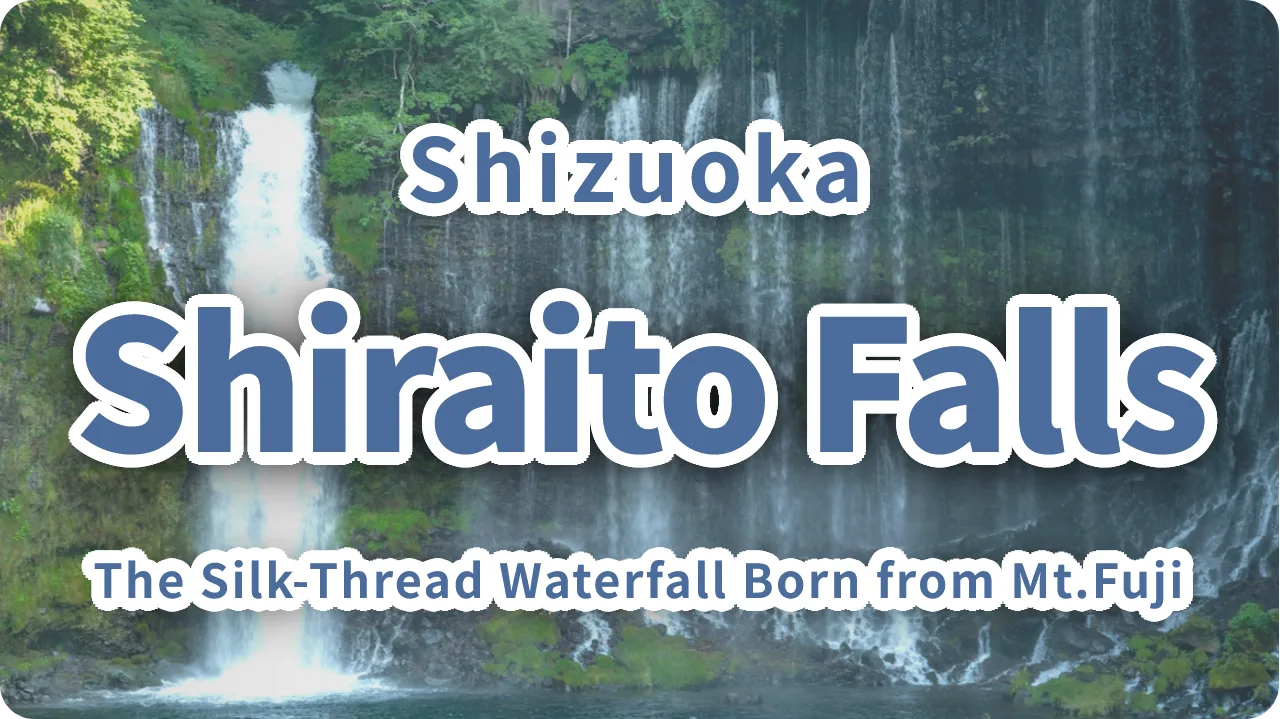
Travel insights from a tour conductor — today’s destination: Shiraito Falls (白糸の滝), on the western foot of Mount Fuji in Fujinomiya, Shizuoka Prefecture. Curving across a cliff face roughly 20 meters high and 150 meters wide, hundreds of individual streams pour out at once, rather than following a single riverbed like most waterfalls. That’s because the water isn’t a river at all — it’s rain and snowmelt that seeped deep into Mount Fuji’s slopes over the years and re-emerged where two volcanic layers meet. The countless threads of falling water are what give the falls their name, evoking strands of white silk draped across the rock. Shiraito Falls is a Japanese National Scenic Spot and Natural Monument, and it’s registered as one of the component assets of the UNESCO World Heritage Site “Fujisan, sacred place and source of artistic inspiration.”
Shiraito Falls: Basic Information
| Item | Details |
|---|---|
| Name | Shiraito Falls |
| Hours | Open access year-round (adjacent parking lot open 9:00 AM–4:30 PM) |
| Closed | None |
| Address | Kamiide/Hara, Fujinomiya City, Shizuoka Prefecture, Japan |
| Access | About 30 minutes by bus from JR Fujinomiya Station (Minobu Line) to the “Shiraito no Taki” stop. About 40 minutes by car from the Fuji Interchange on the Tomei Expressway, or about 35 minutes from the Shin-Fuji Interchange on the Shin-Tomei Expressway |
Mind the Stairs Down to the Falls
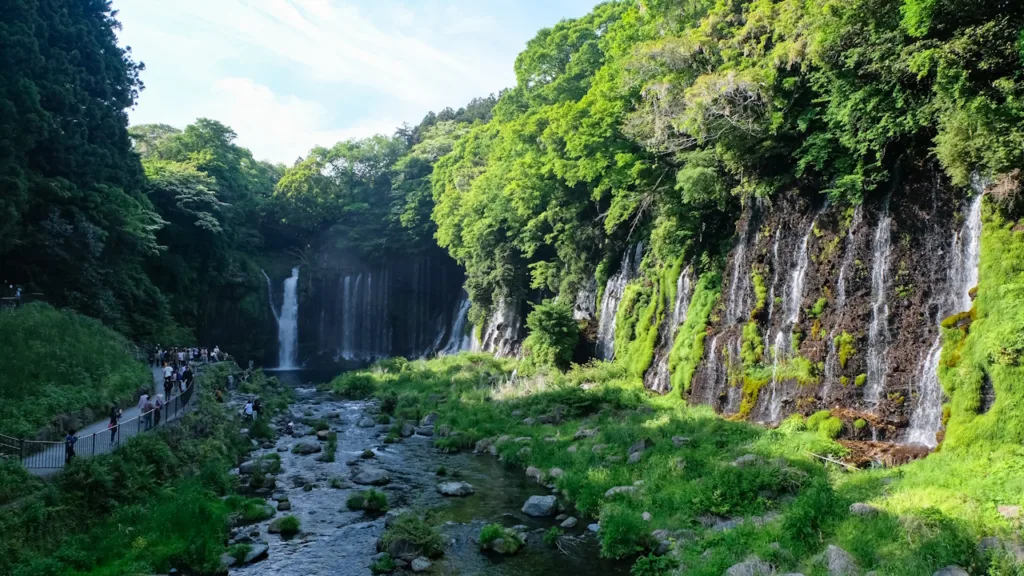
The main path is paved and easy walking, and there’s a wheelchair-accessible viewing area where you can take in the full sweep of the falls without going any further. If you want to get closer to the base, though, you’ll need to tackle a flight of stairs with a noticeable grade. Handrails are in place, but you’ll be climbing back up the same way you came down, so anyone unsteady on their feet may prefer to stick with the main viewing area.
Because the falls sit in a natural spring-fed valley, the walking path slopes gently downhill the whole way there — easy going on the way in, less so on the return climb. If you’re pushing a stroller or a wheelchair, it’s worth checking how far the accessible viewpoint goes before you set off. There’s also a short walk from the bus stop to the falls themselves, so build a little extra time into your schedule if you’re arriving by public transport.
How Mount Fuji’s Geology Created a One-of-a-Kind Waterfall
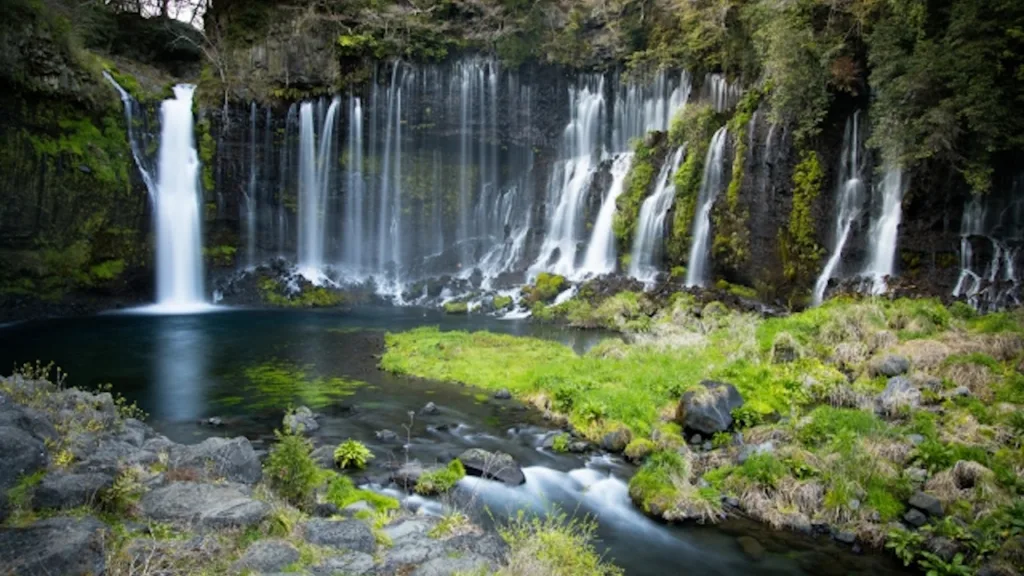
Shiraito Falls owes its unusual form to the geology of Mount Fuji itself. The cliff exposes the boundary between two volcanic layers: the porous “new Fuji” lava layer on top, and the far less permeable “old Fuji” layer beneath it. Rain and melted snow soak down through the upper layer, but the lower layer stops them from going any further. Instead, the water travels sideways along that boundary until it reaches the cliff face and bursts out through the rock. The result is a flow estimated at around 1.5 tons per second — a reminder of just how much water the mountain itself has been quietly storing for centuries.
That underground origin also means the falls barely fluctuate even in drier months, keeping a fairly constant appearance throughout the year. Water temperature stays close to the same level year-round too, giving the area a cool, refreshing air in summer and a faint mist that rises like steam over the falls in winter.
A Waterfall Seen by Minamoto no Yoritomo and Oda Nobunaga, and a Pilgrimage Site for Fuji Worship
Shiraito Falls has been a celebrated scenic spot for centuries, and it shows up repeatedly in Japan’s historical record. In 1193, the shogun Minamoto no Yoritomo is said to have made camp near the falls during a large-scale hunting expedition at the foot of Mount Fuji, and legend holds that he composed a poem after visiting the site. The falls also appear in the Shinchō Kōki, the chronicle of the warlord Oda Nobunaga’s era, confirming that they were already a well-known destination by the Sengoku period.
In later centuries, Shiraito Falls became a pilgrimage site tied to Fuji-kō, the popular religious movement centered on Mount Fuji worship. Hasegawa Kakugyō, regarded as the founder of Fuji-kō, is said to have practiced water austerities in front of the falls during the 16th and 17th centuries. A memorial stone honoring Jikigyō Miroku, one of the movement’s later leaders, was erected near the base of the falls in the early 1830s and still stands there today. Just above the falls, a spring known as Obin-mizu is linked to a legend that Minamoto no Yoritomo once used its water to fix his disheveled hair — another site that became a place of devotion for Fuji-kō followers.
This layered history eventually earned the falls formal recognition: they were designated a National Scenic Spot and Natural Monument in 1936, added to Japan’s list of 100 top waterfalls in 1990, and registered as a component asset of the Mount Fuji World Heritage Site in 2013.
That World Heritage registration also brought changes to the site itself, aimed at preserving the natural setting. Shops and an older bridge that once stood close to the water’s edge were gradually removed or relocated, and a newly rebuilt viewing bridge — Takimi-bashi — opened to visitors in 2013. The relatively unspoiled scene you see today is the result of that ongoing effort to keep the area close to its natural state.
The Silk-Thread Cascade: Shiraito Falls’ Signature View
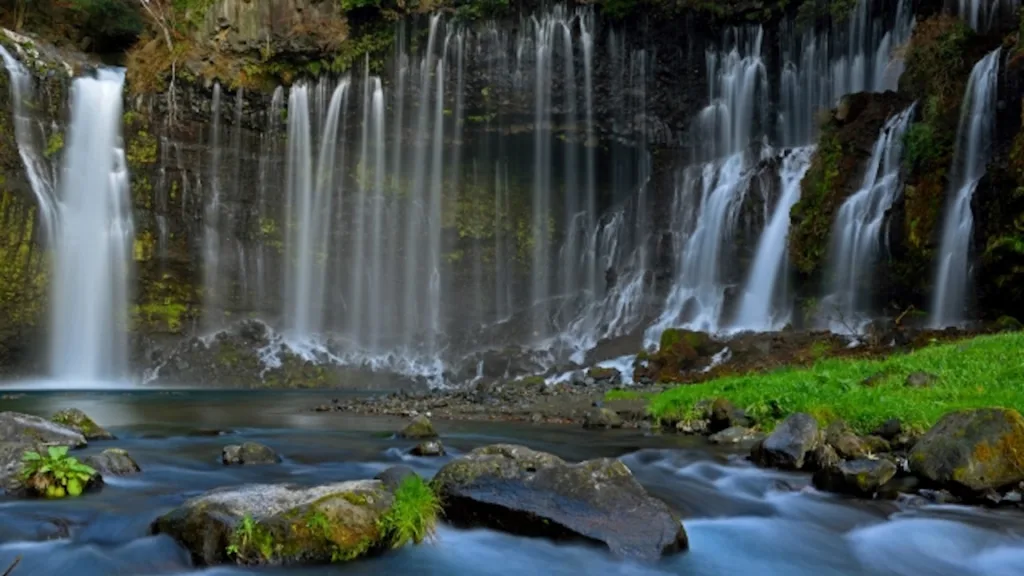
The defining feature of Shiraito Falls isn’t a single powerful stream but the delicate, countless threads of water spilling from every part of the curved cliff face. Standing close to the base, you’re nearly surrounded by an arc of falling water — a scene often described as graceful and almost feminine, in contrast to more forceful waterfalls. A viewing bridge called Takimi-bashi sits directly in front of the falls, letting you look up at the full width of the cascade from close range.
This delicate scenery has long attracted artists. The Edo-period painter Ike Taiga depicted Mount Fuji together with Shiraito Falls in works such as “Fuji Shiraito no Taki-zu,” and that composition went on to influence later generations of painters. Because the water volume barely changes through the seasons, the falls pair with the surrounding foliage to create a scene that shifts constantly with the time of year, even as the waterfall itself stays much the same.
Get close, and you can watch the water emerge continuously from dozens of points across the cliff rather than as one unified flow. The exact volume and pattern differ slightly depending on the height and width of each section of rock, so the view keeps changing even if you stay in the same spot. Near the base, fine spray drifts up like mist, and on the right day you might catch a rainbow forming in it.
A Study in Contrasts: Otodome Falls Next Door, and Four Seasons of Change
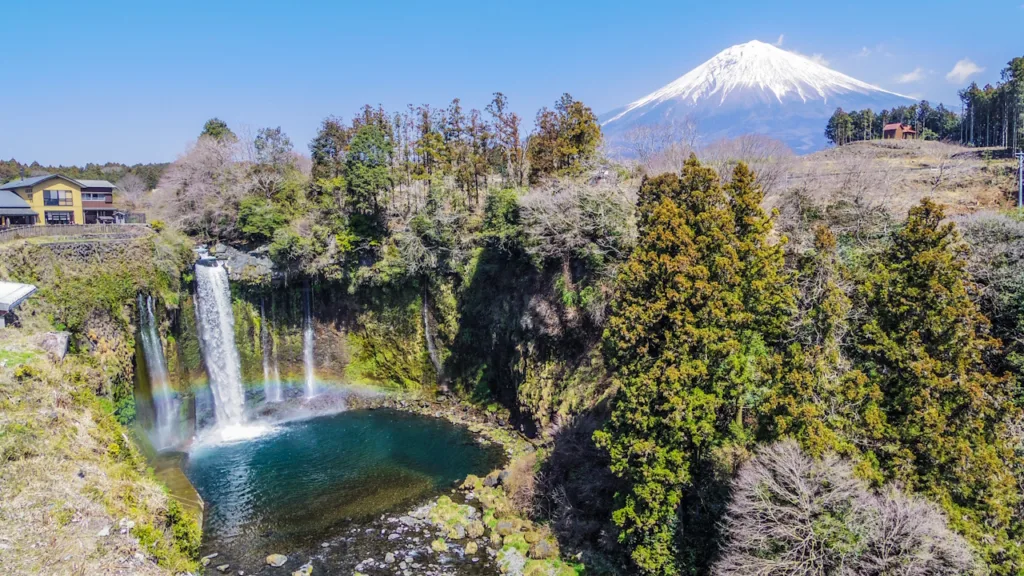
A few minutes’ walk along the path from Shiraito Falls brings you to Otodome Falls, a striking contrast in personality. Fed by the main flow of the Shiba River, Otodome Falls drops about 25 meters as a single, thunderous column of water — a far cry from the hushed, delicate sound of Shiraito Falls nearby. Otodome Falls carries its own legend: during Yoritomo’s hunting expedition, the Soga brothers are said to have been plotting revenge against their father’s killer nearby, only for the roar of the falls to drown out their conversation. According to the story, they prayed for quiet, and the falls fell silent for a moment — hence the name Otodome, or “sound-stopping.” Seeing both falls side by side makes it clear how differently the same underground water source can express itself.
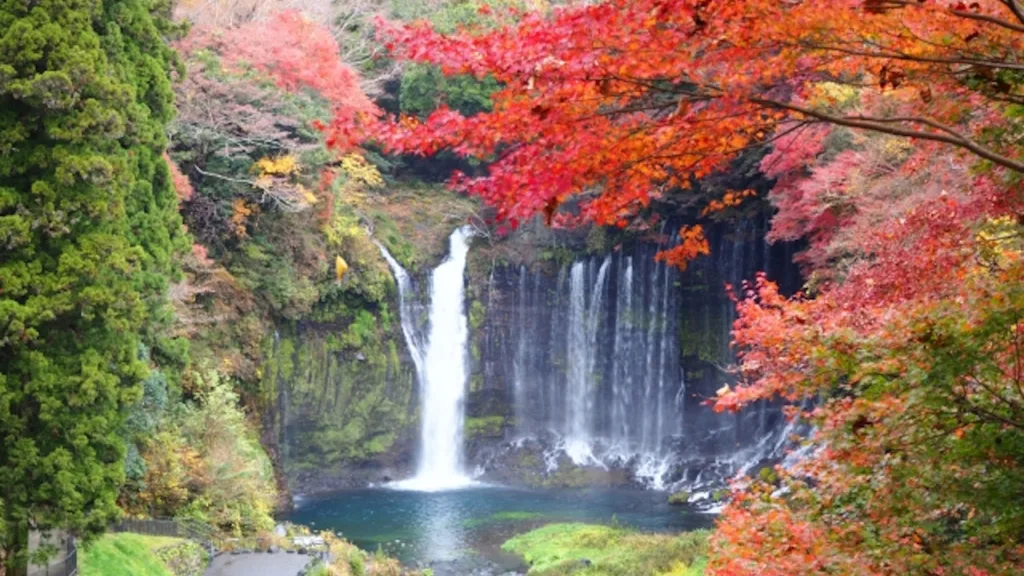
The changing seasons add another layer to the experience. From spring into early summer, fresh green foliage surrounds the cliff, creating a bright contrast with the white cascade. Autumn brings color to the rock face as the leaves turn, while winter’s clear air makes the fine spray stand out more sharply against the dark stone. Because the water flow stays fairly constant, there’s always something worth seeing here regardless of the season — and the rainy season in early summer has its own quiet appeal, with the surrounding greenery deepening in color and a soft, damp atmosphere settling over the sound of the water.
Nearby Spots Worth Your Time
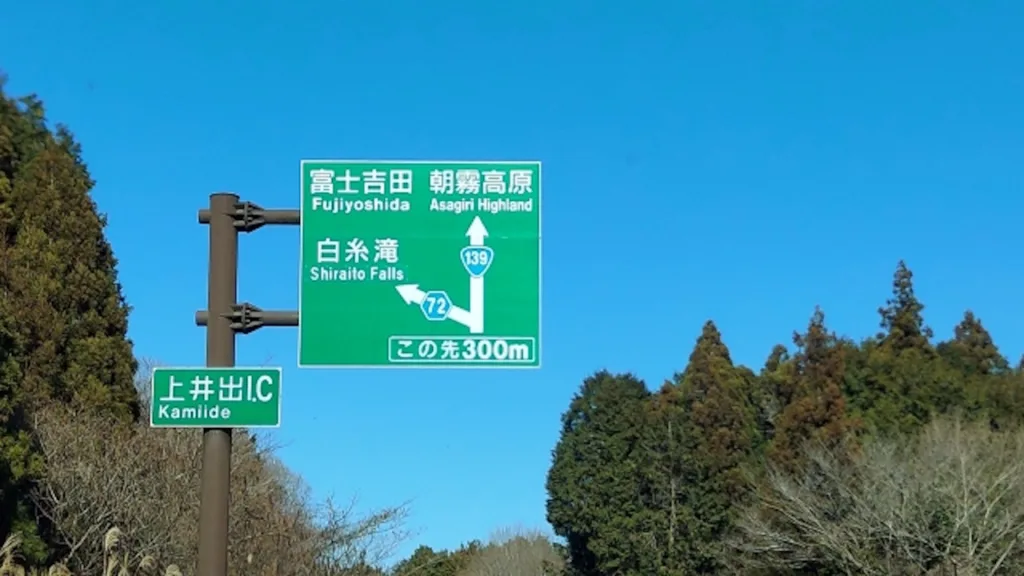
A handful of worthwhile stops sit within walking distance or a short drive of Shiraito Falls, making it easy to build a fuller day around your visit.
Otodome Falls and the Soga Brothers’ Hideaway Rock
Just a short walk from Shiraito Falls along the same path, Otodome Falls is tied directly to the Soga brothers’ revenge legend. Nearby stand the “Soga no Kakure-iwa,” the rock where the brothers are said to have hidden while plotting, and a site traditionally identified as the grave of Kudō Suketsune, the man they sought to avenge themselves upon. Together, the two spots make for a compact detour into local history.
Makaino Farm
About a four-minute drive away on the Asagiri Plateau, Makaino Farm is a hands-on farm park where visitors can interact with sheep, goats, and cows, try their hand at butter-making, and take on a rope course. Combined with sweeping highland views of Mount Fuji, it’s a popular stop for families traveling with kids.
Fuji Milk Land
About a five-minute drive from the falls, Fuji Milk Land is a dairy-themed experience facility built around the Asagiri Plateau’s farming heritage. Soft-serve made from fresh local milk and hands-on cheese-making sessions make it a natural place to pause between waterfall visits and sample the region’s food.
Lake Tanuki
Around a ten-minute drive away, Lake Tanuki is known for its unobstructed lakeside views of Mount Fuji. On calm mornings, the mountain’s reflection sometimes appears on the water’s surface in what’s known locally as “upside-down Fuji.” With a campground and a lakeside walking path on hand, it’s a good match for a half-day or full-day itinerary built around Shiraito Falls. The loop trail around the lake is well maintained and makes for an easy, unhurried stroll with Mount Fuji in view the whole way.
Where to Stay Near Shiraito Falls
Hotels in central Fujinomiya or around Lake Tanuki make convenient bases for visiting Shiraito Falls. Which one fits best depends on how you’re getting around and how close to the falls you’d like to stay.
Super Hotel Fujinomiya
Set on the edge of town, about a seven-minute drive from Fujinomiya Station, Super Hotel Fujinomiya offers separate natural hot spring baths for men and women along with a free breakfast buffet. Shiraito Falls and Fuji Milk Land are both nearby, making this a practical base for a day spent exploring the waterfall area.
Kyukamura Fuji
Standing right on the shore of Lake Tanuki, Kyukamura Fuji is known for Mount Fuji views from every guest room. You can take in the “upside-down Fuji” reflection from the guest rooms or the restaurant, and Shiraito Falls is about a ten-minute drive away, making this a good option for combining the two sights.
Fujinomiya Fujikyu Hotel
Located just a minute’s walk from JR Fujinomiya Station, Fujinomiya Fujikyu Hotel sits close to the bus stop serving Shiraito Falls, making it convenient for travelers relying on public transport. Rooms have a calm, wood-toned interior, and the breakfast buffet features local specialties such as Fujinomiya yakisoba.
Why Visit With a Tour Conductor
Getting the most out of a trip to Shiraito Falls and its surrounding sights often comes down to logistics: coordinating bus timings out to Fujinomiya, working around the walk from the bus stop, and fitting in a stop at Lake Tanuki or Makaino Farm without losing half the day to transfers. A dedicated tour conductor handles exactly that kind of itinerary management, so you can focus on the waterfall itself rather than the schedule around it.
If a bus is delayed or a connection falls through, a tour conductor can rearrange the remaining stops on the spot, and if a language barrier comes up at a ticket counter or a restaurant, interpretation support is on hand to smooth things over. None of this involves guiding you around the sights in person — that part stays with your chosen tour operator — but having someone manage the moving pieces of the day adds real peace of mind, especially if it’s your first time navigating rural bus routes around Mount Fuji. You can learn more about arranging a tour conductor for your own trip at tours.e-stay.jp.

In Summary
Shiraito Falls owes its unusual form to groundwater that emerges directly from a break between two volcanic layers, and that origin story is part of what earned it recognition as a National Scenic Spot, Natural Monument, and component of the Mount Fuji World Heritage Site. Its long history — from Minamoto no Yoritomo’s hunting camp to Oda Nobunaga’s chroniclers to generations of Fuji-kō pilgrims — adds real depth to a visit, and the contrast with neighboring Otodome Falls, plus easy add-ons like Makaino Farm and Lake Tanuki, make it easy to fill a full day in the area. For a stay that keeps you close to it all, a base like Kyukamura Fuji, right on the shore of Lake Tanuki with Mount Fuji visible from every room, is hard to beat.