



This travel report is brought to you by a licensed Tour Conductor — a Japan-based professional who accompanies groups on tour, manages itineraries, and assists travellers through every stage of their journey. Today’s destination is the rooftop garden perched atop GINZA SIX, Tokyo’s largest commercial complex in the heart of Ginza. Known as GINZA SIX Garden, this roughly 4,000 ㎡ green space on the 14th floor is free to enter, open from 7:00 AM to 11:00 PM, and remarkably well-suited to families with young children — a fact that surprises many visitors who assume Ginza is strictly adult territory.
| Item | Details |
|---|---|
| Facility | GINZA SIX Garden (GINZA SIX GARDEN) |
| Address | 6-10-1 Ginza, Chuo-ku, Tokyo (Rooftop above 13F) |
| Opening Hours | 7:00 AM – 11:00 PM (subject to unannounced closure due to weather) |
| Closed | Follows facility schedule; partial closures during private events |
| Admission | Free |
| Access | 2-min walk from Exit A3, Ginza Station (Tokyo Metro Ginza / Marunouchi / Hibiya Lines) |
“Ginza Is Not for Families” — A Misconception Worth Challenging
For many travellers, the name Ginza conjures images of gleaming flagship stores, high-end fashion houses, and a distinctly adult atmosphere. The tree-lined Chuo-dori avenue, flanked by luxury boutiques from every major international brand, can feel intimidating to anyone travelling with small children. The fear of tired legs with nowhere to rest, of prams blocking narrow aisles, or of children growing restless in an upscale setting has kept many families away.
Yet GINZA SIX makes a genuine effort to be family-friendly throughout the building. The second-floor information counter offers complimentary stroller loans, while the sixth floor houses a dedicated baby rest room equipped with a nursing space, nappy-changing tables, and a children’s toilet. The rooftop garden itself is designed with wide, pram-accessible pathways throughout. Whether or not you plan to shop, the garden alone justifies a visit — and it costs nothing to access.
From Matsuzakaya to GINZA SIX: A Century of Change on This Block
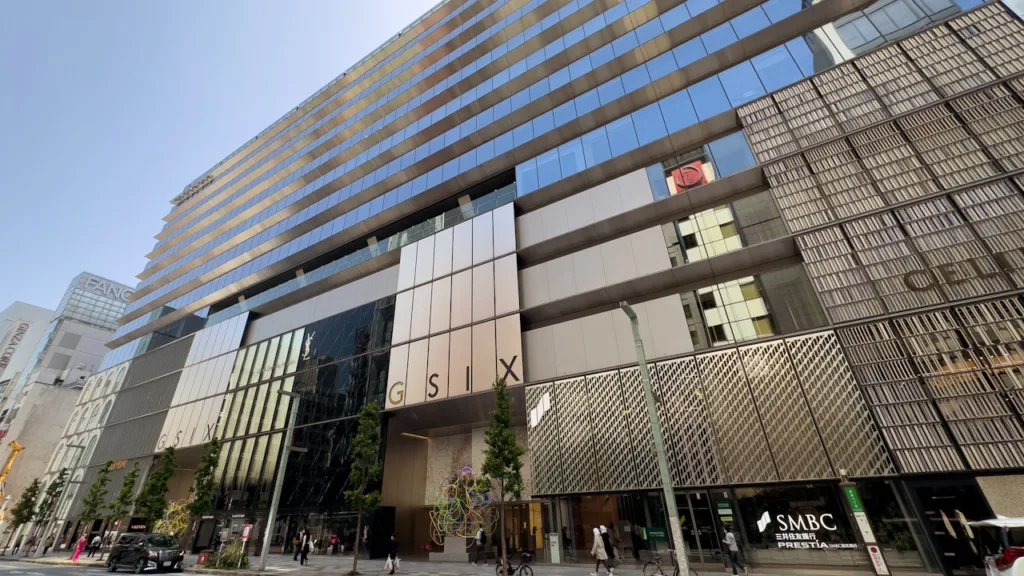
The land beneath GINZA SIX carries a long commercial history. The Matsuzakaya department store opened its Ginza branch here in 1924, during the Taisho era, and remained a cornerstone of the neighbourhood for nearly nine decades. When Matsuzakaya Ginza closed its doors in 2013, the site entered a period of redevelopment that would ultimately reshape this part of the city entirely.
A consortium of four companies — J. Front Retailing, Mori Building, Sumitomo Corporation, and L Real Estate — led the redevelopment of two adjacent city blocks totalling approximately 1.4 hectares in Ginza 6-chome. Architect Yoshio Taniguchi, widely regarded as one of Japan’s foremost contemporary architects, handled the building’s exterior design. The facade, which evokes the traditional Japanese architectural elements of a roof eave (hisashi) and a shop curtain (noren), anchors the building firmly in its historical context while projecting a thoroughly contemporary presence.
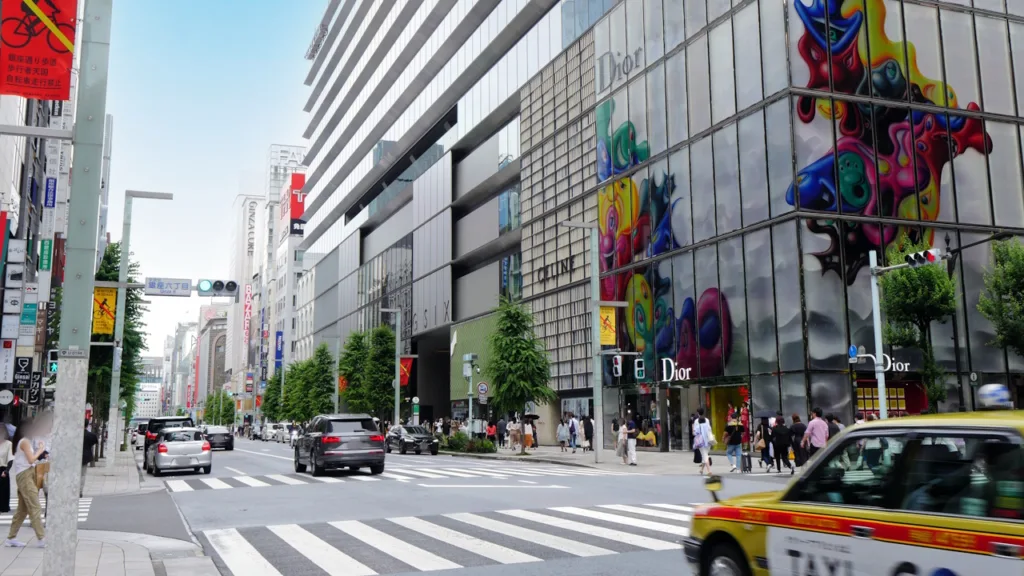
GINZA SIX opened on 20 April 2017, with then-Prime Minister Shinzo Abe and Tokyo Governor Yuriko Koike among those in attendance at the inauguration. The complex covers a gross floor area of approximately 148,700 ㎡, making it the largest commercial facility in the Ginza district, with 241 brands across its retail floors. Beyond retail, it incorporates large-scale offices, the traditional performing arts venue Kanze Nohgakudo, and the rooftop garden — a configuration that positions GINZA SIX as something beyond a conventional shopping centre.
The name itself reflects both the building’s address in Ginza 6-chome and an aspiration to deliver a six-star experience to every visitor.
The Design Philosophy of a Sky Garden
GINZA SIX Garden was designed by landscape architect Shunsaku Miyagi of Placemedia, who approached the brief with a concept that bridges two distinct cultural traditions: the garden culture of Edo-period Japan and the plaza culture of Western Europe. The result is a rooftop that feels simultaneously meditative and open — a balance that serves families particularly well.
Of the garden’s approximately 4,000 ㎡ footprint, around 2,200 ㎡ — roughly 56% of the total — is given over to planted greenery. That proportion is unusual for a rooftop in central Tokyo, and it produces a sense of genuine nature rather than mere decoration.
SKY GROVE — The Woodland Canopy
Along the northern and southern edges of the garden, a grouping of trees forms what the designers call the SKY GROVE: a mid-air woodland drawing on the planting traditions of the great Edo-period feudal lords’ gardens. Cherry (sakura), maple (kaede), azalea, hydrangea, konara oak, osmanthus, camellia, and Japanese umbrella pine all feature here, each labelled with a small nameplate. Children who enjoy nature activities will find plenty to observe across the seasons, and the shade provided by the canopy makes summer visits noticeably more comfortable.
Lawn Area
The central lawn was conceived in the spirit of a Western public square: open, flat, and adaptable. It serves as the main venue for seasonal events and temporary art installations. For families, it offers one of the few places in central Tokyo where children can run freely under an open sky.
Water Feature
Adjacent to the lawn, a shallow water basin — just a few centimetres deep — creates a surface that reads almost as a work of art in its own right: a still plane shaped by a subtle current. The basin can be drained and used as a flat surface when required. For young children, the visual effect of standing near a reflective pool at rooftop height is genuinely memorable.
The Promenade Circuit
Encircling the entire garden, a continuous walkway runs around the outer perimeter of the building. This kaiyū no michi (“circuit path”) takes its cue from the kaiyū-shiki strolling garden tradition of Edo Japan, but inverts the logic: rather than looking inward towards a pond, visitors look outward across the city. On a clear day, the circuit delivers views of the Ginza skyline, Tokyo Tower, Tokyo Skytree, and the high-rise cluster of Shiodome — a near-360-degree panorama of the city. Wide enough for double prams to pass each other comfortably, it doubles as a pleasant walking loop for restless toddlers and their parents alike.
Free to Enter, Open Long Hours
One of the most practical aspects of GINZA SIX Garden is its accessibility. There is no admission charge, and the garden opens at 7:00 AM — well before most of the building’s retail floors begin trading. Early morning visits, before the Ginza crowds build, offer a particularly calm experience: the garden’s greenery, the open sky, and the city laid out below, with no queues and minimal noise.
For families with infants on early schedules, this window is especially useful. The combination of fresh air, wide paths, and natural surroundings makes for a productive start to a day of exploring Ginza. The glassed-in promenade also offers shelter from light rain, though in cases of serious weather the garden may close without notice.
Public Art as a Family Experience
GINZA SIX has maintained a strong commitment to public art throughout the building since it opened, and the rooftop garden regularly hosts large-scale outdoor works. From 10 April to 30 June 2026, British artist Julian Opie’s installation 20 Children occupies the lawn area — twenty life-scale figures of children in motion, swaying gently in an interactive arrangement that animates the open space. Opie’s distinctive graphic aesthetic, familiar to many through his work with musicians and in gallery settings worldwide, translates particularly well to a family context: the child figures are immediately engaging for young visitors.
Inside the building, public art appears throughout — in the central atrium’s suspended LED installations, in the elevator lobbies, and in the basement display windows. Walking through GINZA SIX with children and pausing to look at what is displayed at each level makes for an informal, low-pressure introduction to contemporary art.
Four Seasons in the Garden
The planting scheme across GINZA SIX Garden was deliberately chosen to reflect the turning of the Japanese seasons. Kawazu-zakura cherry blossoms appear from early to mid-February; Oshima-zakura and Edo Higan cherries follow in early-to-mid April. Summer brings dense green canopy and welcome shade. Autumn turns the maples, and the winter garden has in past years hosted a seasonal ice-skating rink on the central lawn. Visiting the same garden across multiple seasons is a rewarding experience in itself, and families returning to Tokyo can use it as a reliable, zero-cost anchor point for each trip.
Nearby Attractions
Kabuki-za Theatre
A five-minute walk from GINZA SIX brings you to Kabuki-za, the principal home of kabuki, Japan’s classical theatre tradition. The building’s grand facade alone is a striking sight. Single-act (hitomakumi) tickets allow visitors to watch just one scene — a flexible format that works well for families who want a taste of the art form without committing to a full programme.
Kyobunkwan Narnia — Children’s Bookshop
A two-to-three-minute walk from GINZA SIX, the Kyobunkwan bookshop (founded 1885) occupies a landmark building on Ginza’s main street. Its sixth floor is given over entirely to children’s literature under the name Narnia, with approximately 15,000 titles in stock ranging from picture books to chapter novels. It is a relaxed, browsing-friendly space and a regular stop for families visiting Ginza.
Ginza Tsutaya Books (GINZA SIX, 6F)
Inside GINZA SIX itself, the sixth floor houses Ginza Tsutaya Books, a bookshop specialising in art, design, and photography. Its picture-book selection is curated with a distinctly artistic sensibility, and an integrated café makes it a comfortable place to linger after time spent in the garden above.
Travel with a Tour Conductor
Navigating Tokyo with young children involves a particular set of logistical challenges that a licensed tour conductor is positioned to help manage. A tour conductor does not serve as a guide, but does take responsibility for itinerary coordination, emergency response, and interpretation assistance when communicating with service providers — functions that become especially valuable when travelling with children who have unpredictable schedules and needs.
In the context of a visit to GINZA SIX Garden and the surrounding Ginza area, a tour conductor can handle the practical details: coordinating transit connections, assisting with stroller loan processes, communicating with hotel concierges, and managing the logistics of moving between sites on a changing timeline. For families unfamiliar with Tokyo’s train network or without Japanese language ability, having a professional manage these elements allows parents to focus on the experience itself.
If you are planning a family trip that includes Tokyo’s Ginza district, the tour conductor and travel arrangement service at tours.e-stay.jp can support the planning and operational side of your visit.
Recommended Hotels Nearby
Courtyard by Marriott Tokyo Ginza Hotel
A property within the Marriott portfolio, the Courtyard by Marriott Tokyo Ginza is located a three-minute walk from Higashi-ginza Station and within easy walking distance of GINZA SIX. Positioned on Showa-dori Avenue in central Ginza, the hotel offers a 24-hour fitness centre and the practical, reliable service standards that the Marriott brand maintains across its properties. For families wanting a well-located Ginza base with consistent quality, this is a straightforward choice.
Mitsui Garden Hotel Ginza Premier
The only tower-format hotel in the Ginza district, Mitsui Garden Hotel Ginza Premier occupies the upper floors (16th to 25th) of the Ginza Mitsui Building. Its high-floor rooms offer expansive views of the Tokyo skyline and Tokyo Bay, and the 16th-floor lobby and restaurant share the same panorama. The hotel is a four-minute walk from Shimbashi Station and within easy reach of GINZA SIX on foot. As a Mitsui Garden Hotels property, it represents one of Japan’s well-established domestic hotel chains.
Mitsui Garden Hotel Ginza Tsukiji
Also operated by Mitsui Garden Hotels, this property is a three-minute walk from Exit 6 of Higashi-ginza Station and similarly close to GINZA SIX. Its location gives quick access to the Tsukiji outer market area as well as central Ginza, and the 14th-floor restaurant GINZA ONO Gratia adds a worthwhile dining option within the building. A practical and well-connected base for families covering multiple parts of central Tokyo.
Conclusion
The assumption that Ginza is exclusively adult territory does not hold up when GINZA SIX Garden is part of the picture. A free-to-enter, wide-access rooftop space of 4,000 ㎡, open at seven in the morning and running until eleven at night, with seasonal planting, rotating public art, and uninterrupted city views — this is an unusual combination of qualities for any urban green space, let alone one in one of Tokyo’s most prestigious districts. The garden’s design, rooted in Edo garden tradition and anchored by a contemporary landscape vision, offers genuine interest for children and adults alike. A morning visit before the shops open, followed by a browse through Narnia or Ginza Tsutaya Books, makes for a low-cost, high-quality half-day in the city centre.