


Welcome to travel information brought to you by a professional Tour Conductor. Today’s destination is Senso-ji Temple — formally known as Kinryuzan Senso-ji — the ancient heart of Tokyo’s Asakusa district and one of Japan’s most visited sacred sites, welcoming over 30 million visitors each year. While the Thunder Gate (Kaminarimon) and Nakamise-dori shopping street tend to steal the spotlight, the temple grounds are home to a remarkable collection of halls, shrines, and sub-temples, each enshrining a different deity. Researchers and devotees alike have long described Senso-ji as a “department store of Buddhist and Shinto deities,” a place where a single visit can yield blessings ranging from good health and business prosperity to marital harmony, skill in needlework, and protection from fire.
| Item | Details |
|---|---|
| Official Name | Kinryuzan Senso-ji (金龍山浅草寺) |
| Sect | Sho-Kannon-shu (Head Temple) |
| Address | 2-3-1 Asakusa, Taito-ku, Tokyo |
| Main Hall Hours | 6:00–17:00 (Oct–Mar) / 6:00–17:30 (Apr–Sep) / Grounds open 24 hours |
| Admission | Free |
| Access | Approx. 5 min walk from Asakusa Station (Tokyo Metro Ginza Line / Tobu Skytree Line); approx. 5 min walk from Asakusa Station Exit A4 (Toei Asakusa Line) |
Navigating One of Asia’s Most Crowded Pilgrimage Sites
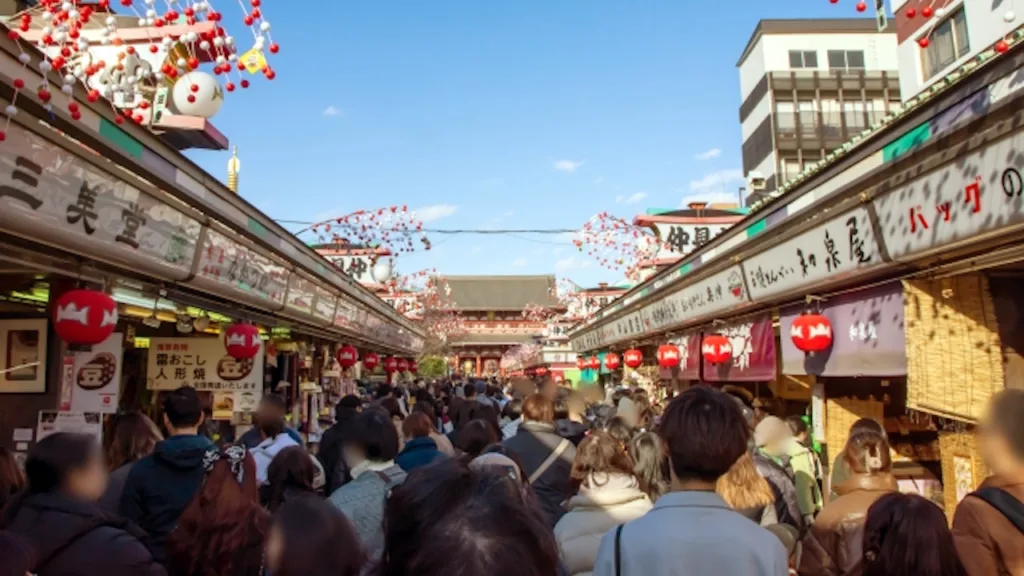
Senso-ji draws visitors from every corner of the world, and the sheer volume of foot traffic can make a visit feel more like a rush-hour commute than a contemplative pilgrimage. On weekday afternoons, Nakamise-dori and the area around the Thunder Gate are already densely packed; on weekends and public holidays the density rises sharply. During the first three days of the New Year, access restrictions are sometimes put in place around the main hall, and wait times of several hours are not uncommon.
The rapid growth of international tourism has also transformed the atmosphere inside the grounds, with multilingual signage and crowd-management measures now a permanent feature of the landscape. For a first-time visitor, knowing which halls to seek out and in what order can be genuinely difficult amid the bustle.
The solution is preparation. Understanding the origin, presiding deity, and significance of each hall before you arrive transforms Senso-ji from a visually impressive backdrop into a living encounter with over 1,400 years of Japanese religious culture. This guide covers everything you need — from the founding legend and key historical turning points to the individual halls that give Senso-ji its reputation as the most spiritually diverse temple grounds in Tokyo.
Tokyo’s Oldest Temple, Born from a Fisherman’s Net: 1,400 Years of History
The Kannon Statue Caught in a Fisherman’s Net
The story of Senso-ji begins on March 18, 628, during the reign of Empress Suiko. Two fishermen brothers, Hinokuma no Hamanari and Hinokuma no Takenari, were casting their nets in the Sumida River — known at the time as Miyatogawa — when they pulled up a small golden statue. A local landowner and man of learning named Haji no Nakatomo recognized the figure as a manifestation of Sho Kannon (Arya-Avalokitesvara, the Bodhisattva of Compassion), and was so profoundly moved that he renounced secular life, converted his own home into a place of worship, and devoted the rest of his days to venerating the image. This act of dedication marks the founding of Senso-ji.
According to tradition, on the night of the statue’s discovery, a thousand pine trees appeared in the surrounding landscape overnight, and a golden dragon descended from the heavens. This celestial dragon is the origin of the temple’s mountain name, Kinryuzan (“Golden Dragon Mountain”), and every year on March 18 and October 18, a ceremonial “Dance of the Golden Dragon” is performed in the precincts to honor the event.
In 645, the monk Shokai visited the site and constructed a formal hall to enshrine the statue. Following a divine revelation received in a dream, the principal image was declared a hibutsu — a “hidden Buddha” — meaning it would be permanently sealed from public view. To this day, the original statue has never been seen by anyone outside of an extraordinarily small group of individuals. It remains one of the most absolute “secret Buddhas” in Japan.
Revival Under Jikaku Daishi and the Patronage of Warrior Clans
In 848, the great Tendai monk Jikaku Daishi Ennin visited Senso-ji and undertook a major restoration of the temple. He carved a new “substitute principal image” (maedachi go-honzon) to stand before the hidden original, and crafted Nio guardian figures for the gates, significantly elevating the temple’s prestige. Over the following centuries, Senso-ji received devoted patronage from some of Japan’s most powerful warrior figures, including Minamoto no Yoritomo, Ashikaga Takauji, and Tokugawa Ieyasu, who prayed here for victory in battle.
Under the third Tokugawa shogun, Iemitsu, the main hall and numerous other structures were rebuilt in 1649 with generous shogunate funding. The grounds were systematically developed into a thriving complex combining religious devotion with popular entertainment — the early predecessor of Nakamise-dori took shape along the approach road, and a performance area known as Okuyama became a hub for storytellers, acrobats, and variety acts. Faith and festivity were inseparable at Senso-ji even then.
Destruction in the Tokyo Air Raids and Reconstruction
The main hall, designated a National Treasure in 1907, was destroyed in the Tokyo air raids of March 10, 1945. The principal image was moved to a temporary hall erected where Awashimado now stands, and kept safe through the devastation. Supported by donations from worshippers across Japan, a new main hall was completed in reinforced concrete in 1958, faithfully replicating the sweeping hip-and-gable roof of the original. The heavy ceramic roof tiles were replaced with lightweight titanium tiles in 2010, and the structure stands today exactly as it has for the past six decades.
Entering the Presence of Kannon: The Main Hall and Its Sacred Interior
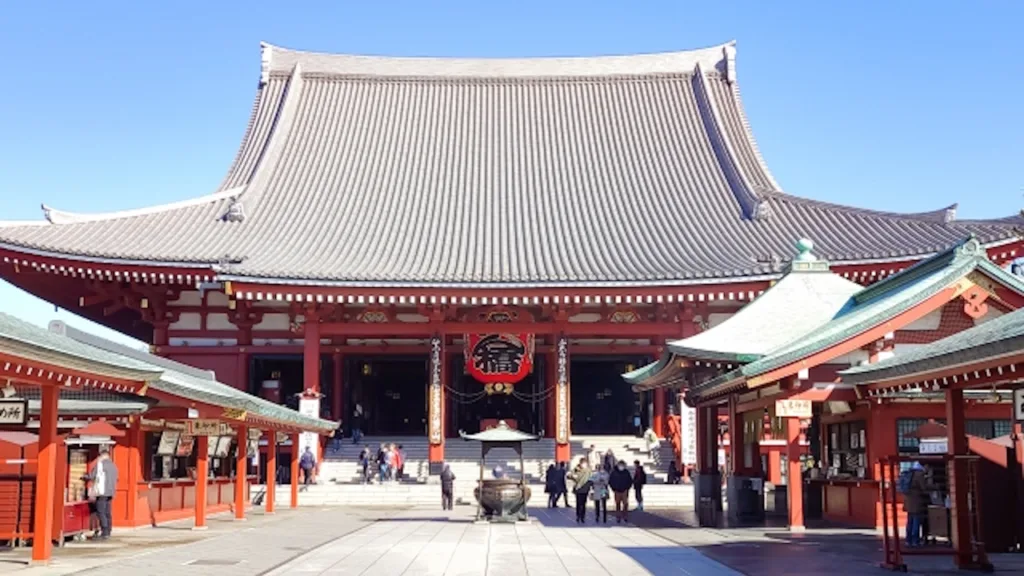
The Main Hall (Kannon-do) is the spiritual center of Senso-ji. Visitors enter through the front porch beneath a large hanging lantern measuring 4.5 meters in diameter, stepping first into the outer sanctuary (gaijin). The ceiling overhead bears two celebrated paintings: “Dragon” by Ryushi Kawabata and “Celestial Beings” and “Scattering Flowers” by Insho Domoto, whose scale and intensity immediately impress.
The inner sanctuary (naijin) is reached by ascending a few steps. At its center stands the go-kuuden — an ornate gilt shrine in the Tang Chinese style with a multi-tiered roof — housing both the hidden principal image and the substitute image carved by Jikaku Daishi. Flanking the go-kuuden are standing images of Taishakuten and Bonten; in the right rear of the inner sanctuary stands Fudo Myo-o, and in the left rear, Aizen Myo-o. Behind the main altar, a corridor known as the “rear hall” enshrines a Kannon image called the “Rear Kannon,” allowing worshippers to circumnavigate the entire hall and offer prayers from every direction.
The 18th of each month is the Kannon Ennichi (monthly day of grace), when the grounds draw particularly fervent crowds of devotees.
How to Pay Respects at the Main Hall
Begin at the Thunder Gate: press your palms together and bow once before stepping inside. Before passing through Hozo-mon Gate, pause at the Jokoro (incense burner) to draw the smoke toward your body — a purifying ritual — then wash your hands at the Temizusha water pavilion. At the Main Hall, place an offering in the offertory box, press your palms together, offer your prayer, and bow. You are welcome to remove your shoes and step up into the tatami-floored inner sanctuary for a closer encounter with the enshrined images.
Omikuji at Senso-ji: Why 30% of Fortune Slips Are “Kyo” (Bad Luck)
After paying respects at the Main Hall, most visitors make their way to the omikuji station — the fortune slip draw. Senso-ji is widely known, and often talked about on social media, for producing an unusually high proportion of “kyo” (bad luck) results. Notices in the precinct even specify that kyo slips should be tied to the designated racks rather than taken home. This reputation is not a rumor: it is a tradition that Senso-ji officially acknowledges and deliberately preserves.
What Is Kannon Hyakusen?
The omikuji at Senso-ji is formally called Kannon Hyakusen (“The Hundred Lots of Kannon”). The practice traces its origins to an ancient Chinese divination system called Tenjiku Reisen, which reached Japan by the Muromachi period (14th–16th centuries). In Japan, it merged with a system attributed to the Heian-era Buddhist monk Ryogen — known posthumously as Ganzan Daishi — to produce the Ganzan Daishi Hyakusen, which spread across the country during the Edo period. The mechanics remain unchanged from that era: visitors shake a cylindrical container holding 100 numbered sticks until one emerges, then open the corresponding numbered drawer to retrieve a printed paper slip.
The Breakdown at Senso-ji, Compared with Other Shrines and Temples
Senso-ji has publicly confirmed the following distribution in response to media inquiries:
| Fortune | Slips | Probability | Rank (best to worst) |
|---|---|---|---|
| Daikichi (Great Blessing) | 17 | 17% | 1st |
| Kichi (Blessing) | 35 | 35% | 2nd |
| Hankichi (Half Blessing) | 5 | 5% | 3rd |
| Shokichi (Small Blessing) | 4 | 4% | 4th |
| Suekokichi (Faint Blessing) | 3 | 3% | 5th (rarest) |
| Suekichi (Future Blessing) | 6 | 6% | 6th |
| Kyo (Misfortune) | 30 | 30% | 7th (lowest) |
Kyo accounts for 30% of all slips. The six categories carrying some form of “kichi” (blessing) together total 70%. To put that 30% figure in context: surveys of multiple shrines and temples across Japan place the average probability of drawing kyo at approximately 11%, and many modern shrines — especially those popular for New Year’s visits — deliberately reduce kyo to as low as 1 to 5% to avoid leaving worshippers with a poor impression at the start of the year. Senso-ji’s 30% is therefore roughly two-and-a-half to three times the contemporary average.
When asked why the ratio has not been adjusted, Senso-ji’s response is straightforward: “We have not changed the distribution since the Kannon Hyakusen was passed down to us in the Edo period. We are simply maintaining the tradition as received.”
The Historical Basis for the 30% Figure
The ratio is not arbitrary. The Ganzan Daishi Mikujicho — the founding text attributed to Ganzan Daishi — specifies a distribution of approximately 16% daikichi, 35% kichi, and 29% kyo, with the remaining 20% assigned at the discretion of each temple. Senso-ji’s current distribution closely mirrors this original formula. In other words, a roughly 3-in-10 chance of drawing kyo was the intended norm when omikuji first spread across Japan. Most temples gradually shifted their ratios toward more favorable outcomes in the modern era; Senso-ji and Kiyomizu-dera in Kyoto are among the most prominent institutions to have preserved the traditional proportion.
What to Do If You Draw Kyo
Senso-ji recommends that visitors who draw kyo tie the slip to one of the designated racks in the precinct. Within the temple’s tradition, kyo is not a verdict of misfortune but a message from Kannon: “Exercise caution, reflect carefully, and your circumstances will improve.” The slip itself is not the point. Omikuji are understood not as predictions but as written guidance — short passages of Buddhist teaching intended to direct behavior and attitude. Reading the text of the slip carefully, whatever the result, is the practice the temple encourages.
Drawing again immediately, in search of a better result, is actively discouraged. As Senso-ji has noted publicly: “You are asking Kannon. Once is the proper approach.”
| Comparison | Kyo Probability |
|---|---|
| Senso-ji (Kannon Hyakusen) | 30% |
| Kiyomizu-dera, Kyoto (same tradition) | approx. 30% |
| Multi-shrine survey average (Japan) | approx. 11% |
| Modern shrines with adjusted ratios | 1–5% (approx.) |
Senso-ji as a “Department Store of Deities”: Each Hall, Its Origin and Blessings

Beyond the Main Hall, Senso-ji’s grounds contain numerous subsidiary halls and small shrines, each dedicated to a different deity and carrying its own tradition, origin story, and set of attributed blessings. This remarkable density of sacred spaces — unusual even among major Japanese temples — is precisely what earns Senso-ji its informal title as a “department store of deities.” Knowing what each hall enshrines, and why it came to be here, brings an entirely different depth to your visit.
Eigodo Hall: Pray to the Guardian Deity of Your Zodiac Year
Standing to the northwest of the Main Hall, the graceful hip-roofed Eigodo Hall was constructed in 1994 to mark the 1,200th anniversary of the birth of Jikaku Daishi Ennin, credited with Senso-ji’s revival.
The word “eigo” refers to the appearance of a deity in visible form. At Senso-ji, the bodhisattvas and guardian deities who assist Kannon in her compassionate work are collectively called the “Eigo-shu,” and eight of them — each associated with a different sign of the Japanese zodiac — are enshrined side by side in Eigodo.
The central image is Sho Kannon herself. To either side stand: Senju Kannon (Rat), Kokuzo Bosatsu (Ox and Tiger), Monju Bosatsu (Rabbit), Fugen Bosatsu (Dragon and Snake), Seishi Bosatsu (Horse), Dainichi Nyorai (Sheep and Monkey), Fudo Myo-o (Rooster), and Amida Nyorai (Dog and Boar). The outer sanctuary also enshrines Daikokuten, one of the Seven Lucky Gods of the Asakusa Pilgrimage Circuit. Eigodo doubles as Senso-ji’s primary stamp office (shuin-jo) for those collecting the temple’s seal.
How to pray / blessings: Face the guardian deity corresponding to your birth year, press your palms together, and pray. Blessings are tailored to each deity, covering good fortune and the fulfillment of prayers. Daikokuten is associated with wealth and good fortune.
Yakushido Hall: The Healing Buddha for Health and Longevity

South of Eigodo stands the compact three-bay Yakushido, formally known as Hashimoto Yakushido. Originally located to the north of the Main Hall under the name “Kita Yakushi,” it was rebuilt to the northwest in 1649 by Shogun Iemitsu and renamed for the small bridge that stood beside it. Together with Rokkakudo and Nitenmon, it is among the oldest surviving pre-Edo-era structures anywhere in the precinct; it was relocated to its current position in 1994. The interior — not open for entry — enshrines the principal image of Yakushi Nyorai alongside Nikko and Gakko Bosatsu, the Twelve Divine Generals, and a group of the Ten Kings who judge the dead in Buddhist cosmology.
How to pray / blessings: Press your palms together in prayer before the hall. Yakushi Nyorai, often called “the King of Medicine,” is associated with healing illness, preserving health, and the well-being of mind and body.
Awashimado Hall: A Women’s Guardian Deity and the Art of Needlework
Awashimado was founded during the Genroku period (1688–1704) to enshrine the Awashima Myojin, a deity venerated at Kada Grand Shrine in present-day Wakayama Prefecture. The hall holds particular historical significance: after the Main Hall was destroyed in the 1945 air raids, it served as a temporary sanctuary for the temple’s principal image while the new hall was under construction.
The presiding deity, rooted in the veneration of Sukunahikona no Mikoto, has long been regarded as a special guardian of women. During the Edo period, itinerant devotees known as “Awashima no Gannin” traveled through city streets spreading her cult. Every year on February 8, the hall hosts the Harikuyoue — a traditional ceremony in which worn-out needles are pressed into soft tofu or konjac and offered in gratitude for their service, a custom that persists to this day.
How to pray / blessings: Pray at the front of the hall. Awashimado is associated with blessings for conception, safe childbirth, recovery from gynecological ailments, and skill in needlework.
Zenizuka Jizodo Hall: Business Fortune and a Story of Honest Poverty

Zenizuka Jizodo enshrines a remarkable legend. During the Kyoho period (1716–1736), a samurai’s wife in what is now Nishinomiya City, Hyogo Prefecture, lived a life of honorable poverty. One day, her children unearthed a large quantity of kanei-tsuho coins — the copper coins of Edo-period Japan — from the garden. Rather than keeping the windfall, the mother declared that accepting money without cause was a disgrace, and had the coins reburied. Her children, raised with these values, grew to be upright and prosperous adults, and a Jizo statue was enshrined at the spot where the coins were buried. That original statue still stands in Yamaguchi-cho, Nishinomiya City. Senso-ji’s Zenizuka Jizodo enshrines a divided spirit (bunrei) of the same deity.
The hall contains six Jizo statues, and tradition holds that kanei-tsuho coins are buried beneath them. Beside the hall stands a stone image known as “Kankan Jizo,” to which visitors traditionally present an offering of salt — the ringing metallic sound produced when a stone is lightly touched to the figure is said to amplify blessings of financial fortune. Monthly memorial services are held on the 4th, 14th, and 24th of each month, with a major ceremony (sho-go-ku) on the 24th of January, May, and September.
How to pray / blessings: Pray at the front of the hall. Blessings cover business prosperity and financial fortune. Offering salt is a recognized form of prayer here.
Chingodo Shrine: Raccoon Dog Spirits, Fire Protection, and the Performing Arts
Of all the sacred spaces in the precinct, Chingodo stands apart for the sheer charm of its origin story. In the mid-19th century, raccoon dogs (tanuki) that had lived freely in the hills of Ueno and the Asakusa entertainment district were displaced by the Battle of Ueno in 1868 and subsequent development. The displaced animals found their way to the Denbo-in sub-temple area of Senso-ji, where their mischievous antics — reportedly including throwing sandals into cauldrons and scattering sand through guest rooms — became something of a nuisance.
According to temple records, a tanuki appeared in the dream of the then head priest, Yuiga Shoshun, with a proposal: enshrine us properly, and we will protect Denbo-in from fire and bring lasting prosperity. In 1883, the animals were duly honored as Chingo Daishi (“Great Protectors of the Temple”) and a small shrine was built in their name. Remarkably, both Denbo-in and Chingodo survived both the Great Kanto Earthquake of 1923 and the 1945 air raids intact.
Because the word “tanuki” can be read as “ta wo nuku” — “to surpass others” — the shrine has attracted devoted followings among rakugo storytellers, kabuki actors, and performing artists of all kinds.
How to pray / blessings: Pray at the front of the shrine. Blessings include fire protection and theft prevention, along with skill and advancement in the performing arts.
Benten-yama and Bentendo Hall: One of the Three Benten of Kanto, Home of the Bell of Time
A low forested hill to the southeast of the Main Hall is Benten-yama, topped by the small Bentendo Hall dedicated to Benzaiten, the only goddess among Japan’s Seven Lucky Gods. The hill once rose from the middle of a pond; the pond has since been filled in and the area is now a small park. Bentendo’s principal image, nicknamed “Old Woman Benten” for her white-haired appearance, is recognized as one of the three great Benten of the Kanto region, alongside Enoshima Benten in Fujisawa and Fuse Benten in Kashiwa. The hall’s doors are opened only on the “Days of the Snake” (mi no hi) — the days corresponding to the snake sign in the 12-day zodiac cycle — when a special service is held.
To the right of the hall stands a bell tower housing the “Bell of Time” (Toki no Kane). Cast on the orders of the fifth shogun, Tokugawa Tsunayoshi, in 1692, the bell once rang out across Edo to mark the hours of the day. Matsuo Basho, who lived in the Fukagawa district, immortalized its sound in the famous haiku “Hana no kumo / kane wa Ueno ka / Asakusa ka” — wondering whether the bell heard through the blossoms came from Ueno or Asakusa. While most temple bells in Japan were melted down for the war effort, this one survived due to its exceptional historical pedigree. It still sounds every morning at 6:00 AM and rings in the New Year on December 31.
How to pray / blessings: Pray in front of Bentendo Hall. Benzaiten is associated with financial fortune, the arts, and romantic connection. Visits on the Days of the Snake are traditionally believed to strengthen blessings of financial luck.
Rokkakudo Hall and the Higiri Jizo: A Prayer over Fixed Days
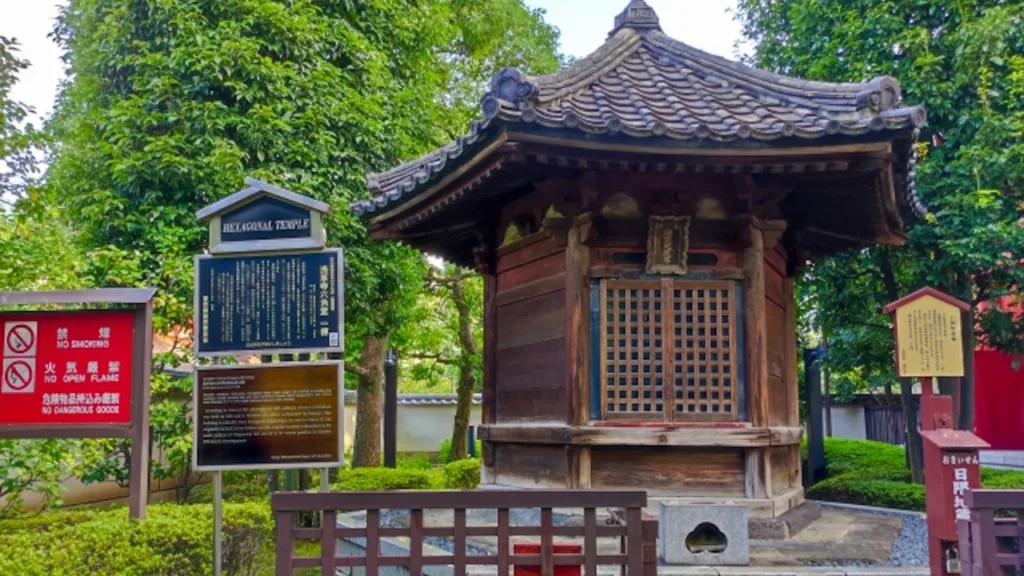
The small hexagonal Rokkakudo stands beside Eigodo and dates to the Muromachi period (around the 16th century), making it a designated Tokyo Metropolitan Cultural Property and the oldest surviving wooden structure in the city. It enshrines the Higiri Jizo — the “Day-Counting Jizo” — a Jizo statue to whom worshippers commit to praying for a set number of consecutive days. The tradition holds that the more earnestly and consistently the prayer is repeated over the chosen period, the more likely the wish is to be fulfilled.
How to pray / blessings: Decide on a number of days for your prayer and return each day for that period. This hall is particularly frequented by those with especially pressing or heartfelt wishes.
Walking the Grounds: Landmarks of the Senso-ji Precinct
The Thunder Gate (Kaminarimon): The Symbol That Vanished for 95 Years

The grand outer gate of Senso-ji is formally called Fujin Raijin Mon — “Gate of the Wind and Thunder Deities” — though it has been universally known as Kaminarimon (Thunder Gate) since at least the mid-Edo period. A haiku of the time nonchalantly referred to “the Wind God lodging at the Thunder Gate,” confirming that the popular name was already firmly established. The gate was first built in 942 by Taira no Kinmasa, the governor of Musashi Province, and was moved to its current location in the Kamakura period when the Wind and Thunder deity statues were installed.
The gate suffered repeated fires and reconstructions over the centuries until a blaze in 1865 destroyed it, and for 95 years Senso-ji stood without its iconic outer gate. It was rebuilt in 1960 thanks to a personal donation by Konosuke Matsushita, founder of Matsushita Electric Industrial (now Panasonic), as an expression of gratitude following his recovery from joint pain after prayers offered at the temple. The current gate preserves the style of the Edo-period original.
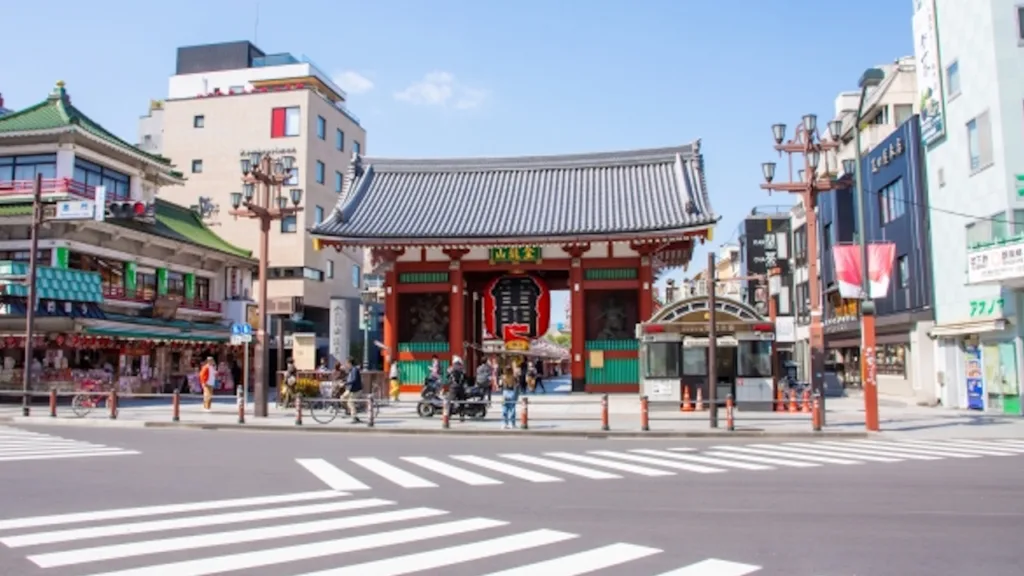
The enormous red lantern at the center stands 3.9 meters tall, measures 3.3 meters in diameter, and weighs approximately 700 kilograms. Its framework is made from bamboo sourced in the Tanba region of Kyoto Prefecture, and approximately 300 sheets of washi paper from Fukui Prefecture cover the surface — an entirely Japanese-made work. The underside of the lantern bears a carved dragon, a direct reference to the golden dragon that descended from the heavens on the night the sacred image was first discovered. Look carefully at both sides of the lantern: the front reads “Kaminarimon” while the reverse carries the formal name “Fujin Raijin Mon.”
The Wind and Thunder deity statues flanking the gate are guardian spirits protecting the temple from storm damage and fire. Only their heads survived the fire of the late Edo period; new bodies were added in 1874. On the inner (northern) side of the gate stand two further guardian figures: a male Tenryu statue (approximately 2.93 m tall) and a female Kinryu statue (approximately 2.74 m tall), donated by associates of the Matsushita group in 1978. They are worshipped as dharma-protecting deities of water, invoked for bountiful harvests and safe passage at sea. The gate is illuminated from sunset until around 11:00 PM, presenting a distinctly different, more solemn character than the daytime view.
Nakamise-dori: One of Japan’s Oldest Shopping Streets, Stretching from Edo to Today
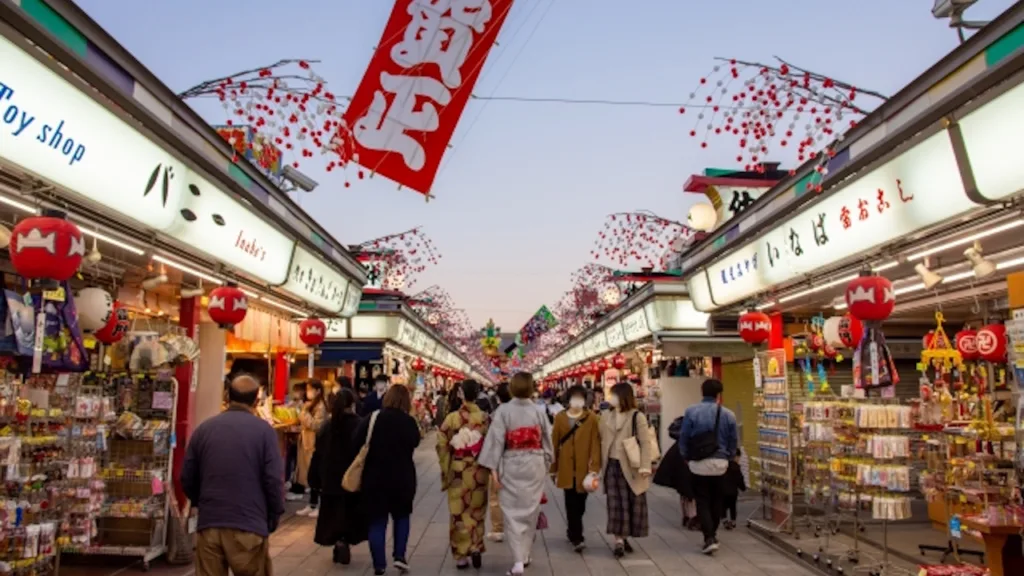
Pass through the Thunder Gate and a 250-meter corridor of vermilion shopfronts stretches before you all the way to Hozo-mon Gate. This is Nakamise-dori. The name is thought to derive from the street’s position midway — “naka-mise,” or “middle shops” — between the outer gate district and the shops clustered directly in front of the main hall.
The street traces its origins to around 1685. As the volume of pilgrims to Senso-ji increased, the temple began granting permission to local residents to operate stalls along the approach road in exchange for their help cleaning the precinct. By the mid-Edo period, the stretch nearest Hozo-mon Gate was lined with twenty teahouses staffed by celebrated young women; their fame was sufficient to inspire verse in the popular haiku of the day.
After the Meiji Restoration stripped the temple of its landholdings, the special status of the stalls was extinguished, but in December 1885 a modernized arcade of Western-style red-brick buildings rose in their place. The Great Kanto Earthquake of 1923 wiped out the entire street; it was rebuilt in 1925 as the current structure in reinforced concrete with a Momoyama-inspired vermilion finish. The 1945 air raids gutted the interior while leaving the facades standing, and the shopkeepers restored operations with characteristic speed.
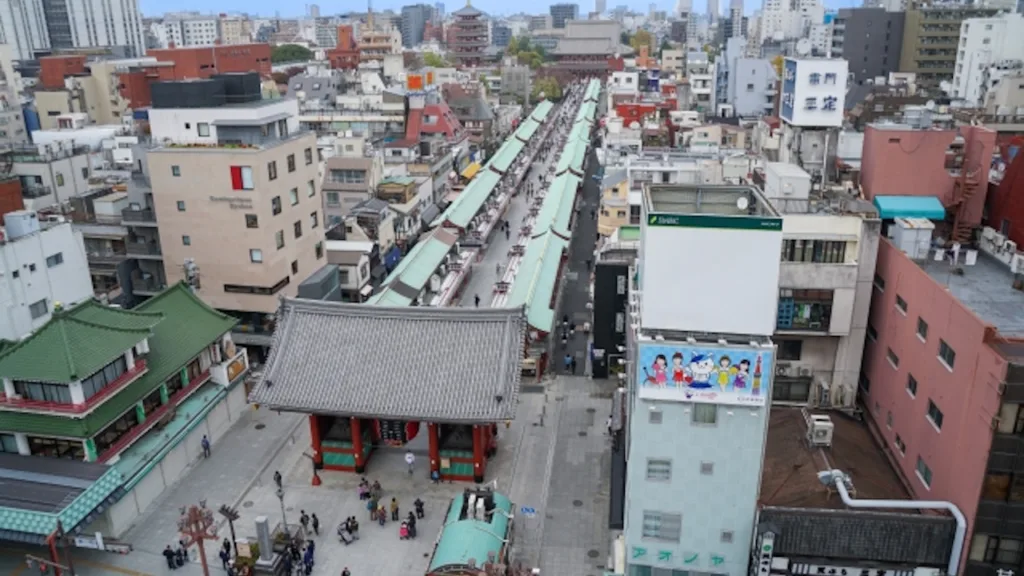
Today, 87 shops — 52 on the east side, 35 on the west — line the cobbled street, unified by matching illuminated signboards and seasonal decorations that change with the calendar. In 1994, overhead utility lines were buried underground, opening up the full visual sweep of the corridor. The street offers a classic range of Asakusa-made snacks and souvenirs — ningyo-yaki (sweet red-bean cakes in figurine form), kaminariokoshi (puffed-rice crackers), fried sweet dumplings, and kibidango among them. In 1989, a team led by Ikuo Hirayama of Tokyo University of the Arts painted the shutters of every shop along the street with a panoramic depiction of Asakusa’s traditional festivals and seasonal scenery titled “Asakusa Emaki.” Once the shops close for the evening, the painted shutters offer a second, quieter spectacle.
Hozo-mon Gate: The Treasury Gate Guarded by the Nio Kings
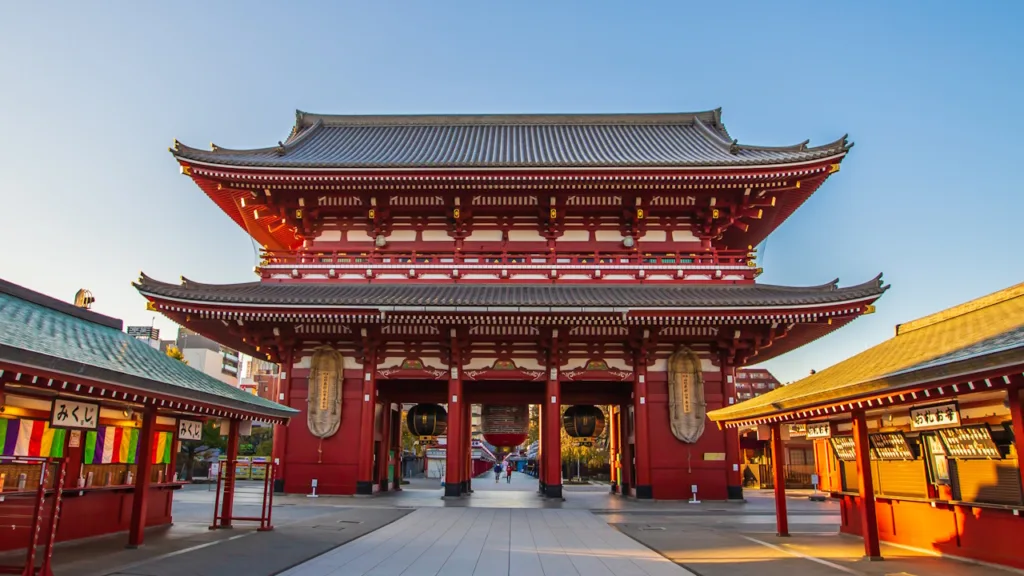
At the end of Nakamise-dori, a towering vermilion gate marks the formal entrance to the inner precincts. This is Hozo-mon, the “Treasury Gate” of Senso-ji. Formally a double-roofed hip-and-gable gate standing approximately 21.7 meters tall, it shares the same founding date as the Thunder Gate — 942 — and was likewise called the “Nio-mon” (Gate of the Guardian Kings) for most of its history. The current structure was built in reinforced concrete in 1964, funded by the personal donation of Yonetaro Otani, president of Otani Heavy Industries and founder of Hotel New Otani, and his wife. With its reconstruction, the gate took on the additional function of a treasure repository for the temple’s historical scriptures and cultural artifacts, and was renamed Hozo-mon accordingly. The roof tiles were replaced with titanium in 2007.
On either side of the gate stand Nio statues (Kongo Rikishi, the Guardian Kings): the Agyo figure on the left (west) was carved by sculptor Shinkan Nishikido, the Ungyo on the right (east) by woodcarver Kyusaku Muraoka. The Agyo figure is said to have been modeled on the great yokozuna sumo wrestler Kitanoumi. Both carry ancient Indian weapons and stand as fierce sentinels of the temple. An Edo-period folk belief held that paper chewed and rolled into a ball, then thrown against the statues, would grant a wish if it stuck — and even today visitors sometimes press their palms together before the Nio in prayers for health and protection from misfortune.
The large red lantern hanging at the center bears the characters “Kobunacho” — a reference to Nihonbashi Kobunacho, the merchant district whose residents have been donating a lantern to this gate since 1659. The lantern is renewed approximately every decade, and at around 3.8 meters tall it remains one of the defining visual elements of the inner precinct.
On the inner (temple-side) face of the gate hangs an enormous pair of straw sandals, 4 meters long, 1.5 meters wide, and weighing approximately 500 kilograms. Donated by volunteers from Murayama City in Yamagata Prefecture, the sandals carry the symbolism of stomping out evil and are offered in prayer for health and the warding off of misfortune. Pass through the gate and take a moment to look back up at them from inside the precinct.
The upper story of the gate houses a nationally designated Important Cultural Property: the Gen-ban Issaikyo, a Song-dynasty Chinese edition of the complete Buddhist canon. The collection had been held at Tsurugaoka Hachimangu in Kamakura before the Meiji-era policy of separating Buddhism and Shinto placed it at risk of destruction. A Buddhist nun named Teiun-ni, a devoted follower of Senso-ji, purchased the scriptures and donated them to the temple — a story of preservation as unlikely as the survival of the scriptures themselves.
Gojunoto: The Five-Storied Pagoda
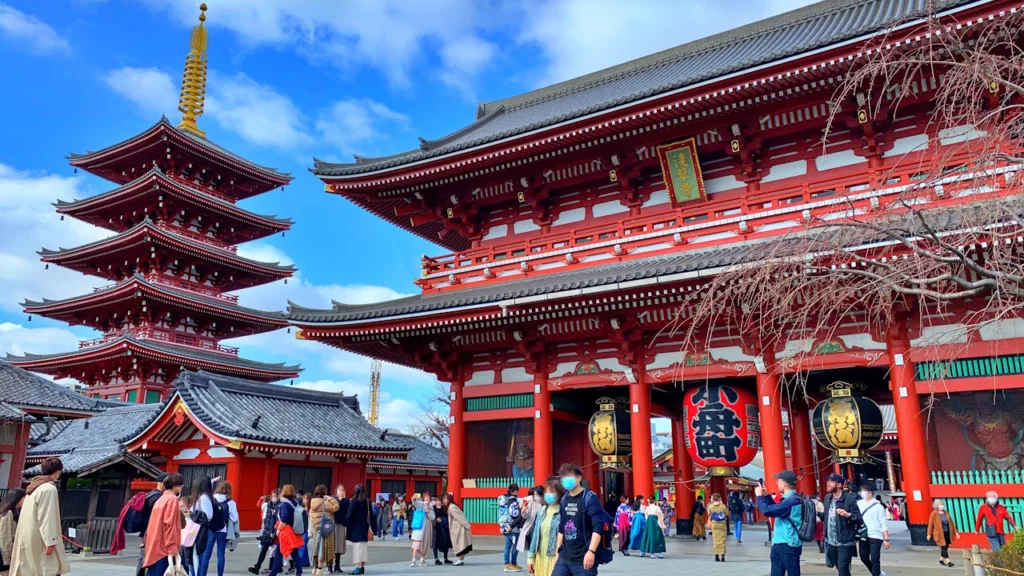
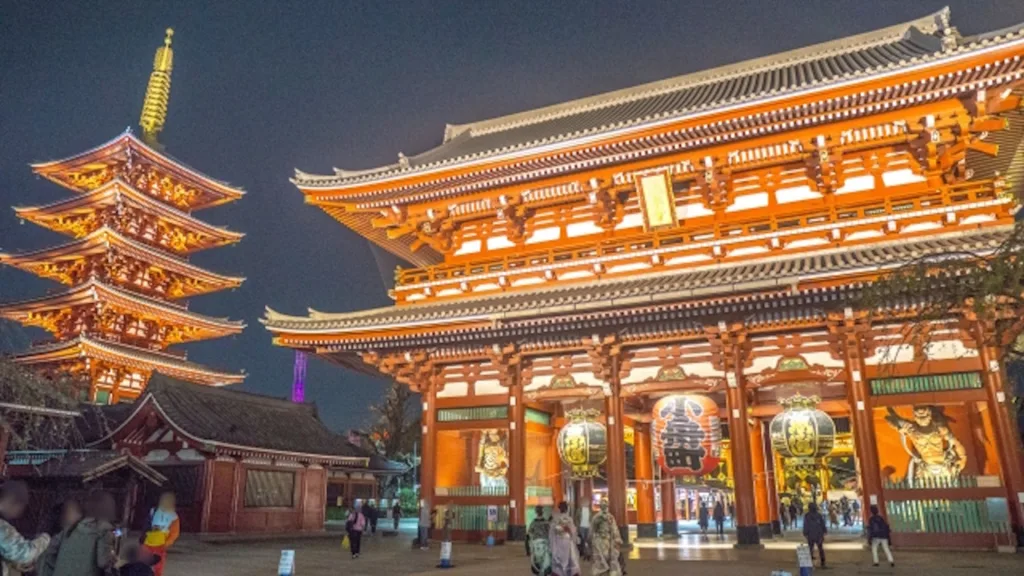
The current five-storied pagoda was reconstructed in 1973 and rises approximately 53 meters on the western side of the precinct. Its vivid vermilion exterior is among the most recognizable silhouettes in Asakusa.
Komagata-do Hall: The Sacred Ground Where It All Began
A short walk from the main precinct, at the western foot of Komagata Bridge over the Sumida River, stands Komagata-do Hall — the site where, according to tradition, the sacred Kannon image was first brought ashore in 628. Regarded as the founding ground of Senso-ji, the current hall dates to a 2003 reconstruction. Its monthly day of observance falls on the 19th.
Matchi-yama Shoten: One of Japan’s Three Great Shoten Temples

Matchi-yama Shoten (formally known as Honryu-in) is a sub-temple of Senso-ji situated about ten minutes on foot north of the main precinct, along the Sumida River. Set on a small hill approximately ten meters above the surrounding flatlands, it claims a founding date of 595 — more than three decades before Senso-ji itself. Together with Myokenzan Kanshoji in Kumagaya City (Saitama) and Ikoma Shoten in Ikoma City (Nara), it is counted among the Three Great Shoten of Japan, drawing devoted worshippers who seek blessings for physical well-being, marital harmony, and business prosperity.
The defining characteristic of this temple is its ritual offering of daikon radishes. The daikon, representing bodily health and conjugal harmony, and the kinchaku (drawstring purse), representing material fortune, appear as motifs throughout the grounds. Bundles of daikon for offering can be purchased at the temple office.
Each morning, the temple performs the yokuyu kito — an esoteric rite unique to Shoten temples, during which sesame oil is poured over the deity’s image as part of a cycle of prayers. Worshippers can commission a seven-day prayer cycle in exchange for a protective amulet. Every January 7, the “Daikon Festival” is held, during which daikon radishes collected as offerings during the New Year period are prepared as furofuki daikon (simmered radish with miso) and served to visitors alongside sacred sake.
The Asakusa Shichifukujin Pilgrimage: Seven Lucky Gods in One Neighborhood
Senso-ji and the surrounding district form the backbone of the Asakusa Meisho Shichifukujin, a pilgrimage circuit visiting nine temples and shrines associated with the Seven Lucky Gods of Japanese tradition. Within the Senso-ji grounds alone, two of the seven can be found: Daikokuten in Eigodo Hall and Benzaiten on Benten-yama. The circuit also includes Bishamonten at Matchi-yama Shoten, among others. While the pilgrimage is most actively observed over the New Year holidays, stamp collection is available throughout the year at each site. The fact that multiple Lucky Gods can be venerated within a single temple precinct is itself a defining feature of Senso-ji’s identity as a “department store of deities.”
Nearby Attractions Worth Combining with Your Visit
Asakusa Shrine

Immediately to the east of the Main Hall stands Asakusa Shrine, dedicated to the three individuals most directly associated with Senso-ji’s founding: Haji no Nakatomo, Hinokuma no Hamanari, and Hinokuma no Takenari. Known colloquially as “Sanja-sama” (the Three-Shrine Deity), it is the setting for the Sanja Matsuri — one of Tokyo’s most celebrated festivals — held every May, when mikoshi (portable shrines) are carried through the streets in a display of energy and tradition that draws hundreds of thousands of spectators.
Denbo-in Garden
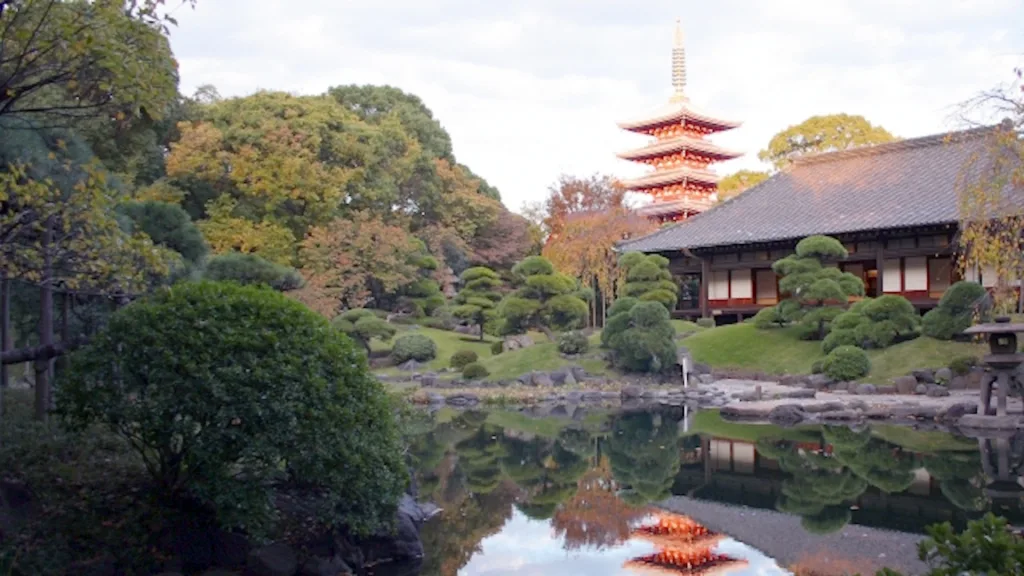
Adjacent to Denbo-in, the administrative center of Senso-ji, this refined stroll garden preserves the refined aesthetic of an Edo-period daimyo garden. Public access is limited to certain periods; checking current availability in advance is advised.
Kappabashi Kitchenware Street
A short walk from Asakusa, Kappabashi-dori is Japan’s largest wholesale kitchenware district, lined with approximately 170 specialist shops selling cooking equipment, tableware, knives, and the hyper-realistic food sample replicas for which Japan is internationally famous. The food models in particular make memorable and unusual souvenirs.
Tokyo Skytree (Oshiage)
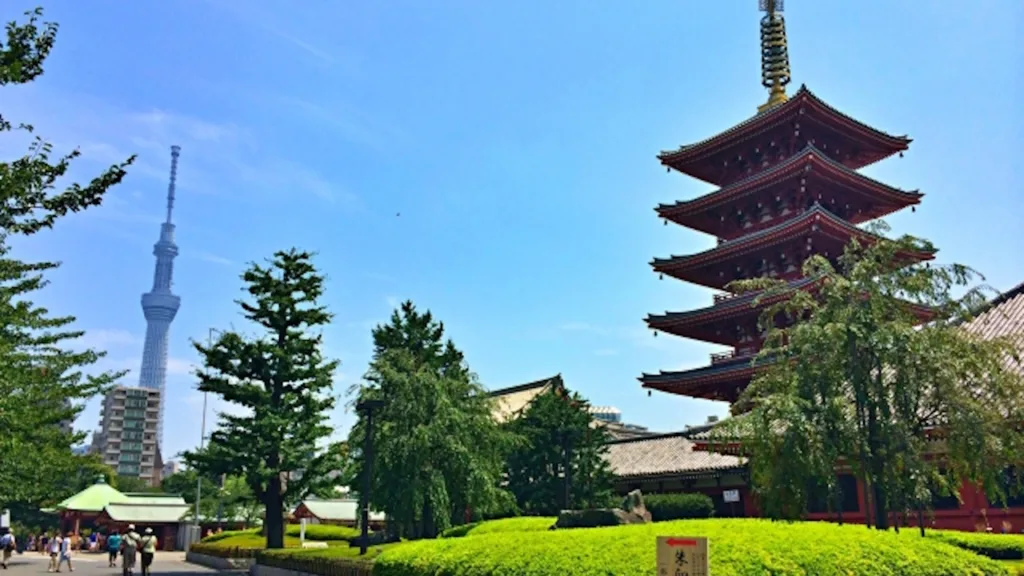
One stop from Asakusa on the Tobu Skytree Line, the 634-meter Tokyo Skytree is the world’s tallest broadcast tower and one of the most recognizable structures in Asia. The observation decks offer sweeping views across the Tokyo metropolitan area.
Recommended Hotels Near Senso-ji
Asakusa View Hotel
A landmark city hotel directly connected to Asakusa Station on the Tsukuba Express Line, Asakusa View Hotel offers high-floor rooms with unobstructed views of Tokyo Skytree. The property features multiple dining options including a Western grill and Chinese restaurant with panoramic city views, a year-round indoor pool, and a full-service gym. The hotel is a short walk from both Nakamise-dori and the Senso-ji temple complex, making it a well-established base for exploring the district.
OMO3 Asakusa by Hoshino Resorts
Opened in July 2023, OMO3 Asakusa is a property in the Hoshino Resorts portfolio, located approximately four minutes on foot from Exit 7 of Asakusa Station on the Tokyo Metro Ginza Line — a one-minute walk from the Hozo-mon Gate. The hotel’s rooftop terrace affords direct views of both the Senso-ji pagoda and Tokyo Skytree. The OMO brand’s signature neighborhood-exploration program offers curated introductions to the lesser-known corners of Asakusa, bringing the texture of the shitamachi into the guest experience itself.
Onyado Nono Asakusa Bettei Natural Hot Spring (Dormy Inn Chain)
Opened in January 2024, Onyado Nono Asakusa Bettei is a tatami-floored premium Japanese inn operating under the Onyado Nono brand of the Dormy Inn chain. Located approximately four minutes on foot from Asakusa Station on the Tsukuba Express Line, the property sits adjacent to Senso-ji and the historic Hanayashiki amusement park. Its signature natural black hot spring (kuroyu) large communal bath and self-service sauna are the central draws, alongside the Dormy Inn tradition of late-night ramen service and a full Japanese-style breakfast.
Exploring Senso-ji with a Dedicated Tour Conductor
Navigating a site as historically layered and physically expansive as Senso-ji becomes a substantially different experience when a dedicated tour conductor is part of your journey. Japan’s Tour Conductor (TC) role is a licensed profession distinct from that of a tour guide: tour conductors are responsible for itinerary management and travel logistics, and while they do not provide commentary or perform guiding duties, their presence resolves the practical and linguistic challenges that can derail even the most carefully planned independent trip.
In a busy, multilingual environment like Senso-ji — where signage is dense, crowds move unpredictably, and the differences between halls are not immediately legible to a first-time visitor — having a TC on hand means that logistical friction disappears. If your itinerary includes multiple sites across Tokyo on the same day, the TC coordinates movement between locations, handles any changes to transportation, and ensures that timing works even when the unexpected arises. For visitors who need assistance communicating in Japanese — at temple offices, souvenir counters, or in situations that require reading official notices and instructions — a TC’s support with translation and communication removes a significant layer of uncertainty.
Should a genuine emergency arise during your trip, the TC’s role includes arranging the necessary response: connecting with appropriate services, supporting communication with local authorities or medical facilities, and ensuring that your onward plans are adjusted appropriately. This is the core of what a Tour Conductor provides: reliable, professional presence that keeps the journey on track regardless of what happens on the day.
To arrange travel in Japan with a dedicated tour conductor, visit tours.e-stay.jp.
In Conclusion: The Full Depth of Senso-ji Awaits
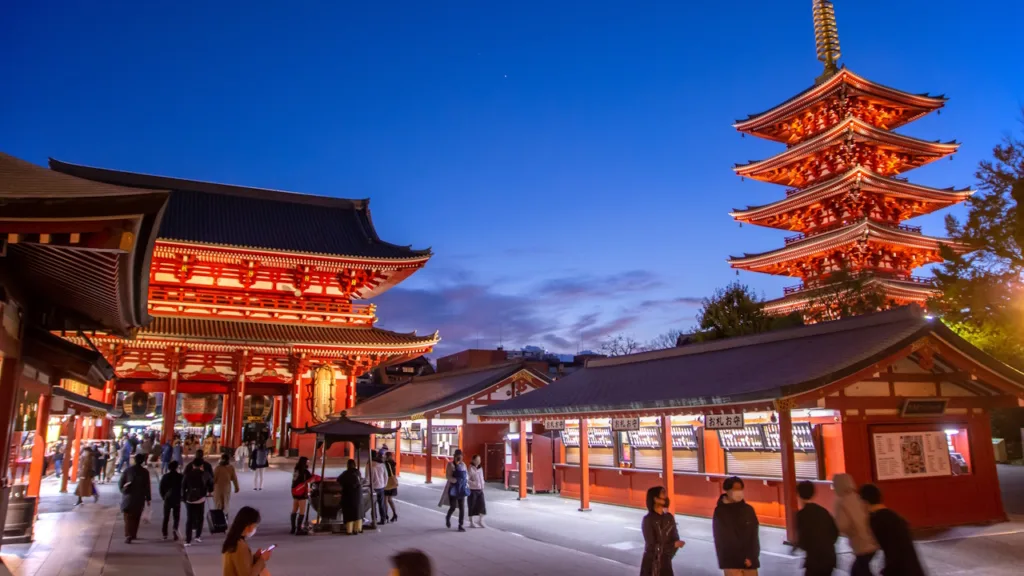
Senso-ji is Tokyo’s oldest temple, a site of continuous worship for more than 1,400 years, and a living embodiment of Japan’s tradition of harmonious coexistence between Buddhist and Shinto devotion. Its grounds enshrine not only the principal image of Sho Kannon but a full constellation of deities: the zodiac guardian Bodhisattvas in Eigodo, the healing Buddha in Yakushido, the women’s guardian in Awashimado, the fortune-bringing Jizo in Zenizuka Jizodo, the fire-protecting tanuki spirits of Chingodo, the goddess Benzaiten on Benten-yama, and the day-counting Jizo of Rokkakudo.
Coming to Asakusa and stopping only at the Thunder Gate misses the greater part of what makes this place extraordinary. Each hall has a story; each deity has a tradition that stretches back across centuries of Japanese life. Walk the full circuit, take your time with each space, and the “department store of deities” will reveal itself as something far richer than any photograph can capture.
For visitors looking to stay within walking distance of the temple, Onyado Nono Asakusa Bettei offers the rare combination of direct proximity to Senso-ji and the restorative experience of a natural hot spring bath — a fitting way to close a day of pilgrimage in old Asakusa.