



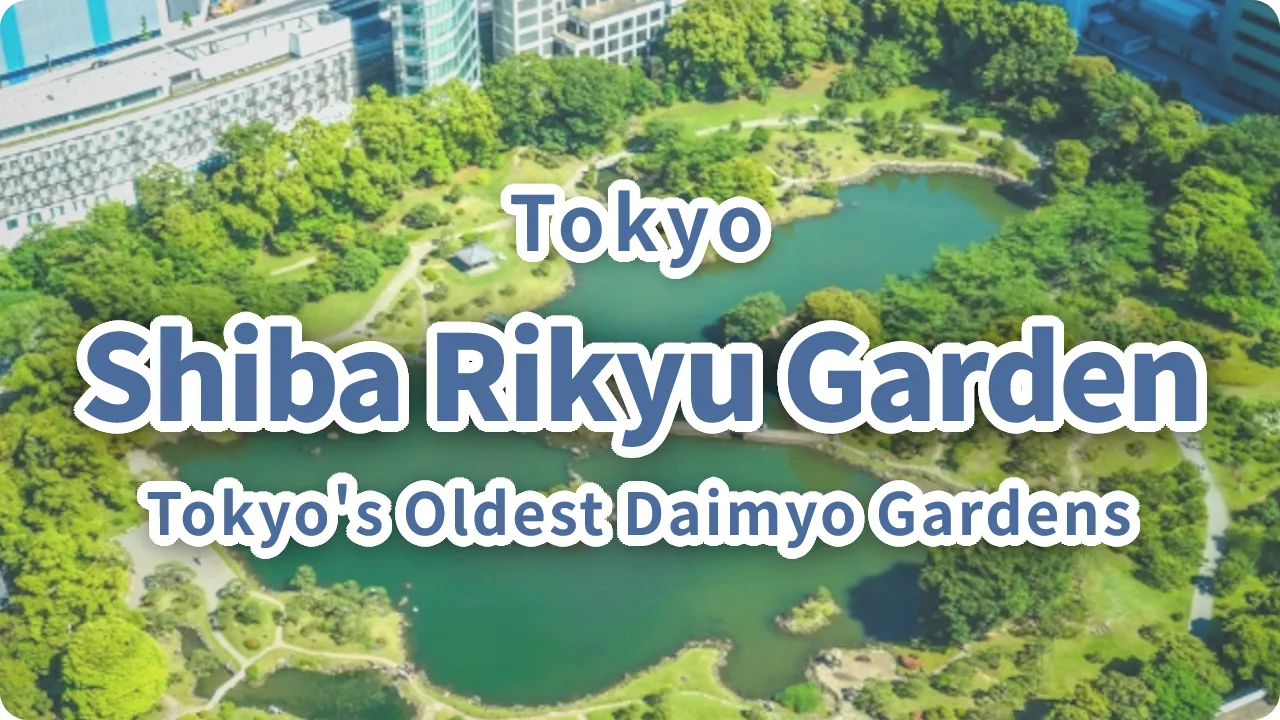
Travel information brought to you by a professional tour conductor. This time, we explore Kyu Shiba Rikyu Gardens — a nationally designated Place of Scenic Beauty tucked just one minute on foot from JR Hamamatsucho Station, yet rooted in over 350 years of Edo-period history.
Covering approximately 43,175 m², this classical strolling garden sits surrounded by high-rise office towers and a monorail line in the heart of Minato, Tokyo. The stonework, the outline of a former tidal pond, and the carefully composed landscape all trace back to the late seventeenth century — a remarkable survival in one of the world’s densest urban environments.
| Official Name | Kyu Shiba Rikyu Gardens (旧芝離宮恩賜庭園) |
| Address | 1-4-1 Kaigan, Minato, Tokyo 105-0022 |
| Opening Hours | 9:00 AM – 5:00 PM (last entry 4:30 PM) |
| Closed | Year-end and New Year holidays (December 29 – January 3) |
| Admission | General ¥150 / Seniors (65+) ¥70 / Elementary school and below: free / Junior high school students residing or attending school in Tokyo: free |
| Free Admission Days | Greenery Day (May 4), Tokyo Citizens’ Day (October 1) |
| Access | 1-min walk from JR Yamanote/Keihin-Tohoku Line Hamamatsucho Station (North Exit) / 3-min walk from Toei Asakusa/Oedo Line Daimon Station |
| Parking | Not available |
An Edo Garden Ringed by Glass and Steel
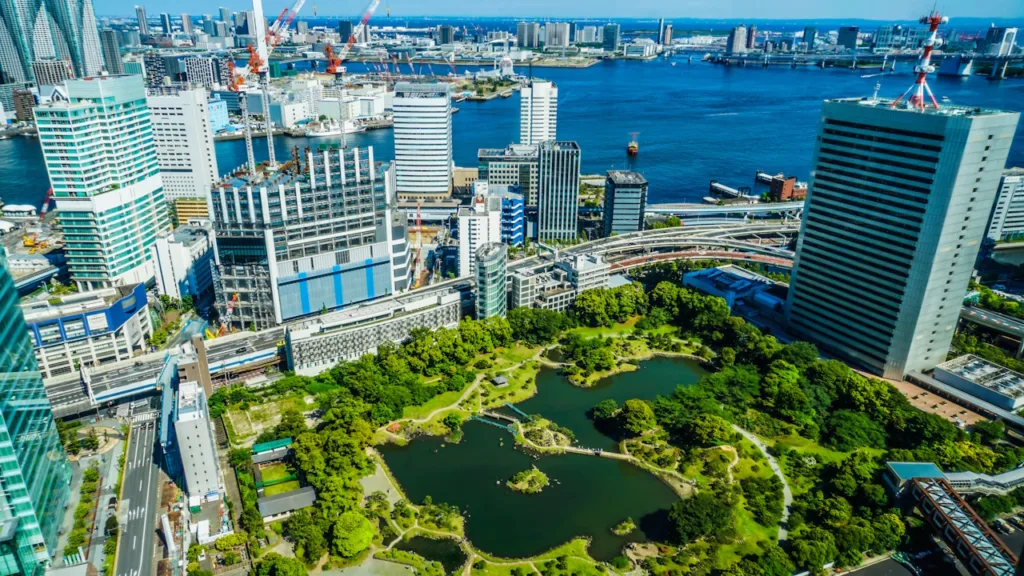
The first impression that strikes most visitors is one of temporal dissonance. The garden’s treetops are visible directly from the Hamamatsucho Station platform, and the elevated Tokyo Monorail passes only metres from its boundary wall. A garden that once drew tidal seawater from Edo Bay now exists cheek-by-jowl with a skyline of contemporary office towers — a contrast that is unmistakably Tokyo.
That proximity to modern infrastructure, however, also reflects genuine loss. Railway expansion from the Meiji era onwards trimmed the original grounds, and land reclamation has permanently cut off any view of the sea. The complete experience of the tidal garden as Okubo Tadatomo conceived it in the seventeenth century is no longer accessible. That caveat noted, what remains — the density of historical stonework, the layered spatial design, and the weight of continuous history — more than justifies a visit to this urban cultural property.
From a Shogun’s Falconry Ground to the Daimyo Garden “Rakujuen”
The story of Kyu Shiba Rikyu Gardens begins with the sea. The land on which the garden stands was reclaimed from Tokyo Bay during the Meireki era (1655–1658) and initially managed as a falconry ground for the Tokugawa shogunal family.
The pivotal moment came in 1678, when Okubo Tadatomo, a senior councillor (rōjū) who had recently risen to that position under the fourth shogun Tokugawa Ietsuna, was granted approximately 35,000 m² of reclaimed land. The Okubo clan had served the Tokugawa through the reigns of Ieyasu, Hidetada, and Iemitsu, but fell from favour during the tenure of Tadatomo’s predecessor, Tadachika. Tadatomo’s restoration to shogunal service and eventual elevation to rōjū marked the family’s rehabilitation. With this grant of land, he summoned gardeners from his domain of Odawara and set about creating a formal daimyo garden.
The Birth of “Rakujuen” — 1686
The completed garden was named Rakujuen. A document discovered by the garden historian Ryūi Matsunosuke — the Rakujuenki, dated 1686 — records that the garden already contained a tidal pond fed by seawater, a residential hall named Kanjinisō, and a pavilion bearing the plaque “Moonlit Waves.” The eastern grounds included a riding track and an archery range, giving the garden the character of a warrior’s estate as much as an aesthetic retreat.
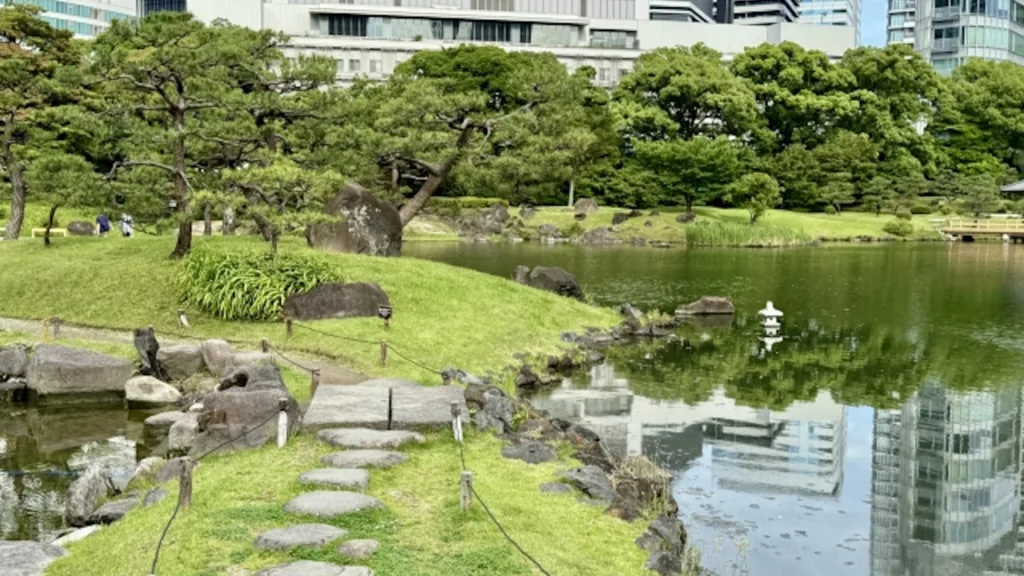
Particularly distinctive was the extensive use of Nebukawa stone (a volcanic andesite quarried near Odawara) throughout the garden. Stonework along the pond’s banks, stepping stones across the water — all were fashioned from this rough, pitted volcanic rock, largely uncut and unsmoothed. Most daimyo gardens of the period favoured rounded, gentle stones for their revetments; the Okubo garden’s angular, textured volcanic stonework became its defining characteristic and remains so today.
Nine Periods of Ownership
Rakujuen remained in the Okubo family for approximately 140 years. In 1818, the seventh-generation lord, Okubo Tadazane, transferred the main Okubo residence closer to Edo Castle upon his appointment as rōjū, relinquishing the garden after a century and a half of family stewardship. Ownership then passed through the Hotta clan (lords of Shimōsa-Sakura domain), the Shimizu Tokugawa house (one of the gosankyō, the three branch families of the Tokugawa), and ultimately to the Kii Tokugawa house in 1846, when the estate became known as Shiba-Oyashiki.
After the Meiji Restoration, the property passed to the household of Prince Arisugawa Taruhito in 1871, then was purchased by the Imperial Household Ministry in 1875 and officially designated Shiba Rikyu — the Shiba Detached Palace — in 1876. During its years as an imperial palace, the estate functioned as a reception venue for foreign dignitaries, and a Western-style building was erected within the grounds.
The Great Kanto Earthquake of 1923 caused devastating damage: most structures and mature trees were destroyed by fire. The following January, the estate was donated to the City of Tokyo as a commemorative gift marking the betrothal of the then-Crown Prince (later Emperor Shōwa). After restoration works, the garden opened to the public on 20 April 1924 as Kyu Shiba Rikyu Onshi Teien — Kyu Shiba Rikyu Gardens. In 1979, it received formal designation as a Place of Scenic Beauty under Japan’s Law for the Protection of Cultural Properties, and is today managed by the Tokyo Metropolitan Park Association.
The Strolling Pond Garden — Design and Key Features
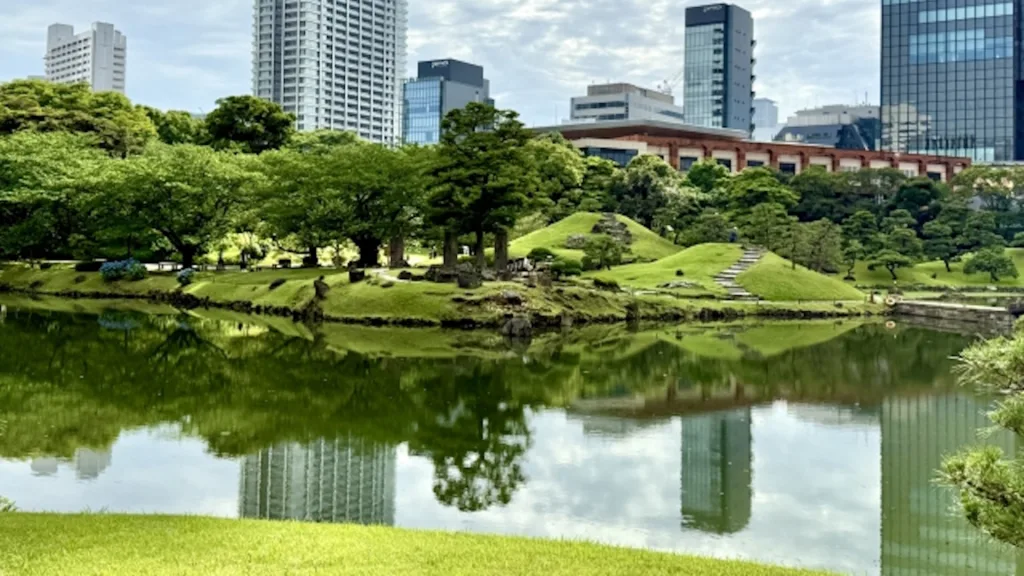
Kyu Shiba Rikyu Gardens is a canonical example of the kaiyū-shiki sensui teien — a strolling pond garden — in which the visitor circumnavigates a central body of water, encountering a succession of composed views. The Daisen’sui (great pond), covering approximately 9,000 m², forms the nucleus around which islands, earthen hills, stone arrangements, and a sandy shore are distributed.
The Daisen’sui and the Legacy of the Tidal Pond
The pond is now fed by fresh water, but was originally a tidal pond drawing directly from Edo Bay. The tidal system allowed the water level to rise and fall with the sea, altering the garden’s appearance hour by hour — a feature characteristic of coastal daimyo gardens in the early Edo period. After the garden was transferred to the City of Tokyo in 1924, industrial wastewater intrusion made it necessary to close off the tidal inlet; the pond has been freshwater ever since. A stone structure labelled “Former Seawater Inlet” remains in the garden as a physical record of this lost function.
The West Lake Causeway — A Chinese Landscape Recreated
Extending from the bank towards the central island is a stone causeway modelled on the Su Causeway of West Lake (Xī Hú) in Hangzhou, Zhejiang Province, China. West Lake was one of the most celebrated landscapes in the classical Chinese world — a recurring subject in poetry and painting — and for Edo-period intellectuals who could not travel to China, its recreation within a garden carried considerable cultural weight. A comparable causeway exists at Koishikawa Korakuen, offering an interesting point of comparison for visitors inclined to explore Edo garden culture more broadly.
The Central Island — Stone Composition of Mount Hōrai
The island at the centre of the Daisen’sui bears a stone arrangement representing Mount Hōrai (Penglai in Chinese), the mythical island said in East Asian tradition to be the dwelling place of immortals. This stonework is believed to date from the original Rakujuen construction, making it among the oldest surviving garden elements in the grounds — unchanged for more than 350 years.
Ōshima Island, Tai Bridge, and Nebukawa Hill
The largest island, Ōshima, sits to the south of the pond and is connected to the shore by the Tai Bridge — a single slab of Nebukawa stone shaped to suggest the form of a sea bream (tai). Adjacent to the island, Nebukawa Hill was formed from volcanic stone transported from the Okubo domain around Odawara, and continues to display the rough-textured volcanic material that defines the garden’s aesthetic.
Karatsu Hill, Ōyama, and the Lawn Area
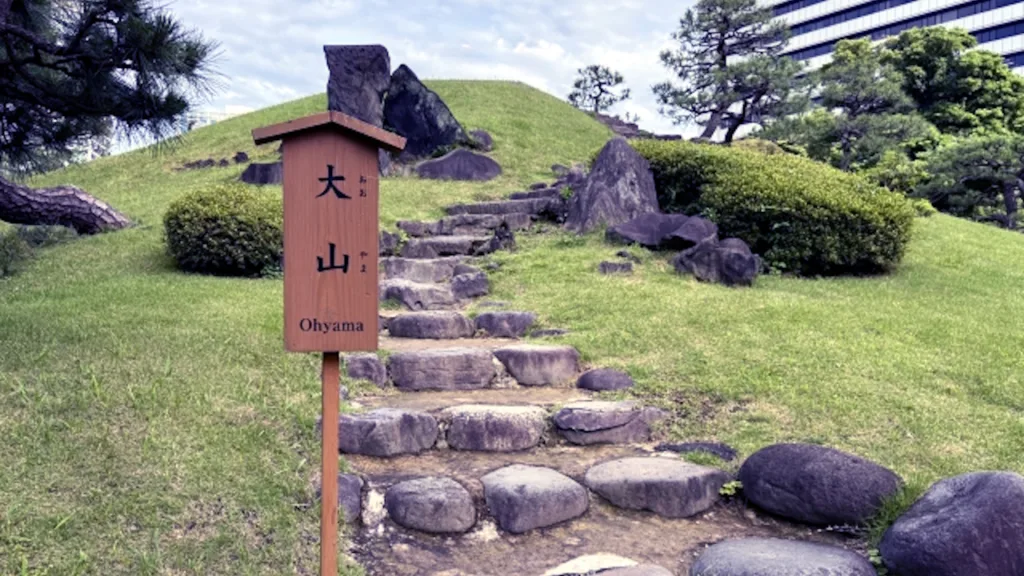
The garden contains several earthen hills. Karatsu Hill is named after the domain of Karatsu, which Okubo Tadatomo governed before ascending to the status of rōjū — a personal geographical reference embedded in the landscape. Ōyama (“great hill”) is the highest elevation within the garden, and affords a panoramic view of the entire composition. The lawn area in the southwestern corner offers a quiet space away from the pond, suitable for resting between circuits.
Dry Waterfall, Sandy Shore, and Snow-Viewing Lantern
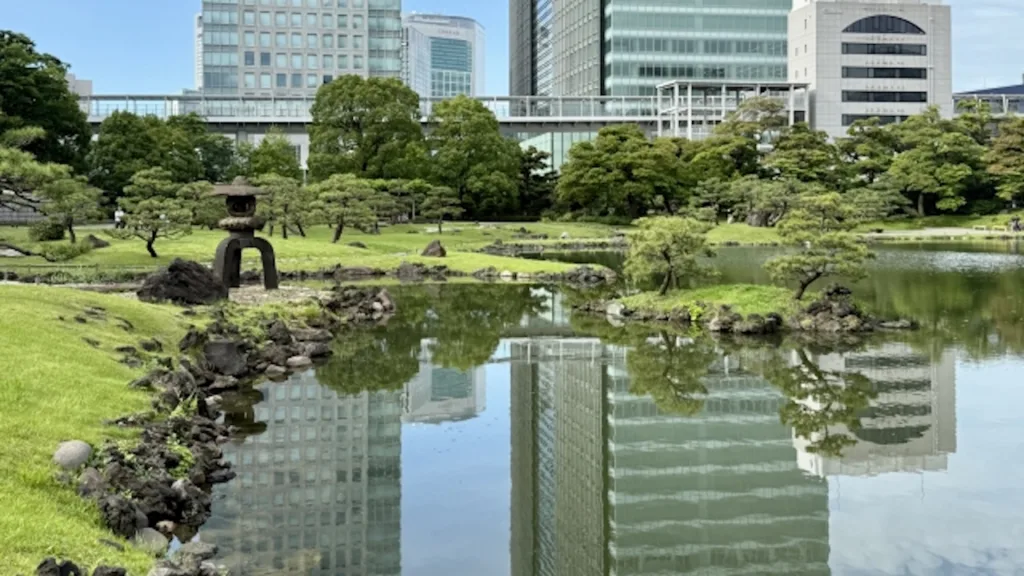
A dry waterfall (karetaki) uses stone arrangement alone to suggest falling water — the classic dry-landscape technique of expressing motion without it. The adjacent sandy shore (suhama) recreates the sensation of a tidal beach, and the large round-roofed snow-viewing lantern (maruyu-kimidōrō) placed upon it is the garden’s most recognisable element. Installed during the imperial palace period, the lantern’s base is andesite and its upper sections sandstone.
Stone Pillars — A Sengoku-Period Relic
An apparently purposeless pair of old stone columns stands within the garden. These are believed to be gate pillars from the former residence of Matsuda Norihide, a Sengoku-period warrior who served the Later Hōjō clan, transported here on Okubo Tadatomo’s instructions when he was lord of Odawara. They are thought to have subsequently served as pillars for a tea ceremony room during a visit by the fifth shogun Tokugawa Tsunayoshi, and represent a tangible physical link between the garden and the age of the warring states.
Kyūshakudai — Where the Meiji Emperor Watched the Sea
A modest elevated platform known as Kyūshakudai (“nine-shaku platform”) carries the record that Emperor Meiji stood here in 1875 to watch fishing on the sea and enjoy the coastal panorama. At that time, the garden faced open water. The continued existence of this small platform quietly attests to a coastal character that has since been entirely obscured by land reclamation.
Admission and Annual Passes
The general admission fee of ¥150 is among the lowest of the nine Tokyo Metropolitan Cultural Heritage Gardens, several of which — Hamarikyu Gardens, Koishikawa Korakuen, Rikugien — charge ¥300 or more. Free admission applies on Greenery Day (May 4) and Tokyo Citizens’ Day (October 1). An annual pass covering Kyu Shiba Rikyu Gardens alone is available for ¥600 (general) or ¥280 (seniors 65+). A combined annual pass covering all nine Tokyo metropolitan cultural heritage gardens is also available at ¥4,000 (general) or ¥2,000 (seniors).
Seasonal Planting — A Garden of Flowers Through the Year
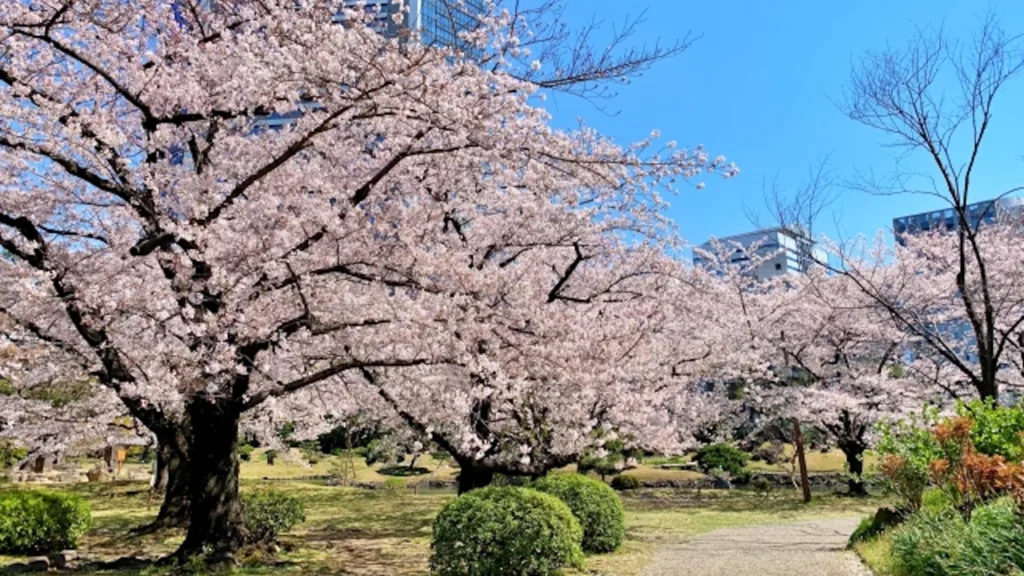
The garden’s planting calendar marks the passage of the year in distinct phases. In the depths of winter, wintersweet (rōbai) and narcissus carry a quiet fragrance. March brings plum blossom, quince, and snow willow; April opens with Somei Yoshino cherry, followed in sequence by Hanakaido crabapple, azalea, rhododendron, and wisteria. The wisteria trellis in mid-to-late April, with cascading violet flower clusters set against the Daisen’sui, is one of the garden’s best-regarded seasonal views.
Summer brings hydrangea, crape myrtle, and rose of Sharon; autumn transitions through spider lily, fragrant olive, and silver leaf daisy before the yellowing and reddening of the zelkova and cherry trees. The reflection of November foliage on the surface of the Daisen’sui is one of the quieter pleasures the garden offers to off-season visitors.
A Garden Between Two Eras
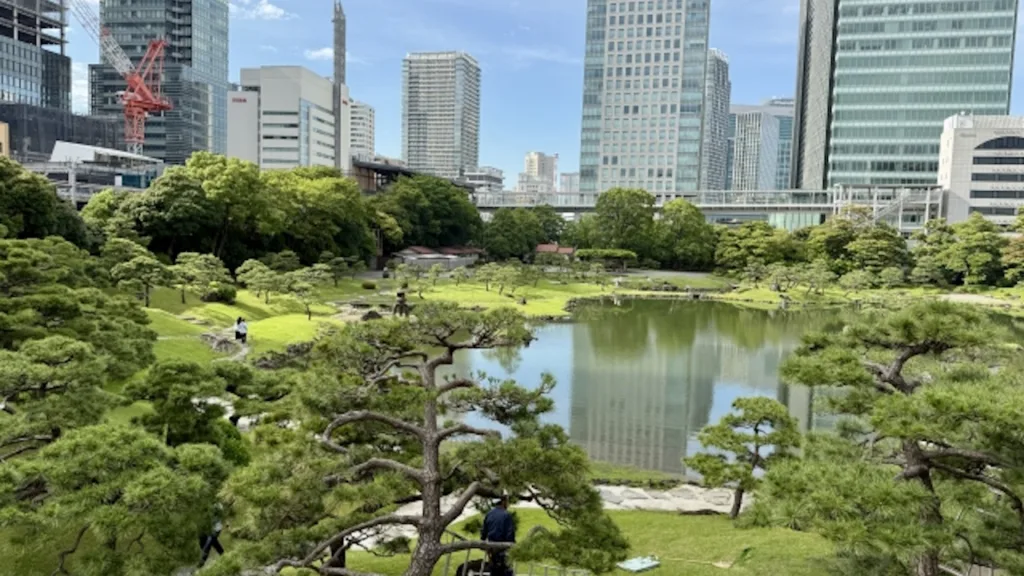
What distinguishes Kyu Shiba Rikyu Gardens from most surviving historical gardens is the overt presence of the contemporary city within its frame. The surface of the Daisen’sui catches reflections of the surrounding high-rises and, on clear days, of Tokyo Tower. The monorail passes on an elevated track along the garden’s northern boundary; trains are both visible from within the garden and able to look down upon it from above. Bullet trains have reportedly been recorded in the water’s reflection — a juxtaposition unique to this site. The value of the garden as a cultural artefact reaches beyond its historical period precisely because it holds these two worlds in such direct tension.
Free guided tours of the garden are conducted by the management on Saturdays and Sundays at 2:00 PM (excluding July and August), lasting approximately 45 minutes to one hour.
Kyu Shiba Rikyu Gardens and Hamarikyu Gardens — A Shared History
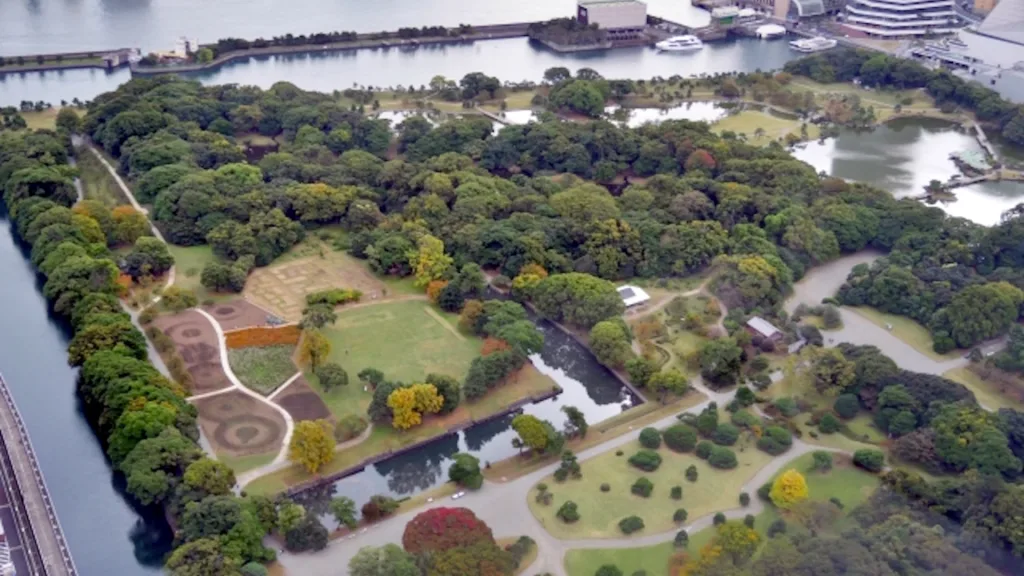
Approximately 300 metres to the north — a 15 to 20-minute walk — lies Hamarikyu Gardens. The two gardens are connected by a history far deeper than geographical proximity.
Two Tidal Gardens — A Divergent Fate
Both Kyu Shiba Rikyu Gardens and Hamarikyu Gardens were created during the Edo period as tidal gardens drawing seawater directly from Edo Bay. The rise and fall of the tide continuously altered the appearance of each garden’s pond — a technique particular to coastal daimyo estates. Today, Hamarikyu Gardens is the only garden in Tokyo that still maintains a functioning tidal pond; seawater continues to enter and exit with each tide. Kyu Shiba Rikyu Gardens, by contrast, closed its tidal inlet after the 1924 transfer to the City of Tokyo, when industrial wastewater intrusion made the connection untenable. The “Former Seawater Inlet” marker is virtually all that remains of that original tidal character. Two gardens with the same origins, the same former relationship with the sea — one retained it, one lost it. Visiting both on the same day makes that divergence tangible.
Two Imperial Palaces on the Same Bayfront
Both gardens came under Imperial Household control after the Meiji Restoration. Kyu Shiba Rikyu was purchased by the Ministry of the Imperial Household in 1875 and became “Shiba Rikyu” the following year; Hamarikyu had also transitioned to imperial management. For a period, two detached imperial palaces stood in close proximity along the Tokyo waterfront, each receiving foreign dignitaries and functioning as retreat spaces for the imperial family. This parallel history is rarely remarked upon, yet it defines the character of the area.
A Shared Threat of Demolition in 1924
After the Great Kanto Earthquake of 1923, a plan reportedly circulated in early 1924 to repurpose both Hamarikyu and Shiba Rikyu as railway facilities and a fish market. The scheme triggered strong opposition from scholars and garden preservation advocates. The Asahi Shimbun ran a headline reading “Both Detached Palaces Decided for Transfer — Fish Market Confirmed,” precipitating a wider public debate. The Imperial Household Ministry ultimately stated publicly that there was no intention to dispose of the gardens. Kyu Shiba Rikyu Gardens opened to the public in April 1924; Hamarikyu Gardens followed after the war in April 1946. That both gardens survived intact to the present day is in no small part a consequence of the advocacy that defeated this shared threat.
The Combined Garden Ticket
Hamarikyu Gardens sells a combined ticket (Sonmusubi Ticket) covering both gardens: ¥400 for general visitors and ¥200 for seniors (65+), with no expiry date. Given the shared history, the contrasting fate of their respective tidal ponds, and the short distance between them, visiting both in a single day offers one of the more rewarding historical itineraries available within central Tokyo.
Nearby Attractions
The area around Kyu Shiba Rikyu Gardens has a concentration of historical and cultural sites within walking distance. For Hamarikyu Gardens and the history that connects it to this garden, see the preceding section.
Zōjō-ji Temple
A 10-minute walk from Hamamatsucho Station and located within Shiba Park, Zōjō-ji is the head temple of the Jōdo sect in the Kantō region, established in 1393 and relocated to its present site in 1598. It served as the Tokugawa shogunal family’s mortuary temple, and several mausolea of Tokugawa shoguns remain on the grounds. The Sangedatsumon (main gate) has survived fire and earthquake and is a designated Important Cultural Property. The temple grounds afford a clear view of Tokyo Tower, creating a frequently photographed juxtaposition of the feudal and the modern.
Shiba Park
Adjacent to Zōjō-ji, Shiba Park is one of Tokyo’s oldest designated parks and brings visitors directly to the base of Tokyo Tower. The green space provides a natural connection between the garden, the temple, and the tower, and is a practical point for those wishing to walk between these sites.
Takeshiba Pier (Takeshiba Passenger Terminal)
To the east of the garden, Takeshiba Pier serves water buses crossing Tokyo Bay as well as regular ferry services to the Izu and Ogasawara island chains. The waterfront development at Waters Takeshiba includes restaurants and commercial facilities. Combining a morning at the garden with an afternoon on the water is a popular routing among visitors to the area.
Recommended Nearby Accommodation
Shiba Park Hotel
An 8-minute walk from Hamamatsucho Station and 4 minutes from Daimon Station, Shiba Park Hotel has served the area for over half a century. It operates as a library hotel, maintaining a collection of more than 2,000 books in Japanese and English throughout the property. The dining room, The Dining, serves Japanese and Western menus across the day. Tokyo Tower is within walking distance, and the hotel is well positioned for reaching Kyu Shiba Rikyu Gardens, Zōjō-ji, and Shiba Park.
Richmond Hotel Tokyo Shiba
A 2-minute walk from Daimon Station Exit A6 and 6 minutes from Hamamatsucho Station, Richmond Hotel Tokyo Shiba is a well-equipped city hotel catering to both business and leisure travellers. All rooms include complimentary Wi-Fi, a humidifying air purifier, and a mobile device charger. The location provides quick access to the Toei Asakusa and Oedo subway lines, offering efficient connections across central Tokyo.
Tokyo Grand Hotel
Situated adjacent to Shiba Park, Tokyo Grand Hotel is known for rooms from which Tokyo Tower is visible. The property includes a universally designed twin room and is within walking distance of Kyu Shiba Rikyu Gardens, Zōjō-ji, and Shiba Park, making it a practical base for exploring this corner of Minato. The nearest station, Onarimon on the Toei Mita Line, is approximately 5 minutes on foot.
Visiting Kyu Shiba Rikyu Gardens with a Private Tour Conductor
Kyu Shiba Rikyu Gardens rewards visitors who come with context. The stonework that at first appears to be simple rock piling carries over three centuries of deliberate placement; the dry waterfall, the tidal inlet marker, and the stone columns each hold specific historical narratives that are not self-evident on the ground. For international visitors, navigating those layers while managing the practicalities of transportation, transit connections, and time is not always straightforward.
A professional tour conductor accompanies you throughout the journey — not as a guide providing local commentary, but as the person responsible for managing your itinerary, handling any logistical issues that arise during travel, and providing interpretation assistance where needed. If a train service is disrupted, a ticket needs to be purchased at an unstaffed machine, or an unexpected situation requires communication with a venue, the tour conductor addresses it. That operational support allows you to focus on the garden itself rather than the mechanics of getting to and from it.
For a visit that combines Kyu Shiba Rikyu Gardens with Hamarikyu Gardens, Zōjō-ji, and other Minato sites, having consistent logistical management across several locations in a single day adds practical value beyond what a self-guided visit typically affords.
Further information on private tour conductor services is available at tours.e-stay.jp.

A Garden of 350 Years in the Middle of Tokyo
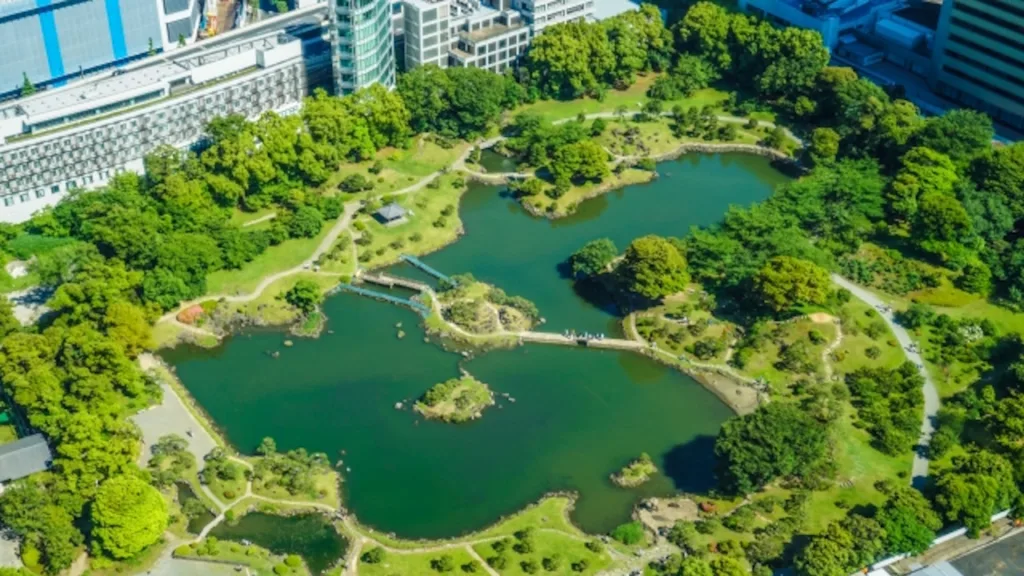
At ¥150 admission, Kyu Shiba Rikyu Gardens is among the most accessible nationally designated cultural properties in Japan. The garden was established on land reclaimed from Tokyo Bay, designed by gardeners brought from Odawara, and named Rakujuen by the rōjū Okubo Tadatomo in the late seventeenth century. It passed through nine distinct periods of ownership — from the Okubo clan through successive daimyo houses, imperial custody, earthquake, and restoration — before opening to the public in 1924. Designated a Place of Scenic Beauty in 1979, it continues to hold the Edo-period stonework, spatial structure, and historical memory that its original creator commissioned.
One minute from the north exit of Hamamatsucho Station, this garden places 350 years of history within reach. Whether as the starting point of a day exploring Tokyo’s surviving daimyo gardens, or as a single destination in its own right, Kyu Shiba Rikyu Gardens offers a level of historical density that is rare in any city, and exceptional in one as thoroughly transformed as Tokyo.