
Travel insights from a tour conductor. This guide covers Toyosu Market — the Tokyo Metropolitan Central Wholesale Market located in the Toyosu district of Koto Ward. How has the fish market tradition born in Nihonbashi during the Edo period carried forward to the shores of Tokyo Bay? Known as the world’s largest public wholesale market, Toyosu Market offers an experience unlike anything else in Tokyo tourism: encounters with the freshest seafood imaginable, and a front-row view of the legendary tuna auction in the pre-dawn hours.
| Item | Details |
|---|---|
| Facility | Tokyo Metropolitan Central Wholesale Market, Toyosu Market |
| Address | 6-chome, Toyosu, Koto-ku, Tokyo (Blocks 5, 6 & 7) |
| General Visitor Hours | 5:00 AM – 5:00 PM (dining/retail shops close at their own hours) |
| Tuna Auction Viewing | 5:45 AM – 6:25 AM (advance registration required, lottery system, free) |
| Closed Days | Sundays, public holidays, year-end/New Year period, and others (seafood division: 251 operating days in 2026) |
| Access | Yurikamome Line “Shijomae Station” — direct connection |
The Early Start Challenge — What to Know Before You Visit
The tuna auction, Toyosu Market’s most sought-after attraction, begins at 5:45 AM. Attendance requires advance online registration and entry is decided by lottery — not on a first-come basis. Applications for the following month open in the first week of each month on the Tokyo Metropolitan Government’s official website, and demand is high enough that many applicants are turned away.
It is also essential to understand that Toyosu remains an active, working wholesale market. The trading floors where market operators conduct business are not open to general visitors; access is limited to designated walkways and exhibition areas. Members of the public cannot freely purchase fresh produce or seafood directly at the market itself. Those looking to enjoy a meal should head to the dining areas inside the market buildings or to the adjacent Toyosu Senkyakubanrai complex.
The market also observes numerous closed days. With only 251 operating days in 2026 for the seafood division, nearly every Sunday means a closed market. Checking the official calendar before planning a visit is essential.
From Nihonbashi to Toyosu — Four Hundred Years of the Fish Market
The Fish Market Tokugawa Ieyasu Built
The roots of Toyosu Market reach back to the early years of the Edo period. After Tokugawa Ieyasu took up residence in Edo Castle, he brought fishermen from Tsukuda-mura in Settsu Province (present-day Osaka) to the city, granting them special fishing rights. These fishermen supplied seafood to the shogunate’s kitchen, and Ieyasu permitted them to sell their surplus catch along the banks of the Nihonbashi River. This is regarded as the origin of the Nihonbashi fish market, known as Uogashi.
Nihonbashi was the convergence point of all five major highways connecting Edo with the rest of Japan, and the busiest commercial hub in the city. The Uogashi stretched along the northern bank of the Nihonbashi River between Nihonbashi Bridge and Edobashi Bridge — roughly the area of present-day Nihonbashi-honcho and Muromachi 1-chome — and for more than 300 years from the early seventeenth century, it sustained the food life of Edo and, later, Tokyo.
The most prosperous fish wholesalers of the Uogashi wielded considerable financial power, becoming patrons of Edo culture: kabuki theatre, ukiyo-e, and haiku poetry all benefited from their sponsorship. Sugiyama Sanpu, the wealthy fish merchant who was a close disciple of the poet Matsuo Bashō and a principal supporter of his literary work, is among the most famous examples.
The Great Kanto Earthquake That Reshuffled History
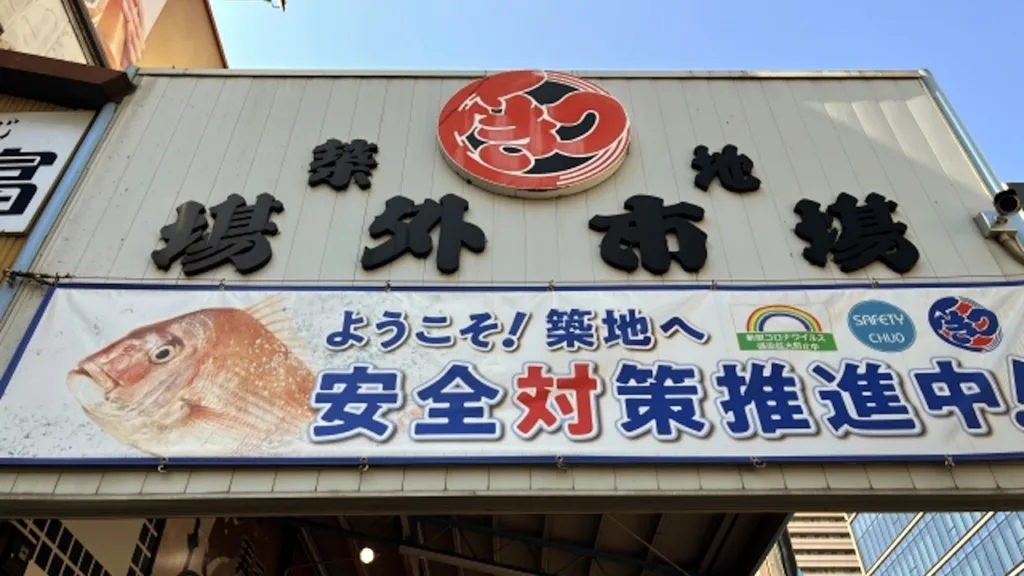
More than three centuries of continuous history came to an abrupt end with the Great Kanto Earthquake of 1923, which left the Nihonbashi Uogashi in ruins. A temporary market was established in Shibaura, but its cramped conditions and poor transport links prompted Tokyo City to seek a permanent solution. Land at Tsukiji — formerly belonging to the Navy Ministry — was selected as the site for a new, modern facility. After thorough preparation, the Tokyo Metropolitan Central Wholesale Market opened officially in Tsukiji in February 1935, covering approximately 230,000 square meters.
Freight trains from the old Shiodome Station ran directly into the facility on a dedicated spur line, and boats docked at a pier on the Sumida River to deliver produce. The market expanded rapidly. Although wartime rationing and controls stripped the market of its commercial function for several years, trading recovered after the end of controls in 1950. Through Japan’s high-growth decades, Tsukiji grew into the country’s largest market.
Aging Infrastructure and the Move to Toyosu
By the time more than 80 years had passed since the 1935 opening, Tsukiji’s buildings had deteriorated seriously. After years of debate over whether to rebuild on-site or relocate, the decision was made to move to Toyosu. However, the designated site was the former grounds of a Tokyo Gas plant, and soil contamination concerns emerged, delaying the originally planned November 2016 opening.
Following extensive investigation and remediation work, Toyosu Market finally opened on October 11, 2018. Tsukiji Market closed its doors on October 6 of the same year after 83 years of operation, and the center of Tokyo’s food supply chain moved to its new home by the bay.
407,000 Square Meters — The World’s Largest Public Market
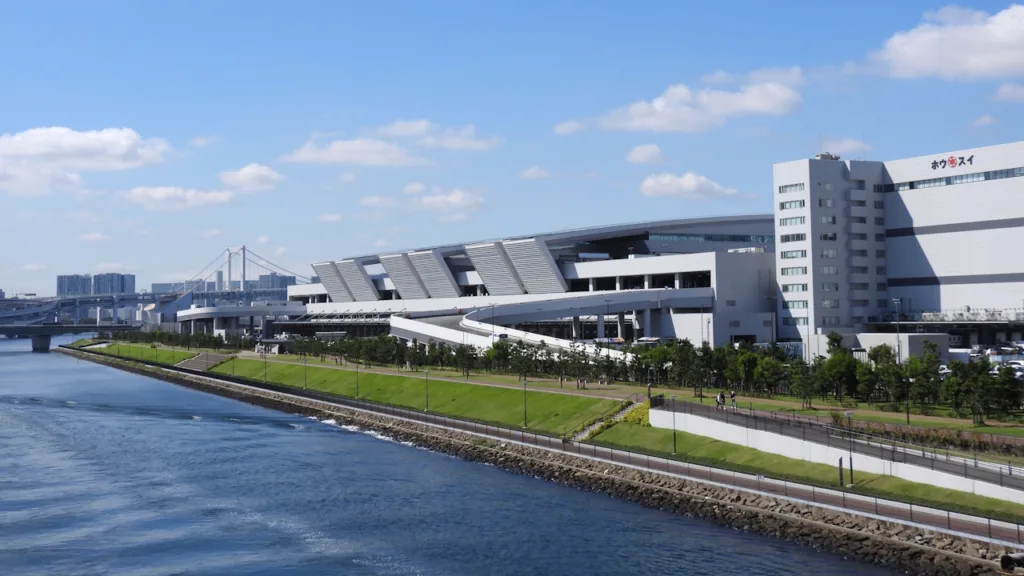
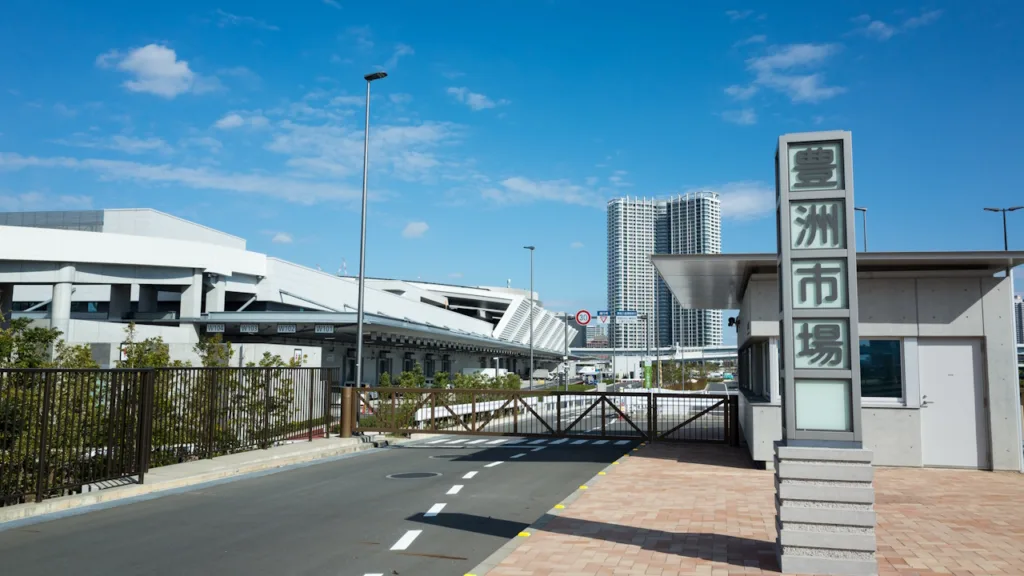
Toyosu Market covers a site area of 407,000 m² with a total floor area of 517,000 m², functioning as both Japan’s largest and the world’s largest public wholesale market. The facility is divided into three blocks — Blocks 5, 6, and 7 — each with a distinct role.
Block 5 — Produce Building
This is where fresh vegetables and fruits are traded at both wholesale and intermediate wholesale levels. Produce gathered from domestic and international sources changes hands here before reaching restaurants and greengrocers, and the trading activity can be observed from designated visitor corridors.
Block 6 — Seafood Intermediate Wholesale Building
The largest building in the complex, Block 6 is where the city’s fish shops, sushi restaurants, and food service businesses come to source their seafood from more than 500 intermediate wholesalers. In the visitor corridor, two actual turrets — the compact electric cargo vehicles that dart throughout the market — are on permanent display alongside seasonal seafood panel exhibits and a life-size bluefin tuna panel for photographs. The rooftop garden offers canal views on clear days.
Block 7 — Seafood Wholesale Building and Administration Building
The wholesale trading floors for tuna and other seafood are located here, alongside the market’s management facilities. Block 7 connects directly to Shijomae Station on the Yurikamome Line, making it the first point of entry for most visitors. The third floor of the administration building houses a PR corner introducing the history of fish and the market, and it is from here that visitors make their way to the dedicated tuna auction viewing deck.
The Tuna Auction — A Working Market in Full Force
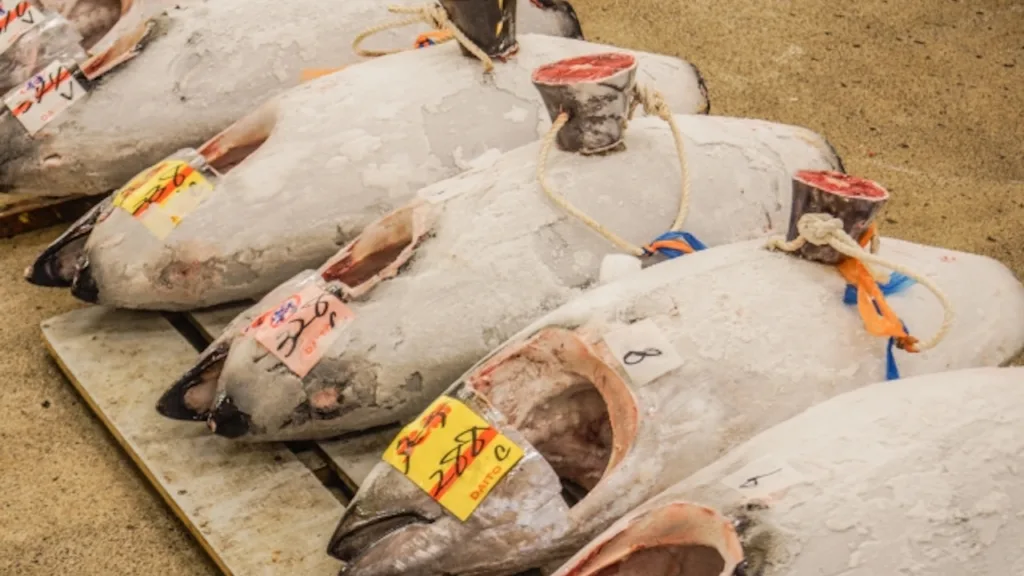
The tuna auction is Toyosu Market’s most popular experience for visitors. Viewing runs from 5:45 AM to 6:25 AM. On the auction floor, close to a thousand tuna are laid out in rows, and buyers move through the hall with flashlights, tapping each fish, pressing the flesh, and listening to the sound it produces to assess quality in seconds. The pace and intensity of the scene leave a lasting impression.
The facility’s audio system carries the opening bell and the auctioneers’ calls along the visitor corridor, so even from behind the glass the atmosphere of the pre-dawn trading floor comes through clearly. Admission is free, but entry requires winning the monthly online lottery that opens in the first week of each month.
A New Face for Tokyo’s Food Scene — Toyosu Senkyakubanrai
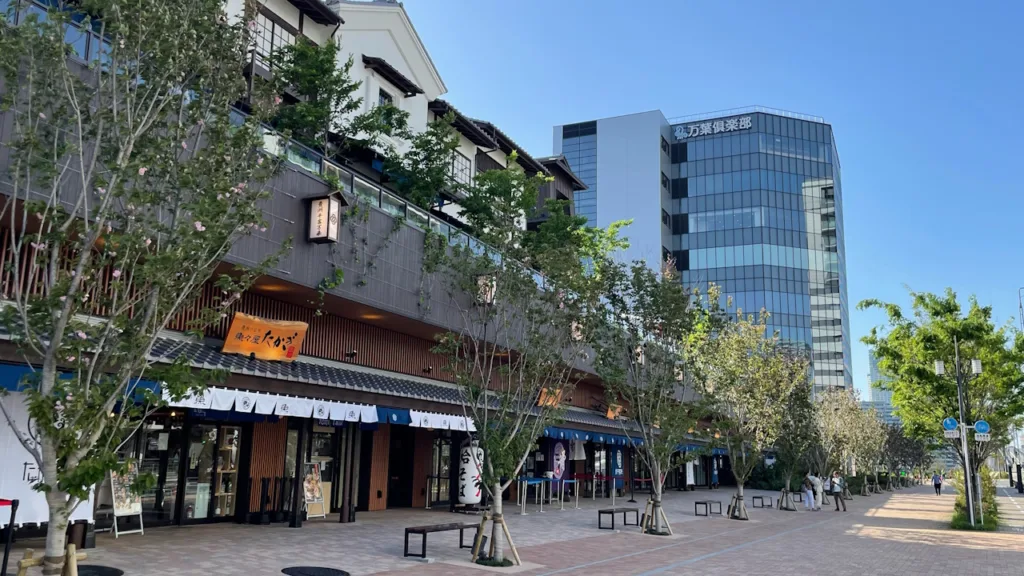
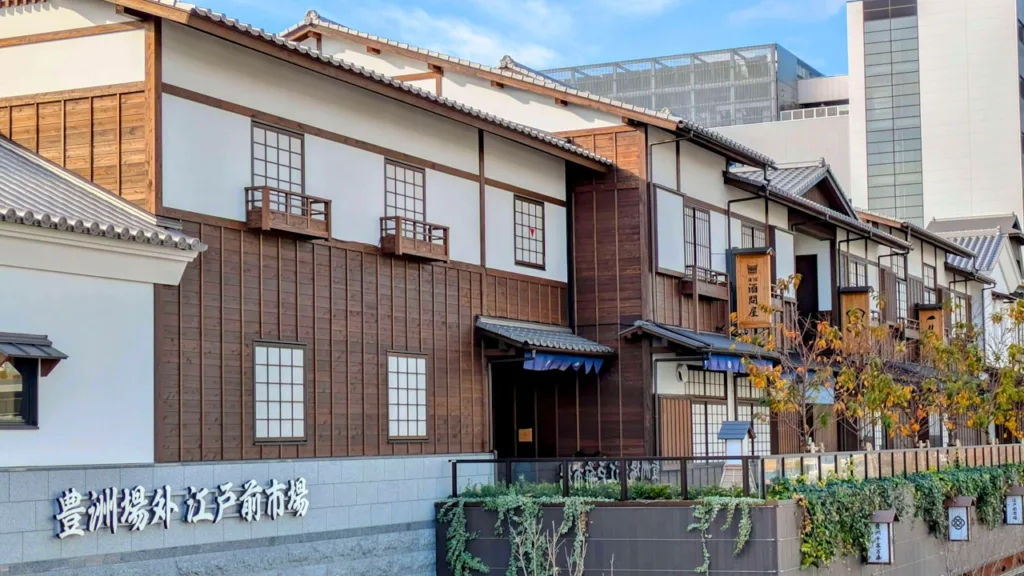
Opened on February 1, 2024, immediately adjacent to Toyosu Market, Toyosu Senkyakubanrai is an open-air commercial complex modeled on an Edo-period townscape. Operated by Manyo Club Co., Ltd., it consists of two sections: the food and shopping building “Toyosu Jogai Edomae Ichiba” and the bathing facility “Tokyo Toyosu Manyo Club.”
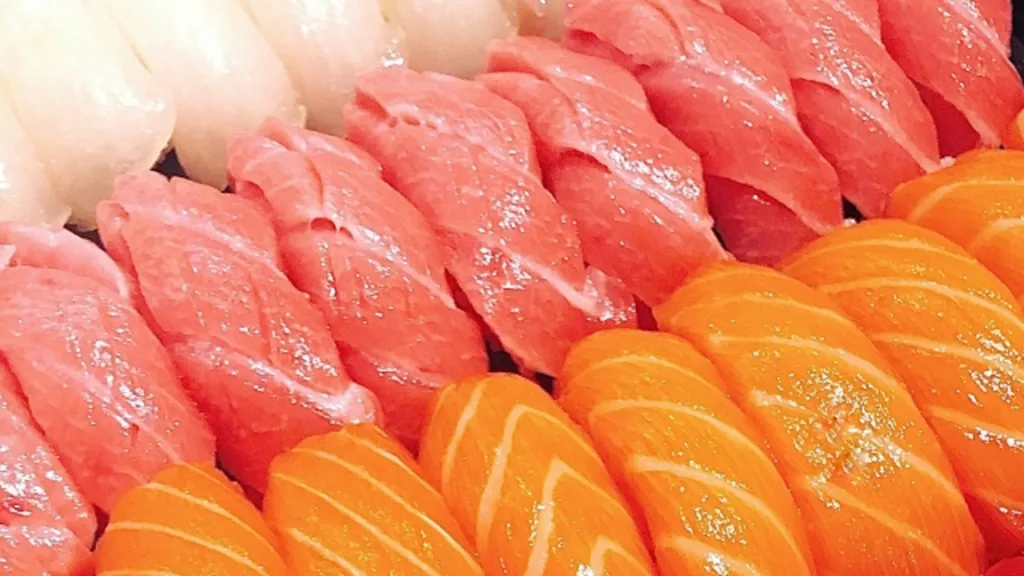
The food building spans three floors and houses approximately 70 shops. The ground floor offers casual street food and ramen, the second floor features two zones called “Mekiki Yokocho” and “Toyosu Mainstreet,” and the third floor offers a food court centered on sushi and seafood rice bowls. The architecture draws on traditional materials including granite, Awaji Island roof tiles, and Tama timber, creating an Edo atmosphere throughout — and there is no entry fee to browse and eat.
The bathing facility “Tokyo Toyosu Manyo Club” operates 24 hours and receives fresh natural hot spring water transported daily by tanker from the Hakone and Yugawara hot spring regions. The facility includes outdoor baths overlooking Tokyo Bay, a panoramic rooftop foot-bath garden, rock-salt saunas, and recliner rest areas. A pedestrian deck connects directly from Shijomae Station on the Yurikamome Line, making it easy to combine with a market visit.
Nearby Attractions Worth Combining
teamLab Planets TOKYO DMM (approx. 5-minute walk)
One of the world’s most remarkable immersive digital art museums, teamLab Planets is a roughly five-minute walk from Toyosu Market. Since opening in 2018, it has drawn visitors from across the globe and holds the Guinness World Record as the most-visited museum dedicated to a single art group. In 2026, the venue has confirmed its operation through 2027, and a major expansion in January 2025 added new zones that continue to attract record attendance. The defining experience is a barefoot walk through water-filled art installations.
Toyosu Park (approx. 10-minute walk)
Located to the north of the market, this Tokyo Metropolitan park opens onto spacious lawns facing Tokyo Bay. The promenade along the canal offers clear sightlines to Tokyo Skytree and Rainbow Bridge, and its calm atmosphere makes it a natural stopping point after an early-morning market visit.
Michinoterrasse Toyosu (steps from Shijomae Station)
Directly connected to Shijomae Station, this elevated terrace in Block 4 hosts the “Toyosu Jogai Marché” on the third Saturday of every month. Seasonal vegetables, fruit, and processed goods sourced directly from Toyosu Market are sold at market prices, offering a relaxed way to experience the market’s energy without waking before dawn.
Recommended Hotels Nearby
La Vista Tokyo Bay (Kyoritsu Resort)
About a one-minute walk from Shijomae Station, La Vista Tokyo Bay is one of the closest hotels to Toyosu Market. The top floor (14th) houses a natural hot spring spa with panoramic views — outdoor bath, jacuzzi, and sauna all facing out over Tokyo Tower, Tokyo Skytree, and Rainbow Bridge. Part of the Kyoritsu Resort group, the hotel offers signature late-night ramen (“yonaki soba”) and post-bath ice cream as hallmarks of the brand. The breakfast buffet features ingredients sourced directly from Toyosu Market, making it a natural extension of the market experience. The hotel also has a sky bar, indoor infinity pool, and athletic gym.
Hotel JAL City Tokyo Toyosu (Okura Nikko Hotels)
A two-minute walk from Shijomae Station and equally convenient for Toyosu Senkyakubanrai, Hotel JAL City Tokyo Toyosu is part of the Okura Nikko Hotels group. All 330 rooms measure at least 20 m², with separate bath and toilet and an in-room coffee machine as standard. The all-day dining restaurant “Shiomachi Saryo” on the ground floor serves a breakfast buffet, and a 24-hour convenience store is located in the lobby. For travelers arriving specifically for the early-morning tuna auction, the walking distance to the market is one of the hotel’s most practical advantages.
Explore Toyosu Market with a Dedicated Tour Conductor
Japan’s wholesale market culture can feel daunting to navigate independently — especially when the most memorable experiences start before the city’s public transport is fully running, and when language barriers may make pre-dawn logistics unexpectedly complicated. This is where traveling with a dedicated tour conductor makes a tangible difference.
A tour conductor’s core role is itinerary management: keeping the schedule on track so that early departure times are met, pre-arranged bookings are honored, and the group moves seamlessly from one point to the next. At Toyosu Market, where the tuna auction lottery results must be confirmed well in advance and the window for viewing lasts under 45 minutes, having someone whose job it is to manage those logistics removes a significant source of stress for travelers.
Tour conductors are also trained to provide interpretation assistance where needed and to coordinate emergency arrangements — medical, transportation, or otherwise — should anything unexpected arise. Traveling through Tokyo’s pre-dawn streets with a contact who can communicate clearly with local staff and handle on-the-spot changes gives travelers a level of security that independent itineraries cannot fully replicate.
For anyone planning a Japan trip that puts Toyosu Market, the tuna auction, and Tokyo Bay’s broader food scene at the center of the itinerary, the dedicated tour conductor and travel arrangement service at tours.e-stay.jp is worth exploring.

Conclusion
The food distribution system that began at the Nihonbashi Uogashi more than 400 years ago continues to pulse through modern Tokyo in the form of Toyosu Market — the world’s largest public wholesale market. From the pre-dawn tuna auction to the dining corridors inside the buildings and the adjacent Senkyakubanrai complex, the market rewards repeated visits with something new each time.
For those making Toyosu Market the anchor of a Tokyo stay, La Vista Tokyo Bay — a one-minute walk from Shijomae Station — combines natural hot spring bathing and Tokyo Bay night views with a breakfast sourced from the market itself, providing a stay that extends the Toyosu experience well beyond the trading hours.