


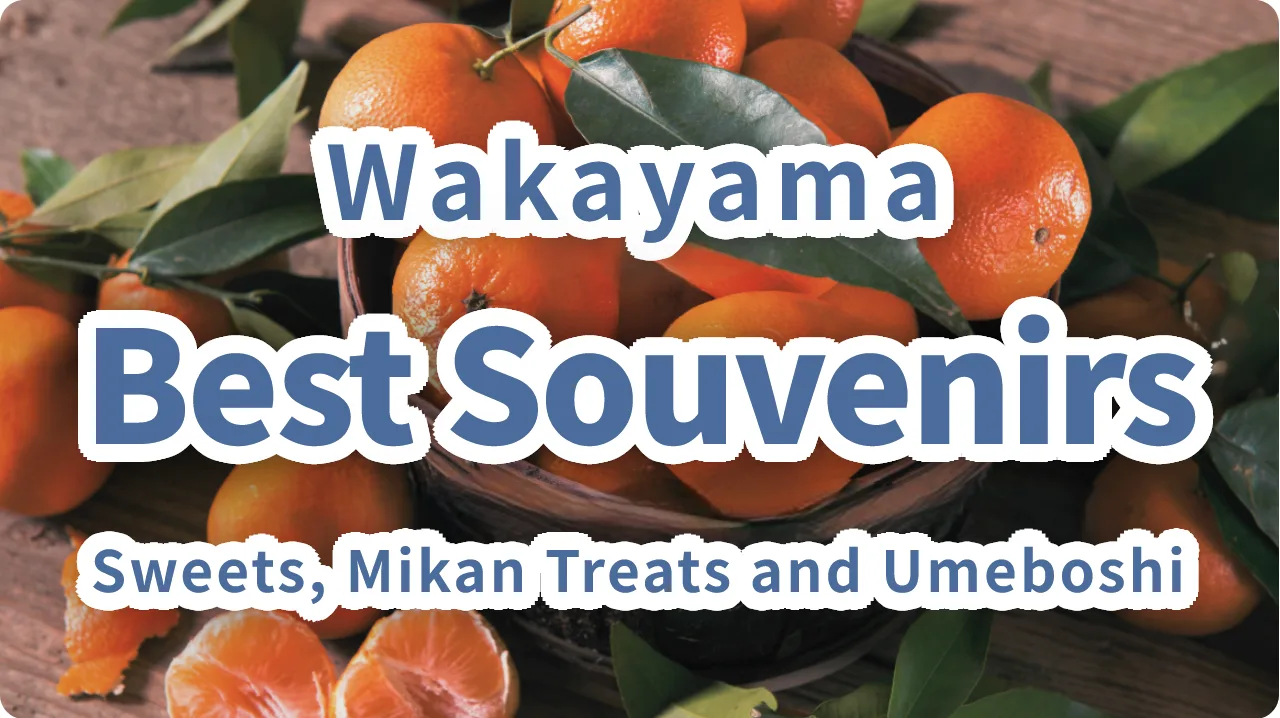
Travel insights from a tour conductor — today’s destination: Wakayama, and the souvenirs that make the trip last after you’ve unpacked.
Wakayama’s gift shelves hold castle-town confections from the Kishu domain, treats made from Arida mikan, and umeboshi pickled plums from the country’s best-known plum region. This guide sorts them into three categories: sweets for handing out, mikan products, and umeboshi. It then covers where to buy them, what to see around Wakayama Castle, and where to stay in the city center. One note on the rankings: they’re editorial picks, not the result of a nationwide survey.
What to Know Before You Shop in Wakayama
Wakayama’s specialties follow the seasons closely. Grape sansho (a Japanese pepper) is at its best from early May to mid-August, plums are harvested around June, and Arida mikan peak in winter. What’s fresh on the shelf depends on when you visit.
Shelf Life Varies Widely
Shelf life is the first thing to check for gifts you’ll hand out. Fukubishi’s Kagerou keeps for 40 days from the production date, while Maruyama Foods’ Pettanko Chobiume carries a two-year label. A baked sweet and a dried plum snack sit at opposite ends of the scale (labels checked in October 2026).
Some Items Sell Out or Come from One Shop Only
Wasa Kajuen’s Temari Mikan is popular enough that online sales sometimes switch to a reservation system when stock runs low. Fukubishi’s main shop in Shirahama also sells Nama Kagerou, a version you won’t find elsewhere. Deciding where to buy before you set out saves a wasted trip.
The Kishu Domain Shaped Wakayama’s Famous Foods
Many of Wakayama’s best-known foods trace back to the Tokugawa family of Kishu, one of the three branches of the Tokugawa clan.
Honnoji Manju, a Travel Snack from the Procession Days
Sohonke Surugaya, based in Wakayama City, traces its roots to 1461, when it opened a manju shop in Fushimi, Kyoto. The business later followed Tokugawa Yorinobu, founder of the Kishu Tokugawa line, through Suruga to Wakayama and served the domain as an official confectioner. Its signature Honnoji Manju is a sake manju stamped with the character for “book” (本). Because it’s made with rice flour, the surface hardens as it dries, which kept it from spoiling on the road. During the Edo period it was a handy snack on the Kishu lords’ long journeys to and from Edo.
Nankoume, Discovered in Minabe About 130 Years Ago
Most plums grown in Wakayama are the Nankoume variety. It was found roughly 130 years ago at the Takada orchard in Minabe (formerly the village of Minabegawa). The original tree still stands and bears a little fruit every year. June 6 is Ume Day in Japan, a date that goes back to 1545, when plums were offered at a festival at Kamo Shrine in Kyoto.
Arida Mikan, Grown for More Than 440 Years
Mikan farming in the Arida area has a history of more than 440 years. The Satsuma mandarins grow on steep terraced slopes and reach their peak in winter. Wasa Kajuen grew out of Wasa Kyosen, a group formed in 1979 by seven mikan farming families in Arida. Today the company handles everything from growing to processing and sales.
Grape Sansho from the Tenpo Era
Wakayama grows about 70 percent of Japan’s sansho. Aridagawa Town leads the country in output, and the Shimizu district is regarded as the birthplace of grape sansho. The story begins in the Tenpo era (1830 to 1844), when trees growing wild in the Toi district of Aridagawa were first planted on purpose. Back then the pepper was used as medicine.
Wakayama Sweets Ranked: The Best for Handing Out
Individually wrapped sweets with a long shelf life are the easy choice for colleagues and friends. Wakayama’s lineup covers everything from rice crackers to manju to Western-style cakes.
No. 5: Wakaura Senbei (Takaya Seika)
This gentle egg-flavored senbei is a Wakayama City classic, and each cracker is branded with a scene from Wakaura. The bay is also home to Fuki Bridge, a stone arch bridge completed in 1851. It belongs to the Wakanoura Scenic Area, a nationally designated place of scenic beauty, and Edo-period stone arch bridges of this type are rare outside Kyushu. Take a cracker out of the box and the bay comes to mind.
No. 4: Kamikishiya Yakimochi
Yakimochi is the specialty of Hanazaka in Koya Town, at the foot of Mount Koya. Rice cake is seared on an iron griddle and filled with lightly sweet, house-made chunky red bean paste. The recipe has been passed down through generations, and the plain white and mugwort versions taste simple and homey. You can take it away or eat it at the shop, and frozen yakimochi is available too.
No. 3: Kin no Honnoji Manju (Sohonke Surugaya)
This is a modern take on Surugaya’s signature Honnoji Manju. The smooth red bean filling is the same, but the sake lees from a local brewery are mixed in before baking. The skin is soft and chewy, and the mild sweetness of the filling plays against it. The original manju once traveled with the Kishu Tokugawa lords, so this version carries a lot of history for a snack.
No. 2: Suzuya Deluxe Cake
Suzuya, a confectioner in Tanabe, opened in 1924. Its Deluxe Cake is a square sponge cake made with a special blend and method, filled with the shop’s own jam and coated in white chocolate. The dense sponge, tart jam and mellow white chocolate come in layers. The retro Showa-era packaging adds to the charm, and locals have loved this cake for decades.
No. 1: Kishu Meika Kagerou (Fukubishi)
Fukubishi, a confectioner in Shirahama that opened in 1933, makes Kagerou. Soft baked sponge sandwiches a lightly sweet cream, and the name comes from the way it vanishes on the tongue like heat shimmer over a beach. It keeps for 40 days from the production date, which makes it a practical choice for handing out. Ice Kagerou, a frozen version, is not ice cream, so it won’t melt away. The main shop in Shirahama sells Nama Kagerou, which you can’t buy anywhere else.
Arida Mikan Souvenirs Ranked
Arida mikan show up as more than fresh fruit. They’re also made into syrup-packed treats, juice and Western-style cakes. These picks come from makers and bakeries around Arida and travel well.
No. 3: Temari Mikan (Wasa Kajuen)
These are whole, undersized Arida mikan about 5 cm across, preserved in syrup and sold in jars of roughly seven. The fruit is small with thin skin, so each one goes down in a bite. Because the mikan are processed right after harvest, the juice stays plentiful. You can buy them through the official online shop or at the outlet on the first floor of the head office in Miyahara, Arida. They’re popular enough that reservations may be required when stock is low.
No. 2: 100% Pure Juice Mikanshibori (Ito Noen)
Ito Noen in Arida presses this straight juice from Arida mikan alone. It has no additives, so the natural sweetness of the fruit comes through. The juice has won top awards at Monde Selection, and a prefectural document lists it among award-winning products. Ito Noen also makes pure juices from hassaku, kiyomi and other citrus.
No. 1: Arida Mikan Baum (MAHALO Baumkuchen Specialty Shop)
MAHALO, a baumkuchen specialist with its main shop in Miyahara, Arida, bakes local ingredients such as Arida mikan and Yuasa soy sauce into its cakes. Its Chocolate-Dipped Arida Mikan, devised by Wakayama University students, is one of the Wakayama Shittori Nama Baum lineup. It has been sold since December 25, 2025 at the Kinokawa Service Area on the Hanwa Expressway, in both directions. The cake is known for its moist crumb.
Umeboshi Souvenirs Ranked
Nankoume plums are fragrant, thin-skinned and fleshy, and umeboshi made from them are a Wakayama staple.
No. 2: Maboroshi no Ume (Okahata Noen)
This honey-flavored umeboshi uses fully ripe Kishu plums. Okahata Noen works only with top-grade Kishu umeboshi and says it tests its raw plums for residue on 104 items in its own laboratory. A unique method skips the desalting step that’s usually done in water. Unopened, the plums keep for one year.
No. 1: Kishu Godai Ume (Godaian)
Higashi Noen, which runs Godaian, was founded in 1834 and has grown plums for five generations. Kishu Godai Ume uses only top-grade Nankoume, soaked over 30 to 40 days in three rounds so the flavor reaches every fruit. The skin is thin, the seasoning is even, and fans say even the pit tastes good. Skilled workers hand-select plums with no blemishes or spots and an even size. Boxed sets in wooden and decorated cases are popular as gifts. Godaian runs shops in Wakayama, Tokyo and Osaka.
Bonus: Pettanko Chobiume (Maruyama Foods)
Maruyama Foods in Minabe thins out pitted Kishu Nankoume pulp and sun-dries it. It contains only Kishu plums and salt, and the saltiness is addictive. It’s handy for replacing salt in summer, and the label gives a two-year shelf life.
Bonus: Umeshu
Umeboshi makers and sake breweries also turn Nankoume into umeshu, or plum liqueur. Godaian’s direct-sales shop stocks umeshu and plum juice alongside umeboshi. Nate Shuzoten, the brewery behind Kurogyu covered below, also makes a Kurogyu-style umeshu.
Wakayama Souvenirs Beyond Plums and Mikan
Kawazoe Tea
This high-grade sencha comes from the Ichishikano district of Shirahama. The area gets plenty of rain, morning mist and large temperature swings between day and night, which suit tea plants. Yabukita is the main variety, and farmers handle growing, processing and sales together. New-crop tea is sold in tea shops in Tanabe and at some supermarkets.
Kurogyu (Nate Shuzoten)
Nate Shuzoten in Kuroe, Kainan, brews this sake. The lineup includes junmai daiginjo and junmai Kurogyu, plus Kurogyu-style umeshu and yuzu liqueur. The brewery’s history reaches back to 1866 (Keio 2).
Chirimen Sansho (Marutomo Kaisan)
Fresh chirimen (tiny dried sardines) simmered in Yuasa soy sauce with grape sansho. Biting into a sansho berry releases a crisp, peppery aroma. It’s an easy way to take home the sansho that Wakayama produces more of than any other prefecture.
Where to Buy Souvenirs in Wakayama
JR Wakayama Station
The station connects directly to the Wakayama MIO shopping complex and the Wakayama Kintetsu Department Store. Kuroshio Ichiba on the first floor of the MIO main building stocks umeboshi and other Wakayama specialties.
Kinokawa Service Area, Hanwa Expressway
The shopping corner at Kinokawa Service Area is open 24 hours in both directions. MAHALO’s Chocolate-Dipped Arida Mikan is sold here.
Main Shops and Direct-Sales Outlets
Fukubishi’s main shop is in Shirahama and has an attached cafe, Kagerou Cafe. The Ogura store at Sohonke Surugaya’s head office factory in Wakayama City is company-run, with a factory viewing area and a tearoom. Wasa Kajuen’s head office has a direct-sales outlet on the first floor. Fukubishi and Suzuya also run official online shops.
Sights Around Wakayama Castle
Once the shopping is done, Wakayama Castle in the middle of the city makes an easy next stop. These three sights sit close together around Wakayama Castle Park, and each is worth the walk.
Wakayama Castle
Toyotomi Hideyoshi ordered his younger brother Hidenaga to build Wakayama Castle in 1585. From 1619, when Tokugawa Ieyasu’s tenth son Yorinobu moved in, it was the seat of the Kishu Tokugawa, one of the three main Tokugawa branches, until the Meiji era. From the keep, rebuilt after the war, you can look out over the Kinokawa River. Standing in the home of the Kishu Tokugawa, it’s easy to see how Honnoji Manju and umeboshi fit into the region’s story.
Nishinomaru Garden (Momijidani Garden)
This nationally designated place of scenic beauty lies inside Wakayama Castle Park. Tokugawa Yorinobu laid it out in the early Edo period as a place for tea ceremony and Noh performances. It’s a strolling garden built around a large pond, with a two-tiered pond fed by spring water and a waterfall. A teahouse called Shigyokaku floats in the moat, and the bridges frame some lovely views. True to its other name, Maple Valley Garden, the leaves turn red in autumn and reflect in the pond and waterfall. Pair it with a souvenir run on an autumn trip and the visit comes together nicely.
Wakayama Castle Park Zoo
The zoo inside the park keeps Humboldt penguins and other animals. It sits right by the castle, so it works as a relaxed stroll after the climb up the keep.
A Tour Conductor Makes Wakayama Easier
A dedicated tour conductor takes care of the logistics so you can spend your time on the trip itself. Travelers who join a private tour with a tour conductor don’t have to work out train connections between Wakayama City and Shirahama, or sort out which shop is open when.
A tour conductor manages the itinerary from start to finish: running the schedule, keeping track of luggage, and stepping in with interpretation assistance when language gets in the way. If a train is delayed or a reservation falls through, the tour conductor handles the emergency rebooking, so a small hiccup doesn’t derail the day. For visitors who don’t speak Japanese, that peace of mind is a real advantage on a trip that mixes city stops with coastal towns.
To see how a tour conductor can support your trip to Japan, visit tours.e-stay.jp.
Where to Stay in Central Wakayama
A night in the city center makes it easy to combine shopping with a walk around the castle. These three hotels are either connected to a station or close to the castle, and each one is a good base.
Hotel Granvia Wakayama
This city hotel is part of the JR-West Hotels group. It stands in the same building as Wakayama Kintetsu Department Store, a two-minute walk from the Central Exit of JR Wakayama Station. All 134 rooms have Simmons mattresses and Nishikawa down comforters. Breakfast is a buffet with a Kishu corner serving Wakayama chagayu (tea porridge), whitebait and umeboshi. With the station and the department store a few steps away, it’s a smart pick for a trip built around shopping.
Daiwa Roynet Hotel Wakayama
This 20-story hotel stands directly in front of Wakayama Castle and was fully renovated in April 2024. Of its 219 rooms, 144 look out on the castle, and the breakfast buffet serves Japanese and Western dishes made with local ingredients. A 24-hour convenience store and restaurants occupy floors one through three. It’s a great base for exploring the castle on foot.
Candeo Hotels Nankai Wakayama
The 120-room hotel connects directly to Nankai Electric Railway’s Wakayama-shi Station. A sky spa on the 12th floor has an open-air bath, an indoor bath and a sauna. Step out of the elevator and a chandelier modeled on Wakayama Castle greets you. After a day of sightseeing, it’s the place to soak and unwind.
Wrapping Up: Wakayama Souvenirs
Wakayama’s souvenirs fall into three groups: sweets for handing out, mikan products and umeboshi. Kagerou, with its 40-day shelf life, is a dependable sweet for sharing. Temari Mikan and Mikanshibori capture the flavor of Arida mikan, and Kishu Godai Ume is the classic umeboshi. Shelf life, sell-outs and shop-only items are worth a look before you choose.
Browsing souvenirs and then wandering Wakayama Castle and Nishinomaru Garden gives you the history of the Kishu domain and the stories behind its specialties in a single outing. Book a room at Hotel Granvia Wakayama, right at the station, or at Daiwa Roynet Hotel Wakayama, facing the castle, and spend an unhurried trip shopping and strolling the old castle town.