


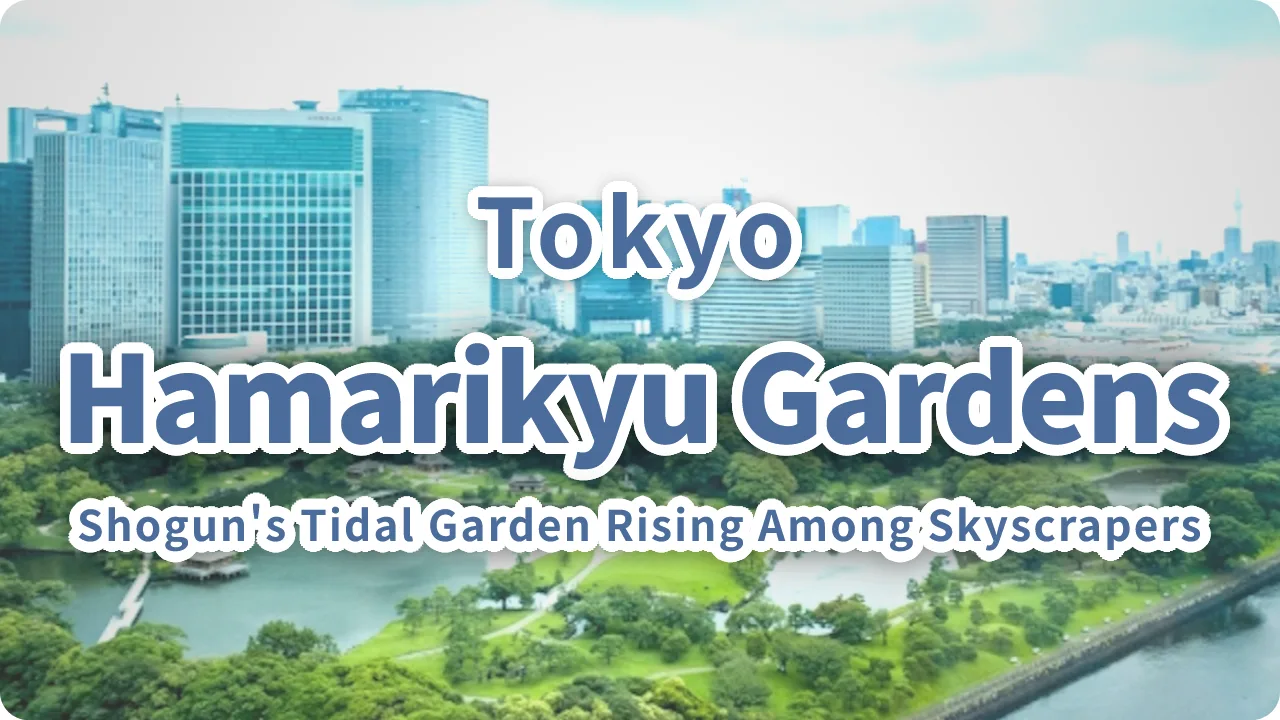
Travel insights from a professional tour conductor. Today we explore Hamarikyu Gardens (浜離宮恩賜庭園), a 250,000-square-meter Edo-period Japanese garden sitting at the foot of Tokyo’s glittering skyscrapers in Chuo Ward — a place where the tides of Tokyo Bay still dictate the mood of a garden that once hosted shogun, emperors, and foreign heads of state.
Originally built as the private retreat of the Tokugawa shogunate and later used as an imperial detached palace, Hamarikyu Gardens opened to the public in 1946. Its remarkable tidal pond — the only one of its kind still connected to the sea in Tokyo — along with seasonal flowers, a 300-year-old black pine, and four restored teahouses, preserve the refined aesthetic of Edo’s great daimyo gardens. Designated as both a Special Place of Scenic Beauty and a Special Historic Site under Japan’s cultural property laws, the highest dual classification the country offers, this extraordinary garden can be experienced for just ¥300.
| Item | Details |
|---|---|
| Name | Hamarikyu Gardens (浜離宮恩賜庭園) |
| Address | 1-1 Hama-Rikyu Teien, Chuo-ku, Tokyo 104-0046 |
| Opening Hours | 9:00 AM – 5:00 PM (last entry 4:30 PM) |
| Closed | Year-end/New Year (December 29 – January 1) |
| Designation | National Special Place of Scenic Beauty & Special Historic Site |
What to Know Before You Visit
Hamarikyu Gardens is as rewarding as it is occasionally inconvenient. The nearest station, Shiodome, is only a 5–7 minute walk away, but there is no public parking lot available for general visitors, making a car trip to the gardens impractical. During peak seasons — cherry blossom, cosmos, and autumn foliage — competition for nearby paid parking can be fierce, and public transit is by far the more reliable option.
Dining options within the grounds are limited to the Nakajima no Ochaya teahouse on the central island, which serves matcha and Japanese sweets. If you plan to spend a few hours exploring the full garden, it is worth having a meal beforehand or bringing refreshments, as re-entry is generally not permitted once you exit.
Circling the entire garden takes between one and one and a half hours at a relaxed pace. Visitors fitting the garden into a tighter Tokyo itinerary should plan accordingly and allow sufficient time to take in both the historical highlights and the seasonal scenery without feeling rushed.
The History of the Garden — From Falconry Ground to Imperial Palace
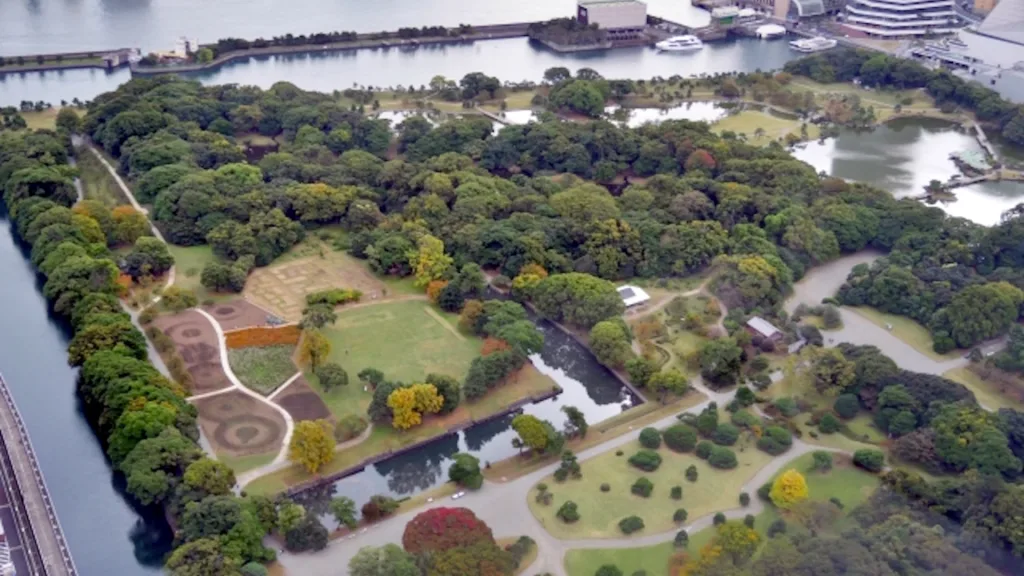
A Reed Marsh Claimed by the Shogunate
Hamarikyu Gardens traces its origins to the early Edo period, when the entire area was little more than a vast expanse of reed marshland used by the Tokugawa shogunate as a falconry ground during the Kan’ei era (1624–1644). The garden’s foundations were laid in 1654 when Matsudaira Tsunashige (Tokugawa Tsunashige), younger brother of the fourth shogun Ietsuna, received the land as a grant from the shogun, reclaimed the sea, and built a private retreat known as the Kofu Hama Yashiki.
The Birth of “Hama-Goten” and the Golden Age of the Edo Garden
The pivotal moment in the garden’s history came in 1707 (Hoei 4), when Tsunashige’s eldest son, Tsunatoyo, became the sixth shogun Ienobu. The estate was elevated to a shogunal villa, and Ienobu undertook a sweeping renovation: the seawater tidal pond (shio-iri no ike) was excavated and connected to Tokyo Bay, the Otodai Bridge was constructed to an island in its center, the Nakajima no Ochaya teahouse was built, and the main gate was erected. He named the estate “Hama-Goten” — the Beach Palace.
The garden was subsequently refined by successive shoguns, reaching roughly its present form during the reign of the eleventh shogun Ienari. The strolling garden (kaiyu-shiki teien) featured five distinct teahouses, three artificial hills, and a panoramic composition designed to frame the sailboats of Shinagawa Bay in the middle distance and Mount Fuji on the horizon — a layered landscape of land, sea, and sky considered the pinnacle of the Edo garden tradition.
From Shogun’s Garden to Imperial Detached Palace
After the Meiji Restoration dismantled the shogunate, the Beach Palace was rapidly transformed. In May 1869, construction was completed on the Enryokan, Japan’s first full-scale Western-style building, built to receive Prince Alfred, Duke of Edinburgh, on his visit to Japan. In October 1870, the garden came under the management of the Imperial Household Ministry and was renamed Hama Rikyu — the Hamarikyu Imperial Detached Palace.
The garden’s most celebrated international episode came in 1879, when former U.S. President Ulysses S. Grant visited Japan for approximately two and a half months and stayed at the Enryokan. On August 10, Emperor Meiji traveled to Hamarikyu for a two-hour audience with Grant at the Nakajima no Ochaya — a gathering attended by some 800 guests — firmly establishing the garden as a stage for Japan’s international diplomacy.
Disaster, Recovery, and the People’s Garden
The 1923 Great Kanto Earthquake destroyed the Enryokan and many other structures, and the air raids of the Second World War reduced the teahouses and most of the garden’s historic trees to ash. In November 1945, the garden was transferred (gifted) to Tokyo Metropolis and renamed Hamarikyu Onshi Teien — “Onshi” meaning “gifted by imperial grace.” It opened to the public in April 1946. In November 1952, it received its dual national designation as a Special Place of Scenic Beauty and a Special Historic Site, the highest-tier classification under Japan’s Law for the Protection of Cultural Properties.
The Highest-Ranked of Tokyo’s Four Surviving Edo Daimyo Gardens
At the height of the Edo period, Japan’s roughly 300 feudal lords each maintained multiple residences in the capital, with an estimated 1,000 or more daimyo gardens across the city. Urbanization, disasters, and war have reduced that number to just four surviving examples: Koishikawa Korakuen, Kyu Shiba Rikyu Garden, Rikugien, and Hamarikyu Gardens — barely 0.4% of what once existed. Among these four, Hamarikyu stands apart on two counts: it holds the dual Special designation that the others do not, and it remains the only garden in Tokyo whose tidal pond is still connected to the sea and actively receives saltwater from Tokyo Bay with every change of the tide.
The Tidal Pond — A Living, Breathing Water Garden
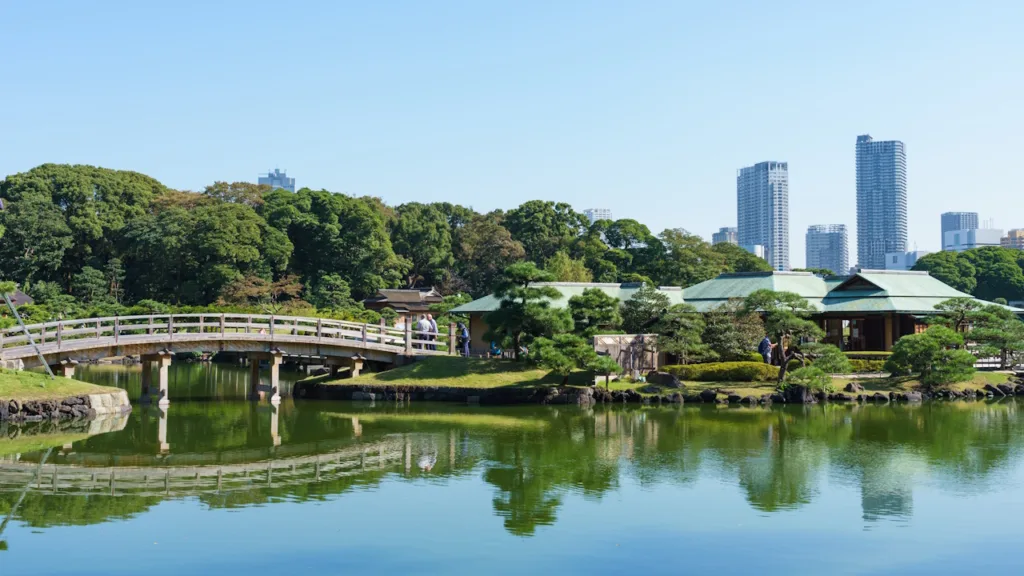
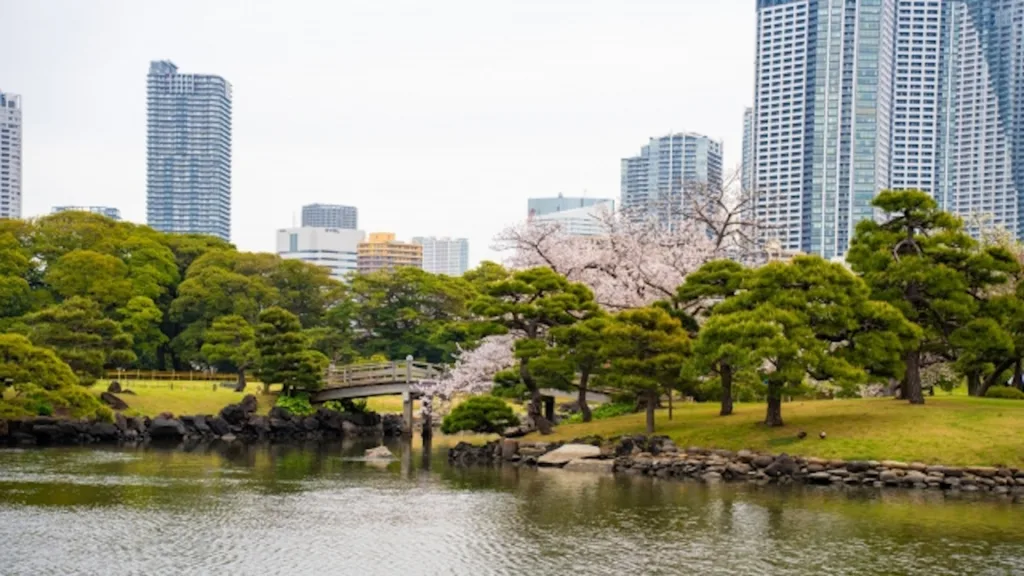
The defining feature of Hamarikyu Gardens is the large tidal pond (shio-iri no ike) at the heart of the garden. Connected to Tokyo Bay via a sluice gate, the water level rises and falls with the tides throughout the day, creating a living, constantly shifting water landscape. In the past, several Tokyo gardens maintained tidal ponds; today, Hamarikyu is the only one where real seawater still moves in and out with the rhythm of the ocean.
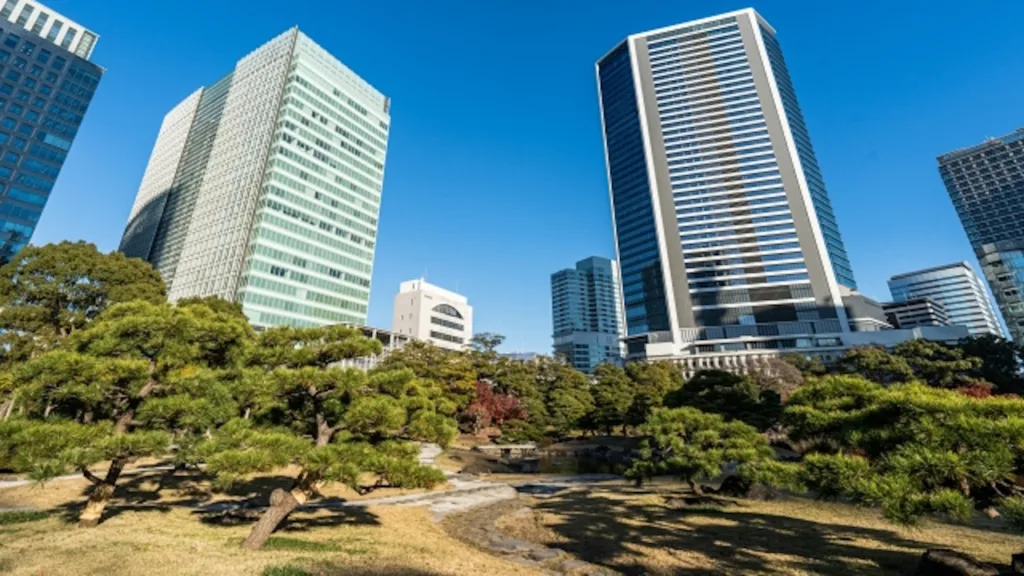
The shifting tides support a rich aquatic ecosystem. Mullet, gobies, eel, and carp inhabit the pond, while herons and ducks are regular visitors. Stretching 118 meters across the pond to the central island is the Otodai Bridge. Looking down from the bridge, the reflections of seasonal flowers, teahouse rooftops, and the surrounding skyscrapers create a composition that could only belong to Hamarikyu.
On the island sits the Nakajima no Ochaya teahouse, reconstructed in 1983 based on historical records of the original built by sixth shogun Ienobu in 1707. A veranda projecting out over the water offers sweeping views of the garden. The teahouse operates from 9:00 AM to 4:30 PM and serves matcha with seasonal Japanese confectionery. Each month brings a different design of namagashi (fresh wagashi), a hand-crafted sweet molded to reflect the flowers and motifs of that season.
Flowers in Every Season
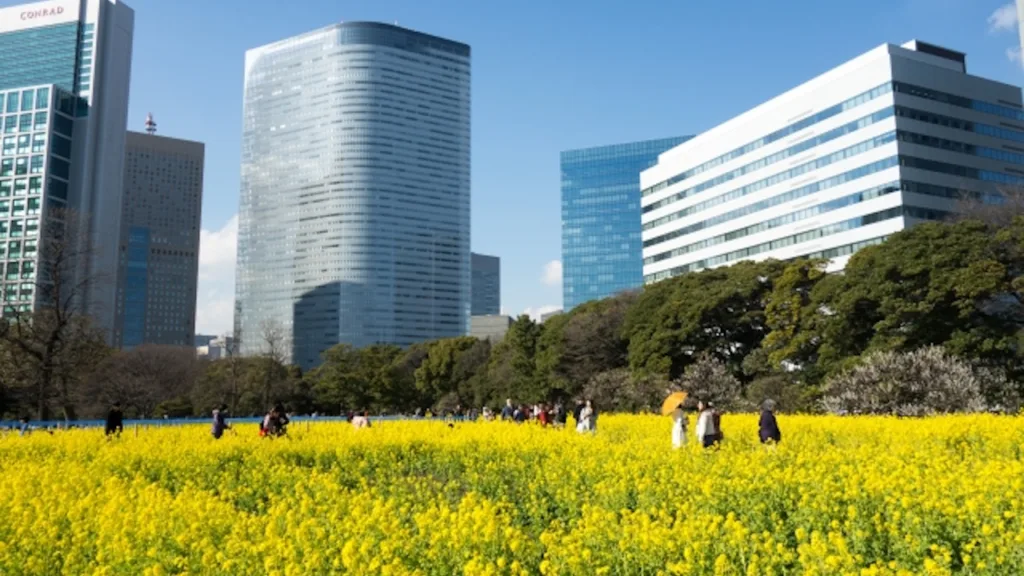
Spring: A Field of Gold, Then a Wash of Blossom Pink
Spring at Hamarikyu begins with rapeseed flowers (nanohana) — approximately 300,000 plants spreading across a 3,000-square-meter flower field in vivid yellow from mid-February to mid-March. The contrast between the golden field and the steel-and-glass towers overhead is one of Tokyo’s most distinctive springtime views. Around the same period, roughly 130 plum trees bloom in red and white.
Cherry blossoms follow from late March to mid-April: about 80 trees of multiple varieties, including the common Somei Yoshino, the unusual green-flowering Gyoiko, the pale yellow Ukon, and the early-blooming Kanhi Zakura. Because the varieties open at slightly different times, the cherry blossom season extends for several weeks. Late April brings the wisteria trellises into bloom, filling the air with a distinctive fragrance.
Early Summer and Summer: Iris, Hydrangea, and a Sea of Yellow Cosmos
From mid-May to early June, hanashobu (Japanese water iris) bloom alongside seven varieties of hydrangea. From July through August, approximately 150,000 yellow cosmos (kibanakosmosu) fill the flower field, peaking in late August to early September.
Autumn: Pink Cosmos Against a Skyline
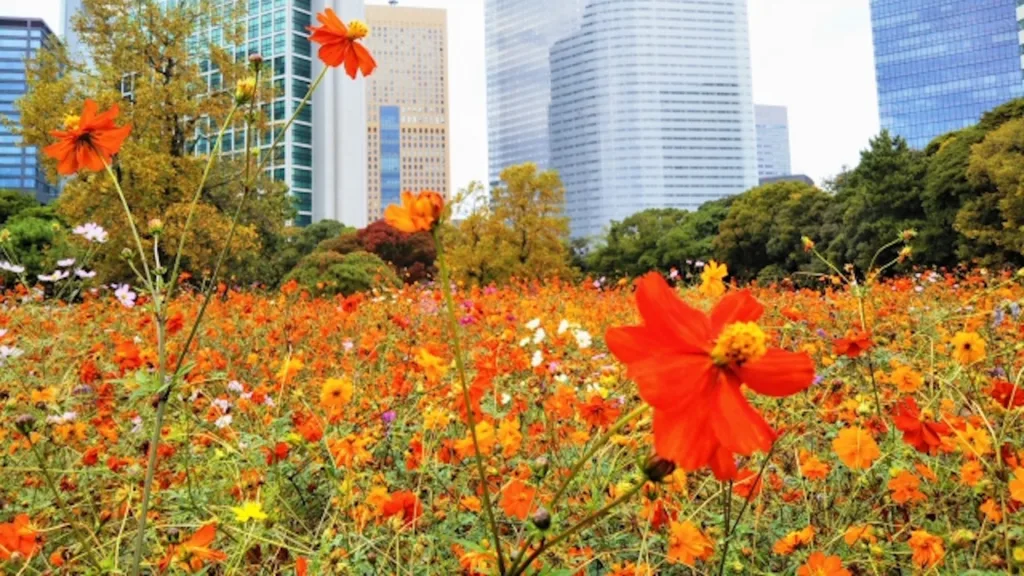
From mid-September to mid-October, some 150,000 pink and white cosmos take over the flower field. The sight of delicate blossoms swaying against a backdrop of skyscrapers is something uniquely achievable in Hamarikyu — an image simultaneously ancient and unmistakably modern Tokyo.
From mid-November to early December, approximately 260 trees turn color across the garden. Nine species — including the Japanese maple (Iroha Momiji), the wax tree, ginkgo, zelkova, and Trident maple — provide a palette ranging from deep crimson to bright gold, their reflections doubling in the still water of the tidal pond.
Winter: Camellias, Winter Peonies, and Serene Stillness
Winter brings camellias, winter peonies, and narcissus into quiet bloom, along with the waxy yellow flowers and sweet scent of roubai (Japanese allspice). With visitor numbers lower than in other seasons, the garden feels almost private — an unhurried space for taking in the same stillness that Edo-period nobles once enjoyed.
Teahouses, a 300-Year-Old Pine, and Duck Hunting Ponds
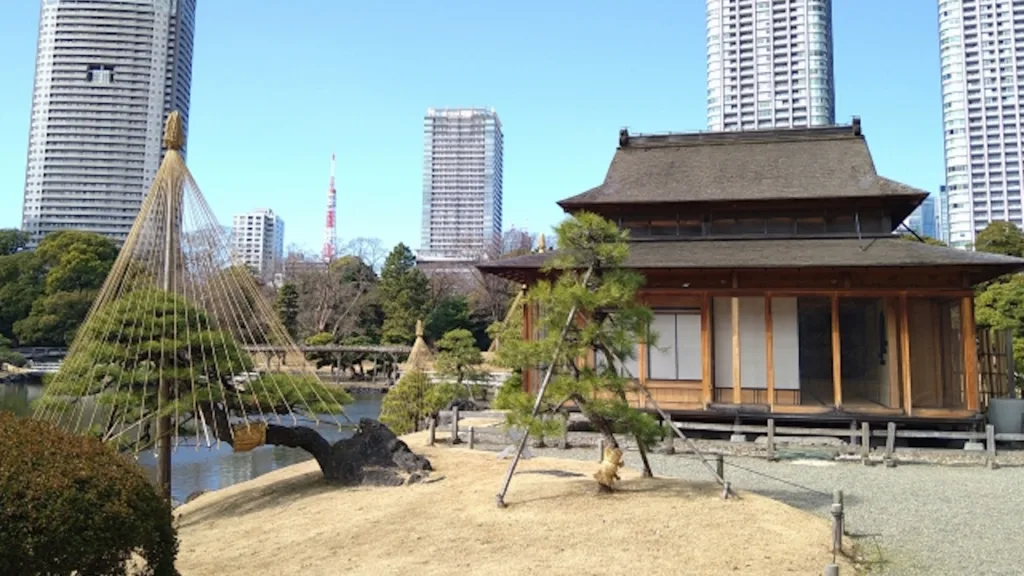
Four Historic Teahouses
Scattered around the tidal pond are four teahouses, each used by successive shoguns for entertaining guests, viewing artworks, and resting during falconry outings.
Nakajima no Ochaya (Central Island Teahouse)
The only teahouse currently open for service. Matcha and wagashi are available, with the monthly confectionery design changing to reflect the season. The island setting and views from the open veranda make this a memorable stop in any visit.
Matsu no Ochaya (Pine Teahouse)
A reconstructed teahouse open for interior viewing on Thursdays from 11:00 AM to 2:00 PM, on a rotational basis of approximately 20 minutes per group (limited to 25 visitors aged middle school or above; socks required). The building faithfully replicates Edo-era materials and construction methods.
Tsubame no Ochaya and Taka no Ochaya (Swallow and Hawk Teahouses)
Viewable from the exterior only, these two teahouses stand at the pond’s edge as silent keepsakes of the shogunal era.
The 300-Year-Old Pine and the Duck Ponds
The garden’s most celebrated tree is the Sanbyakunen no Matsu (“300-Year-Old Pine”), a massive black pine said to have been planted to commemorate the renovation overseen by sixth shogun Ienobu. Its thick, low-spreading branches make it one of the largest black pines in Tokyo.
Two traditional duck hunting ponds — Koshin-do Kamoba and Shinsenza Kamoba — occupy a quieter section of the garden, both constructed in the latter half of the 1700s. Near each pond stands a kamozuka, a small memorial erected to honor the spirits of the waterfowl taken in hunting. From the garden’s artificial hill, Fujimi-yama, clear days afford a distant view of Mount Fuji — the same view the Edo-era occupants of this garden once admired.
Admission Fees and Annual Passes
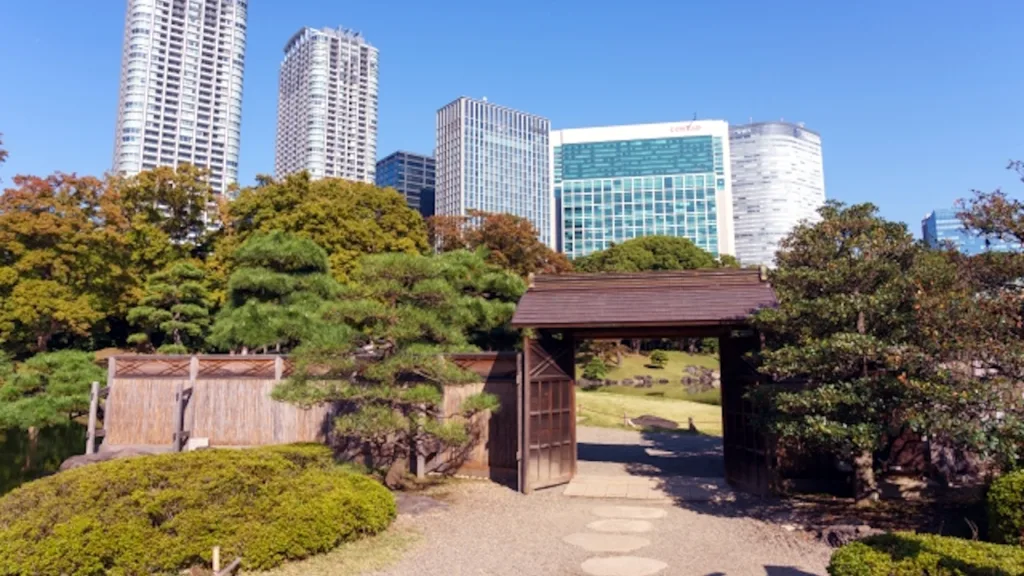
| Category | Standard | Group (20+) | En-musubi Ticket |
|---|---|---|---|
| General | ¥300 | ¥240 | ¥400 |
| 65 and over | ¥150 | ¥120 | ¥200 |
| Elementary school and under | Free | — | — |
Free admission days: Greenery Day (May 4) and Tokyo Citizens’ Day (October 1).
The En-musubi Ticket (valid indefinitely, no expiration) covers admission to both Hamarikyu Gardens and Kyu Shiba Rikyu Garden (approximately 15 minutes on foot). It is the most economical option if you plan to visit both gardens on the same day.
| Annual Pass | Hamarikyu Only | 9 Gardens Combined |
|---|---|---|
| General | ¥1,200 | ¥4,000 |
| 65 and over | ¥600 | ¥2,000 |
The 9-garden combined annual pass is valid at Hamarikyu Gardens, Kyu Shiba Rikyu Garden, Koishikawa Korakuen, Rikugien, Mukojima Hyakkoen, Kiyosumi Garden, Kyu Furukawa Gardens, Kyu Iwasaki-tei Garden, and Tonogayato Garden.
Getting There
By Train and Subway
From the Otemon (Main) Gate:
- Toei Oedo Line “Tsukijishijo Station” — approx. 7 min walk
- Toei Oedo Line / Yurikamome “Shiodome Station” — approx. 7 min walk
- JR / Tokyo Metro Ginza Line / Toei Asakusa Line “Shimbashi Station” — approx. 12 min walk
From the Naka no Okado Gate:
- Toei Oedo Line / Yurikamome “Shiodome Station” — approx. 5 min walk
- JR “Hamamatsucho Station” — approx. 15 min walk
By Water Bus
Tokyo Cruise water buses operate between Asakusa and the Hamarikyu Gardens Landing Pier, traveling down the Sumida River — a scenic journey in its own right, offering river-level views of Tokyo’s skyline and historic bridges. Note that the Hamarikyu Gardens Landing Pier is a drop-off point only; boarding is not available at this pier.
Two Edo Gardens, Two Radically Different Philosophies
If you have the time, pairing Hamarikyu Gardens with a visit to Kyu Shiba Rikyu Garden — roughly 15 minutes on foot — unlocks one of Tokyo’s most intellectually satisfying comparisons. Both gardens were built on reclaimed Tokyo Bay land during the Edo period. Both survived centuries of urban development, earthquake, and war. Yet in almost every other respect, they represent opposing visions of what a garden should be.
Different Origins, Different Masters
Kyu Shiba Rikyu Garden was created in 1678 when Senior Councillor Okubo Tadatomo received land from the fourth shogun Ietsuna and summoned master gardeners from his domain in Odawara to build what he called Rakuju-en. This makes it approximately 24 years younger than Hamarikyu’s origin point of 1654 — but the more significant difference is one of rank. Kyu Shiba Rikyu was the private creation of a senior councillor, a powerful figure certainly, but still a subject of the shogun. Hamarikyu, by contrast, was built by a direct member of the Tokugawa bloodline and subsequently became a shogunal villa. If Hamarikyu was the garden of supreme political power, Kyu Shiba Rikyu was the garden of the bureaucratic elite who made that power function.
Scale and Pace
Hamarikyu covers approximately 250,000 square meters and takes one to one and a half hours to circuit. Kyu Shiba Rikyu covers roughly 43,000 square meters — about one-sixth the area — and can be walked comfortably in around 30 minutes. Its proximity to JR Hamamatsucho Station (one minute on foot) makes it one of the most accessible gardens in the city, well suited to a visit squeezed between other Tokyo appointments. Hamarikyu demands a fuller commitment of time; Kyu Shiba Rikyu rewards spontaneity.
“Garden of Water” vs. “Garden of Stone”
The most fundamental difference lies in what each garden chooses to show. Hamarikyu’s centerpiece is living water — a tidal pond still connected to Tokyo Bay, whose surface changes with each turn of the tide and whose depth carries the salt of the ocean. The garden is in constant, subtle motion.
Kyu Shiba Rikyu’s masterpiece, by contrast, is stone. The garden’s Odawara gardeners brought root-river stones (nebukawa-ishi) and black Fuji stone (kurohaku-ishi) from their region to construct meticulously layered rock arrangements. The most celebrated feature is a stone causeway modeled on the Sudi of West Lake (Xihu) in Hangzhou, China — an idealized recreation of a landscape that Edo-era intellectuals knew only through poetry and painting. The central island holds a stone arrangement representing Horai, the mythical mountain in Chinese tradition where immortals were said to dwell. The entire garden is a philosophical statement in rock.
Kyu Shiba Rikyu also once had a tidal pond like Hamarikyu’s, but land reclamation in the surrounding area severed its connection to the sea. Today its pond holds fresh water only — another point of contrast with Hamarikyu, where the ocean connection remains unbroken.
Different Cultural Property Designations
From a cultural property standpoint, the two gardens sit at different levels. Hamarikyu holds the dual designation of Special Place of Scenic Beauty and Special Historic Site — the highest category under Japan’s Law for the Protection of Cultural Properties. Kyu Shiba Rikyu is designated as a Place of Scenic Beauty (one tier below “Special”). This gap reflects the difference in their historical significance as assessed under Japanese cultural heritage criteria, though scholars consistently praise Kyu Shiba Rikyu’s stone-work as among the finest surviving examples of Edo garden craftsmanship.
Visiting Both on the Same Day
Spending a day visiting both gardens offers a complete survey of what Edo landscape culture could achieve. The scale, drama, and living tide of Hamarikyu pair naturally with the compact, philosophically layered world of Kyu Shiba Rikyu. The En-musubi Ticket (valid indefinitely) covers both gardens at a reduced combined admission, and Kyu Shiba Rikyu’s admission of ¥150 makes the addition of a second garden an easy decision.
Nearby Attractions
Kyu Shiba Rikyu Garden
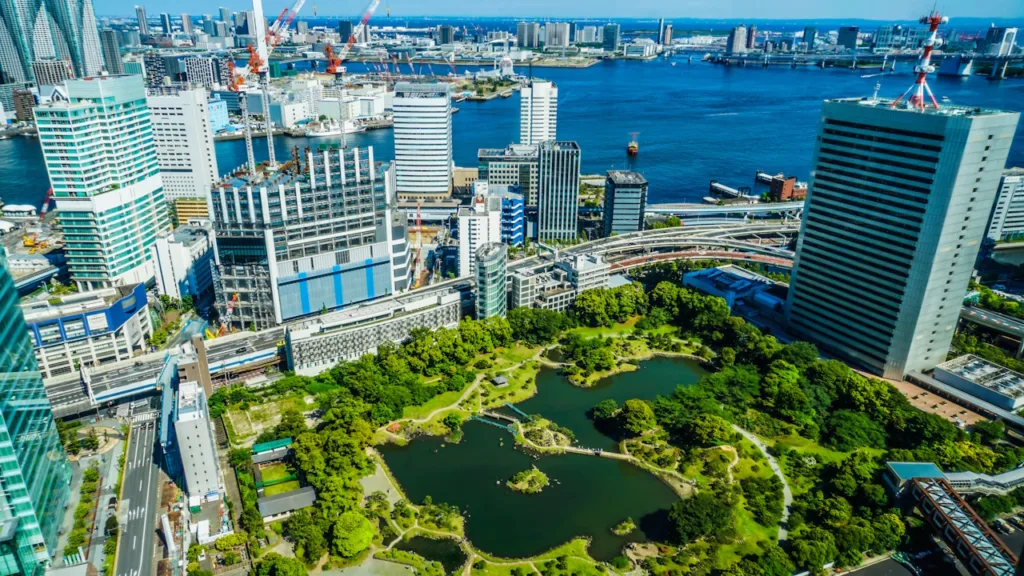
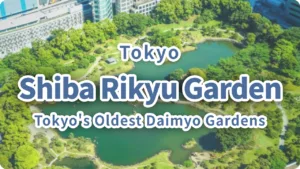
Approximately 15 minutes on foot from Hamarikyu, this national Place of Scenic Beauty is discussed in detail above. Its stone-focused, compact strolling garden provides an instructive contrast to Hamarikyu’s expansive water landscape. One minute from JR Hamamatsucho Station, it fits naturally into the same day’s itinerary.
Shiodome / Caretta Shiodome
The Shiodome commercial district adjoins Hamarikyu to the north. Caretta Shiodome houses restaurants on its upper floors, and the surrounding complex of towers offers dining, shopping, and an observation deck — a convenient base before or after the garden visit.
Tsukiji Outer Market
About 10 minutes on foot from Hamarikyu, the Tsukiji Outer Market remains a destination for fresh seafood, sushi, tamagoyaki (Japanese rolled omelette), and an assortment of kitchen goods. A stop here before the garden makes for a practical and satisfying way to combine two very different Tokyo experiences.
Ginza
Tokyo’s most prestigious shopping and dining district is within easy walking distance of Hamarikyu. Department stores, luxury boutiques, long-established Japanese specialty shops, and high-end restaurants are all accessible, making Ginza a natural destination for an evening after the garden.
Where to Stay Nearby
Conrad Tokyo
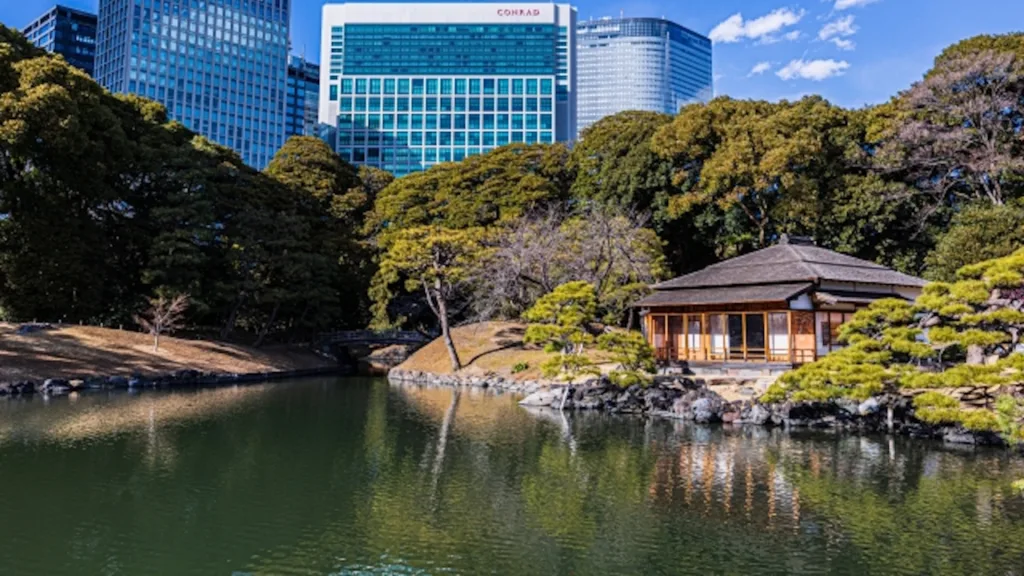
The first Conrad hotel in Japan and a flagship property of Hilton’s ultra-luxury Conrad brand, Conrad Tokyo occupies floors 28 to 37 of the Shiodome skyscraper directly overlooking Hamarikyu Gardens. Every room sits at the 26th floor or above, with floor-to-ceiling views of either Tokyo Bay, the gardens, or both. Standard rooms begin at 48 square meters with 3-meter ceilings — among the largest in Tokyo — and glass-walled bathrooms frame the greenery of the garden below. The hotel’s restaurants include China Blue for contemporary Chinese cuisine and Kazahana for refined Japanese kaiseki; the 28th-floor bar and lounge offers panoramic city views. Conrad Tokyo has received the Forbes Travel Guide Four-Star Award and consistently ranks among the top luxury hotels in Japan for international travelers.
mesm Tokyo, Autograph Collection
A Marriott Autograph Collection hotel occupying the waterfront WATERS Takeshiba complex, mesm Tokyo positions itself as an “art and music” hotel — its 265 rooms are equipped with digital pianos, and the design throughout the property channels the concept of “TOKYO WAVES” in deep midnight blue. Balcony rooms overlook both Hamarikyu Gardens and Tokyo Bay. The hotel’s French restaurant, Chef’s Theatre, and the 25th-floor Club Mesm lounge are particular highlights. A cruise pier directly in front of the hotel connects to Asakusa via the Sumida River, offering a water-based entry point to the city that complements a visit to the adjacent garden.
Daiichi Hotel Tokyo
A classic city hotel connected directly to Shimbashi Station by underground passage, Daiichi Hotel Tokyo has served travelers for more than 80 years. With Ginza a 5-minute walk away and Hamarikyu Gardens within easy reach, its location balances accessibility with a quieter residential feel compared to the Shiodome waterfront. Limousine bus services to both Haneda and Narita airports operate from directly in front of the hotel, a practical advantage for visitors arriving or departing by air.
Explore Japan with a Dedicated Tour Conductor
Visiting Hamarikyu Gardens is a rewarding experience on its own terms — but navigating the full context of a Tokyo trip, from airport connections and rail passes to communicating at teahouses and managing unexpected changes to a day’s schedule, is where the complexity of Japan travel often makes itself felt.
A dedicated tour conductor accompanies your itinerary throughout the journey. This is not a guiding role: a tour conductor’s professional responsibility covers itinerary management, emergency arrangements, and interpreter assistance in the kinds of on-the-ground situations that arise without warning — a missed connection, a booking discrepancy, a sudden change in accessibility at a venue. For visitors who want to engage deeply with a place like Hamarikyu — its history, its seasonal character, its position within the broader landscape of Edo culture — having the logistical and communication side of the trip handled by a professional frees up the attention to actually be present in the garden rather than managing the trip around it.
The experience of standing at the Otodai Bridge with the tidal pond stretching out below, the Nakajima no Ochaya ahead, and the towers of Shiodome rising in the distance, is one that rewards full presence. If you are planning a Japan trip and would like to explore what a dedicated tour conductor service can offer, details are available at tours.e-stay.jp.
Conclusion: Where the Tide Still Moves in an Edo Garden
Hamarikyu Gardens is, by almost any measure, an improbable survival. A 370-year-old landscape designed for a society that no longer exists, wedged between some of Tokyo’s most valuable real estate, still receiving the ocean tides its shogunal builders originally drew in. The seasonal flowers, the teahouses, the ancient pine, and the duck ponds are all part of it — but the tidal pond is the irreplaceable heart.
As a nationally designated Special Place of Scenic Beauty and Special Historic Site, Hamarikyu represents the highest tier of Japan’s cultural heritage protection. As a public garden open for ¥300, it represents something rarer still: a space where the full depth of Edo history and the full spectacle of Tokyo’s modernity exist in the same frame, available to anyone willing to walk through the gate.
Whether you visit in February for the rapeseed flowers and plum blossoms, in October for the cosmos, or in November for the maples, the garden offers a different face with each return. The tidal pond ensures that even within a single day, the view from the Otodai Bridge is never quite the same twice.