



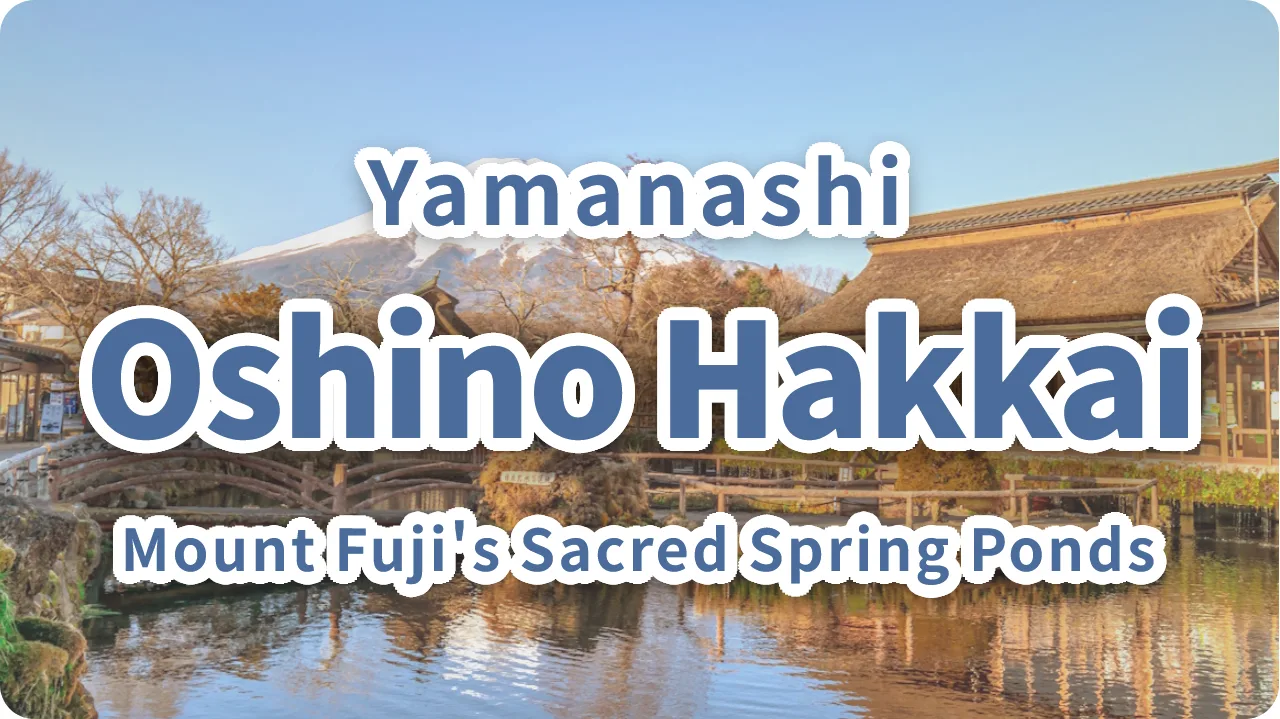
Travel insights from a tour conductor — today’s destination: Oshino Hakkai, a cluster of eight crystal-clear spring ponds in the village of Oshino, Yamanashi Prefecture.
Oshino Hakkai (literally “the eight seas of Oshino”) is fed entirely by snowmelt from Mount Fuji. Rain and snow that fall on the mountain seep into layers of porous lava and spend decades being filtered underground before emerging here as some of the clearest spring water in Japan. The ponds were designated a National Natural Monument in 1934, selected as one of Japan’s 100 Exquisite Waters in 1985, and in June 2013 they were inscribed as a component of the UNESCO World Heritage Site “Fujisan, sacred place and source of artistic inspiration.”
The appeal goes beyond the water itself. Thatched-roof farmhouses, a working waterwheel, and rice fields spread out beneath Mount Fuji, creating a scene that feels like Japan’s countryside frozen in time. On a clear, windless day, the mountain reflects perfectly on the surface of the ponds. Sitting at roughly 940 meters above sea level, the village makes an easy day trip from Tokyo and ranks among the most visited spots in the Fuji Five Lakes region.
| Item | Details |
|---|---|
| Name | Oshino Hakkai |
| Hours | Open at all times (Sokonashi Pond, inside the Hannoki Bayashi Museum, is viewable 9:00 a.m.–5:00 p.m.) |
| Closed | Never (the Hannoki Bayashi Museum closes irregularly) |
| Address | Shibokusa, Oshino Village, Minamitsuru District, Yamanashi Prefecture |
| Access | Local bus from Fujisan Station (Fujikyuko Line) to the Oshino Hakkai bus stop; by car, about 10 minutes from the Yamanakako IC or 20 minutes from the Kawaguchiko IC |
What to Know Before You Go
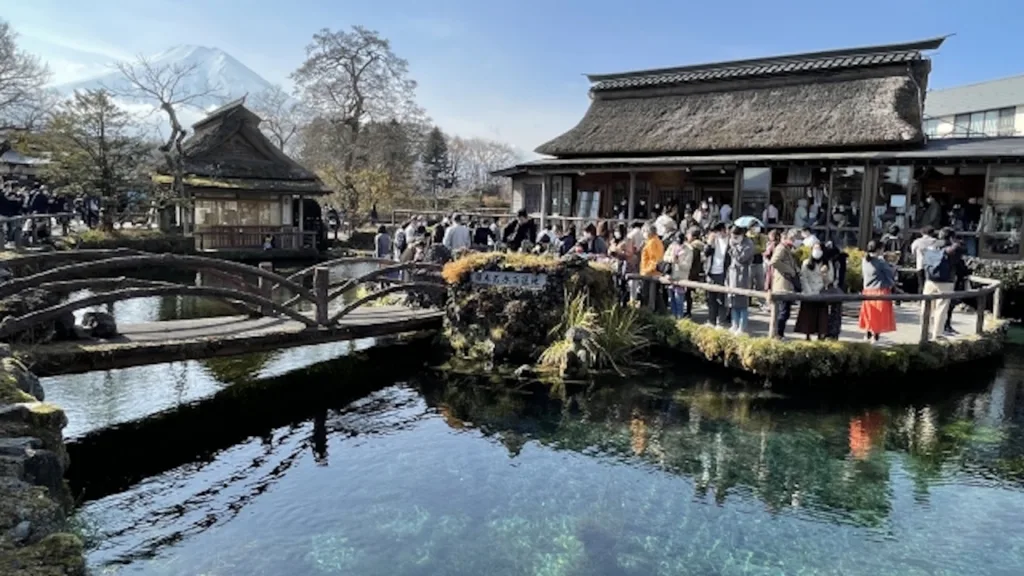
Here’s the single most common mistake visitors make at Oshino Hakkai: the large, dazzlingly clear pond at the center of the tourist area — the one everyone crowds around for photos — isn’t one of the eight. That pond, called Naka-ike, is a man-made pool attached to a souvenir shop. It’s about 10 meters deep and genuinely beautiful, but the National Natural Monument and World Heritage designations apply only to the eight natural spring ponds: Deguchi, Okama, Sokonashi, Choshi, Waku, Nigori, Kagami, and Shobu. Plenty of travelers photograph Naka-ike, browse the shops, and leave without ever seeing the real Oshino Hakkai. A quick look at a map before you arrive prevents that.
Crowds are the other consideration. Oshino Hakkai draws visitors from around the world, and the central ponds get packed from late morning onward. If you want the ponds in something close to silence, arrive early — before the tour buses roll in. There’s no evening illumination and few streetlights, so plan your visit for daylight hours. One more point of etiquette: the ponds hold precious spring water, so tossing coins into them or dipping your hands in the water is off-limits.
From a Vanished Lake to a Sacred Pilgrimage Site
The land where Oshino Village now sits was once the bottom of a vast lake called Lake Utsu. According to tradition, Mount Fuji’s great eruption in the year 800 split Lake Utsu in two with flows of lava, creating Lake Oshino and Lake Yamanaka. Over the centuries that followed, Lake Oshino gradually drained away, leaving behind the basin that became the village — along with a handful of spring-fed ponds where Fuji’s underground water continued to well up. Those ponds are Oshino Hakkai.
For centuries, the ponds were revered as sources of pure, spiritually potent water. They became a site of misogi — ritual purification — tied to the Fuji worship tradition founded by the ascetic Hasegawa Kakugyo. Pilgrims of the Fujiko movement, who climbed Mount Fuji as an act of devotion, performed water austerities in these ponds before their ascent. The eight ponds came to be known collectively as the Fujisan Kongen Hakko Reijo, the “eight sacred lakes at the foot of Fuji.”
Fuji pilgrimage flourished during the Edo period, when Fujiko confraternities in the capital were said to number in the hundreds. By the late Edo era the practice had declined, and in 1843 a devotee named Tomoemon, founder of the Taigako confraternity, revived the site by enshrining one of the Eight Great Dragon Kings at each pond and erecting stone monuments carved with their names and poems. The revival spread Oshino Hakkai’s fame among Fujiko followers throughout the Kanto region. Fuji worship faded again after the Meiji government’s suppression of Buddhist practices, and by the postwar years the sight of white-robed ascetics performing water rituals had all but vanished. Tourism took over from around 1965, and the 1985 “100 Exquisite Waters” selection cemented the ponds’ place on Japan’s travel map.

One elegant detail survives from the ponds’ sacred past: the eight are said to be arranged in the shape of the Big Dipper and the North Star, with the outlying Deguchi Pond representing Polaris and the remaining seven tracing the constellation. Knowing the history transforms a stroll among pretty ponds into a walk through centuries of mountain worship.
The Eight Ponds, One by One
Each pond has its own character and its own legend. Seven of the eight sit within a compact area you can cover on foot in about 10 minutes’ walking distance of each other; only Deguchi Pond lies apart. Visiting all eight takes roughly two hours, while a circuit of seven (skipping Deguchi) takes about one hour. Following the ponds in their traditional pilgrimage order adds a satisfying structure to the walk.
Deguchi Pond (First Sacred Site)
The largest of the eight, and the only one set apart from the rest — about a 12-minute walk from the central area. With no shops nearby and far fewer visitors, it’s the pond that best preserves its natural atmosphere. A small shrine to Deguchi Inari Daimyojin stands in the woods overlooking the water.
Okama Pond (Second Sacred Site)
The smallest pond, yet one of the most vigorous. Its name — “cauldron pond” — comes from the way water surges up from below like boiling water in a kettle. Aquatic baikamo plants sway in the current above a startlingly blue depth.
Sokonashi Pond (Third Sacred Site)
The “bottomless pond” sits inside the grounds of the Hannoki Bayashi Museum, a paid facility covered in detail below. It’s shallow and calm in appearance, but legend holds that anything dropped into it gets pulled into a vortex and later surfaces in Okama Pond — the two are said to be connected by an underground water vein.
Choshi Pond (Fourth Sacred Site)
Named for its resemblance to a choshi, a traditional sake flask. You can watch spring water bubble up from the bottom, stirring the sand as it rises. Local tradition also links the pond to matchmaking and marriage.
Waku Pond (Fifth Sacred Site)
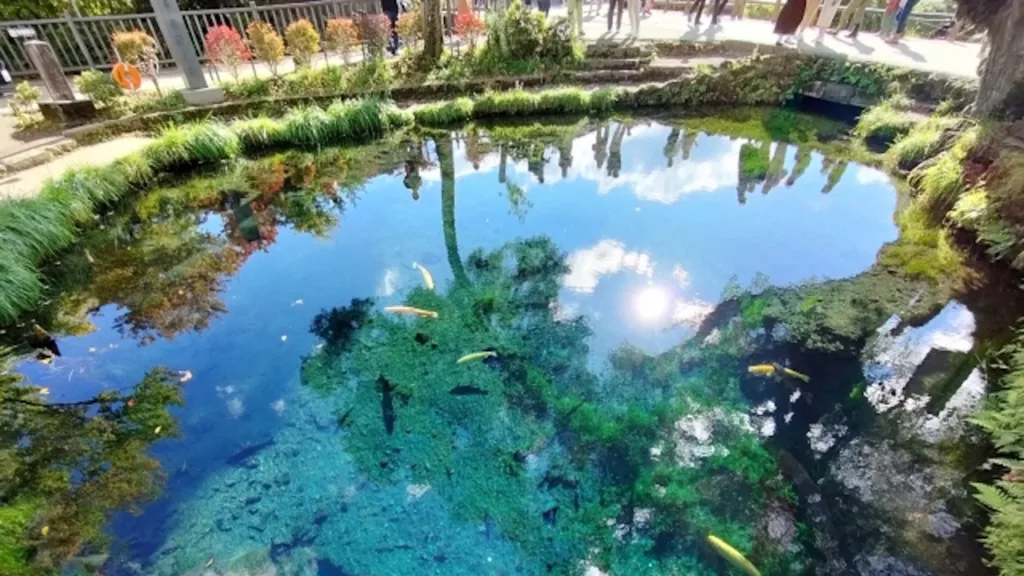
The signature pond of Oshino Hakkai, boasting the largest volume of spring water and the most celebrated scenery of the eight. It faces the busiest street, lined with souvenir shops and a waterwheel hut across the way. The shimmering surface and sculpted depths are mesmerizing — and in 1983, NASA reportedly used water from this very pond in an experiment to create snow in space.
Nigori Pond (Sixth Sacred Site)
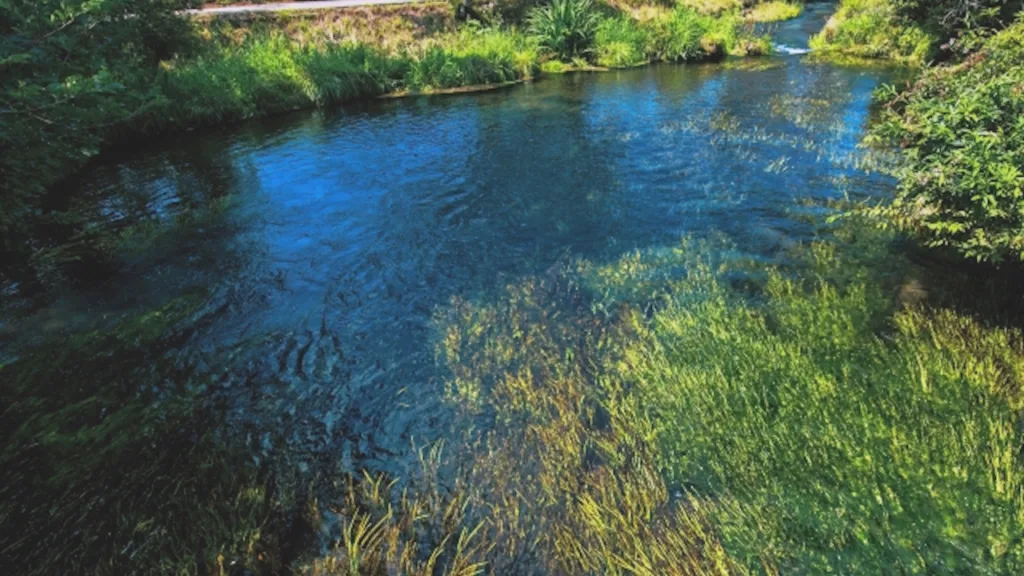
Adjacent to Waku Pond and merging with the Ahara River. The name means “muddy pond,” from a legend about a shabby-looking ascetic who was refused a cup of water here, causing the pond to cloud over. Today the water runs clear.
Kagami Pond (Seventh Sacred Site)
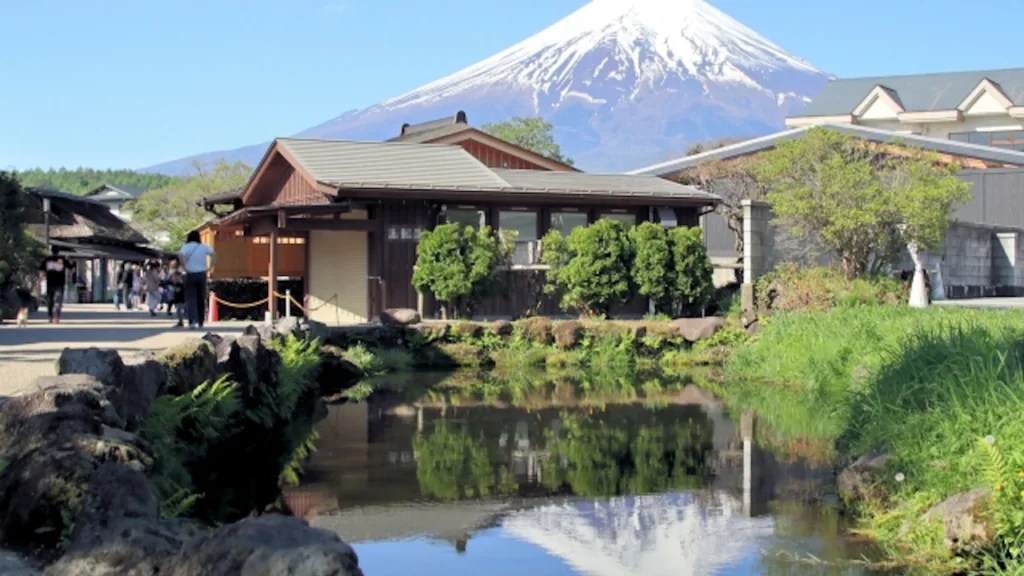
The “mirror pond” lives up to its name: on calm, clear days it reflects Mount Fuji like glass. The inverted Fuji seen here is one of the classic photographs of Oshino Hakkai.
Shobu Pond (Eighth Sacred Site)
The easternmost pond, ringed with iris plants that grow to shoulder height in season. A small park, Hakkai Shobuike Park, extends behind it.
Mount Fuji Through the Seasons
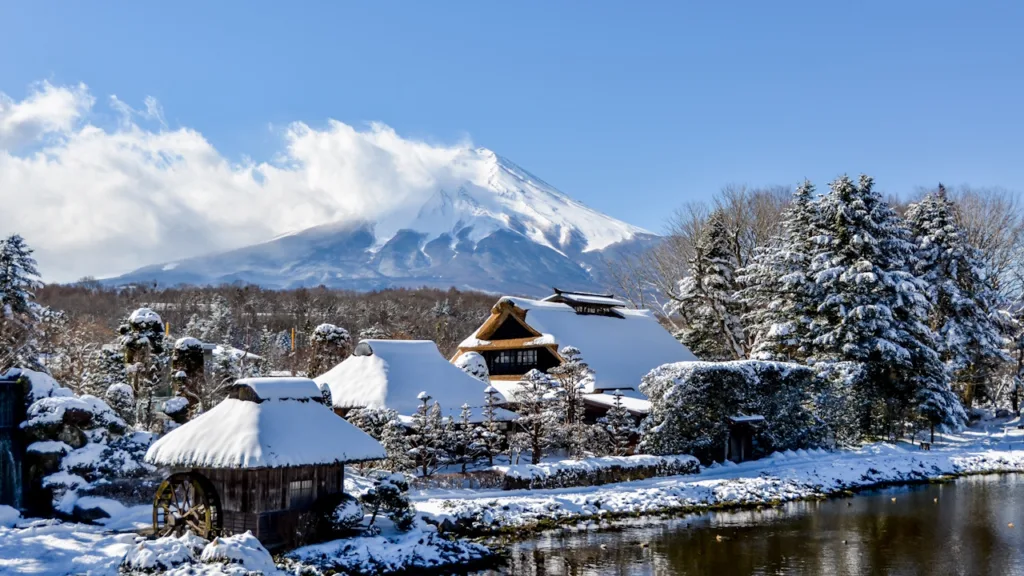
Oshino Hakkai rewards visits year-round. In spring, cherry trees bloom from mid- to late April, and the banks of the Shinnasho River on the village’s north side turn into a 400-meter corridor of somei-yoshino blossoms with Mount Fuji rising behind them. The Omiya Bridge is the spot photographers stake out for the classic frame of river, cherry blossoms, and mountain in a single shot.
Summer brings highland relief: at roughly 940 meters of elevation, August averages around 22°C, making the village a natural escape from the lowland heat. The Hakkai Festival on August 8 each year — honoring the Eight Great Dragon Kings — fills the village with bon dancing, food stalls, and fireworks. Autumn colors peak from late October through mid-November, when maples and ginkgo trees blaze around the ponds and reflect on the water. In winter, the air turns crystalline, and snow-dusted thatched roofs beneath a white-capped Fuji make for some of the most atmospheric scenes of the year.
Local Flavors Born of Famous Water
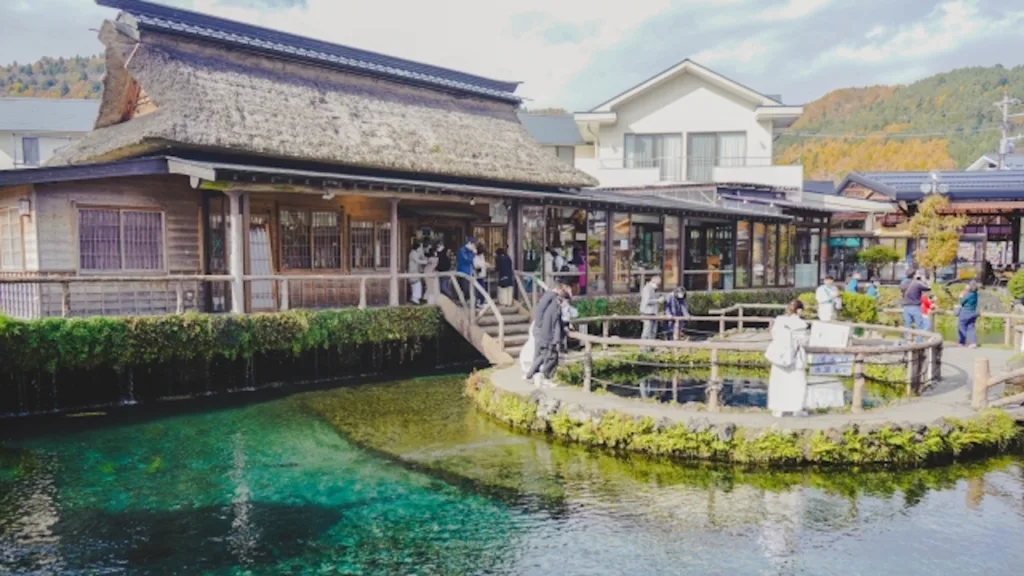
The same spring water that fills the ponds shapes the local table. Oshino’s signature dish is Oshino soba — buckwheat noodles made with the village’s spring water and locally grown buckwheat flour, prized for their firm, springy texture. Oshino is one of Yamanashi’s finest buckwheat-growing areas, and noodle shops cluster around the ponds. You’ll also find houtou (Yamanashi’s hearty flat-noodle miso stew), grilled river fish on skewers, and dango rice dumplings for snacking as you stroll. Lunch, in short, takes care of itself.
Sokonashi Pond and the Hannoki Bayashi Museum
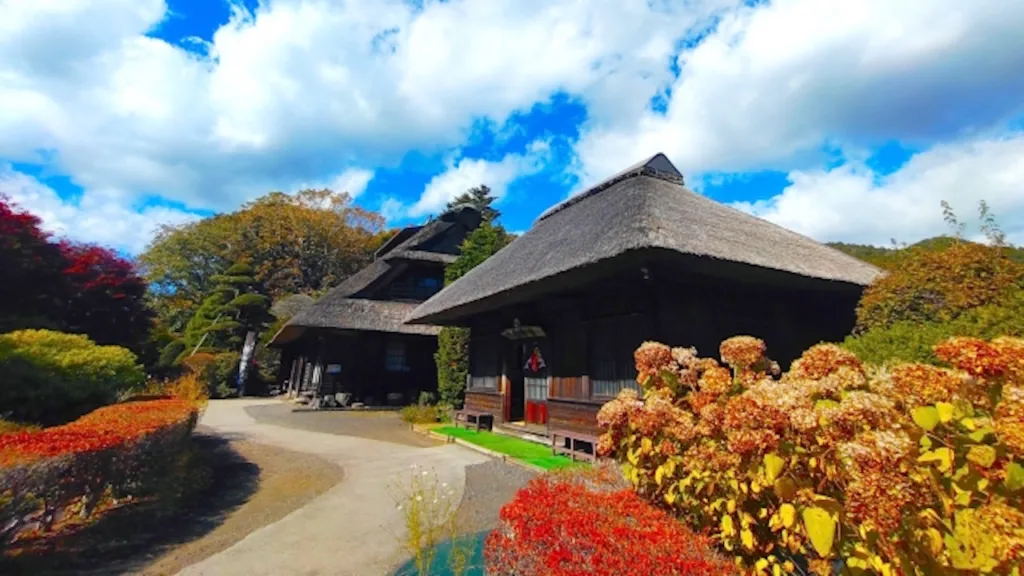
The third sacred site, Sokonashi Pond, is the only one of the eight that requires paid admission, as it sits within the grounds of the Hannoki Bayashi Museum. The museum occupies the oldest surviving thatched farmhouse in Oshino Village — the Watanabe family residence, built in the late 18th century — and displays the household’s furnishings, farming tools, silkworm-raising equipment, samurai armor, and historical documents just as they were used. The standout artifact is a vermilion-seal letter from the Hojo clan, sent in 1582 after the fall of the Takeda family, urging a local retainer to rally the region — a tangible piece of Sengoku-era history.
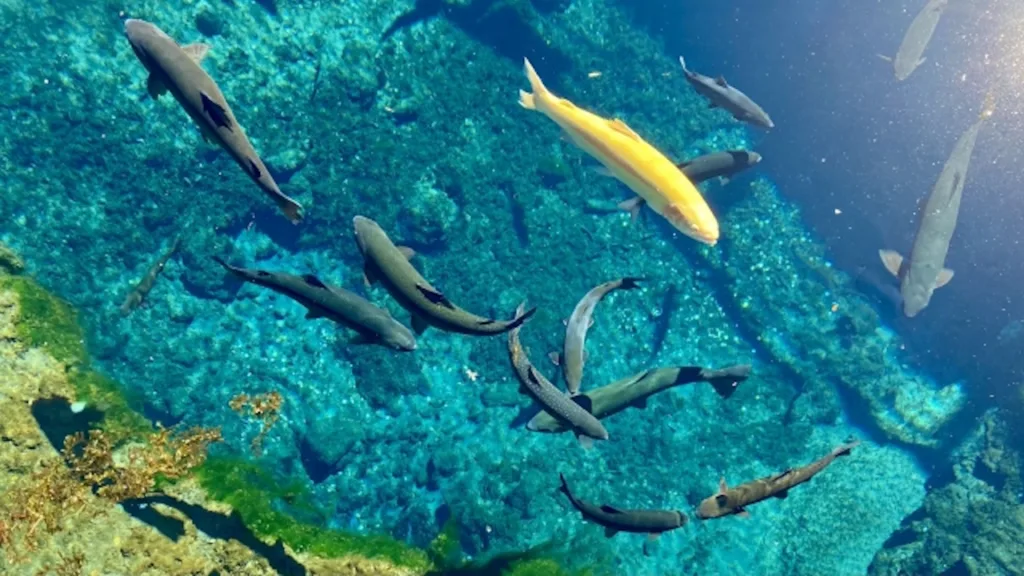
Beyond the pond itself, the grounds hold carp and rainbow trout ponds, and an observation spot frames Mount Fuji rising above the thatched rooftops — arguably the single most “Oshino” view in the village. Because entry is paid, the grounds stay far quieter than the free central area, making this a genuine refuge from the crowds. The museum opens 9:00 a.m. to 5:00 p.m. and closes irregularly. Everything else at Oshino Hakkai can be seen free of charge.
Nearby Spots Worth Adding to Your Itinerary
Oshino Shinobi no Sato
A ninja theme park about five minutes’ drive from the ponds, complete with live ninja shows, shuriken throwing, a trick maze house, and a formal Japanese garden with Mount Fuji as its borrowed scenery. It works equally well for families and adults, and pairs neatly with a morning at the ponds.
Yamanashi Prefectural Fuji Spring Water Aquarium (Sakana Park)
Also about five minutes away by car, this freshwater aquarium inside Sakana Park uses Fuji’s spring water in its tanks. The signature exhibit is a clever double-ring tank where large and small fish appear to swim together in the same water. The cool, clear-water displays have a serenity you won’t find at big marine aquariums, and it’s a reliable rainy-day option.
Shibokusa Sengen Shrine
A small shrine right beside the ponds, long venerated as the guardian of Oshino Hakkai. Its three sacred statues are designated cultural properties. The compact grounds carry a real weight of history, and it’s close enough to fold into your pond circuit without any detour.
Where to Stay Near Oshino Hakkai
Oshino itself is a small village, so most travelers base themselves around Lake Yamanaka or Fujiyoshida, both within an easy drive. Here are three highly rated options.
Hotel Mt. Fuji
A resort hotel perched at 1,100 meters on a rise above Lake Yamanaka, with the lake spread out in front and Mount Fuji filling the view to the right. The hotel draws its hot-spring water from the Benifuji no Yu source and offers two bathing areas: the Mantenboshi baths and the panoramic open-air Hanare no Yu, which takes in both the mountain and the lake. Oshino Hakkai is about a 15-minute drive, making this a convenient base for the whole Fuji Five Lakes area.
Fuji Marriott Hotel Lake Yamanaka
Part of the global Marriott chain, this quiet forest retreat near Lake Yamanaka offers rooms all exceeding 40 square meters, a hot-spring bathhouse with an open-air bath fed by the Yamanakako onsen source, and select rooms with private hot-spring tubs. It suits travelers who want international-brand consistency wrapped in a genuinely tranquil natural setting.
Fujisan Onsen Hotel Kaneyamaen
A classic Japanese ryokan in Fujiyoshida, famous for its expansive landscaped garden and a rooftop open-air bath that faces Mount Fuji head-on from about 35 meters up. Ranked 8th nationwide in the 2024 “100 Best Ryokan Selected by Professionals,” it delivers the full ryokan experience — seasonal kaiseki dinners, taiko drum performances, and meticulous omotenashi hospitality. Oshino Hakkai is roughly a 15-minute drive away.
Visiting Oshino Hakkai with a Dedicated Tour Conductor
The Fuji Five Lakes region is straightforward to reach but surprisingly fiddly to navigate: local buses run infrequently, signage at smaller stops is mostly in Japanese, and a missed connection can cost you an hour of precious daylight. A dedicated tour conductor takes that friction out of the day. Your conductor manages the itinerary from start to finish — confirming bus and train timings, keeping the schedule on track between Oshino Hakkai, Lake Yamanaka, and your hotel, and handling luggage logistics so you’re free to focus on the scenery.
If something goes wrong — a cancelled bus, sudden weather that closes a route, a lost reservation — the conductor handles the emergency re-booking on the spot, in Japanese, while you stay warm and unbothered. They’ll also assist with interpretation when you’re ordering Oshino soba, checking in at a ryokan, or asking about museum exhibits. It’s the difference between spending your energy on logistics and spending it on the view of Mount Fuji reflected in a spring pond. For details and bookings, visit tours.e-stay.jp.

Final Thoughts: Where Fuji’s Water Meets Japan’s Past
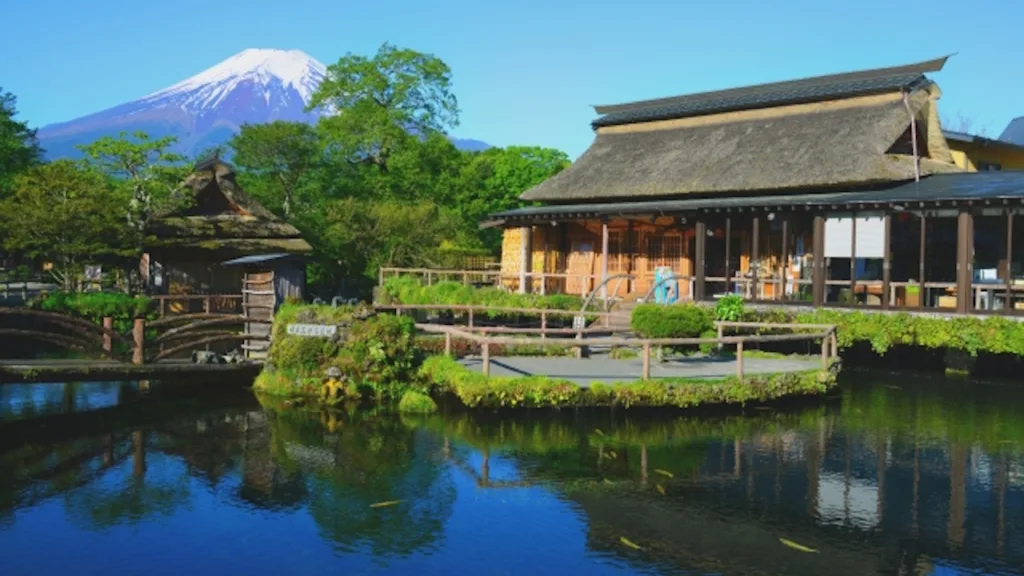
Oshino Hakkai packs a remarkable amount into one small village: eight sacred ponds fed by decades-old snowmelt, a millennium of Fuji worship, thatched-roof scenery straight out of old Japan, and — on a lucky day — a flawless reflection of the mountain itself. Sort out the difference between Naka-ike and the true eight ponds, walk the circuit in pilgrimage order, and step into the Hannoki Bayashi Museum grounds for that postcard view of Fuji above the thatched roofs.
A day trip covers the essentials, but staying overnight nearby lets you catch the ponds at their quiet, early-morning best and soak in a Fuji-view hot spring afterward. However you plan it, a dedicated tour conductor from tours.e-stay.jp will make sure the logistics never get between you and one of Japan’s most serene landscapes.