



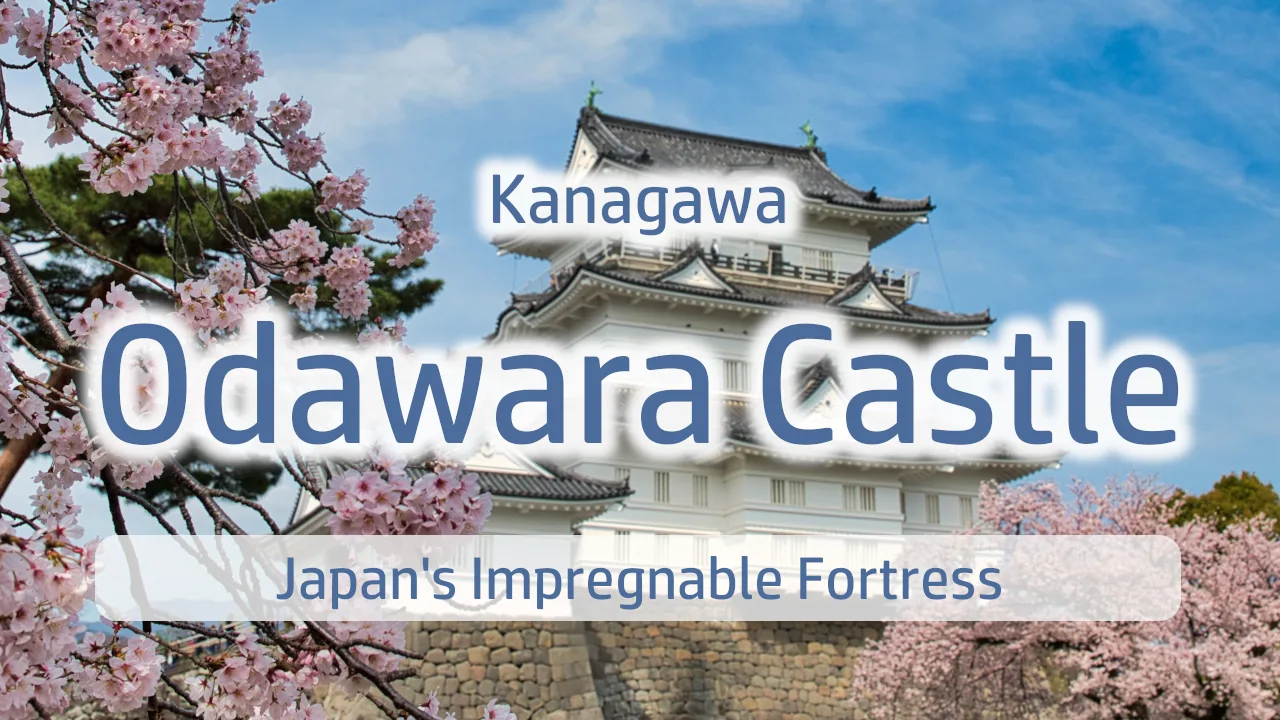
A travel writer brings you this guide to Odawara Castle (Odawara Castle Park), one of Kanagawa Prefecture’s most iconic landmarks. Rising above Sagami Bay on a commanding hilltop, the gleaming white keep has stood as the symbol of Odawara for generations — and with good reason. Within the castle park, visitors can explore five floors of samurai history inside the main tower, admire suits of armor up close at the SAMURAI Hall, and take on the role of a ninja at the interactive NINJA Hall. Few castles in Japan pack so much history, atmosphere, and hands-on experience into a single site. This guide walks you through everything you need to know before your visit.
| Facility | Odawara Castle (Odawara Castle Park) |
|---|---|
| Address | 6-1 Jonai, Odawara City, Kanagawa Prefecture |
| Opening Hours | 9:00 AM – 5:00 PM (last admission 4:30 PM) |
| Closed | 2nd Wednesday of December (Keep); December 31 – January 1 (all facilities) |
| Access | Approx. 10-min walk from the East Exit of Odawara Station (JR, Odakyu, Hakone Tozan Railway) |
One Thing to Be Aware Of Before You Visit
The admission fees at Odawara Castle were revised in March 2026. Adult admission to the main keep is now higher than before, and the NINJA Hall — while a genuinely entertaining experience — requires a separate ticket. If you are planning to visit multiple facilities, factor this into your budget. The NINJA Hall currently does not offer online ticket sales, so tickets must be purchased on-site. For visitors with limited time, prioritizing the main keep (which now includes entry to the SAMURAI Hall) gives you the best return per ticket.
From a Small Hilltop Fort to Japan’s Greatest Medieval Castle
The origins of Odawara Castle trace back to the Muromachi period. Around the mid-15th century, the Omori clan, who had extended their influence across western Sagami Province, constructed a modest fortification on this hilltop. Its original scale and exact founding date remain unclear, but it was almost certainly a small mountain stronghold by the standards of the era.
Everything changed around 1500, when Ise Shinkuro — better known to history as Hojo Soun, the founder of the Later Hojo clan — moved against the Omori and seized the castle. From that moment, Odawara became the beating heart of Hojo power. Over the next century, five successive Hojo lords — Soun, Ujitsuna, Ujiyasu, Ujimasa, and Ujinao — steadily expanded their hold over the Kanto region, and Odawara Castle grew with their ambitions, evolving from a regional outpost into the administrative and military capital of eastern Japan.
The castle reached its greatest extent under the fourth and fifth lords, Ujimasa and Ujinao, as the shadow of Toyotomi Hideyoshi’s unification campaign crept closer. Determined to withstand any siege, the Hojo constructed an extraordinary defensive network known as the sōgamae — a continuous system of moats and earthworks that encircled both the castle and the entire castle town in a loop stretching nine kilometers. At its completion, Odawara Castle had grown into the largest medieval castle complex in Japanese history.
Yet no fortress, however formidable, could hold back the tide of history forever. In 1590, Hideyoshi mobilized an army said to number two hundred thousand men and threw a ring of steel around Odawara. To further demoralize the defenders, he constructed a fully fortified castle on the ridge of Ishigaki-yama — overlooking Odawara from barely a kilometer away — completing it in secret before dramatically felling the surrounding trees to reveal it overnight. The psychological blow was devastating. After nearly three months of siege, the Hojo surrendered, bringing their century of dominance to an end. The fall of Odawara effectively marked the close of Japan’s Warring States period.
In the centuries that followed, the castle passed through a succession of lords under the Tokugawa shogunate — first the Okubo clan, then the Inaba, then the Okubo again — each leaving their mark on the structure. It served as a strategic stronghold guarding the Tokaido highway and the Hakone mountain pass throughout the Edo period. The Meiji government abolished the castle in 1870, and most of its buildings were dismantled and sold. The Great Kanto Earthquake of 1923 destroyed nearly all of the remaining stone walls. A corner turret was reconstructed in 1934, and in 1960 — ninety years after abolition — the main keep was rebuilt in reinforced concrete to restore the appearance it had held during the Edo period. The Tokiwagi-mon gate followed in 1971, the Akagane-mon in 1997, and the Umadashi-mon in 2009. The castle park is now designated a national historic site, a rare space where modern reconstructions stand alongside genuinely ancient earthworks.
Inside the Main Keep: Five Floors of History and a View Over Sagami Bay
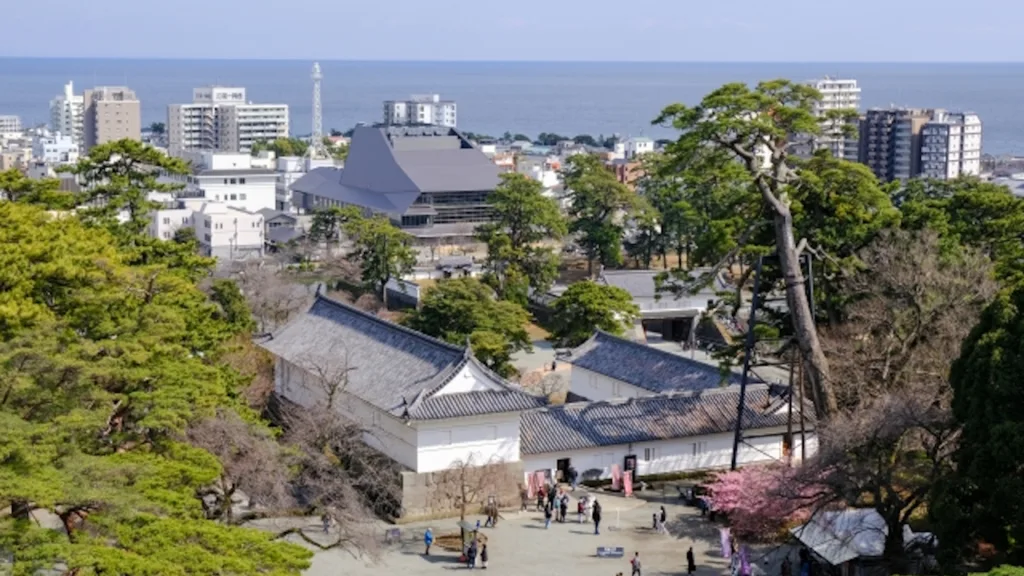
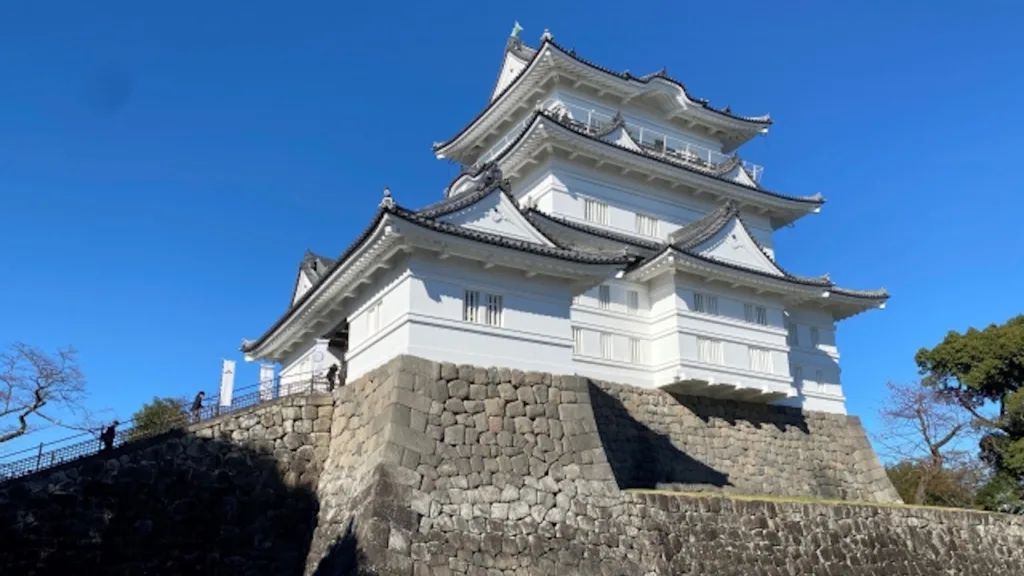
The current keep, reconstructed in 1960, is a reinforced concrete building faithfully modeled on the Edo-period original. Its interior has been fitted out as a history museum, with exhibits spread across five floors covering the full arc of Odawara’s story. Suits of armor, swords, illustrated maps, and historical documents fill the display cases, and video presentations at several points make the content accessible even without prior knowledge of Japanese history.
The top floor is the undisputed highlight. From roughly 60 meters above sea level, the observation deck commands a sweeping panorama of Sagami Bay that stretches, on clear days, all the way to the Boso Peninsula in Chiba Prefecture. The same floor also features a reconstructed altar space housing an image of Marici — a deity venerated as a protector by samurai — evoking the spiritual atmosphere that would have pervaded the original keep.
Throughout the castle park, the seasons paint the stone walls and gates in shifting colors. Spring brings around 250 cherry trees into bloom — an assemblage spectacular enough to earn a place on Japan’s list of top one hundred cherry blossom sites. Plum blossoms appear in February and March, wisteria and iris follow in May and June, lotus flowers emerge in summer, and hydrangeas bring cool color in autumn.
SAMURAI Hall (Tokiwagi-mon)
The SAMURAI Hall occupies the second floor of the Tokiwagi-mon gate, which stands at the entrance to the main bailey. It is a focused exhibition of armor and weaponry: elaborate battle dress, intricately crafted helmets, and the full equipment of a Sengoku-period warrior are displayed at close range. On the ground floor of the same gate, a samurai armor dress-up experience is available for a fee — an opportunity to put on a full suit of replica armor and pose for photographs in the main bailey. Since March 2026, a single keep admission ticket covers entry to the SAMURAI Hall as well, so there is no need to purchase a separate ticket.
NINJA Hall (Odawara Castle Historical Museum)
Located just past the Akagane-mon gate, the NINJA Hall is a participatory attraction built around the Fuma, a legendary ninja clan that served the Hojo throughout their century of rule. The facility opens with exhibits on the Hojo’s history and the nature of the Fuma clan — whose leaders bore the hereditary name Kotaro and whose fifth head was said to stand over two meters tall, with four protruding fangs and an appearance described as genuinely terrifying. From there, visitors are assigned a mission to defend Odawara Castle against Hideyoshi’s forces, and must work through a series of interactive zones — learning stealth techniques, solving challenges, and ultimately facing enemy ninja in a motion-sensing battle theater. The Fuma were immortalized in the popular manga NARUTO, which brought them renewed recognition worldwide. Children tend to love it; adults find it more engaging than expected.
Akagane-mon and Umadashi-mon Gates
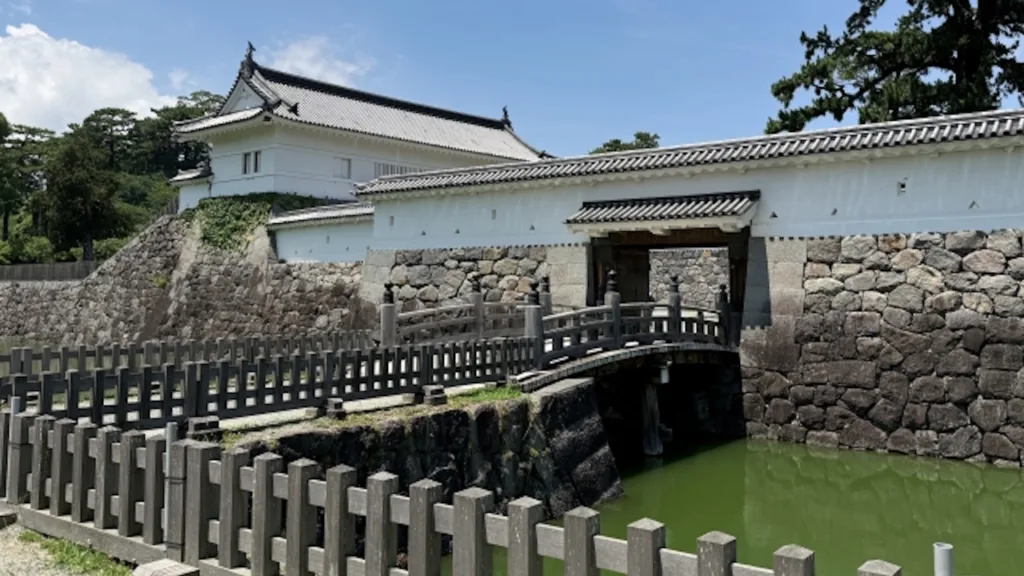
The Akagane-mon (Copper Gate), reconstructed in 1997, is the main gate of the second bailey and takes its name from the copper fittings that decorate its doors and walls. The Umadashi-mon, completed in 2009, is the outermost gate of the castle complex, combining stone walls with timber construction in a configuration that accurately reflects Edo-period castle architecture. Both are free to enter and make excellent subjects for photography.
A Castle Park That Changes With Every Season
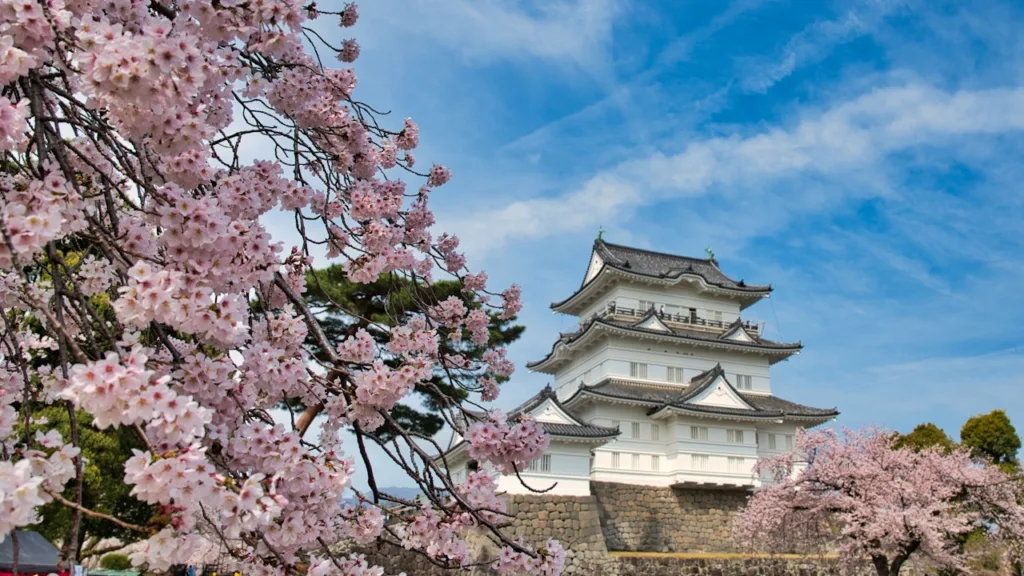
One of the defining qualities of Odawara Castle Park is the rhythm of its seasonal flowers, which transform the atmosphere of the stone walls and reconstructed gates throughout the year. In spring, the cherry blossoms — around 250 trees — frame the white keep against pale pink and blue sky in a composition that photographers travel considerable distances to capture. The plum grove blooms in late winter with a quiet, clean fragrance. From May into June, wisteria and iris bring deeper colors, and the vivid red of the Tokiwagi Bridge makes a striking foreground when the irises below it are in flower. Summer brings lotus blossoms to the ponds, and early autumn adds hydrangeas to the mix.
Within the park, several designated photography spots have been set up with camera stands, making it easy to capture the castle even when visiting alone. The Sumiyoshi Bridge, rebuilt in wood in 2018, and the Tokiwagi Bridge offer particularly strong compositions.
The Sōgamae: A Nine-Kilometer Fortress That Still Exists
What genuinely sets Odawara Castle apart from almost every other castle in Japan is that portions of the sōgamae — the nine-kilometer defensive perimeter that once enclosed the entire castle town — survive intact in the modern city. In most urban areas, such earthworks were long ago swallowed by development. In Odawara, sections including the massive Komine Ogane-no-dai moat system remain in remarkably good condition and can be walked or cycled. Standing at the edge of these broad, deep trenches, the sheer scale of what the Hojo built — and the ambition it represented — becomes viscerally real in a way that no museum exhibit can replicate. The city continues to restore and maintain these earthwork sites, and their historical value only grows with time.
Nearby Attractions Worth Combining With Your Visit
Hōtoku Ninomiya Shrine
Directly adjacent to the castle park, this shrine was established in 1894 to honor Ninomiya Sontoku — known affectionately as Ninomiya Kinjiro — an agricultural reformer and moral philosopher who was born in the Odawara area. The grounds are spacious and open, with an adjacent Hōtoku Museum dedicated to his life and legacy. An open-terrace café within the precinct makes it an easy and pleasant stop before or after exploring the castle.
Kamaboko Street
Running through the area between the castle and Odawara Station, this historic shopping street brings together around thirty long-established businesses: fishcake (kamaboko) makers, dried fish sellers, katsuobushi purveyors, Japanese sweets shops, and traditional restaurants. The street has no fences or barriers — visitors are free to wander at their own pace, graze, and shop. Kamaboko, a seasoned fish cake deeply associated with Odawara’s culinary identity, is available in a range of styles unique to this area.
Minaka Odawara
A compact three-minute walk from the east exit of Odawara Station, Minaka Odawara is a mixed-use complex combining local food, specialty shopping, a rooftop foot-bath garden with views of the bay, a library, and a hotel. The fourteenth-floor restaurant overlooks Sagami Bay and offers a natural wind-down point after a full day at the castle park.
Where to Stay Near Odawara Castle
Hilton Odawara Resort & Spa
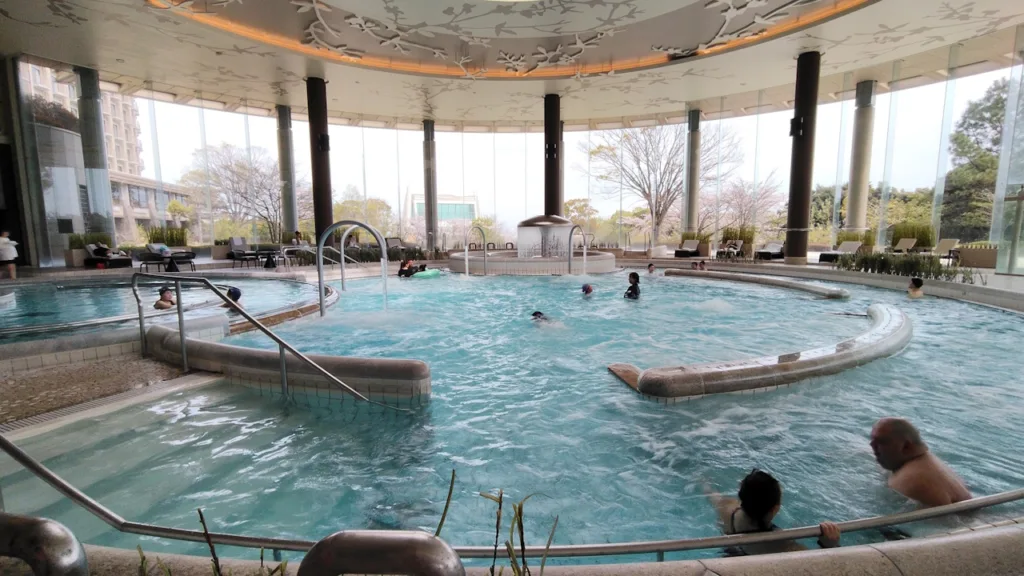

Perched at 183 meters above sea level on a ridge between the Hakone mountains and Sagami Bay, the Hilton Odawara Resort & Spa is the area’s flagship full-service resort. All 163 rooms face the ocean. The facilities are exceptional by any standard: a natural hot spring bath complex with outdoor tub, indoor bath, water bath, and sauna; a leisure pool zone (Baden Zone) with ten pools including a 25-meter lap pool; a full-service spa; indoor and outdoor tennis courts; a putting green and driving range; a fitness room; and a bowling alley. The natural spring drawn from 1,500 meters underground is a sodium chloride hot spring with notably strong heat-retention properties — guests regularly note that they stay warm for hours after bathing. The dinner buffet draws on locally sourced and farm-direct ingredients prepared across multiple cooking styles. Hotel guests may use the hot spring and pool facilities free of charge from before check-in through after checkout. Access is by free shuttle bus from JR Nebukawa Station (approximately 5 minutes); the castle is about 20 minutes by car.
THE VIEW Odawara (inside Minaka Odawara)
A three-minute walk from Odawara Station’s east exit and located within the Minaka Odawara complex, this city hotel combines outstanding convenience with polished facilities. The tenth floor houses a natural hot spring bath and sauna sourced from Hakone Yumoto, and a rooftop foot-bath garden offers views of Sagami Bay. All rooms use Airweave mattresses. The fourteenth-floor Sky Dining serves a breakfast buffet featuring local Odawara produce. The castle is within easy walking distance, and the hotel sits at the hub of train connections to Hakone and Atami.
Hotel Orenji
Approximately two minutes on foot from Odawara Castle and three minutes from the station, Hotel Orenji occupies one of the most privileged positions of any property in the city. Rooms designed with the imagery of the castle town create a quietly distinctive atmosphere, and the surrounding blocks are dense with restaurants, convenience stores, and the kind of low-key streetlife that makes a base easy and enjoyable. Travelers who have stayed here consistently highlight the castle-view rooms as the standout feature.

Explore Japan With a Private Tour Conductor
Traveling in Japan independently is entirely feasible, but navigating language barriers, local train systems, and site-specific nuances can occasionally make the experience more stressful than it needs to be. A private tour conductor — distinct from a tour guide — travels alongside you throughout your trip, handling itinerary logistics, providing translation support when needed, and assisting with any unexpected situations that arise. The focus is on making your journey run smoothly so that you can direct your full attention to the places themselves. For travelers visiting a historically layered destination like Odawara — where the context behind the castle, the surviving earthworks, and the surrounding town genuinely enriches what you see — having someone on hand who understands that context can make a real difference.
For details on private tour conductor services, visit https://tours.e-stay.jp.

Final Thoughts
Odawara Castle rewards visitors who come with a degree of curiosity about what they are looking at. The reconstructed keep is handsome and the view from the top is genuinely striking, but the deeper satisfaction of a visit here comes from understanding the story behind it — the five generations of Hojo ambition that transformed a minor hilltop fort into the most formidable castle complex in medieval Japan, and the dramatic morning in 1590 when it was all brought to an end. The earthwork trenches that still run through the modern city are perhaps the most powerful reminder of that story: silent, massive, and easy to walk past without realizing what they represent. Give yourself time to find them.
From Tokyo, the journey takes around 35 minutes by Shinkansen — short enough for a day trip, but Odawara repays an overnight stay.