



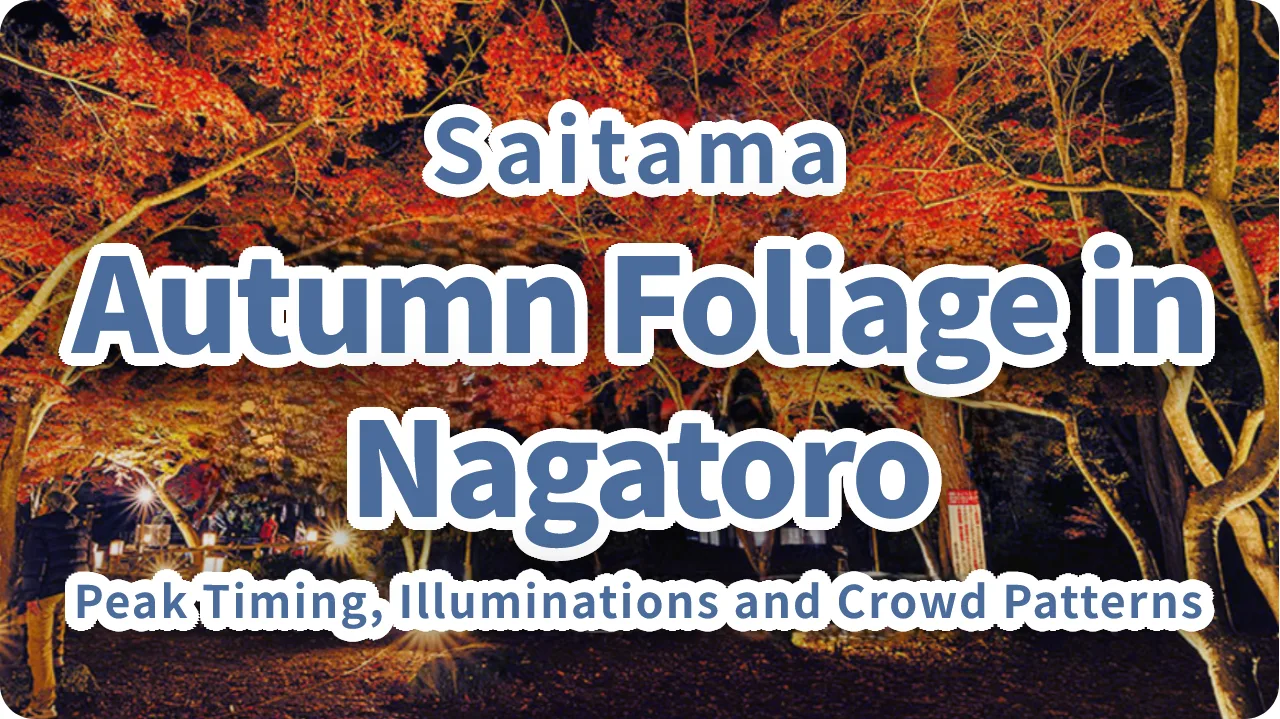
Travel insights from a tour conductor — today’s destination: the Nagatoro and Chichibu area of Saitama Prefecture, where autumn color rolls down from the mountains to the riverbanks over about six weeks. This guide covers 12 foliage spots, along with typical peak dates, evening illuminations and what the crowds usually look like.
It’s only about 1.5 to 2 hours from central Tokyo by train or car, which makes the area an easy day trip. The scenery changes a lot from place to place, too: a rocky gorge, mountain shrines, riverside parks and a railway bridge. Because the leaves turn at different times depending on elevation, you can plan around the week you’re traveling.
Autumn Crowds and Timing: What to Know First
On peak weekends, both Nagatoro and Chichibu get busy. Three points are worth sorting out before you go.
Weekend Traffic and Parking Queues
In Nagatoro, traffic jams are common during the foliage season, and parts of the town have traffic restrictions. Tsuki-no-Ishi Momiji Park tends to fill up between 4 pm and 7 pm on weekends and national holidays.
Up in the mountains, Mitsumine Shrine sits at about 1,100 m. Roughly 50,000 visitors are said to come during the foliage season. Roads nearby back up on weekends, and cars often wait to get into the parking lot.
The Nagatoro river boat ride is just as popular, with boarding queues in peak season. If you plan to combine foliage viewing and a boat trip in one day, build in waiting time.
Peak Dates Vary From Spot to Spot
Elevation drives the schedule. Deep in the Okuchichibu mountains and around Mitsumine Shrine, leaves start changing in mid-October and peak from late October to early November. Around the Iwadatami rock terraces in Nagatoro, the usual peak runs from early to late November.
Temperature and rainfall shift the timing from year to year. Rather than betting on one place, line up several spots, so you can swap in whichever one is at its best.
Evening Illuminations Are Chilly
Nagatoro’s night illuminations mean standing outside in air that’s colder than in central Tokyo. Temperatures can drop below 10°C on autumn mornings and evenings, so bring layers and warm gear. If you’re walking mountain trails, wear shoes with good grip.
The History Behind Nagatoro and Chichibu’s Autumn Scenery
Geology, a river and old shrines shaped these foliage spots. Knowing a little of the backstory makes the walk more interesting.
Nagatoro Gorge, the Birthplace of Japanese Geology
Nagatoro is known as the birthplace of geology in Japan. A monument marking that claim stands on the grounds of the Saitama Museum of Natural History.
Over a very long time, the Arakawa River carved the crystalline schist into flat rock shelves that look like tatami mats. This is Iwadatami, and it stretches about 600 m. It’s designated a national Place of Scenic Beauty and a Natural Monument.
From Timber Rafts to the Nagatoro River Boats
The Nagatoro boat ride grew out of “ikada-nagashi,” the practice of lashing logs into rafts and floating them down the Arakawa. Private operators started the boat service in 1915 (Taisho 4), and Chichibu Railway took over direct operation in 1923 (Taisho 12).
Today there are three courses: Course A (about 3 km) from Oppana Bridge to Iwadatami, Course B (about 3 km) from Iwadatami to just past Takasago Bridge, and Course C (about 6 km) covering both. The boats typically run from early March to early December.
The Three Chichibu Shrines and Yamato Takeru
Chichibu has three great shrines: Chichibu Shrine, Mitsumine Shrine and Hodosan Shrine. According to Hodosan Shrine’s own history, the legendary prince Yamato Takeru founded it during the reign of Emperor Keiko, in the early 2nd century. Legend also says a divine wolf led the prince to the summit after he was caught in a mountain fire.
Mitsumine Shrine is said to have been founded by Yamato Takeru about 1,900 years ago. At the entrance, wolf statues stand guard in place of the usual guardian dogs. Hodosan Shrine’s current main hall was rebuilt in 1874 in the gongen-zukuri style.
A Month-Long Relay of Autumn Color
Chichibu’s foliage starts in the high mountains and works its way down to Nagatoro and downtown Chichibu. From late October to early December, roughly six weeks, something is always at its peak.
Here are the typical peak periods for the main spots. They’re rough guides and shift with the weather.
| Item | Details |
|---|---|
| Mitsumine Shrine | Late Oct to early Nov |
| Nakatsu Gorge | Late Oct to mid Nov |
| Chichibu Muse Park | Late Oct to early Nov |
| Nagatoro Gorge and Tsuki-no-Ishi Momiji Park | Early to late Nov |
| Jomine Park | Early to late Nov |
| Seizenji Temple | Around mid Nov |
| Arakawa Railway Bridge (with the steam train) | Mid Nov to early Dec |
Every November, the Nagatoro Autumn Leaves Festival runs for a full month in town. Tsuki-no-Ishi Momiji Park, Hodosan Shrine and the Maple Forest at the museum are lit up at night during the festival.
12 Autumn Leaves Spots in Nagatoro and Chichibu
Below are 12 spots: three gorge and summit views, six places to stroll, two railway and bridge viewpoints, and one natural monument maple.
Gorge and Summit Views
Nagatoro Gorge (Iwadatami)
Nagatoro’s signature sight is Iwadatami, the rock terraces along the Arakawa River. Across the water, a cliff called Chichibu Akagabe rises up. The rock face, the red and gold leaves and the blue river fit into a single frame.
You can walk along the riverbed, or look up at the foliage from a river boat. From the water, the trees leaning toward the rocks are at eye level.
| Item | Details |
|---|---|
| Address | Nagatoro, Nagatoro-machi, Chichibu-gun, Saitama |
| Access | About 5 min on foot from Nagatoro Station (Chichibu Railway) |
| Typical peak | Early to late Nov |
Mt. Hodosan
At 497 m, Mt. Hodosan has a ropeway that carries you almost to the top. The 832 m ride takes about 5 minutes, and the foliage on the slopes changes color with the altitude outside your window.
At the summit, an observation deck called SUSABINO Terrace looks out over the colored mountains of Chichibu. There’s also a hiking trail from the base that passes Hodosan Shrine, and beginners can reach the top in about an hour.
| Item | Details |
|---|---|
| Address | 1766-1 Nagatoro, Nagatoro-machi, Chichibu-gun, Saitama (ropeway base station) |
| Access | About 20 min on foot from Nagatoro Station |
| Typical peak | Early to late Nov (Nagatoro area) |
Nakatsu Gorge and the Mochioke “Joro Momiji”
Nakatsu Gorge is a roughly 10 km valley carved by the Nakatsu River in the hills above Chichibu. Cliffs rise as high as 100 m, and the gorge is a Saitama Prefecture Place of Scenic Beauty. Maples, rowans and beeches dominate, and the leaves turn earlier here than almost anywhere else in the prefecture.
The “Joro Momiji,” a maple known for its vivid color, stands near the south (downstream) entrance of the Mochioke Tunnel on Prefectural Route 210. There’s no parking nearby. Deeper in Okuchichibu, Mt. Ryokami is another mountain loved by hikers for its autumn color, and plenty of visitors come to Chichibu just for it.
| Item | Details |
|---|---|
| Address | Nakatsugawa, Chichibu, Saitama |
| Access | About 35 min by taxi from Mitsumineguchi Station (Chichibu Railway) |
| Typical peak | Late Oct to mid Nov |
Spots for Strolling
Hodosan Shrine
Hodosan Shrine, one of the three Chichibu shrines, sits at the foot of Mt. Hodosan and is within walking distance of Nagatoro Station. Five carved dragons decorate the front of the main hall. They’re the best-known work of Iwajiro Iida, a sculptor active from the late Edo period, and you can see them with the foliage in the background.
During the Autumn Leaves Festival, the grounds are lit from evening into the night. It’s a classic Nagatoro stop that combines a shrine visit with the leaves.
| Item | Details |
|---|---|
| Address | 1828 Nagatoro, Nagatoro-machi, Chichibu-gun, Saitama |
| Access | About 15 min on foot from Nagatoro Station |
| Typical peak | Early to late Nov (Nagatoro area) |
Mitsumine Shrine
Mitsumine Shrine, at about 1,100 m in the mountains, is one of the first shrines near Tokyo where autumn color arrives. Maples line the grounds and approach, and from the worship hall and the parking area you can take in the whole Chichibu range.
The old approach on foot from the foot of the mountain takes about 2 hours 20 minutes one way. It passes Toryu Bridge and Seijo Falls, with leaves all along the trail. The triple torii gate at the entrance and the wolf statues standing in for guardian dogs are signature sights here.
| Item | Details |
|---|---|
| Address | 298-1 Mitsumine, Chichibu, Saitama |
| Access | About 75 min by Seibu Kanko bus from Seibu-Chichibu Station |
| Typical peak | Late Oct to early Nov |
Tsuki-no-Ishi Momiji Park
This riverside park gets its name from a haiku by the poet Takahama Kyoshi. Japanese maples and sawtooth oaks change color here, and about 50 large-leaf maples add to the display.
During the Autumn Leaves Festival in November, the park is the main venue for the evening illumination. With lights shining up from below, the maples glow against the night sky. Temporary parking is set up, but weekend evenings are crowded.
| Item | Details |
|---|---|
| Address | 947 Nagatoro, Nagatoro-machi, Chichibu-gun, Saitama |
| Access | About 5 min on foot from Kami-Nagatoro Station (Chichibu Railway) |
| Typical peak | Early to late Nov |
Saitama Museum of Natural History “Maple Forest”
The Maple Forest is on the grounds of the Saitama Museum of Natural History, right next to Tsuki-no-Ishi Momiji Park. During the festival, it’s lit up together with Hodosan Shrine and Tsuki-no-Ishi Momiji Park.
Inside the museum, you’ll find a reconstruction of Carcharocles megalodon, the giant shark that swam in the Chichibu sea about 15 million years ago, along with a skeleton of Paleoparadoxia, a marine mammal. So a foliage walk and a lesson in Earth’s history fit in the same stop.
| Item | Details |
|---|---|
| Address | 1417-1 Nagatoro, Nagatoro-machi, Chichibu-gun, Saitama |
| Hours | 9:00 to 16:30 (last entry 16:00) |
| Closed | Mondays (open if Monday is a national holiday or substitute holiday); year-end and New Year holidays |
| Access | About 5 min on foot from Kami-Nagatoro Station; about 15 min on foot from Nagatoro Station |
| Typical peak | Early to late Nov |
Jomine Park
Jomine Park in Kamikawa Town sits on a hill of about 500 m, close to the Saitama-Gunma border. About 600 winter cherry trees (Jugatsu-zakura) grow here, so colored leaves and pale pink blossoms share the same view.
The winter cherries bloom from late October to early December, and the park is lit from sunset to 8 pm depending on the bloom. From the observation deck you can see Shimokubo Dam and Lake Kanna, and the Sanba Gorge, a national Place of Scenic Beauty and Natural Monument, is nearby. Another place where winter cherries and autumn leaves overlap is Sakurayama Park in Fujioka, Gunma.
| Item | Details |
|---|---|
| Address | 1277 Yano, Kamikawa-machi, Kodama-gun, Saitama |
| Access | About 45 min from Honjo-Kodama IC (Kan-etsu Expressway) via Route 462 |
| Typical peak | Early to late Nov |
Chichibu Muse Park
This large park has playgrounds, open lawns and an observation deck. Along Sky Road, which runs through the middle of the park, about 500 ginkgo trees line a 3 km stretch and turn it into a golden tunnel.
Maples around Seseragi Plaza turn red. The Sky Train runs back and forth along Sky Road, so you can also watch the yellow leaves from the window. The park has no illumination, so daytime is the time to visit.
| Item | Details |
|---|---|
| Address | 2518 Nagadoro, Ogano-machi, Chichibu-gun, Saitama |
| Access | About 20 min by bus from Chichibu Station (Chichibu Railway) or Seibu-Chichibu Station |
| Typical peak | Late Oct to early Nov |
Railway and Bridge Viewpoints
Arakawa Railway Bridge
The Arakawa Bridge carries the Chichibu Railway across the Arakawa River. In autumn, you can photograph the steam locomotive “Paleo Express” crossing the bridge with the colored hills behind it. Steam trains run only on certain days, so the best day is one when a run lines up with peak color.
From around Kami-Nagatoro Station, walk down to the embankment of the Arakawa and the bridge comes into view, though you can’t get close to it. A telephoto lens helps frame the bridge and the leaves.
| Item | Details |
|---|---|
| Address | Nagatoro, Nagatoro-machi, Chichibu-gun, Saitama |
| Access | On foot from Kami-Nagatoro Station (Chichibu Railway) to the riverbank |
| Typical peak | Mid Nov to early Dec (steam train with foliage) |
Shiratori Bridge
Shiratori Bridge spans the Arakawa at its farthest point downstream. Beyond the bridge, the river leaves Chichibu and flows into Lake Tamayodo. From the bridge you can look over the rocky gorge.
There’s no parking or restroom around the bridge. Starting from the nearest station, Higuchi Station on the Chichibu Railway, and walking in keeps things simple.
| Item | Details |
|---|---|
| Address | Nogami-shimogo, Nagatoro-machi, Chichibu-gun, Saitama |
| Access | Nearest station is Higuchi Station (Chichibu Railway) |
| Typical peak | Early to late Nov (Nagatoro area) |
A Natural Monument Maple
Seizenji Temple’s Komine Maple
Seizenji Temple in Yokoze is Temple No. 8 on the Chichibu 34-temple Kannon pilgrimage. It’s said to have been founded in 1234, and in 1515 Uesugi Norifusa, the Kanto Kanrei, restored it and gave it its present name.
The Komine maple on the grounds is a giant, with a trunk circumference of 3.75 m, a height of 10 m and branches that spread 17.5 m in each direction. It’s estimated to be 600 years old and is a Saitama Prefecture Natural Monument. The leaves peak a little after the ginkgo, around mid-November. In the foliage season, the temple usually opens the “Muryoju no Ma” room for special viewing, where the maple looks like a folding-screen painting.
| Item | Details |
|---|---|
| Address | 598 Yokoze, Yokoze-machi, Chichibu-gun, Saitama |
| Access | About 25 min on foot from Yokoze Station (Seibu Railway) |
| Typical peak | Around mid Nov |
Nearby Spots Worth Adding to Your Nagatoro Foliage Day
Several places around Nagatoro Station work well between foliage stops. All three below are an easy distance apart.
Kaneishi Suidokyo Bridge
Kaneishi Suidokyo is the only bridge across Nagatoro Gorge, and only pedestrians and bicycles can cross. From the middle you get a 360-degree panorama of the colored hills, and you can watch boats on the Arakawa below. It’s counted among Nagatoro’s three great foliage spots. It’s about 21 minutes on foot from Nagatoro Station, or about 15 minutes from Nogami Station.
Asami Reizo Kanasaki Main Store
Right by Kami-Nagatoro Station, Asami Reizo has been producing natural ice since 1890 (Meiji 23). Its shaved ice, made from natural ice frozen from Hodosan spring water, is the specialty, and the menu of house syrups is long. The address is 27-1 Kanasaki, Minano-machi, Chichibu-gun, Saitama. It’s a good place to cool down and rest in the middle of a foliage walk.
Hodosan Small Animal Park
Near the summit of Mt. Hodosan, this small zoo has Japanese macaques, rabbits and peacocks, among other animals. It fits neatly into the ropeway ride up the mountain, so it works well for families too. If your day has some slack, add it to your summit walk.
Where to Stay for the Foliage Season
You can see Chichibu’s foliage in a day, but an overnight stay gives you the morning and evening light and the night illuminations at an easier pace. Here are three properties in different locations.
Nagatoro Onsen Hana no Omotenashi Choseikan
This long-established ryokan, founded in the Taisho era, is about 3 minutes on foot from Nagatoro Station. Every guest room faces the Arakawa River, with views of the gorge, Iwadatami and a Japanese garden. There are separate open-air baths for men and women, and the water is known for its bamboo vinegar. If you want to look down on Iwadatami in its autumn colors from your room window, this is the closest option.
Okuchichibu Yatsugawakan
Yatsugawakan, in Arakawa-Shiroku, Chichibu, is an inn built entirely of cypress and surrounded by the primeval forest of Okuchichibu. Besides the cypress bath and open-air bath, there are two private baths (one open-air) that guests can use without reservation. It’s about 15 minutes on foot from Shiroku Station on the Chichibu Railway, and a pickup service is available. It makes a handy base for Mitsumine Shrine, Nakatsu Gorge and other Okuchichibu foliage.
NIPPONIA Chichibu Monzenmachi
NIPPONIA Chichibu Monzenmachi is a “hotel in town” made from three renovated old houses near Seibu-Chichibu Station, with eight rooms in all. It opened in August 2022 and turns historic buildings, including the registered tangible cultural property Koike Tobacco Shop, into guest rooms. Every room has a cypress bath, and the restaurant serves dishes made with local ingredients. It suits a day heading to Chichibu Muse Park or Seizenji Temple, and the town itself is worth a stroll.
Visiting With a Dedicated Tour Conductor
Chichibu’s foliage season rewards a flexible plan, but it also punishes a loose one. Weekend queues for the river boats, mountain buses with limited departures and a changing peak schedule can eat into a day fast. A dedicated tour conductor takes that logistics load off your shoulders.
A tour conductor manages the itinerary, not the sightseeing commentary. That means keeping the day on schedule, checking that luggage and tickets are in order, and handling the transport connections between Tokyo, Nagatoro and the mountain areas. If a train is delayed or a road closes, the conductor re-books transport and meals on the spot. And if you don’t speak Japanese, the conductor helps with interpretation at ticket counters, ryokan check-ins and restaurants.
The result is a trip with less stress and more time looking at leaves. You can focus on the scenery while someone else watches the clock. To learn how a dedicated tour conductor service works, visit tours.e-stay.jp.

Conclusion
Chichibu’s autumn color moves like a relay: Mitsumine Shrine and Nakatsu Gorge in late October, Nagatoro’s Iwadatami and Tsuki-no-Ishi Momiji Park in November, and Seizenji Temple from mid-November on. A river boat, a summit view, a night illumination and a steam train crossing a bridge show the same leaves from very different angles. Since weekends bring traffic jams and boat queues, line up several spots and swap them as the color develops.
If it’s your first visit to Nagatoro, the ideal two-day plan is to walk Iwadatami and Kaneishi Suidokyo, stay at Choseikan, about 3 minutes from Nagatoro Station, and head up Mt. Hodosan the next morning. An evening watching the autumn-colored Iwadatami from your window is something a day trip can’t match, and it’s the best way to experience Nagatoro in fall.