

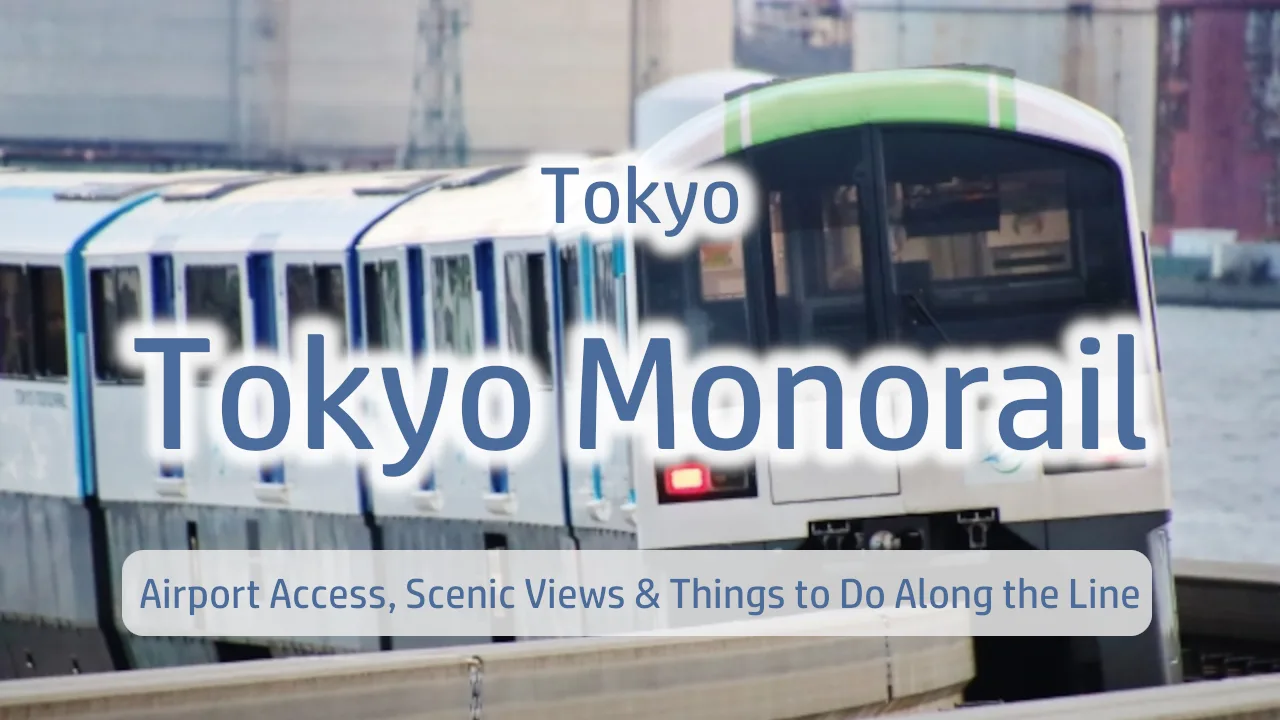
Your travel reporter brings you the latest from Japan. This time, we’re covering the Tokyo Monorail Haneda Airport Line — a 17.8-kilometer elevated railway that whisks you between central Tokyo and Haneda Airport while offering sweeping views of the ever-changing Tokyo Bay waterfront. Born in time for the 1964 Tokyo Olympics, this line has been evolving for over 60 years and continues to do so today.
| Item | Details |
|---|---|
| Line Name | Tokyo Monorail Haneda Airport Line |
| Nickname | Tokyo Panorama Line |
| Starting Station | Monorail Hamamatsucho (Minato, Tokyo) |
| Terminal Station | Haneda Airport Terminal 2 (Ota, Tokyo) |
| Distance | 17.8 km |
| Number of Stations | 11 |
| Maximum Speed | 80 km/h |
| Operator | Tokyo Monorail Co., Ltd. (JR East Group) |
| Official Website | tokyo-monorail.co.jp |
Choosing the Right Train: Service Types and Stops
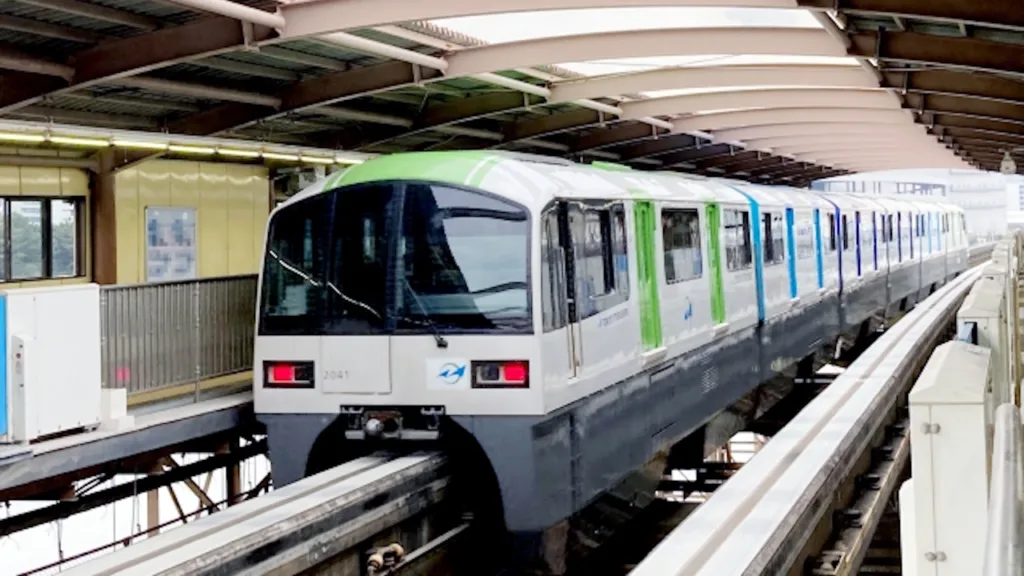
The Tokyo Monorail operates three types of trains — the Airport Express, the Section Express, and the Local — and picking the wrong one can easily cost you precious time.
Station and Service Type Chart
| No. | Station | Airport Express | Section Express | Local |
|---|---|---|---|---|
| MO01 | Monorail Hamamatsucho | ● | ● | ● |
| MO02 | Tennōzu Isle | — | ● | ● |
| MO03 | Ōi Keibajō-mae | — | ● | ● |
| MO04 | Ryūtsū Center | — | ● | ● |
| MO05 | Shōwajima | — | — | ● |
| MO06 | Seibijō | — | — | ● |
| MO07 | Tenkūbashi | — | — | ● |
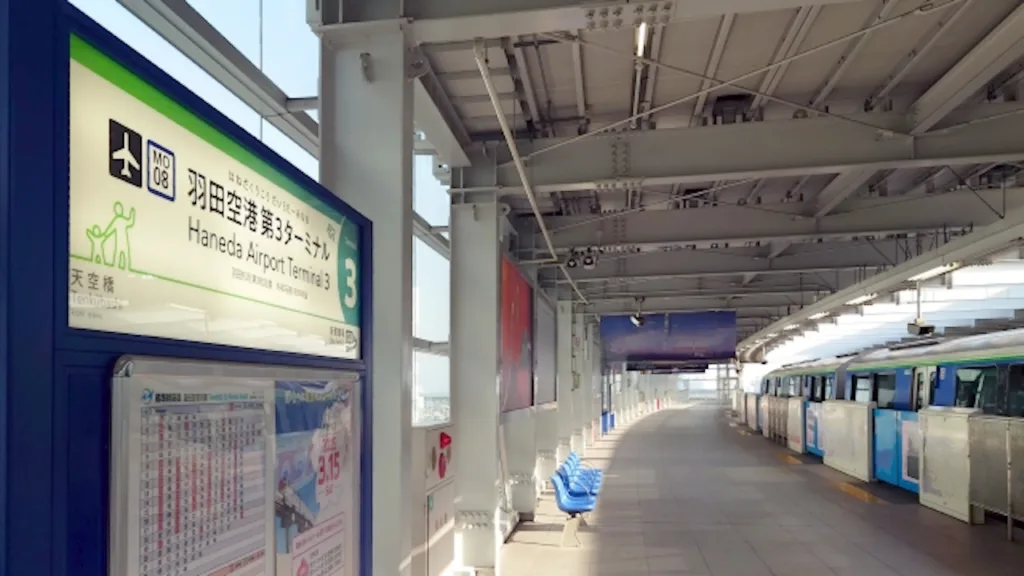
| MO08 | Haneda Airport Terminal 3 | ● | ● | ● |
| MO09 | Shin-Seibijō | — | — | ● |
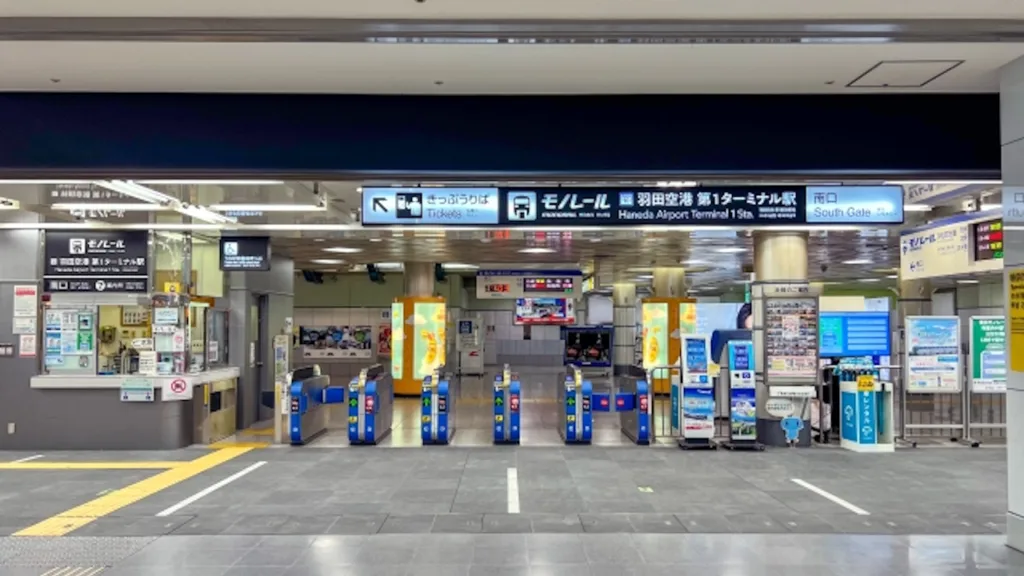
| MO10 | Haneda Airport Terminal 1 | ● | ● | ● |
| MO11 | Haneda Airport Terminal 2 | ● | ● | ● |
The Airport Express stops only at Hamamatsucho and the three airport stations, covering the full route in as little as 18 minutes — the fastest option for airport users. However, it bypasses all intermediate stops, so if you’re heading to Tennōzu Isle or Ōi Keibajō-mae, you’ll need a different service. The Section Express adds those three mid-route stations to the mix, while the Local calls at all 11 stations in around 23 minutes. Matching your service type to your destination is the key to getting the most out of the monorail.
One more thing to note: from June 13, 2026, Monorail Hamamatsucho Station will begin phasing in a newly rebuilt station building. New north and central gates will open, replacing the existing central and south gates. Even regular users should check updated signage before traveling.
Born from the Olympics: The Story Behind Tokyo Monorail
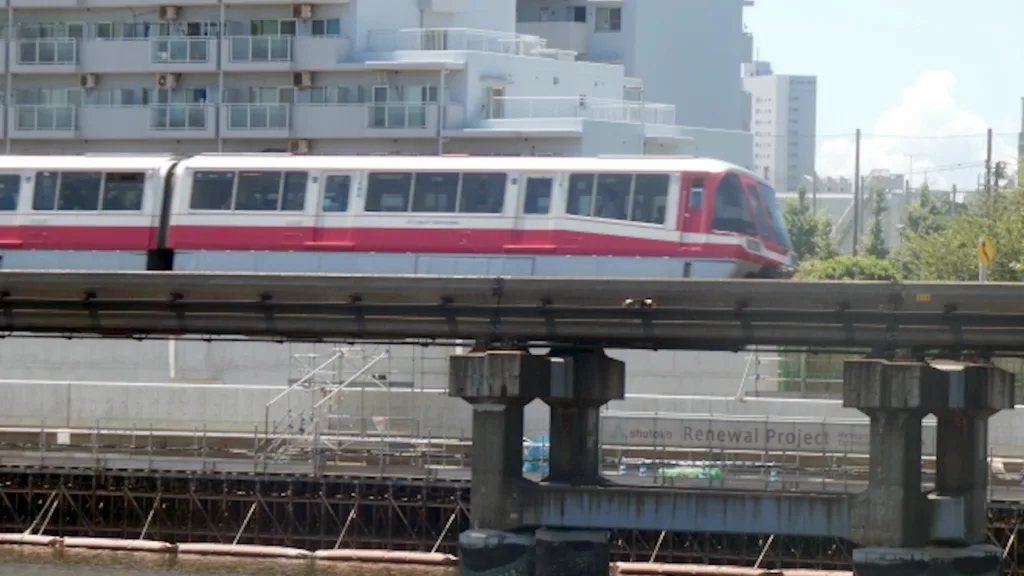
The Tokyo Monorail cannot be told without the 1964 Tokyo Olympics. Construction contracts for the Hamamatsucho–Haneda Airport corridor were signed in December 1962, with groundbreaking following in May 1963. Just 23 days before the Olympic opening ceremony, on September 17, 1964, the line opened as Japan’s first full-scale urban monorail.
The entire project was completed in a remarkable 16 months of intensive construction. At the time, the road journey from Haneda Airport to central Tokyo could take over an hour in heavy traffic; the monorail slashed that to 15 minutes and was hailed as a transportation revolution for Japan. The original line ran nonstop between Hamamatsucho and Haneda with no intermediate stations, a true point-to-point airport connection.
The original plan had called for the line to start from Shimbashi Station, but noise complaints and land acquisition difficulties forced a change of terminus to Hamamatsucho. To build over the busy waterways, engineers employed the Dywidag cantilever method, extending prestressed concrete beams from each pier. Where the route passed beneath the airport runway, a shield tunneling method was used — a showcase of the most advanced construction technology of the era.
Six Decades of Bay Area Transformation in the Windows
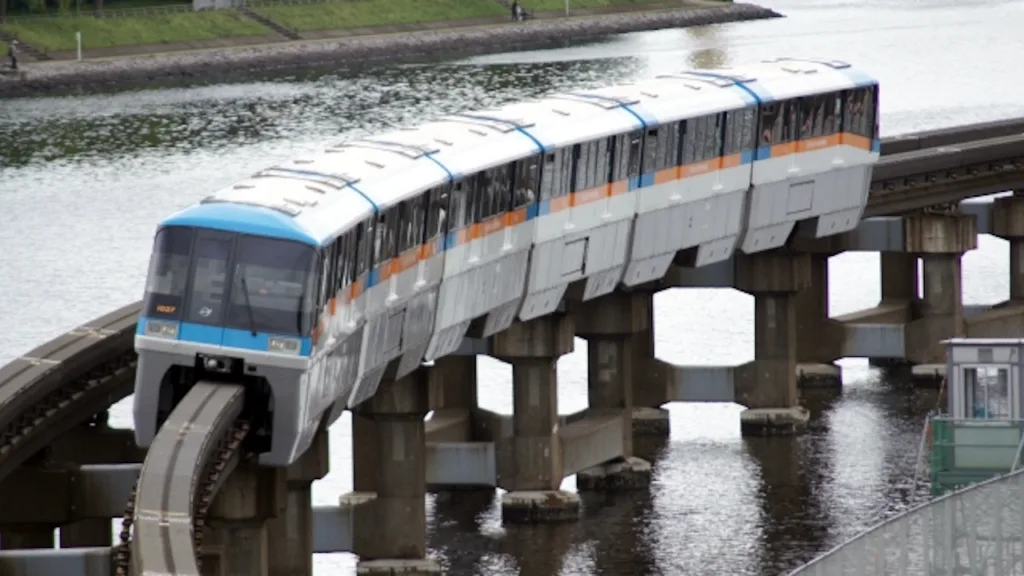
When the monorail first opened, much of the route ran literally over open water. The area around present-day Ryūtsū Center and Shōwajima stations was still largely unreclaimed bay, with Tokyo Bay visible from every window. As land reclamation progressed through the 1960s and 70s, logistics facilities moved in. Shōwajima Station opened in 1985 in response to requests from local residents.
The 1978 opening of Narita Airport shifted nearly all international flights away from Haneda, dealing a serious blow to ridership. The tide turned in 1992 when Tennōzu Isle Station opened as the line’s first petition-driven station, anchoring a pioneering waterfront development that brought new commuter and leisure passengers aboard. Route extensions followed the successive openings of Terminal 1 in 1993, Terminal 2 in 2004, and the international terminal (now Terminal 3) in 2010, bringing the network to its current 11 stations.
The ALWEG System: Japan’s One-of-a-Kind Monorail Technology
The Tokyo Monorail uses the ALWEG-type straddle-beam system, developed in the 1950s, making it the only operating straddle monorail line in Japan to retain this original format. In a straddle system, each car rides astride a single concrete beam — every car in the trainset straddles its own section of the guideway.
Other Japanese monorail lines — including the Tama Monorail, Osaka Monorail, and Kitakyushu Monorail — use the domestically standardized “Japan Straddle” format, which was derived from the ALWEG system. The key difference lies in floor height. The Japan Straddle design raises the floor to fully conceal the running wheels underneath, creating a flat cabin interior. The trade-off is a higher center of gravity that limits cornering speed to around 60–65 km/h on most routes.
The ALWEG system keeps the floor lower, which lowers the center of gravity and allows faster cornering — which is why the Tokyo Monorail can operate at 80 km/h, the highest speed of any monorail in Japan. In exchange, the running wheels create a slight bulge on the cabin floor known as a “tire house,” which the operator has turned into luggage space, including designated areas for large suitcases.
It was none other than Walt Disney who helped bring the ALWEG system to the world’s attention. Captivated by its futuristic appeal, he opened a monorail at Disneyland California in 1959, sparking global interest that influenced the decision to adopt the technology in Tokyo. A vision of transportation that had captured the imagination of a theme park visionary found its real-world expression in an Olympic city five years later.
The company was historically part of the Hitachi Group before becoming a wholly owned subsidiary of JR East in 2002. All rolling stock continues to be manufactured by Hitachi, Ltd., with decades of accumulated engineering expertise underpinning the line’s safety record.
Why the Tokyo Monorail Still Holds Its Own
The Keikyu Airport Line has been a rival for decades, and the two routes each have genuine strengths. Travelers heading to Shinjuku or Shibuya may find the Keikyu route via Shinagawa more direct. Those staying near Hamamatsucho or Daimon, or heading to the eastern side of the Yamanote Line — Tokyo, Ueno, Akihabara, Kanda — will often find the monorail requires only a single transfer.
Two advantages stand out as distinctly Tokyo Monorail. First, every train originates at Hamamatsucho, meaning passengers can always board at the starting point and secure a seat. Keikyu trains frequently enter service as through-operations from the Toei Asakusa or Keikyu lines, arriving at Shinagawa already crowded. For airport travelers carrying heavy luggage, a guaranteed seat from the first stop is a meaningful comfort. Second, the route is simple. The Tokyo Monorail operates a straightforward back-and-forth between Hamamatsucho and Haneda Airport with no branching destinations, eliminating any risk of boarding the wrong train — a real advantage for first-time visitors unfamiliar with Japan’s complex rail network.
IC cards including Suica and PASMO are accepted across the entire line.
JR East’s Haneda Airport Access Line: A New Competitor on the Horizon
A significant development is reshaping the competitive landscape around Tokyo Monorail. JR East is currently constructing the Haneda Airport Access Line (provisional name), targeting a 2031 opening. Full-scale construction began in June 2023, with major track relocation work around Tamachi Station progressing in phases.
The centerpiece of the project is the “East Yamanote Route,” which will connect Tokyo Station to Haneda Airport in approximately 18 minutes without transfers. The line is also planned to accommodate direct services from the Utsunomiya, Takasaki, and Joban lines, dramatically improving airport access from Tokyo’s northern and eastern suburbs. A “Coastal Route” linking the airport to the Rinkai Line’s Tokyo Teleport Station is also being coordinated for simultaneous opening in the 2031 fiscal year.
When the new line opens, Tokyo Monorail will find itself competing with a route operated by its own parent company, JR East — an unusual situation in the railway industry. Even so, the monorail is expected to retain its role as the primary connection to mid-route stations such as Tennōzu Isle and Ōi Keibajō-mae, as well as an alternative service during disruptions on other lines. How the monorail carves out its distinct position after 2031 will be one of the more interesting stories to follow in Tokyo’s evolving transport landscape.
An Aerial Sightseeing Ride: Views from the Tokyo Panorama Line
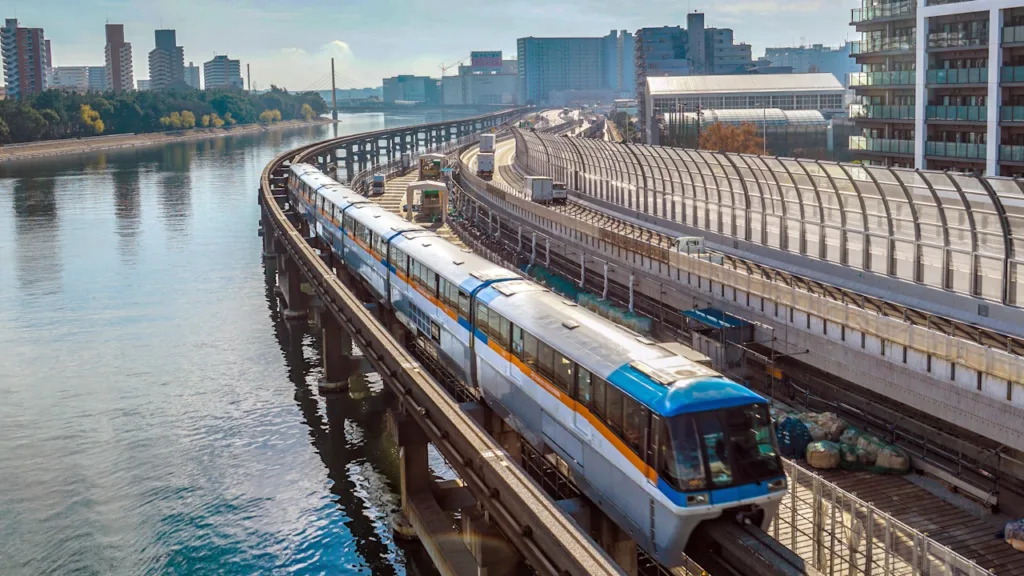
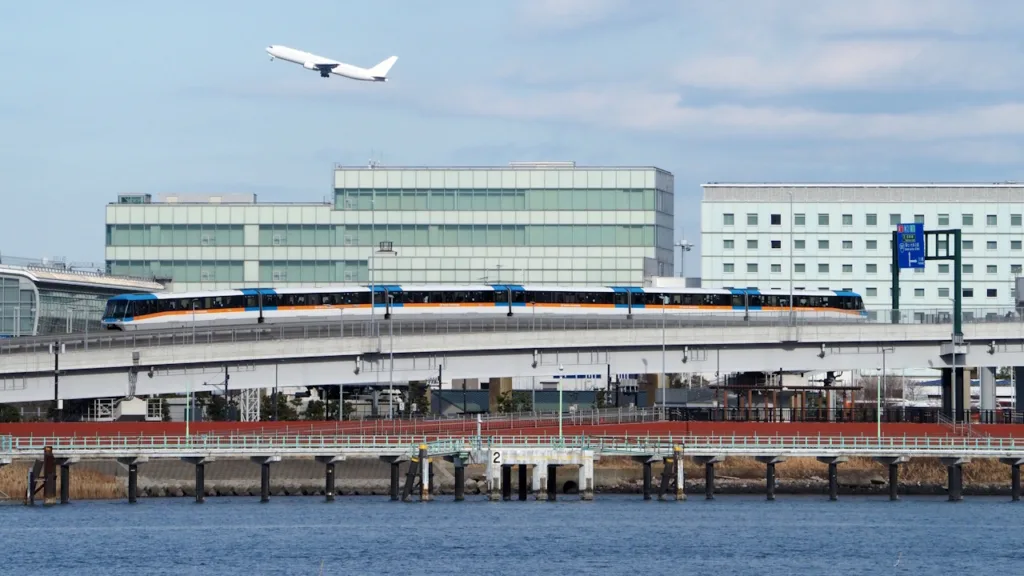
One of the monorail’s undeniable pleasures is what you see through the windows. Leaving Hamamatsucho, the train glides past the Tennōzu Isle canal district with a backdrop of high-rise buildings, then over the green turf of Ōi Racecourse, past the industrial island of Shōwajima, and finally emerges from a tunnel to reveal the vast apron of Haneda Airport laid out before you. In 18 to 23 minutes, you pass through the urban, industrial, and aviation faces of Tokyo in a single continuous panorama.
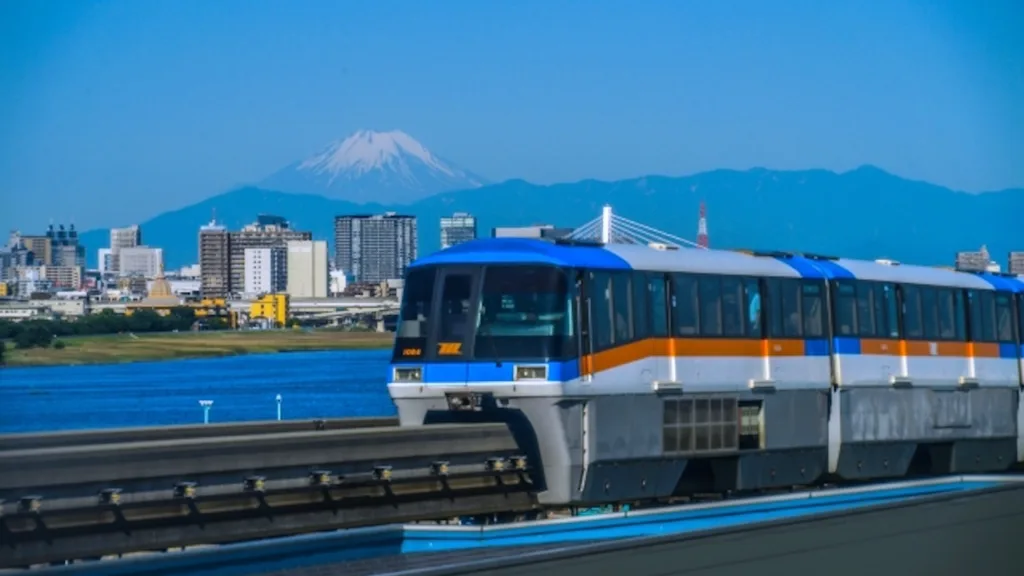
On clear days, Mount Fuji is visible from the train — an added reward for morning travelers. Passengers heading from Haneda Airport toward Hamamatsucho will catch Tokyo Tower coming into view on the left side as the train curves northwest. The tower’s silhouette is particularly striking when seen from this approach, which is why the return journey is the recommended direction for those wanting a clear, head-on look.
For those heading toward the airport, the right-hand side of the train offers the better view of Tokyo Bay, and on clear days the Tokyo Gate Bridge can be spotted in the distance. The most dramatic moment of the ride comes just after Seibijō Station, when the train emerges from a tunnel and the entire airport apron — with aircraft taxiing, departing, and arriving — suddenly fills the window. Since opening day, local lore holds that many passengers rode the monorail not to fly but simply to watch the planes. Sixty years on, the scene retains every bit of its power.
A Station Reborn: The Tokyo Monorail Theater Concept
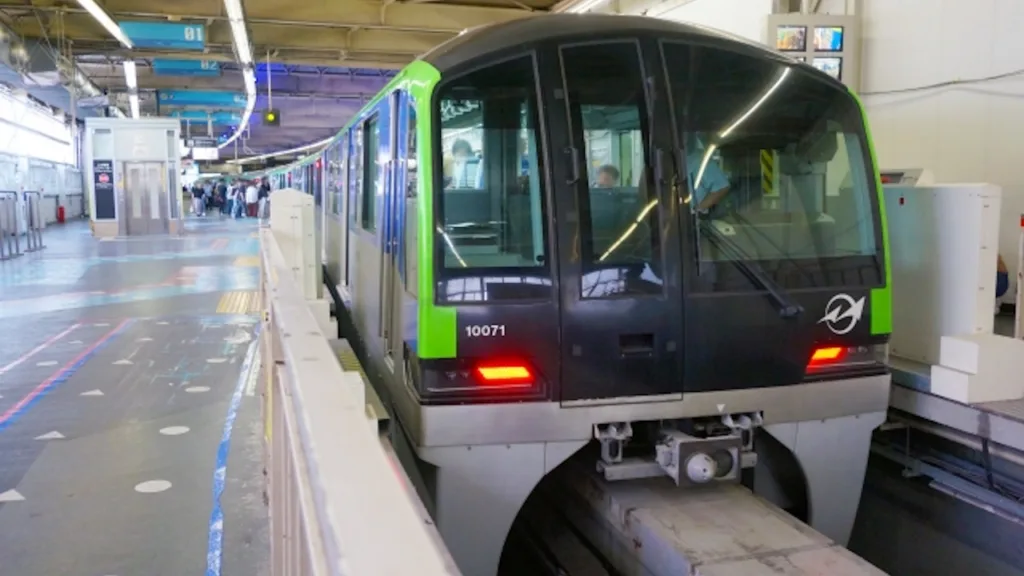
In 2020, Tokyo Monorail articulated a new brand concept called “Tokyo Monorail Theater” — a vision in which passengers are audience members, staff are cast, and every train and station is a stage. Travel, the company declared, should feel like a performance.
The most visible expression of this philosophy is the ongoing reconstruction of Monorail Hamamatsucho Station. The new building is being designed around Japanese aesthetics and the drama of departure, with lighting and interior finishes intended to heighten the sense that a journey is beginning. The partial opening in June 2026 will improve connections to JR Hamamatsucho Station, with full completion expected around 2030.
Sights Worth a Stop Along the Line
Tennōzu Isle
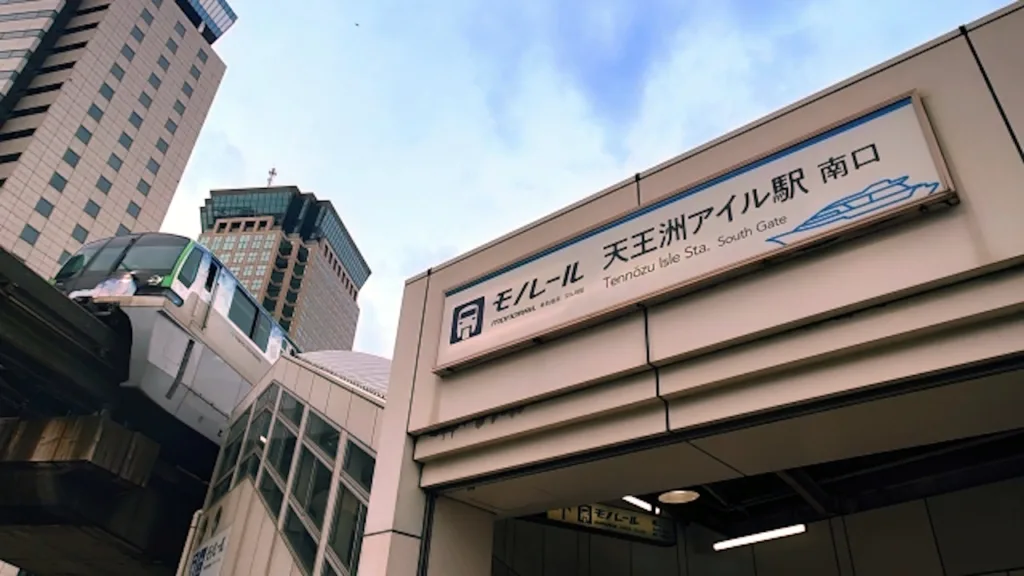
The area around Tennōzu Isle Station (MO02) is a waterfront arts district enclosed by canals. Renovated warehouse buildings now house galleries, cafés, and restaurants, earning the neighborhood a reputation as an “island of art” among both domestic and international visitors. TERRADA ART COMPLEX, home to several leading contemporary art galleries, anchors the cultural scene, while the boardwalk along the water is lined with independent shops. The station also connects to the Rinkai Line, making Odaiba a short ride away.
HANEDA INNOVATION CITY
Directly connected to Tenkūbashi Station (MO07), HANEDA INNOVATION CITY is a large-scale mixed-use development that opened in 2021. Research institutes, retail outlets, dining, and two hotels — Hotel Metropolitan Haneda and Keikyu EX Inn Haneda Innovation City — are all integrated under one roof. On the rooftop of Building E, a free foot bath offers unobstructed views of aircraft movements over the airport, one of the more unusual and memorable ways to spend time before or after a flight.
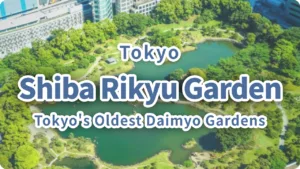
Kyu-Shiba-Rikyu Gardens
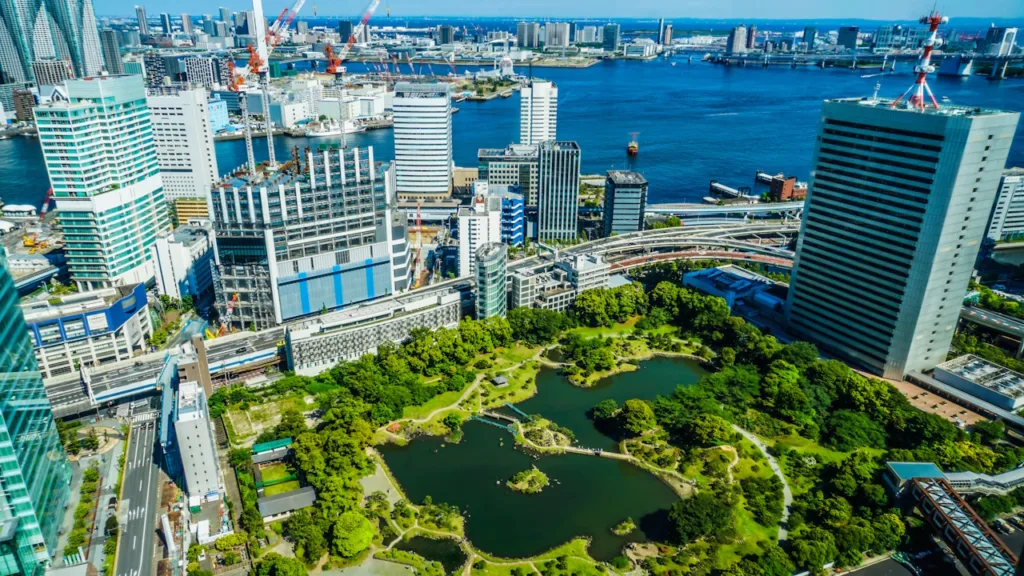
Located immediately adjacent to Monorail Hamamatsucho Station (MO01), Kyu-Shiba-Rikyu is a nationally designated scenic garden with origins in the late 17th century. Laid out as a strolling pond garden for a feudal lord, it offers a quiet, unhurried counterpoint to the energy of the surrounding city — and a natural place to decompress after arriving at the monorail’s city terminus.
Recommended Hotels Along the Line
Fairmont Tokyo
A six-minute walk from Monorail Hamamatsucho Station’s south exit, Fairmont Tokyo opened in 2025 as the brand’s first property in Japan. With 217 rooms and suites, an indoor infinity pool, a spa, and panoramic views of both Tokyo Tower to the west and Tokyo Bay to the east, it sets a high standard for the Hamamatsucho waterfront. Its position at the monorail’s starting terminus makes it an ideal base for travelers using the line.
Hotel Villa Fontaine Grand Haneda Airport
A one-minute walk from Haneda Airport Terminal 3 Station, this 1,531-room hotel is connected directly to the terminal building via an indoor passageway — ideal for early-morning or late-night flights. Guest rooms offer views of Tokyo Bay, the Tama River, and the airport apron. The in-house rooftop hot spring facility, Izumi Tenkū-no-Yu Haneda Airport, makes it possible to enjoy a genuine Japanese bath experience moments before or after a flight.
Hotel Metropolitan Haneda
Opened in autumn 2023 and located a one-minute walk from Tenkūbashi Station’s HICity gate (MO07), Hotel Metropolitan Haneda sits within HANEDA INNOVATION CITY ZONE A. Operated by JR East Hotels, the property has 237 rooms across 13 room types, with interiors that evoke the atmosphere of a departure lounge. Airport-side rooms offer direct views over the runways; river-side rooms look out across the Tama River. Facilities include an all-day dining restaurant, a fitness gym, and a rooftop observation deck. A complimentary shuttle bus to the airport is available for guests. Note that Tenkūbashi Station is served only by Local trains — Airport Express and Section Express trains do not stop here.
Toyoko Inn Shinagawa Minato-guchi Tennōzu Isle
A five-minute walk from Tennōzu Isle Station, this business hotel offers free breakfast and a shuttle bus service to and from Shinagawa Station’s Minato-guchi exit. Its central position on the monorail line makes it a practical base for both airport travel and access to central Tokyo.
Traveling Japan with a Dedicated Tour Conductor
Planning a trip to Tokyo and beyond? Japan’s transportation network is extensive and efficient, but navigating it — especially with luggage, language barriers, or a complex itinerary — can be genuinely daunting. A dedicated Japanese tour conductor travels with your group throughout the journey, handling emergency logistics, assisting with communication, and ensuring the itinerary runs smoothly from start to finish.
For more on what a dedicated tour conductor service can offer your Japan trip, visit tours.e-stay.jp.

Conclusion: Sixty Years of Connecting the City to Its Airport
The Tokyo Monorail emerged from the excitement of the 1964 Olympics and has since documented six decades of Tokyo Bay’s transformation — land reclamation, waterfront development, and international expansion — through its windows. The ability to reach Haneda Airport in as little as 18 minutes, combined with the panoramic views that earned it the nickname Tokyo Panorama Line, ensures it will remain a compelling choice for travelers long into the future.
With the Hamamatsucho Station rebuild underway and a new JR East airport line on the horizon for 2031, the monorail is entering one of the most interesting chapters of its long history. If you find yourself at Haneda Airport, resist the impulse to look only at your phone — the view from the window is very much worth your attention.