



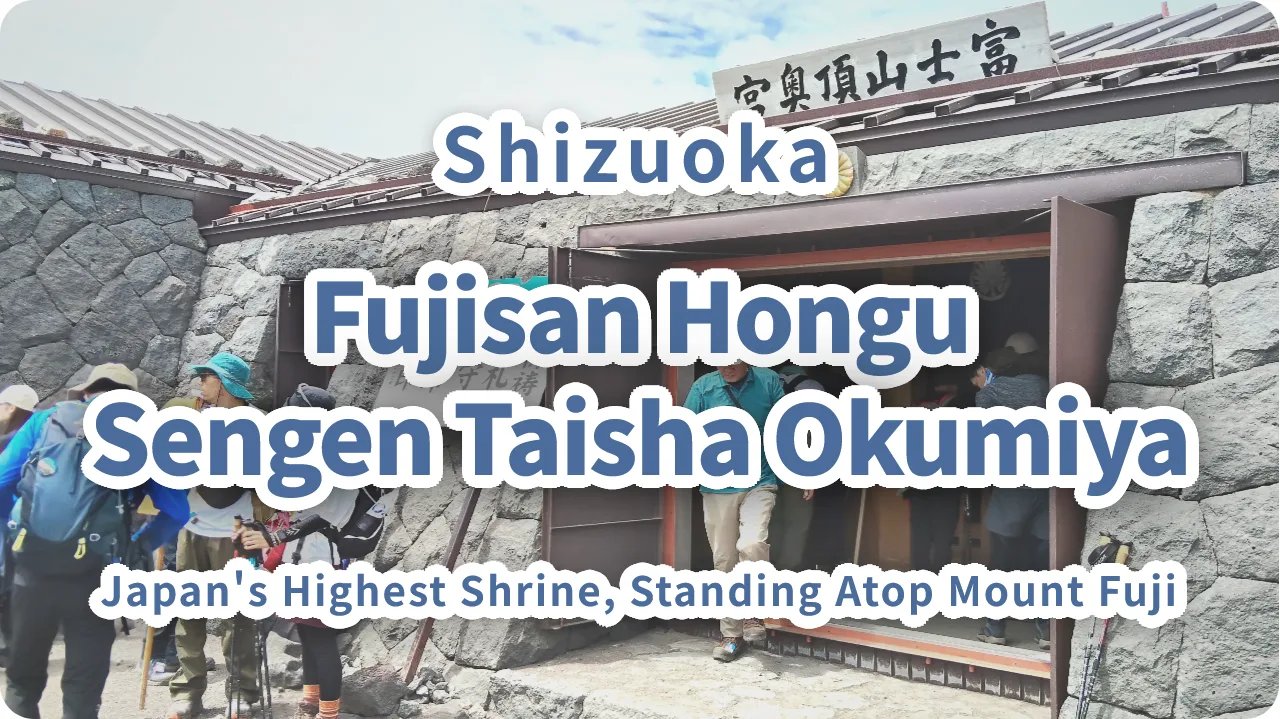
Travel insights from a tour conductor — today’s destination: Fujisan Hongu Sengen Taisha Okumiya, the inner shrine of Fujisan Hongu Sengen Taisha (富士山本宮浅間大社), perched right at the summit of Mount Fuji in Fujinomiya, Shizuoka Prefecture. This isn’t a shrine you stumble across on a stroll. It sits at the top of the Fujinomiya Trail, at the very peak of Japan’s highest mountain, and reaching it is part of the experience.
The Okumiya belongs to the same shrine as the Hongu — the main shrine down at the mountain’s base, roughly 3,000 meters below. Think of it as one shrine with two homes: a grand complex at sea level and a bare, weathered outpost at 3,776 meters. It’s widely considered the highest-altitude shrine in Japan.
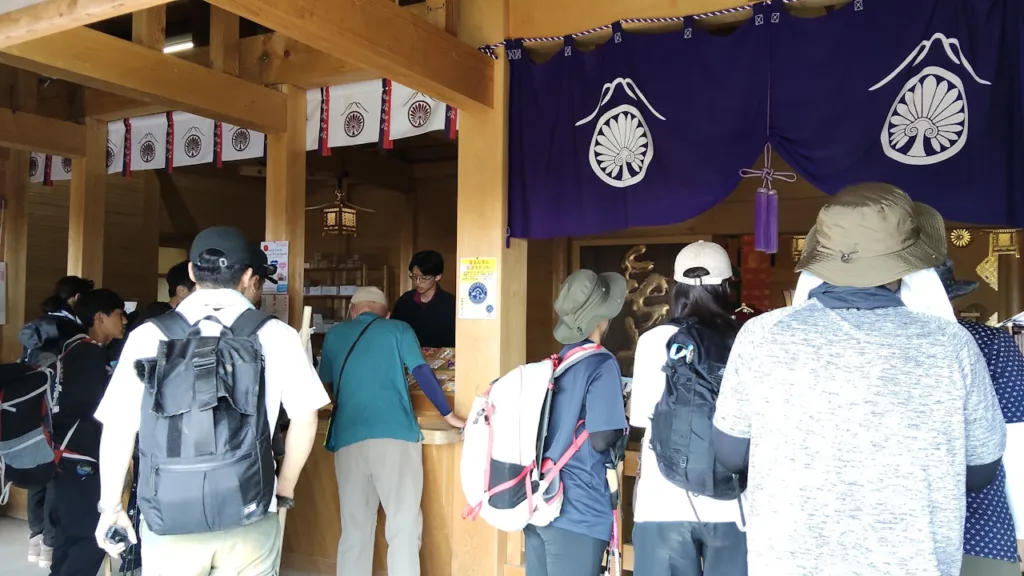
The shrine only comes to life during Mount Fuji’s short climbing season. That’s the only time a priest is stationed there, and the only window in which you’ll find the shrine’s amulets, seals, and stamps available. The rest of the year, it stands empty under snow and ice — a quiet counterpoint to the crowds that pack the summit each summer.
| Item | Details |
|---|---|
| Name | Fujisan Hongu Sengen Taisha Okumiya |
| Hours | Roughly sunrise to 4:00 PM during the climbing season |
| Season | Around July 10 to the morning of September 6 in 2026 (weather-dependent) |
| Address | Summit of Mount Fuji, Fujinomiya, Shizuoka Prefecture |
| Access | Reachable via the Fujinomiya, Yoshida, Subashiri, or Gotemba trails, starting from any 5th station or from the mountain’s base (0th station) |
Before You Go: A Shrine That’s Closed More Often Than Open
The short season is the first thing to understand about the Okumiya. Outside those roughly two months in summer, there’s no priest, no stamps, no amulets — just an empty shrine building at the top of a mountain. Even during the season, hours run from around sunrise to 4:00 PM, and that window can shift with the weather.
Then there’s the climb itself. Whichever trail you choose, you’re looking at over 1,000 meters of elevation gain, and most people break the round trip with an overnight stay at a mountain hut. A climbing fee applies on every route these days, and while brushing up on trail rules and etiquette beforehand isn’t mandatory, it’s well worth doing for a safe climb. This isn’t a shrine you swing by on a whim.

Why There’s a Shrine on Top of a Volcano
Mount Fuji’s summit shrine exists because of Fuji itself — or rather, because of centuries of fear and reverence toward it. According to the shrine’s own account, the deity Asama-no-Okami was first enshrined at the mountain’s foot during the reign of Emperor Suinin, in an attempt to calm the volcano’s eruptions. Records from the Heian period already describe conditions at the summit, and by 1149, a monk named Matsudai is said to have built a hall to Dainichi Nyorai at the very top — the structure that would eventually become today’s Okumiya.
Long before shrine visits, there was mountain worship in its rawest form: ascetic monks climbing in the medieval period, followed by the Edo-era rise of Fujiko, pilgrimage confraternities that spread across the Kanto region under the teachings of Hasegawa Kakugyo. Local guides called oshi led ordinary townspeople up the mountain in growing numbers. In many ways, the Okumiya sits at the summit of that devotional tradition as much as it sits at the summit of the mountain.
The real turning point came in the early Edo period. After his victory at the Battle of Sekigahara, Tokugawa Ieyasu funded a major rebuilding of the Hongu — more than 30 structures, including the main hall, worship hall, and gate — and, on top of that, declared everything above the mountain’s 8th station to be shrine land. That single decision put roughly 4 million square meters of the upper mountain, summit included, under the shrine’s domain. The Okumiya building standing today largely dates to 1902, when porters known as goriki hauled the construction materials up by hand. After the 2011 earthquake damaged its pillars and stonework, the shrine underwent a multi-year reinforcement project carried out during successive climbing seasons, using heavier beams to withstand future tremors.
No Main Hall: A Shrine Built Around the Mountain Itself
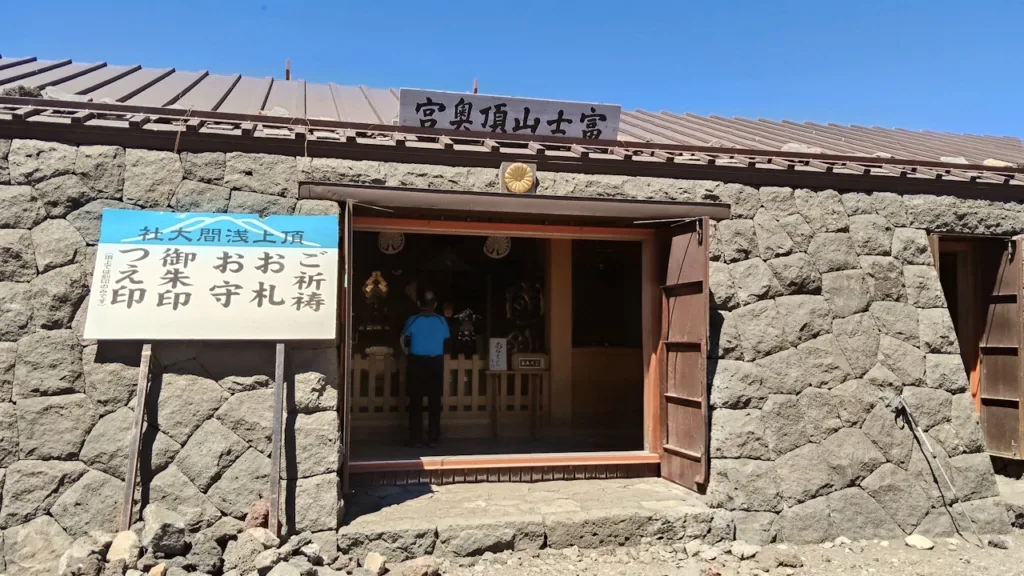
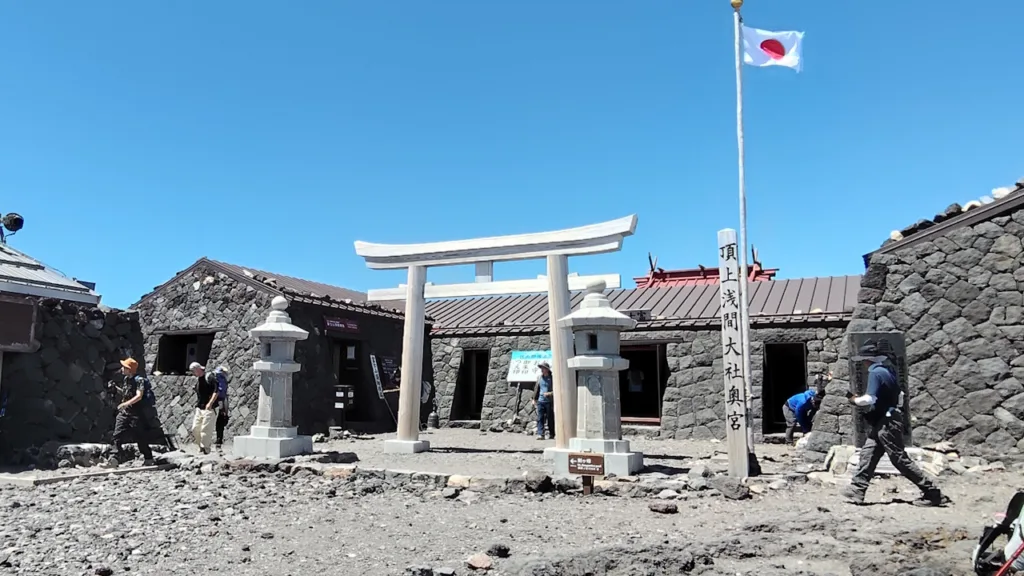
What sets the Okumiya apart architecturally is what it’s missing. Because Mount Fuji itself is treated as the shrine’s true object of worship, there’s no honden (main sanctuary) here — just a haiden (worship hall) and heiden (offering hall). Above the doors, gold characters read “国鎮無上嶽” — roughly, “the peerless peak that pacifies the nation.” A stone marker reading “冨士山頂上淺間大社奥宮” stands in the grounds too, doubling as a landmark for climbers.
The enshrined deity is Konohanasakuyahime — the same goddess worshipped at the Hongu below — alongside her husband Ninigi-no-Mikoto and father Oyamatsumi-no-Kami. According to legend, Konohanasakuyahime set fire to her own birthing hut to prove her innocence and safely delivered three sons within it, which is why she’s also revered for protection from fire and safe childbirth — a role that carries up to this summit shrine as well. The goshuin (shrine seal) here differs from the one at the Hongu: it’s stamped using volcanic sand from Mount Fuji itself, giving it a texture and character you won’t find anywhere else.
Stamps, Records, and Traditions Found Only at the Top
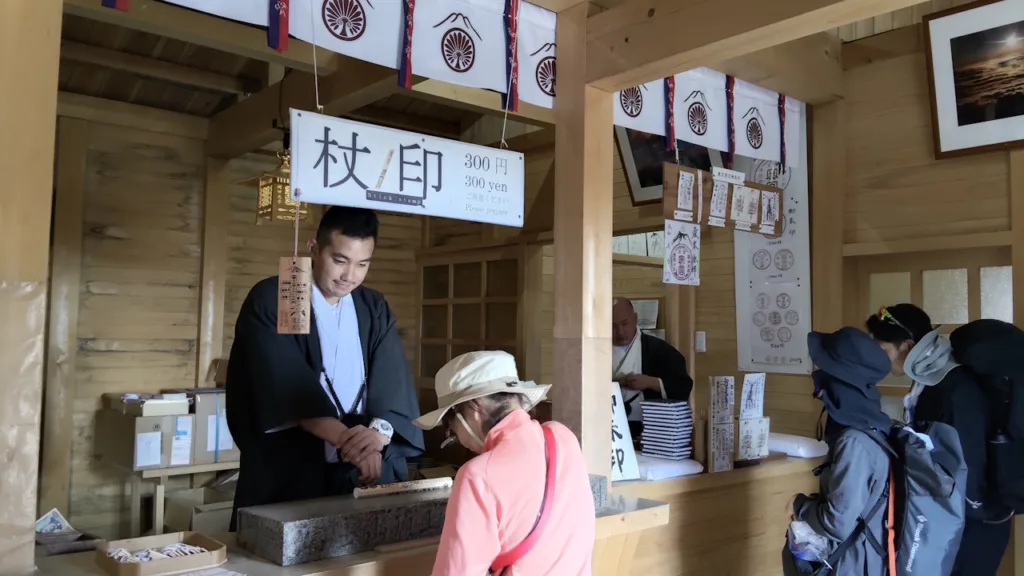
One tradition unique to the Okumiya is the branding of kongozue — the wooden climbing staffs many hikers buy at the 5th station and get stamped at each hut along the way. The stamp you get at the summit functions as proof you made it, and it’s genuinely prized. The Okumiya’s brand differs from the one at Kusushi Shrine on the other side of the crater, which is why some climbers make a point of visiting both.
Nearby, on the Gotenba/Suyama side of the summit, there’s also a spring known as Ginmeisui — paired with Kinmeisui on the Yamanashi side — that’s long been treated as sacred water melting through the mountain’s lava layers. These days, both springs run dry more often than not, so rather than being handed out freely to climbers, bottled Ginmeisui is reportedly sold at the Okumiya’s shrine office instead.
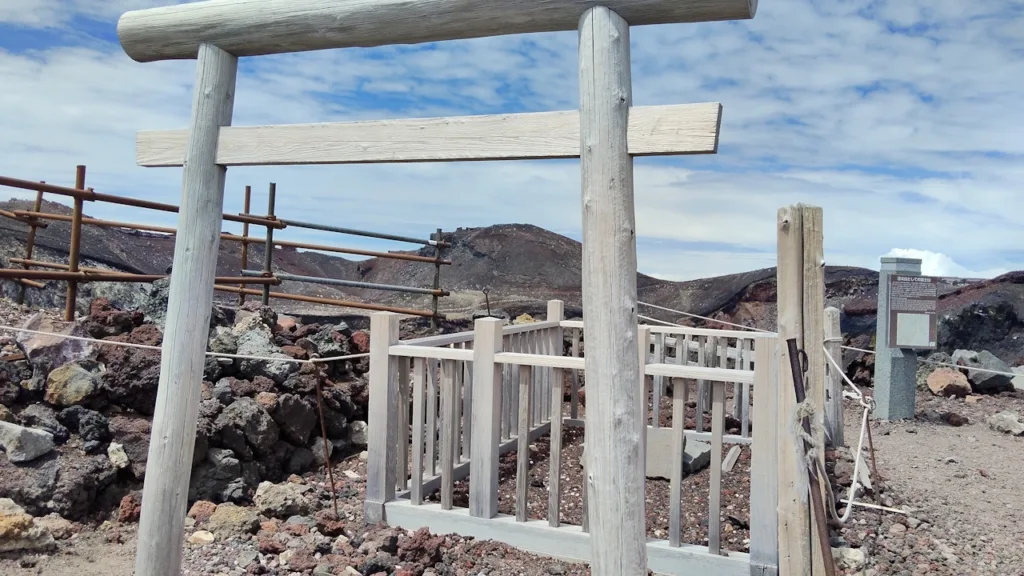
The Okumiya also keeps a “senior climbers’ registry.” Anyone who reaches the summit at the traditional Japanese age of 70 — which typically works out to around 69 in the more familiar Western reckoning — can sign the register and receive a small keepsake. Kusushi Shrine, on the far side of the crater, keeps an identical registry, so climbers can sign in at either shrine. Each July 11, the Okumiya holds its season-opening festival, followed by its main annual festival on August 15 — brief windows in which rites are held for national peace and the safety of climbers.
Not a Branch, But the Head Shrine: Sengen Shrines Across Japan
The Okumiya and the Hongu are, administratively, the same shrine — two locations of one institution, sharing the same principal deity. Fujisan Hongu Sengen Taisha is often called the head shrine of Japan’s roughly 1,300 Sengen and Asama shrines, on the grounds that it was the first to enshrine a deity meant to calm Mount Fuji’s eruptions. That said, “head shrine” here is more a matter of spiritual seniority than an org chart — plenty of the country’s Sengen shrines have their own independent histories rather than a direct administrative link.
One shrine sometimes mistaken for a branch is Kitaguchi Hongu Fuji Sengen Jinja, in Fujiyoshida, Yamanashi Prefecture. It’s a separate religious institution with its own founding history, not a subsidiary of Fujisan Hongu Sengen Taisha — there’s no head-office relationship between the two. What they do share is a common root in Mount Fuji worship and a place among the constituent assets of the UNESCO World Heritage listing “Fujisan, Sacred Place and Source of Artistic Inspiration.” The Okumiya marks the summit for climbers coming up the Fujinomiya and Gotemba trails on the Shizuoka side, while Kusushi Shrine — despite serving hikers arriving via the Yoshida and Subashiri trails from the Yamanashi side — is itself located within Shizuoka, since the entire summit falls under Fujinomiya’s jurisdiction. Kitaguchi Hongu Fuji Sengen Jinja, meanwhile, sits down at the base of the Yoshida Trail in Yamanashi. Three shrines, three distinct lineages, all woven into the same mountain’s story.
Part of a World Heritage Site
In 2013, Mount Fuji was inscribed on the UNESCO World Heritage list as a cultural site, not a natural one — recognized for the Sengen faith that grew out of fear of its eruptions, the pilgrimage culture of the Fujiko confraternities, and the mountain’s enduring presence in Japanese art and literature. The Okumiya, along with the wider summit precinct and the Wakutamaike spring pond at the Hongu, is counted among the listing’s constituent assets. Standing at the Okumiya, in other words, means standing inside a UNESCO site — one built entirely around the idea of Mount Fuji as an object of devotion.
Nearby Highlights
Once you’ve paid your respects at the Okumiya, a few more summit landmarks are within easy reach. The Ohachi-Meguri — a walk around the rim of the crater, known as Ohachi (the “great bowl”) — is itself a pilgrimage tradition dating back to the Fujiko era, and most climbers who visit the Okumiya continue on to complete it.
Kengamine
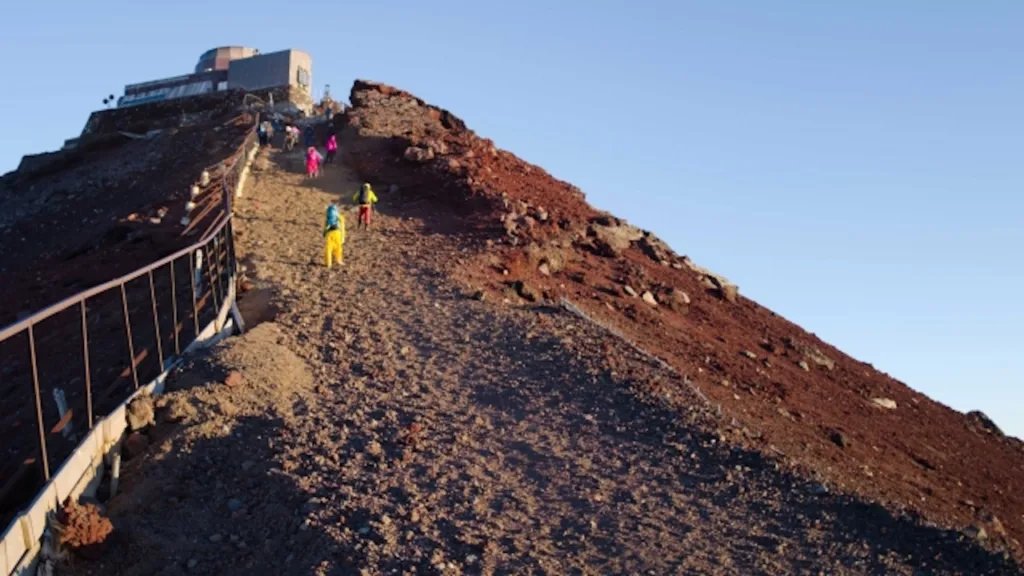
Kengamine is Mount Fuji’s true summit, a short stretch along the Ohachi-Meguri route from the Okumiya. A second-class triangulation point marks the 3,776-meter peak, and it’s the goal most climbers are ultimately chasing. For a closer look at the route up and what’s worth seeing at the top, our dedicated Kengamine article covers it in detail.
Kusushi Shrine
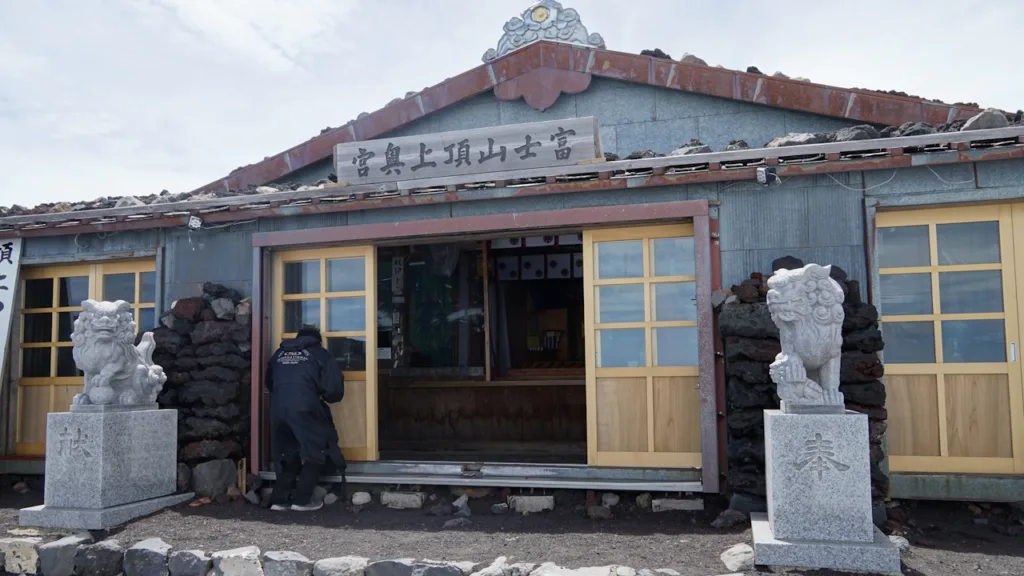
On the opposite side of the crater — where the Yoshida and Subashiri trails converge — stands Kusushi Shrine, a subsidiary shrine of Fujisan Hongu Sengen Taisha. Like the Okumiya, it’s staffed only during the climbing season, offering its own amulets and charms. It’s also a favorite spot for watching goraiko, the sunrise over a sea of clouds, with plenty of climbers gathering there before dawn. Anyone completing the full Ohachi-Meguri will pass both the Okumiya and Kusushi Shrine.
Mount Fuji Summit Post Office
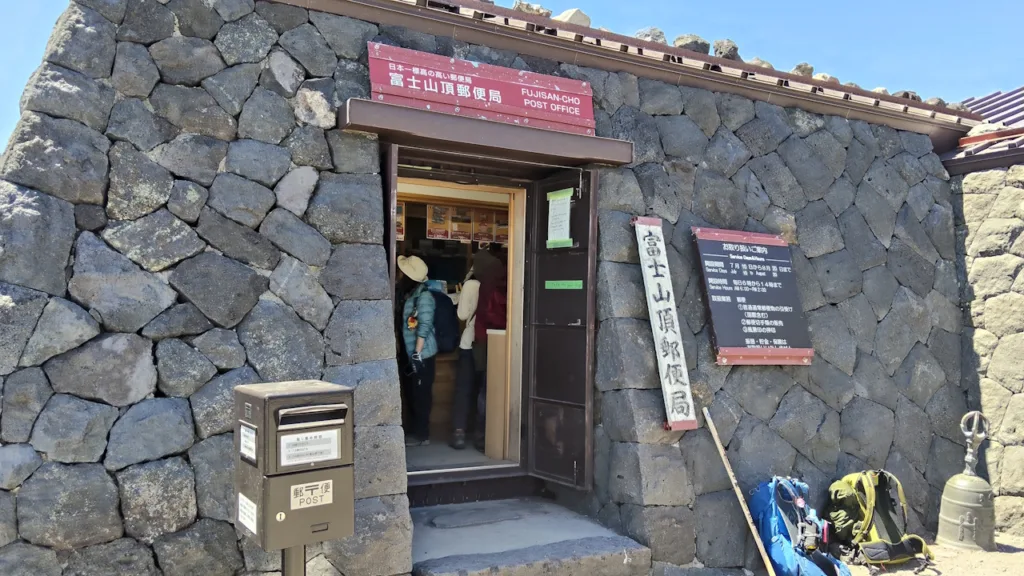
Tucked inside the Okumiya’s shrine office building is Japan’s highest-altitude post office, open for a limited stretch during the climbing season. You can mail letters and postcards from the summit here, and there’s a Mount Fuji–themed commemorative postmark available for anyone who wants one.
Where to Stay Near Fujinomiya
For anyone climbing via the Fujinomiya side, basing yourself in the Fujinomiya area before and after the ascent makes sense. Here are three solid, well-reviewed options — one right by the station, one built around a hot spring, and one with a view worth the detour.
Fujinomiya Fujikyu Hotel sits about a two-minute walk from JR Fujinomiya Station, with buses to the Fujinomiya 5th Station departing right from the terminal in front of the hotel. Rooms on the higher, north-facing floors look straight out at Mount Fuji with nothing in the way, and the free breakfast buffet, built around local ingredients, is a popular draw.
Natural Hot Spring “Sakuya no Yu” Super Hotel Fujinomiya is a business hotel about nine minutes by car from the Fujinomiya interchange, built around a natural hot spring with separate baths for men and women. The sodium-calcium chloride spring water is known for easing muscle fatigue and improving circulation — handy after a day on the mountain. A free breakfast buffet and free parking round out the package, making it a solid choice for anyone driving in.
Kyukamura Fuji sits right on the shore of Lake Tanuki, with views of Mount Fuji from the guest rooms, restaurant, and communal bath alike. The alkaline hot spring bath pairs with a buffet built around Shizuoka’s mountain and coastal specialties, making it a relaxed spot to unwind before or after the climb.
Why Climb With a Tour Conductor
Getting to the Okumiya isn’t like visiting most shrines — it means an overnight mountain climb, unpredictable weather, and a language barrier if plans need to change on the fly. That’s exactly where a dedicated tour conductor earns their keep.
A tour conductor handles the logistics that can derail a Fuji climb: coordinating transport to the 5th station, managing hut reservations, and — if a storm rolls in or a flight gets missed — rearranging bookings on the spot so your trip stays on track. They also bridge the language gap at mountain huts, shrine offices, and transit counters, translating in real time so nothing gets lost in translation when it matters most. What they don’t do is lead you around as a guide or rewrite your itinerary on their own initiative — that’s the tour operator’s job. A conductor’s role is to keep the plan you’ve already made running smoothly, step by step, from departure to your safe return.
For a climb as physically demanding and logistically layered as reaching the Okumiya, that kind of support changes the experience from stressful to genuinely enjoyable. You can find out more about dedicated tour conductor services at tours.e-stay.jp.
Final Thoughts
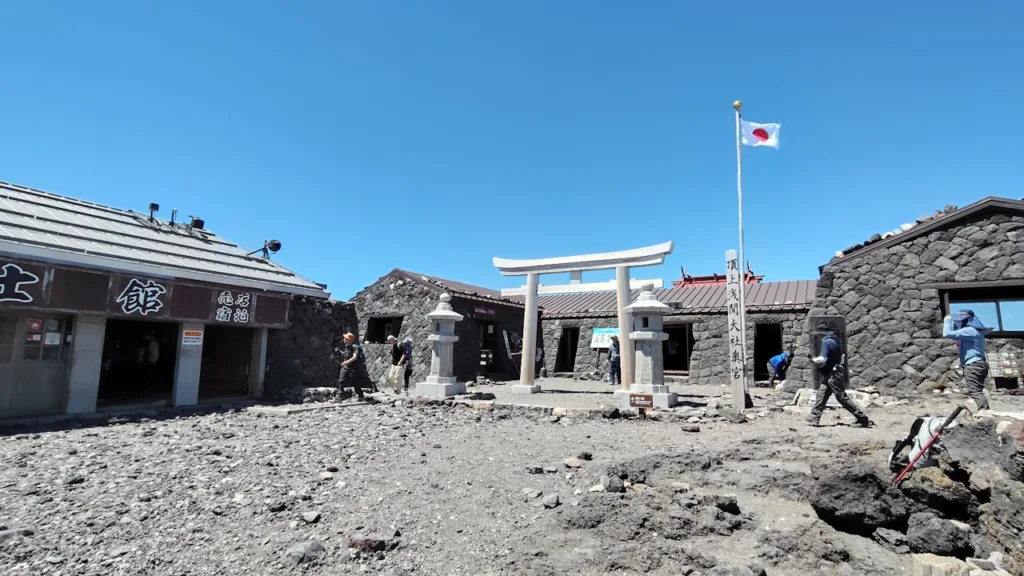
The Okumiya is a shrine unlike any other in Japan — not just for its altitude, but for the layers of history packed into it: Ieyasu’s donation of the mountain’s upper reaches, a main structure with no main hall, a goshuin stamped in volcanic sand, and a registry that’s quietly tracked climbers in their golden years since long before most of today’s hikers were born. Because the climbing season runs only from early July to early September, it’s worth locking in your hut reservations and route plans well ahead of time. And whichever trail brings you to the summit, a comfortable base in the Fujinomiya area — whether that’s the station-front convenience of Fujinomiya Fujikyu Hotel, the hot spring at Super Hotel Fujinomiya, or the lakeside views at Kyukamura Fuji — makes the climb, and the shrine waiting at the top of it, that much more rewarding.