
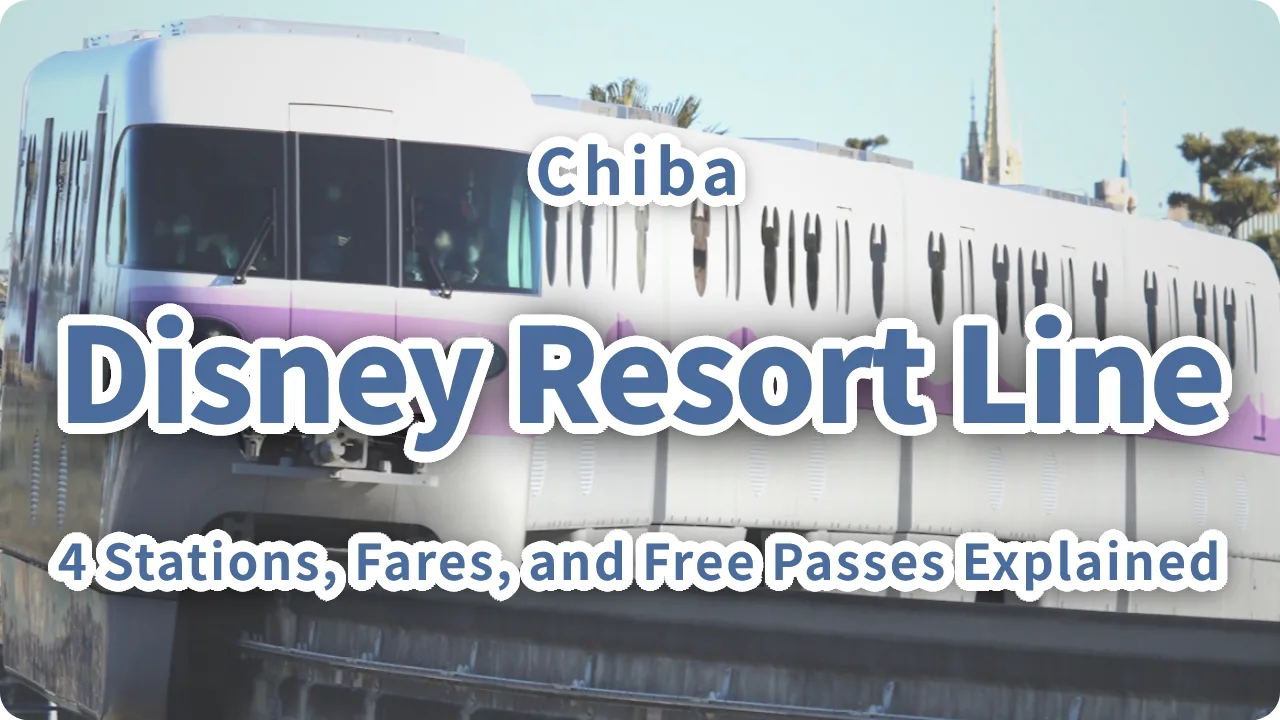
Travel insights from your dedicated Tour Conductor. This time, we dive deep into the Disney Resort Line — the straddle-type monorail that loops through Tokyo Disney Resort in Urayasu, Chiba Prefecture. Connecting Tokyo Disneyland, Tokyo DisneySea, and the Official Hotel area in a single circular route, this line is the backbone of every move you make during your resort stay. In just 5.0 km and roughly 13 minutes per lap, it carries more than 20 million passengers a year. Knowing how it works — its history, its rolling stock, and the story behind each station — will meaningfully elevate your visit.
| Item | Details |
|---|---|
| Line Name | Disney Resort Line |
| Operator | Maihama Resort Line Co., Ltd. (wholly owned subsidiary of Oriental Land Co.) |
| Type | Straddle-type monorail (licensed under Japan’s Railway Business Act) |
| Route Length | 5.0 km (circular) |
| Stations | 4 |
| Operation | Counter-clockwise, one-direction (fully automated) |
| Time per Lap | Approx. 13 minutes |
| Service Began | July 27, 2001 |
| Location | Maihama, Urayasu, Chiba Prefecture |
What to Know Before You Ride
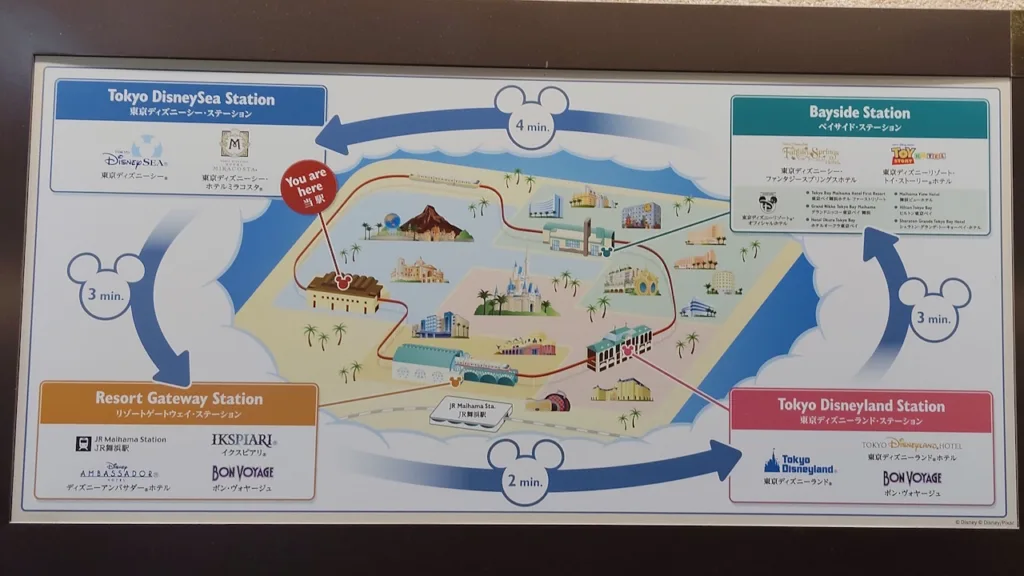
Not understanding how the Disney Resort Line works before your first visit can cost you precious time. The line runs in a single direction — counter-clockwise — and there are no clockwise trains. If you are at Tokyo DisneySea Station and want to reach Resort Gateway Station, which is just one stop “back,” you will need to ride through the remaining three stations, a journey of roughly nine to ten minutes. It is a surprisingly common mistake for first-time visitors.
Single-fare tickets also come with restrictions: once you exit a gate, the ticket is void, and riding more than one full loop on a single ticket is not permitted. The gate closes automatically approximately one hour after entry. If you are planning multiple trips between the parks and the Official Hotels during the day, buying a free pass from the start will save you both money and the inconvenience of repurchasing at each station.
A Public Railway That Was Born Before the Second Park Opened
The Disney Resort Line began service on July 27, 2001 — ahead of Tokyo DisneySea’s grand opening on September 4 of the same year. The launch ceremony the day before drew Mickey Mouse and Minnie Mouse alongside Japan’s Minister of Land, Infrastructure and Transport and the Governor of Chiba Prefecture. Infrastructure work had been underway since 1997 and 1998, with test runs beginning in October 2000.
A point that surprises many visitors: this is not a park attraction or an in-resort shuttle. The Disney Resort Line is a licensed public railway under Japan’s Railway Business Act. Part of its elevated track runs above a public road, which is why the line operates on days when both parks are closed, and why it appears on standard transit maps. All four stations sit within Oriental Land’s property, yet the boarding areas are accessible without a park ticket — precisely because it functions as public transportation. It has been carrying over 20 million passengers annually since its opening, making it the operational core of the Maihama area’s transit network.
The Only Circular Straddle-Type Monorail in Japan
The Disney Resort Line uses straddle-type monorail technology, meaning the cars sit astride the beam — a design known for structural stability and widely adopted in urban transit systems. This is different from the suspension-type monorails found in Chiba and Enoshima, where cars hang below the rail.
As of 2026, Japan has six straddle-type monorail lines in operation:
| Line | Operator | Route | Length |
|---|---|---|---|
| Tokyo Monorail | Tokyo Monorail | Hamamatsucho – HND T1 | 17.8 km |
| Tama Monorail | Tama Toshi Monorail | Kamikitadai – Tama Center | 16.0 km |
| Osaka Monorail | Osaka Monorail Co. | Osaka Airport – Kadoma (Main) | 21.2 km |
| Kitakyushu Monorail | Kitakyushu Rapid Transit | Kokura – Kikugaoka | 8.8 km |
| Yui Rail | Okinawa Urban Monorail | Naha Airport – Tedako-Uradasuki | 17.0 km |
| Disney Resort Line | Maihama Resort Line | Circular (4 stations) | 5.0 km |
Among these six, the Disney Resort Line is the only one that runs in a loop, with Resort Gateway Station serving as both the starting and ending point. It is also the shortest of the six, yet its passenger density — over 20 million riders per year on just five kilometres of track — is remarkable by any measure. Where the Tokyo Monorail is defined by airport access and the Osaka Monorail by its length, the Disney Resort Line stands apart as the only monorail that exists entirely within a single destination.
From the Original Resort Liner (Type X) to the Current Fleet (Type C)
Type X (Series 10): The Train That Ran for 23 Years
The vehicles that operated the Disney Resort Line from its 2001 opening were the Resort Liner Type X. The “X” is the Roman numeral for ten, reflecting the Series 10 registration. There are no Type A or Type B variants — the line’s rolling stock history consists of exactly two generations: Type X and Type C.
Type X ran as five six-car sets (30 cars total) in five colours: yellow, pink, blue, purple, and green. The defining external feature was the Mickey Mouse-shaped window on each car’s side panel — though on the Type X, the shape was closer to an oval and comparatively modest in size. Seating used a curved centre design with a capacity of 537 passengers per set. Grab handles came in a single height, which made them difficult for young children to reach. Interior lighting was fluorescent, and the overall fit-out was simple, consistent with the short journey time.
After 23 years of continuous service, Type X retired on September 1, 2024. A final run was held that evening: six groups of guests, selected by lottery, each rode one car of the last train, giving the original fleet a send-off befitting its quarter-century of service.
Type C (Series 100): The Current Fleet
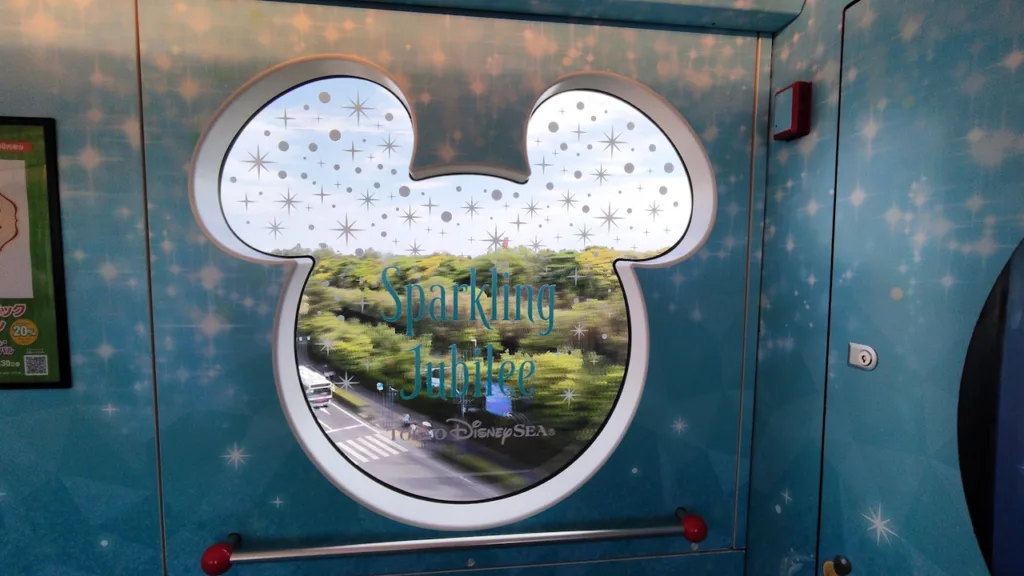
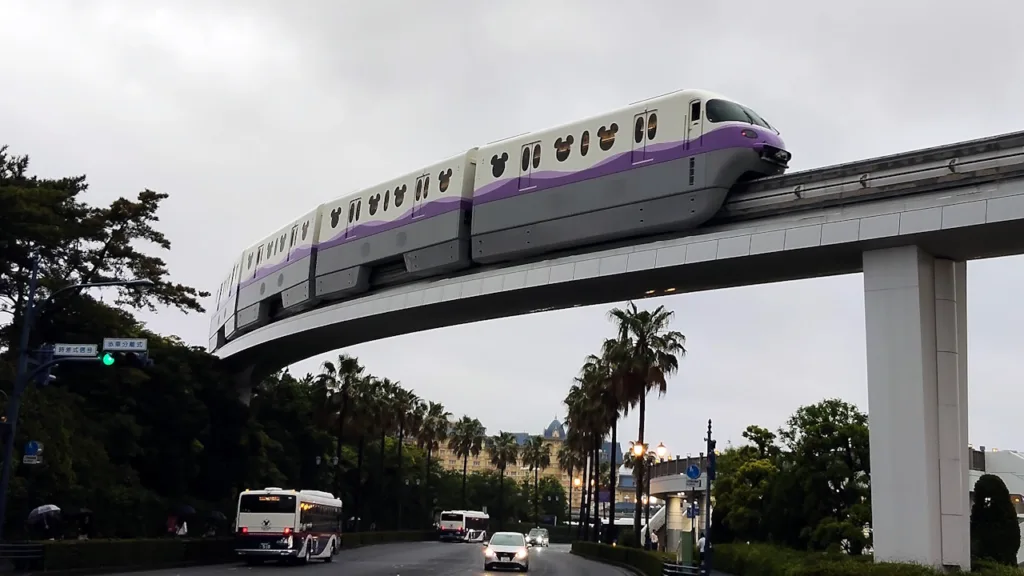
The current Resort Liner Type C debuted on July 3, 2020. “C” is the Roman numeral for one hundred, matching the Series 100 designation. The development concept — “delivering the Disney experience to everyone, everywhere, at any time” — is evident throughout the redesign. Yellow arrived first in 2020, followed by pink in 2021, then blue and purple in 2022, and finally green in January 2024. By September 2024, the full five-colour fleet had replaced every Type X set.
The exterior retains the five accent colours of the predecessor but replaces the solid panels with a two-tone wave gradient. The Mickey Mouse-shaped windows are significantly larger than on the Type X, opening up the views considerably. Interior changes include:
- Longitudinal (long) bench seating for easier boarding and alighting
- LED indirect lighting for a warmer cabin atmosphere
- Mickey-shaped grab handles at three different heights, accommodating children and adults alike
- Accessibility-focused free spaces in every car, with wide free spaces in cars three and four
- Improved front observation seats with barrier-free access
- Disney animations displayed on platform monitors as trains approach
In normal service, one Conductor (onboard staff member) handles door operation, safety monitoring, and passenger guidance under semi-automated operation (GoA3 standard).
Limited-Edition Wrap: The Tokyo DisneySea 25th Anniversary “Sparkling Jubilee” Liner
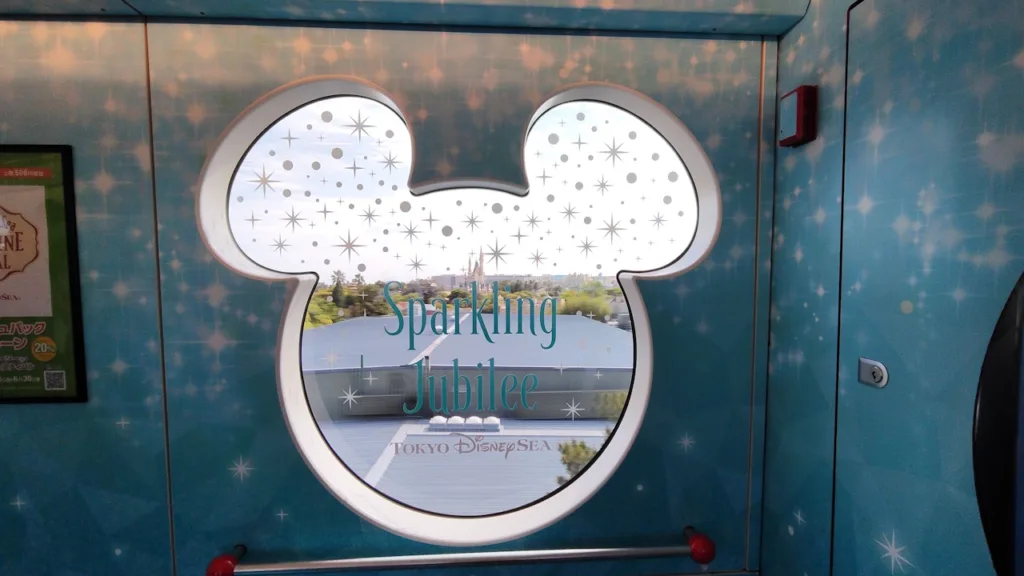
2026 marks Tokyo DisneySea’s 25th anniversary. To celebrate, a special full-wrap monorail — the Tokyo DisneySea 25th Anniversary “Sparkling Jubilee” Liner — has been running from April 15, 2026 through March 31, 2027.
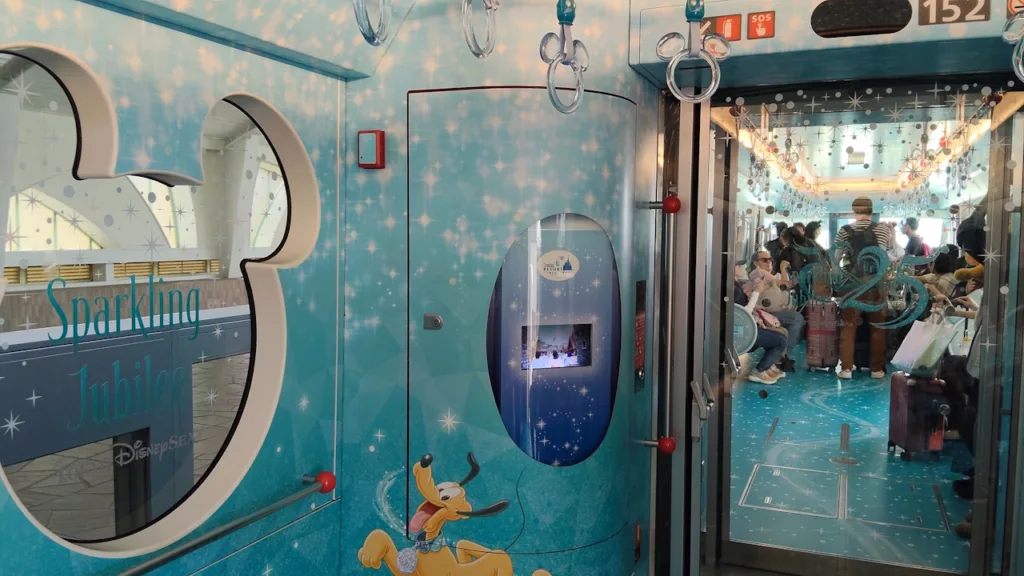
The exterior is built around “Jubilee Blue,” the anniversary theme colour, with Mickey Mouse and friends in special anniversary costumes covering the entire body of the train. The interior is equally immersive: ceiling, floor, and panels are all decorated in a sparkling water motif that picks up the jubilee blue palette. Grab handles are made from clear material designed to catch the light, and the onboard BGM features “Come Join the Jubilee,” the 25th anniversary theme song. Boarding this particular set turns the monorail ride itself into an anniversary experience.
Only one set runs this livery, so encountering it is a matter of timing and luck. Commemorative 25th anniversary free passes and souvenir medals are available at all stations alongside the regular lineup.
Ticket Types and Fares
The Disney Resort Line offers two main ticket types: single-journey tickets and free passes.
Fares (as of May 2026)
| Ticket | Adult (Middle School and up) | Child (Elementary School) | Infant |
|---|---|---|---|
| Single Journey (max. 1 loop) | ¥300 | ¥150 | Free (under 1 year) |
| 1-Day Free Pass | ¥700 | ¥350 | Free (up to 2 pre-school children) |
| 2-Day Free Pass | ¥1,400 | ¥700 | Free (up to 2 pre-school children) |
| 3-Day Free Pass | ¥2,100 | ¥1,050 | Free (up to 2 pre-school children) |
| 4-Day Free Pass | ¥2,800 | ¥1,400 | Free (up to 2 pre-school children) |
If you plan to ride three or more times in a day, the 1-Day Free Pass is the more economical choice. For guests commuting between an Official Hotel and the parks repeatedly, a free pass is effectively the standard option. IC cards such as Suica and PASMO are accepted. As of May 21, 2026, magnetic paper tickets have been fully phased out in favour of QR-code tickets — the design-printed free passes continue, with a QR code on the reverse rather than a magnetic strip. Seasonal and event-themed designs are released regularly and remain collectible items for Disney fans.
The Four Stations: A Complete Guide
The Disney Resort Line stops at four stations in counter-clockwise order. The table below summarises connections and key facilities at each stop.
| Station | Connections | Key Facilities |
|---|---|---|
| Resort Gateway Station | JR Keiyo / Musashino Line (Maihama Station, adjacent) | Ikspiari, Bon Voyage, Maihama Amphitheater |
| Tokyo Disneyland Station | None | Tokyo Disneyland (direct access), Tokyo Disneyland Hotel (adjacent) |
| Bayside Station | None | 6 Official Hotels (shuttle bus connections) |
| Tokyo DisneySea Station | None | Tokyo DisneySea (direct access), Hotel MiraCosta (adjacent), Vehicle Depot |
Resort Gateway Station
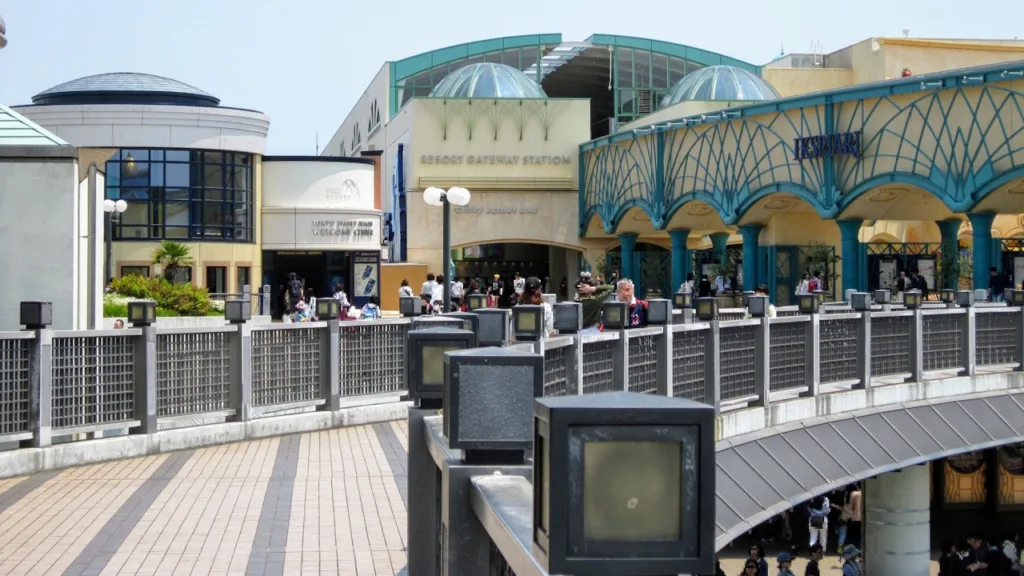
This is the resort’s main gateway, where nearly all guests arriving from central Tokyo step off the JR line and transfer to the monorail. A ticket sales counter inside the station handles season passes and accepts credit cards (operating hours: 7:30–20:00).
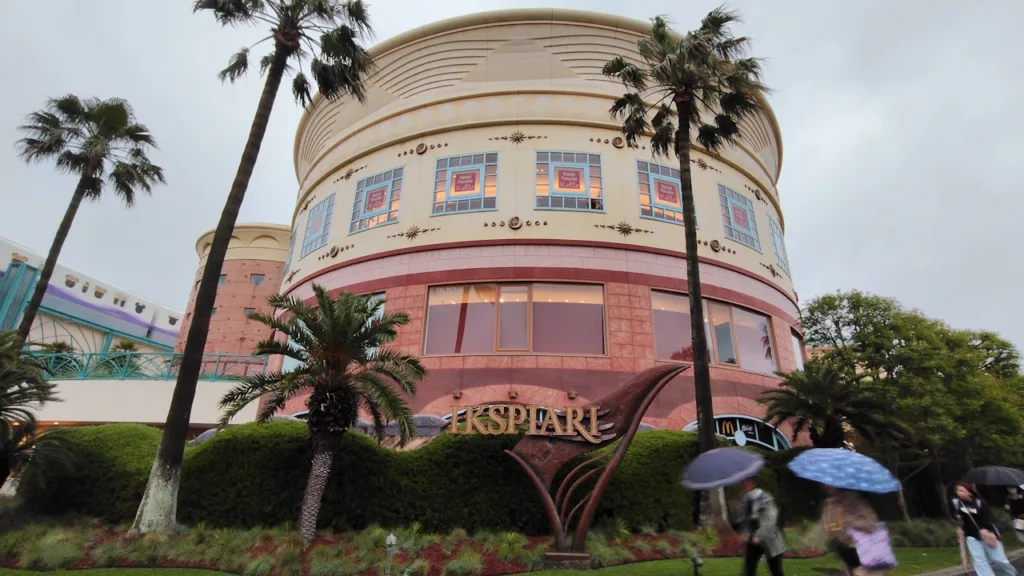
Just outside the gates, Ikspiari — Tokyo Disney Resort’s dining, shopping, and cinema complex — offers everything from table-service restaurants to character merchandise. The Disney character goods store Bon Voyage is also located in this area, making it an ideal spot for shopping before or after the parks.
Tokyo Disneyland Station
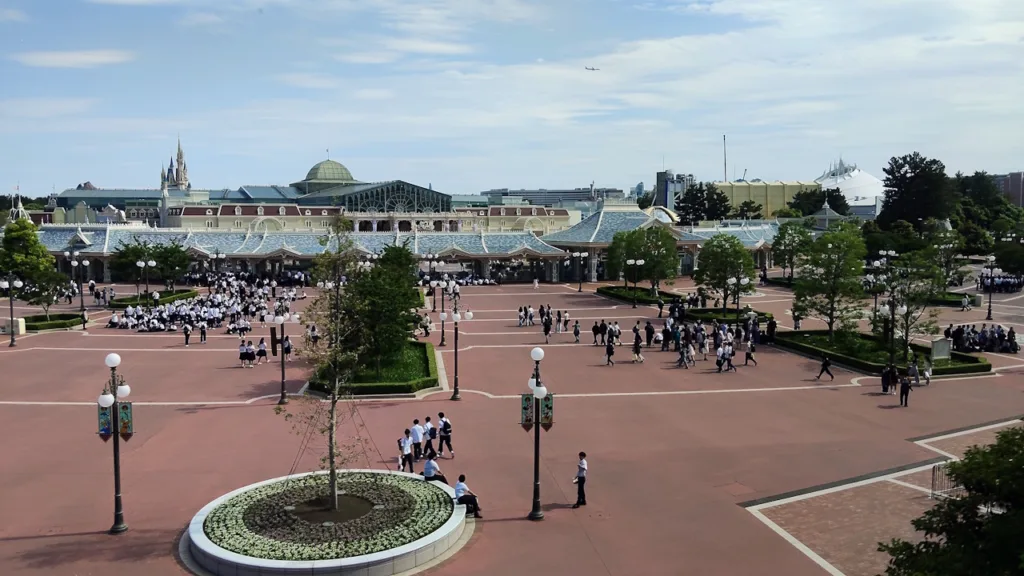
This station connects directly to Tokyo Disneyland’s main entrance. The red-brick exterior, evoking Victorian-era America, is itself part of the Disney experience — guests begin to feel the park’s atmosphere before they even reach the gates. Journey time from Resort Gateway Station is approximately two minutes. Adjacent to the station, the Tokyo Disneyland Hotel is a Disney Hotel built in the French Victorian style favoured by Walt Disney himself.
Bayside Station
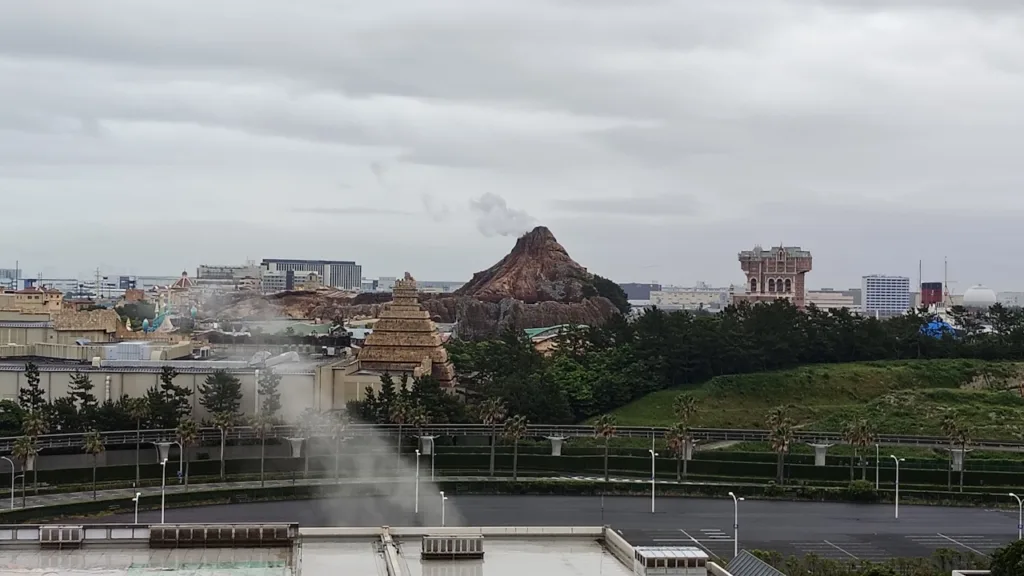
Bayside Station is the access hub for all six Official Hotels, each served by the complimentary Disney Resort Cruiser shuttle bus. The leg between Bayside Station and Tokyo DisneySea Station is roughly four minutes, the longest station-to-station interval on the line. The shuttle bus makes the transfer comfortable even with luggage after check-in.
Tokyo DisneySea Station
This station opens directly onto Tokyo DisneySea’s main entrance. The architecture draws on Italian Tuscany of the 18th and 19th centuries — a refined, antiquarian aesthetic that frames the arrival at “DisneySea Plaza” beautifully. Between this station and Resort Gateway Station, the Vehicle Depot sits alongside the track, serving as the operational base for the fleet.
A Moment Written into History: The Final Day of Magnetic Tickets
On May 21, 2026 at 20:00, a 25-year era quietly ended at the Disney Resort Line. The magnetic paper ticket — a fixture since the line opened in 2001 — sold its last copy. The phase-out was not uniform across all stations: Tokyo Disneyland Station and Bayside Station had already stopped sales on May 18, leaving Resort Gateway Station and Tokyo DisneySea Station as the final two points of sale until the 20:00 cut-off.
In the roughly one hour before park closing at 21:00, rail enthusiasts and Disney fans gathered outside the fare gates, cameras ready, waiting for the machines to go dark. When the moment arrived, a Station Cast member stepped to the front of the now-retired ticket machine and waved to the assembled crowd. What could have been an invisible operational changeover became a Disney-style farewell — quiet, warm, and unmistakably deliberate.
The magnetic free pass had, over 25 years, become a collectible item in its own right. Every seasonal event produced a new design printed directly onto the card, and many guests kept their used tickets as souvenirs. The replacement QR-code tickets carry the same printed designs, so the visual tradition continues — but the tactile quality of a magnetic card is gone, and its absence was felt. Lines reportedly formed at multiple stations on the final day as guests sought to purchase the last magnetic tickets. The fact that a routine infrastructure upgrade became a moment worth photographing and preserving says everything about how the Disney Resort Line operates: not just as transit, but as a show.
Recommended Hotels Near Bayside Station
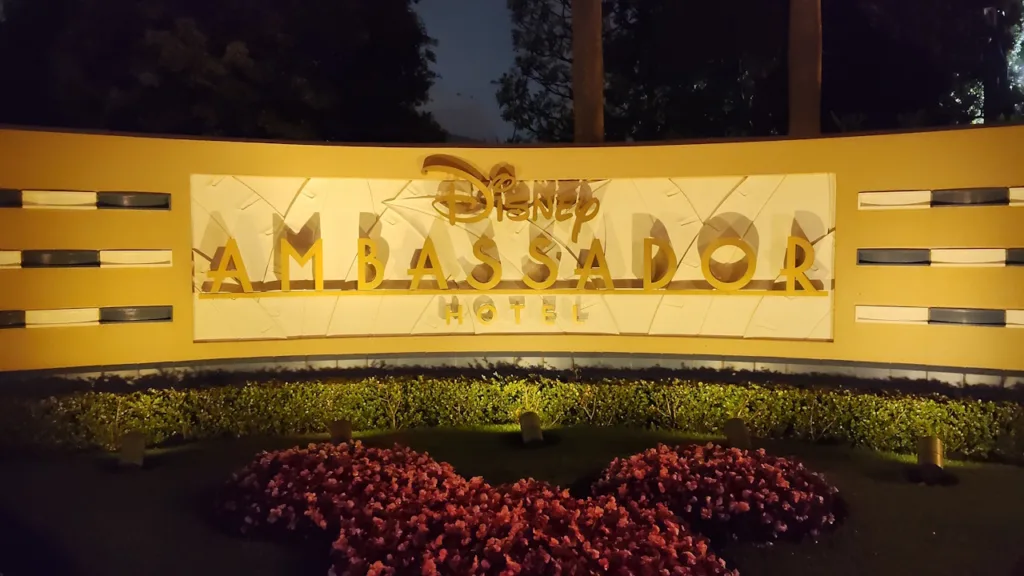
Hilton Tokyo Bay
A Hilton-brand Official Hotel of Tokyo Disney Resort, just one minute’s walk from Bayside Station. The property offers five dining venues, family-friendly “Happy Magic Rooms” sleeping up to six guests, Executive Rooms with lounge access, and a range of suite categories. An outdoor Garden Pool Restaurant is scheduled to open in June 2026.
Grand Nikko Tokyo Bay Maihama
The largest Official Hotel in the Maihama area, about four minutes’ walk from Bayside Station. The hotel is organised into three floor types — Nikko Floor (with dedicated lounge), Rainbow Floor, and Garden Floor — and features the indoor and seasonal outdoor pool “Grand Bleu.” Free shuttle service from JR Maihama Station is also available.
Hotel Okura Tokyo Bay
An Official Hotel approximately three minutes’ walk from Bayside Station. One of the very few Official Hotels to offer traditional Japanese-style rooms, Hotel Okura Tokyo Bay is also noted for its well-regarded Japanese-Western breakfast buffet. Family facilities including KidsLand and a pool make it a strong option for multi-generational groups.
Plan Your Japan Trip with a Dedicated Tour Conductor
Navigating Tokyo Disney Resort is relatively straightforward for English speakers, but the broader landscape of travel in Japan — transport connections, hotel check-in procedures, language barriers in less-tourist-facing situations, and the logistical demands of moving between destinations — can introduce friction that takes time and energy away from the experience itself.
A dedicated Tour Conductor travels with your group for the duration of your itinerary, handling the coordination layer that individual travellers typically have to manage themselves. This includes overseeing schedule adherence, managing luggage logistics, providing translation assistance in situations where English is not available, and coordinating emergency responses if something unexpected arises. The Tour Conductor’s role is defined by itinerary management, not guiding or touring: the job is to ensure the operational side of your trip runs without interruption, so your attention stays on the experience.
For a resort visit that includes the Disney Resort Line, the Official Hotels, and potentially other destinations across Japan, having a Tour Conductor on hand removes the cognitive overhead of planning-in-motion — particularly valuable when group members have different needs, when the itinerary spans multiple regions, or when you are visiting Japan for the first time.
Full details about the dedicated Tour Conductor service and travel arrangement support are available at tours.e-stay.jp.
Conclusion
The Disney Resort Line is far more than a transfer service between the two parks. It is a fully licensed public railway that loops through one of the world’s most concentrated resort destinations in just 13 minutes, carrying 20 million passengers a year on 5.0 km of elevated track. The transition from the original Type X fleet to the current Type C generation marks a generational renewal that touches everything from window design to cabin lighting to accessibility. The Sparkling Jubilee Liner adds an anniversary layer to any ride through 2027. And the quiet ceremony that closed out the magnetic ticket era on May 21, 2026 is as good an illustration as any of what sets this line apart: operational precision delivered with showmanship.
For accommodation, Hilton Tokyo Bay — a Hilton-brand Official Hotel one minute’s walk from Bayside Station — offers an exceptionally convenient base. The combination of Hilton’s international service standards and the direct monorail connection to both parks makes it a natural choice for visitors who want their resort logistics to work seamlessly from the moment they check in.