



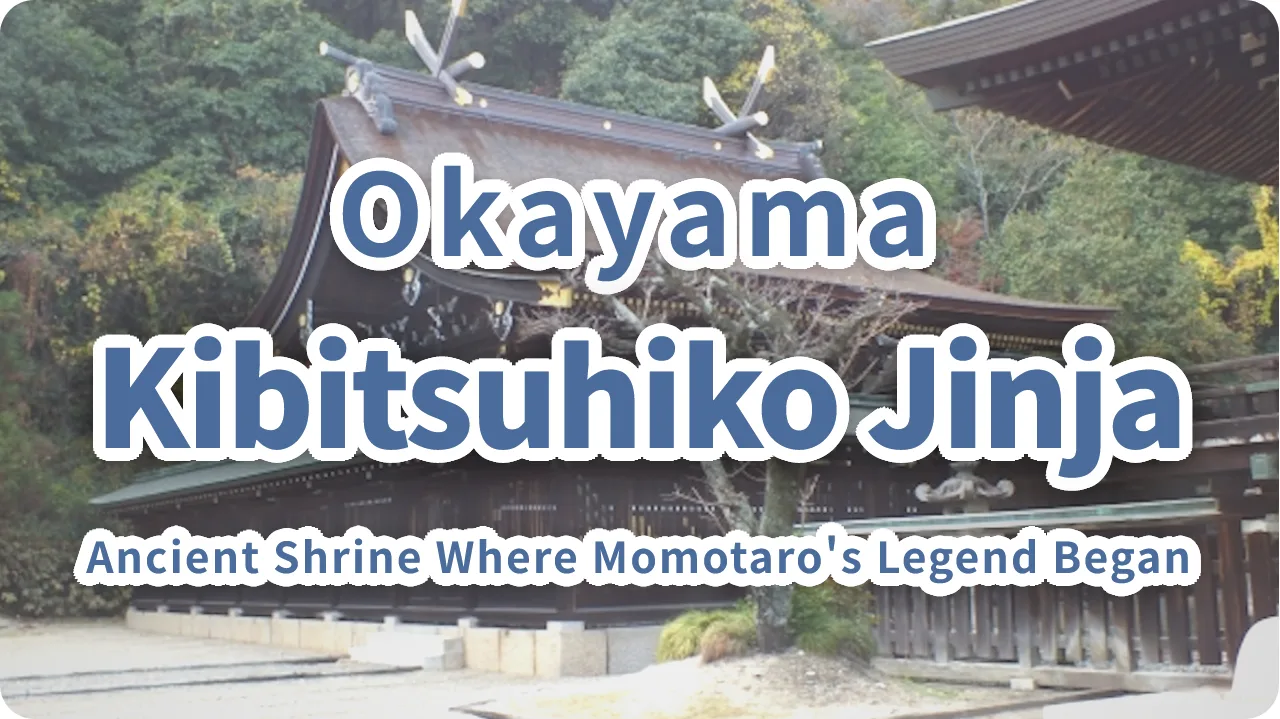
Brought to you by a licensed tour conductor writer. This time, we explore Kibitsuhiko Jinja (吉備津彦神社), the Ichinomiya — the highest-ranked shrine — of the former Bizen Province, enshrined in Kita Ward, Okayama City. This ancient sanctuary is dedicated to Okikibitsuhiko-no-Mikoto (大吉備津彦命), the divine warrior whose exploits against the demon Ura are widely regarded as the origin of Japan’s beloved folktale, Momotaro. Far more than a fairy-tale backdrop, this shrine is a place where ancient politics, sacred belief, and mythic power converge. The sacred mountain of Kibi-no-Nakayama (175 m) rises directly behind the precincts, revered since prehistoric times as a divine peak where gods descend to earth. Each summer solstice, the rising sun passes precisely through the main torii gate and illuminates a mirror enshrined in the Saimonzen, a celestial alignment that has earned the shrine its poetic alternate name: Asahi-no-Miya — “The Shrine of the Morning Sun.”
In 2018, the shrine was designated a component of the Japan Heritage program “The Town Where the Momotaro Legend Was Born — Okayama.” In March 2025, six shrine buildings constructed in 1936 were newly designated as Okayama Prefectural Important Cultural Properties, adding yet another layer of official recognition to a site already steeped in historical significance. For travelers seeking Japan beyond its headline attractions, Kibitsuhiko Jinja and the Kibiji corridor offer an encounter with the ancient soul of the country.
| Item | Details |
|---|---|
| Shrine Name | Kibitsuhiko Jinja (吉備津彦神社) |
| Alternate Name | Asahi-no-Miya (Shrine of the Morning Sun) |
| Shrine Rank | Ichinomiya of Bizen Province; former Kokuheishosha; Beppyo Jinja |
| Principal Deity | Okikibitsuhiko-no-Mikoto |
| Address | 1043 Ichinomiya, Kita Ward, Okayama City, Okayama Prefecture |
| Visiting Hours | 6:00 AM to 6:00 PM (gates close at 6 PM) |
| Prayer Ceremonies | 9:00 AM to 4:00 PM (walk-in; approximately every 30 minutes) |
| Closed | Open year-round |
| Admission | Free |
| Access (Train) | Approx. 3-minute walk from Bizen-Ichinomiya Station on the JR Kibi Line (Momotaro Line) |
| Access (Car) | Approx. 20 minutes from Okayama IC on the Sanyo Expressway; approx. 3.5 km from Kibi Smart IC |
A Few Things to Know Before You Visit
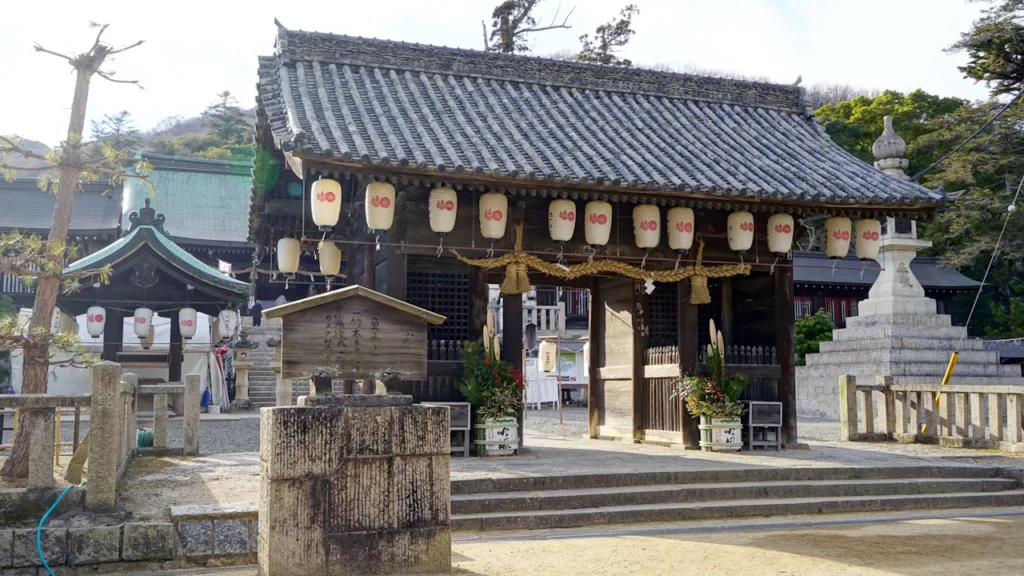
The zuijinmon (随神門), the shrine’s main gate and a designated Important Cultural Property of Okayama City, has been undergoing preservation restoration work since late 2025. The gate itself remains in place, but scaffolding and protective sheeting are installed, meaning the precincts present a somewhat different appearance than usual. The work is ongoing as of mid-2026.
Regarding access by train, the JR Kibi Line (nicknamed the Momotaro Line) runs only one to two trains per hour. Missing a departure can mean a wait of close to an hour for the next service. Rental cars from Okayama Station or the local bus network are practical alternatives.
Where Momotaro Was Born — Okikibitsuhiko-no-Mikoto and the Battle Against Ura
To understand Kibitsuhiko Jinja, one must begin with the story of its principal deity, Okikibitsuhiko-no-Mikoto, and the demon Ura (温羅). Originally named Isaseri-hiko-no-Mikoto (五十狭芹彦命), he was a prince of Emperor Kōrei, the seventh Emperor of Japan. During the reign of Emperor Sujin, he was dispatched to the San’yō region as one of the Shidōshōgun — four generals sent to pacify the outlying provinces — with the mission of subduing a fearsome demon lord who was terrorizing the land of Kibi.
Who Was the Demon Ura?
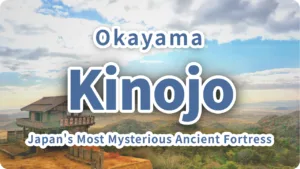
Ura is described in legend as a foreigner, possibly a prince from the ancient Korean kingdom of Baekje. Accounts describe him as a giant of some four meters in height, with blazing eyes like a tiger or wolf and a wild, unkempt beard and hair. He established a mountain fortress called Kinojō (鬼ノ城) on Mount Kijōzan in present-day Sōja City, raiding ships on the Seto Inland Sea routes and terrorizing the surrounding population. The Yamato Court repeatedly sent warriors to subdue him, but Ura’s elusive and shape-shifting nature meant that none could prevail. At last, the task fell to the renowned Isaseri-hiko-no-Mikoto.
The Arrow-Splitting Standoff at Yagui-no-Miya
Establishing his camp at the eastern foot of Kibi-no-Nakayama, Okikibitsuhiko-no-Mikoto fired arrow after arrow toward Ura’s fortress. Each time, Ura hurled back a boulder, and the two projectiles collided in midair, crashing to the ground between the opposing camps without reaching their targets. The site where these arrows and rocks fell is enshrined today as Yagui-no-Miya (矢喰宮), and the actual stones believed to be those ancient rocks remain in its precinct.
Unable to break the stalemate, Okikibitsuhiko-no-Mikoto devised a new strategy: he fired two arrows simultaneously. As before, Ura knocked away one with his rock — but the second arrow found its mark, piercing Ura’s left eye. Blood poured from the wound in such volume that it formed a river, staining the shore crimson downstream. That river is still known today as Chisui-gawa (血吸川) — literally, “Blood-Drinking River” — and flows through present-day Sōja City.
The Shapeshifting Chase: Pheasant, Carp, and Cormorant
Fatally wounded, Ura transformed himself into a pheasant and fled into the mountains. Okikibitsuhiko-no-Mikoto shifted into a hawk and gave chase. Ura then became a carp and plunged into the Chisui-gawa. Undeterred, Okikibitsuhiko-no-Mikoto transformed into a cormorant and dove into the river, finally seizing the carp in his beak. The spot where he brought Ura to the surface is commemorated by Koikui Jinja (鯉喰神社), which still stands today. Cornered and exhausted, Ura surrendered, offering the title of “Kibi-no-Kaja” (吉備冠者) to his captor. It is from this moment that Isaseri-hiko-no-Mikoto came to be known as Kibitsuhiko-no-Mikoto — “Lord of Kibi.”
The Head That Would Not Fall Silent
After his defeat, Ura was beheaded and his head placed on public display. Yet even in death, the head refused to be silenced — it continued to growl and cry out for years on end. Fed to dogs until only the skull remained, it still would not stop. Okikibitsuhiko-no-Mikoto eventually had the skull buried deep beneath the hearthstone of the御釜殿 (御竈殿, the sacred cauldron hall) at Kibitsu Jinja. Still the groaning continued, reverberating for thirteen full years. One night, Ura appeared in Okikibitsuhiko-no-Mikoto’s dream and spoke: “Place my wife, Azohime, in service as the one who prepares the sacred offerings in the cauldron hall. In return, I will become your messenger and reveal fortunes.” When the ritual was carried out as instructed, the groaning at last fell silent. This is the origin of the renowned Narikama Shinji (鳴釜神事) — the oracle-by-cauldron ceremony — observed at Kibitsu Jinja to this day.
The Prototype of Momotaro
This epic legend of Ura’s subjugation is widely considered the prototype of Momotaro, Japan’s most famous folktale. Okikibitsuhiko-no-Mikoto maps onto Momotaro; Ura becomes the oni (demon); Inukai-Takeru-no-Mikoto (犬飼武命), a loyal retainer, is said to be the model for the dog companion; and Sasaforihiko-no-Mikoto (楽々森彦命), a local strategist, corresponds to the monkey. The sites associated with the legend — Yagui-no-Miya, Koikui Jinja, Kinojō, Chisui-gawa — still dot the Okayama landscape, making the entire Kibiji corridor a living, walkable mythological map.
Notably, not all historians read Ura as a simple villain. A counter-narrative holds that Ura was a continental immigrant who brought ironworking and shipbuilding technologies to Kibi, and that the Yamato Court’s campaign was effectively an annexation of a powerful regional civilization. Under this reading, the thirteen years of Ura’s groaning represent the lament of the Kibi people for their defeated leader — and the presence of Ura-no-Miya, a subsidiary shrine within Kibitsuhiko Jinja’s precinct dedicated to Ura’s gentle spirit (和魂, nigimitama), reflects this enduring respect for the vanquished.
After bringing peace to Kibi, Okikibitsuhiko-no-Mikoto settled at the foot of Kibi-no-Nakayama. After his death, the people he had governed built a shrine in his honor — and that shrine became Kibitsuhiko Jinja.
The Shrine’s Rise to Ichinomiya
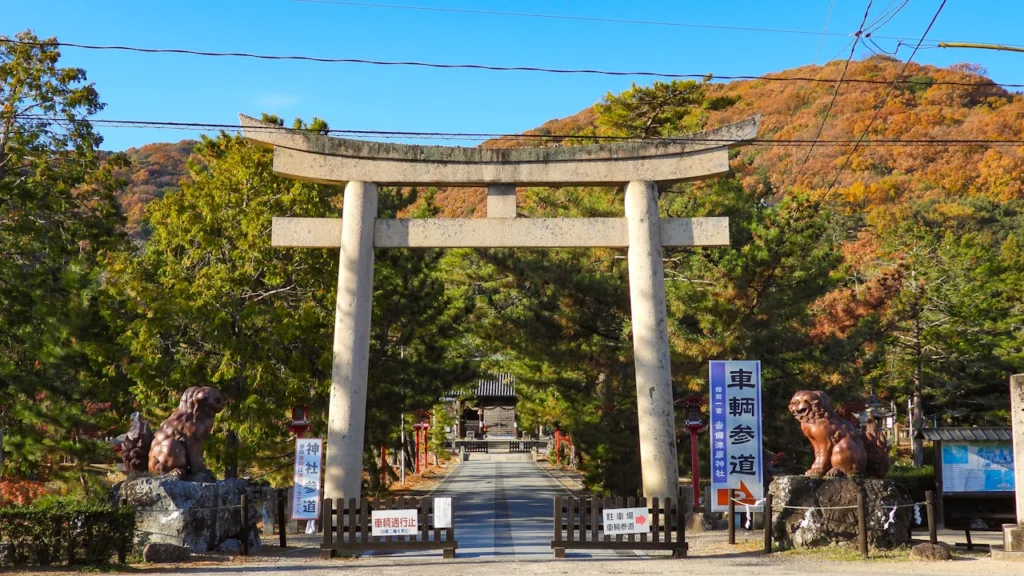
The path to becoming Bizen Province’s Ichinomiya is itself a fascinating chapter. The Engishiki (延喜式), the Heian-period compendium of regulations compiled between 905 and 927, does not list Kibitsuhiko Jinja among the great shrines of Bizen — that distinction at the time belonged to Ani Jinja. However, in 939 (Tengyō 2), Ani Jinja was implicated in supporting the Fujiwara no Sumitomo Rebellion and lost its standing with the Imperial Court. The neighboring Kibitsu Jinja in Bichū Province gained favor through prayers for the rebellion’s suppression, and in the reshuffling that followed, Kibitsuhiko Jinja rose to claim the title of Ichinomiya of Bizen.
Through the medieval period, successive warrior lords — including the Ukita clan and Kobayakawa Hideaki — extended their patronage to the shrine. In the Edo period, the Ikeda clan, lords of the Okayama Domain, became particularly devoted patrons. The present main hall (honden) was begun under Lord Ikeda Mitsumasa in Kanbun 8 (1668) and completed under his son Tsunamasa in Genroku 10 (1697). Built in the nagare-zukuri (flowing-roof) style, with a plan of three bays by two bays, it is designated an Okayama Prefectural Important Cultural Property. The precinct’s subsidiary shrines include ones dedicated to Kōbu-no-Mikoto (Lord Ikeda Nobumasa) and Kasei-no-Mikoto (Lord Ikeda Terumasa), reflecting the Ikeda family’s enduring connection to the shrine.
The 1936 Grand Construction and the 2025 Cultural Property Designation
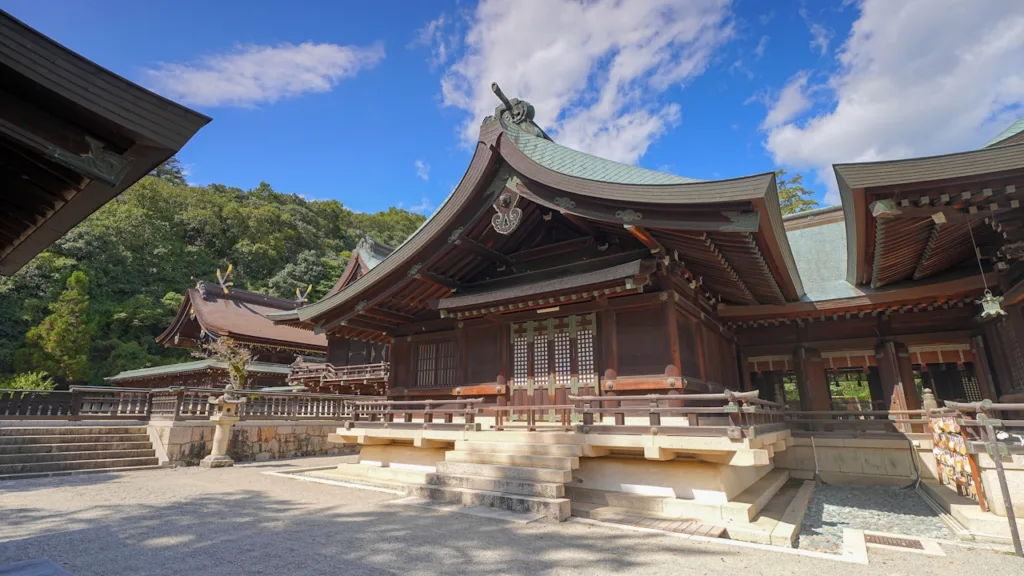
While the honden dates from the Edo period, the remaining main buildings — the haiden (worship hall), the wataridono (connecting hall), the tsuri-dono (hanging hall), the saimonzen (ritual hall), the nokurō (eave corridor), and the shinsenjo (sacred kitchen) — were designed by Takashi Sunami, a native of Okayama Prefecture who served as an engineer for the Ministry of Home Affairs Shrine Bureau. Completed in 1936 (Shōwa 11) as part of a large-scale expansion, these six buildings exemplify the architectural aesthetics of modern shrine construction. In March 2025, all six structures, together with 23 original architectural drawings, were collectively designated as Okayama Prefectural Important Cultural Properties. In March 2026, two ridgepole memorial plaques (棟札, munafuda) were additionally designated as attachments. As an ensemble of early Shōwa shrine architecture without parallel in Okayama Prefecture, their significance has now been formally recognized.
Kibi-no-Nakayama: A Sacred Mountain That Has Never Ceased to Be Worshipped
One of the most distinctive features of Kibitsuhiko Jinja is its relationship with Kibi-no-Nakayama (175 m), the mountain that rises directly behind the shrine precincts. Regarded since antiquity as a shintaizan — a mountain inhabited by the divine — Kibi-no-Nakayama contains immense natural stone formations known as amatsui-wakura (天津磐座, sacred rocks upon which gods alight) and iwasaka (磐境, stone demarcations of sacred space). These features, traceable to the Jōmon and Yayoi periods, confirm that ritual activity on this mountain predates the shrine itself by millennia.
At the summit of the northern peak, Ryūōzan (175 m), the original altar rock of Kibitsuhiko Jinja and a subsidiary shrine to the Dragon Deity are enshrined. The central peak, Chausuzan (160 m), is said to contain the imperial mausoleum of Okikibitsuhiko-no-Mikoto. The entire mountain functions as a sacred precinct, and standing within the shrine grounds, one can feel the weight of this ancient, unbroken tradition.
The Summer Solstice Miracle — Why the Shrine Is Called “Asahi-no-Miya”
The orientation of the shrine buildings conceals a remarkable astronomical intentionality. Each year at the summer solstice, the rising sun climbs precisely behind the main torii gate, and its light travels through the precincts to illuminate a sacred mirror installed in the Saimonzen hall. This is not coincidence — it reflects a deliberate alignment built into the shrine’s design by its ancient architects. The precision of the astronomical knowledge required, and the technical skill involved in translating it into built form, continues to astonish visitors. It is this phenomenon that gives the shrine its secondary name, Asahi-no-Miya (朝日の宮): “The Shrine of the Morning Sun.” Each summer solstice, visitors gather specifically to witness this event.
Legendary Sacred Sword and Other Highlights of the Precincts
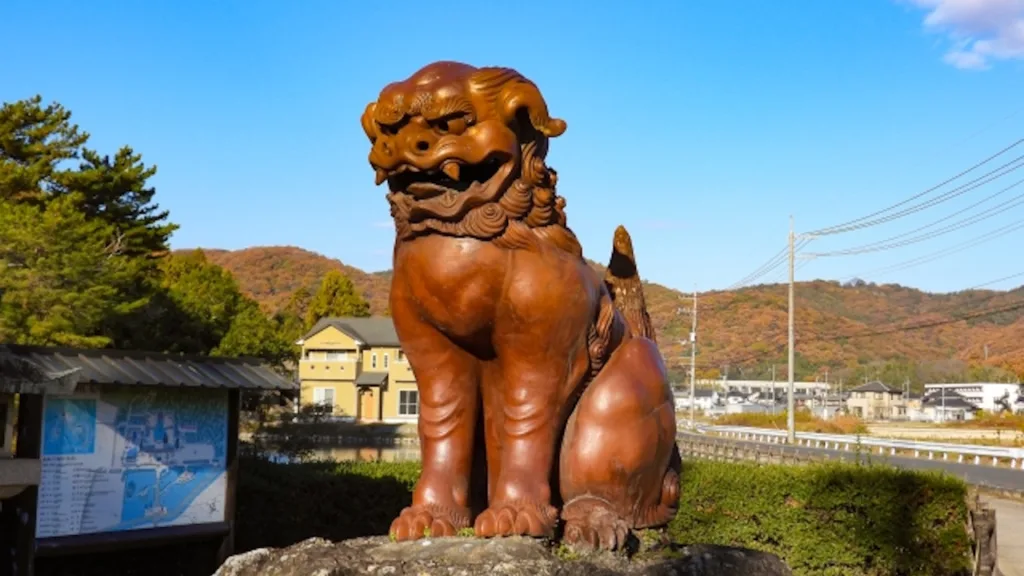
The shrine’s identification with Momotaro is woven into every corner of the precincts. A statue of Momotaro stands on the approach, accompanied by his three animal companions, and the momo-mamori (桃守, peach-shaped amulets) and shiro-momo-mikuji (白桃みくじ, fortune slips in peach-shaped vessels) have become emblematic of the shrine’s character.
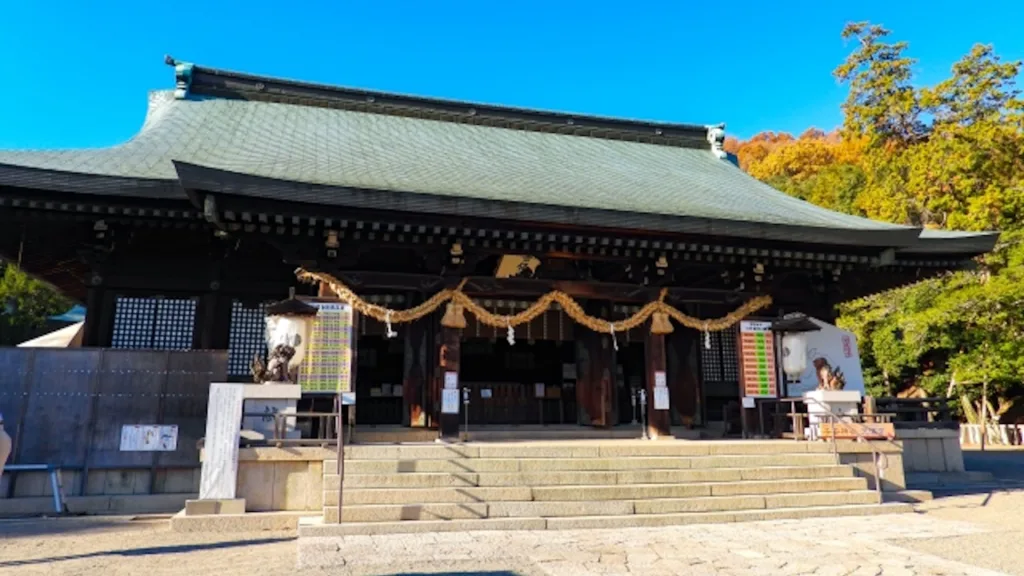
Among the shrine’s most remarkable treasures is the sacred sword known as Momotarō-Sukesada (桃太郎祐定), formally inscribed “備前國長舩住人横山上野大掾藤原祐定” — a great tachi sword designated as an Okayama Prefectural Important Cultural Property. Its blade exceeds three shaku (approximately 90 cm) in length. The blade pattern is called Shinshin-midare (神心乱), interpreted as “calming the hearts of people through divine power” — a fitting inscription for a sword enshrined at the birthplace of a demon-slaying legend. The sword exemplifies the deep connection between Okayama Prefecture and the tradition of Bizen swords, among the most celebrated in Japanese swordsmithing history.
The Ancient Musketry Ceremony at the Autumn Festival
At the annual Autumn Grand Festival (秋季例大祭), the Bishū Okayama-jo Teppōtai — a group dedicated to preserving Edo-period firearms techniques — performs a ceremonial ancient musketry ritual (古式砲術神事). The ceremony is a direct expression of the shrine’s historical ties to the Ikeda Domain lords, and it carries the atmosphere of Edo-period warrior culture intact into the present.
The Shrine Through the Seasons and the Kibiji Landscape
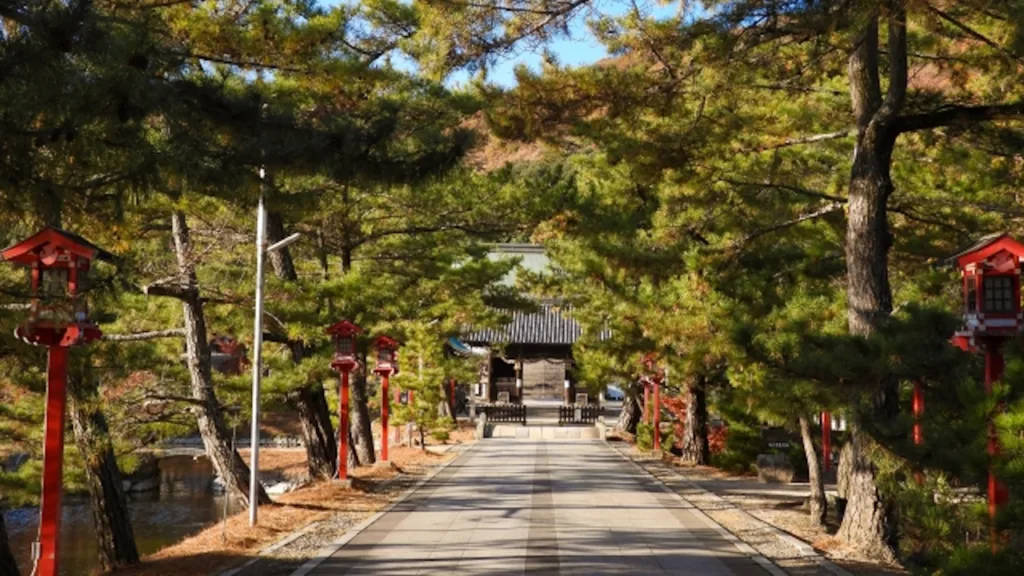
The precincts of Kibitsuhiko Jinja change character with every season. The sacred grove (社叢, shajū) maintains a year-round solemnity, while seasonal blooms soften its grandeur. Spring brings plum and cherry blossoms around the precinct and along the rural lanes of the Kibiji corridor. In autumn, the trees of Kibi-no-Nakayama turn to red and gold, harmonizing with the ancient shrine architecture in a way that feels almost staged. Walking the stone-paved approach and pausing to consider that the same path has been trodden by pilgrims for over a thousand years is one of the quietly affecting experiences this shrine affords.
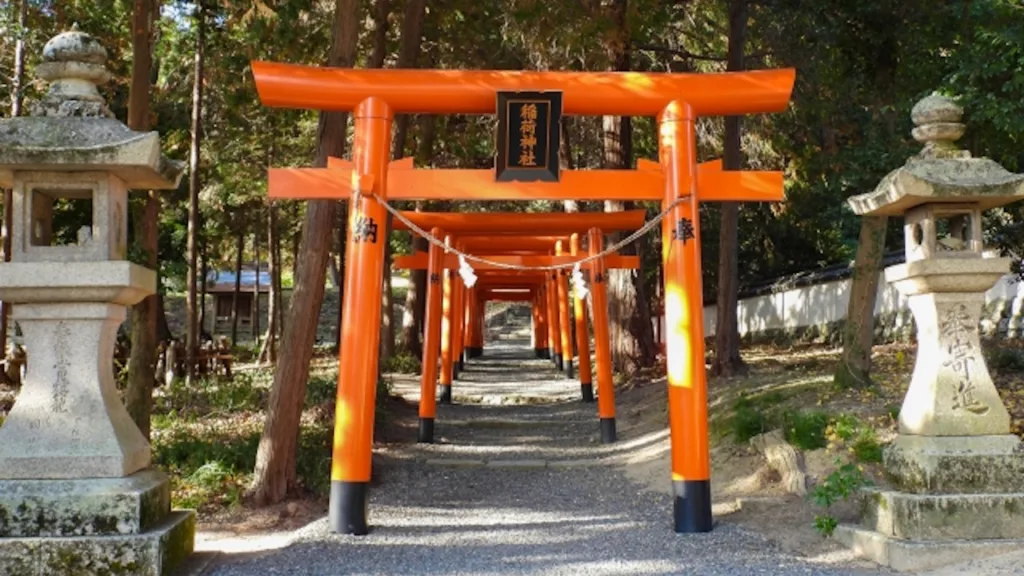
The wider Kibiji landscape rewards those who linger. Within a few kilometers of Kibi-no-Nakayama, the five-storied pagoda of Bicchū Kokubunji rises above paddies in one of the most photographed rural scenes in western Japan. The density of ancient ruins, shrines, and burial mounds in this small area testifies to Kibi’s status as one of the great civilizational centers of ancient Japan.
Nearby Attractions Worth Combining
Kibitsu Jinja
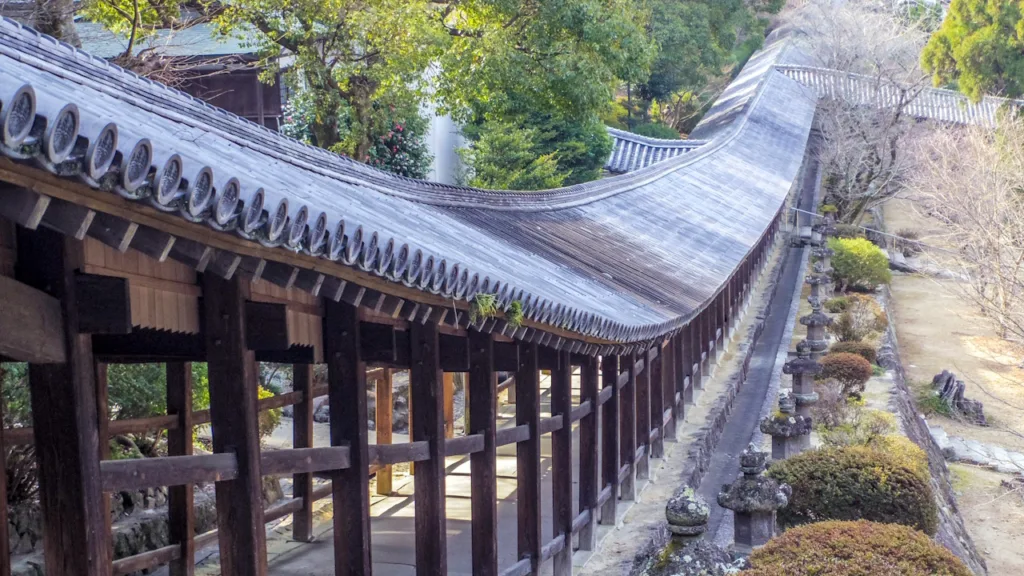
Located approximately ten minutes by car to the northwest of Kibitsuhiko Jinja, on the opposite side of Kibi-no-Nakayama, Kibitsu Jinja is the Ichinomiya of Bichū Province and one of the most architecturally extraordinary shrines in Japan. Its honden and haiden, built in the unique “Kibitsu-zukuri” style — a double hip-and-gable roof found nowhere else in the country — are designated National Treasures. An approximately 360-meter covered corridor connects the main buildings to subsidiary structures, creating a processional experience unlike any other shrine in Japan. Kibitsu Jinja also enshrines Okikibitsuhiko-no-Mikoto and is home to the Narikama Shinji oracle ceremony described in the legend of Ura. The shrine and Kibitsuhiko Jinja together form the sacred dual poles of the Kibi mythological world.
Yagui-no-Miya (Yagunomiya)
Approximately 4 km southwest of Kibitsuhiko Jinja and about ten minutes by car, Yagui-no-Miya is a small shrine marking the exact spot where the arrows of Okikibitsuhiko-no-Mikoto and the boulders of Ura collided in midair during their legendary duel. The actual stones are preserved within the precinct, and the site is designated a component of the Japan Heritage “Momotaro Legend” program. For those who have read the legend closely, standing here — looking toward Kinojō on the horizon — allows the scale of the mythological battlefield to become suddenly, vividly real.
Kinojō (Demon’s Castle)
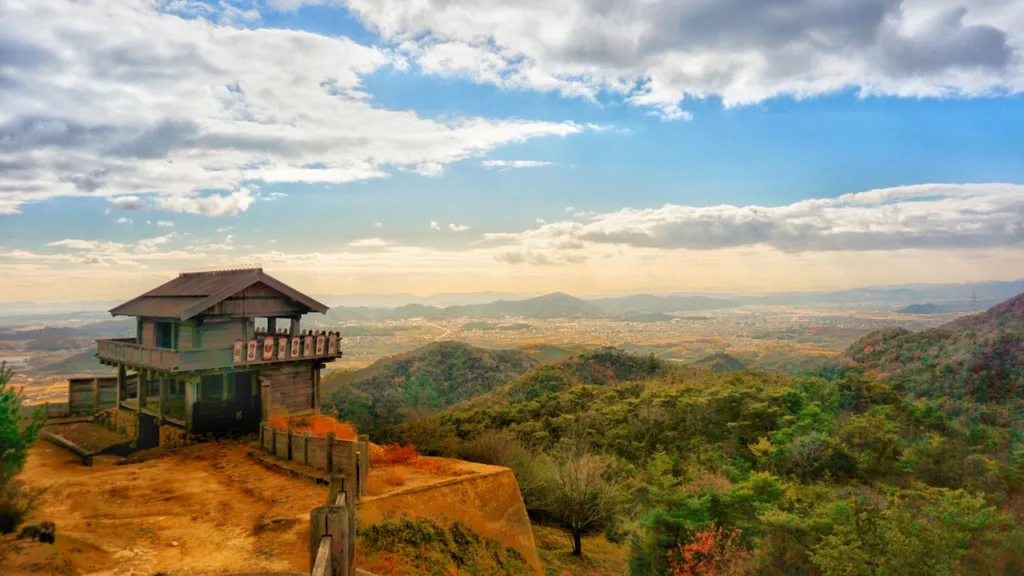
The mountain fortress that tradition identifies as Ura’s stronghold, Kinojō is an ancient mountain citadel built near the summit of Mount Kijōzan (397 m) in present-day Sōja City, about 20 to 25 minutes by car from Kibitsuhiko Jinja. The reconstructed west gate and the stone walls and earthen ramparts extending approximately 2.8 km in total are a designated National Historic Site. The scale of the fortifications — and their resemblance to ancient Korean mountain fortresses — has fueled ongoing scholarly discussion about the relationship between Kibi and the Korean peninsula in antiquity.
Recommended Accommodation Nearby
Hotel Granvia Okayama
Directly connected to the second floor of JR Okayama Station via an enclosed walkway, Hotel Granvia Okayama is a flagship property of the JR Hotel Group and one of the premier hotels in western Japan. Kibitsuhiko Jinja is approximately 20 minutes away by train or car, making the hotel an ideal base for exploring the Kibiji corridor. The hotel’s 329 rooms, indoor pool (20 m, three lanes), sauna, and jacuzzi facilities reflect its position as a full-service luxury property. The 19th-floor Sky Lounge Applause serves a highly regarded breakfast buffet featuring ingredients from the Seto Inland Sea, and the panoramic city views from floors 19 and 20 are a highlight in their own right. In April 2026, the upper floors were relaunched as a premium floor with enhanced amenities and interiors.
ANA Crowne Plaza Okayama by IHG
A two-minute walk from JR Okayama Station’s west exit via a covered pedestrian bridge, ANA Crowne Plaza Okayama by IHG belongs to IHG Hotels & Resorts’ Crowne Plaza brand and delivers the international service standards and refined interiors the brand is known for. All 220 rooms feature wide windows with city views, and the hotel’s 20th-floor Sky Bar & Lounge and Japanese restaurant Kuriya-sen, both commanding panoramic views of Okayama, provide memorable dining experiences. A full renovation of all guestrooms is planned for 2027.
Mitsui Garden Hotel Okayama
A two-minute walk from JR Okayama Station, Mitsui Garden Hotel Okayama is part of Mitsui Fudosan’s Mitsui Garden Hotel brand. Its modern, well-appointed rooms and attentive service make it a consistently well-regarded choice for both leisure and business travelers using Okayama as a base.
Traveling with a Dedicated Tour Conductor
Navigating a site as historically layered as Kibitsuhiko Jinja and the surrounding Kibiji corridor is a rewarding experience — and one that becomes significantly more manageable with a dedicated tour conductor accompanying you from Japan.
A licensed tour conductor does not perform guiding or commentary in the sense of a local guide, but handles the full range of itinerary management responsibilities: coordinating transportation connections between the scattered sites of the Kibiji area, managing luggage logistics, handling emergency arrangements if anything unexpected arises, and providing translation assistance where needed at facilities, ticket offices, or transit points. In a region where train frequencies are low, where the sites are spread across several kilometers of rural roads, and where English signage is limited, having someone fluent in both Japanese and the practicalities of the transport network removes a considerable layer of logistical pressure.
The Kibiji corridor is also the kind of destination where timing matters — arriving at Yagui-no-Miya in quiet morning light, crossing Kibi-no-Nakayama before midday crowds gather at Kibitsu Jinja, and returning to Okayama Station in time to connect onward to Hiroshima or Kyoto without the anxiety of a missed train. A tour conductor’s role is precisely to hold these threads together, so that the journey itself remains the experience rather than the obstacle.
For travelers planning a Japan itinerary that includes Okayama and the Kibiji corridor, our tour conductor and travel arrangement service is available at tours.e-stay.jp.

In Closing
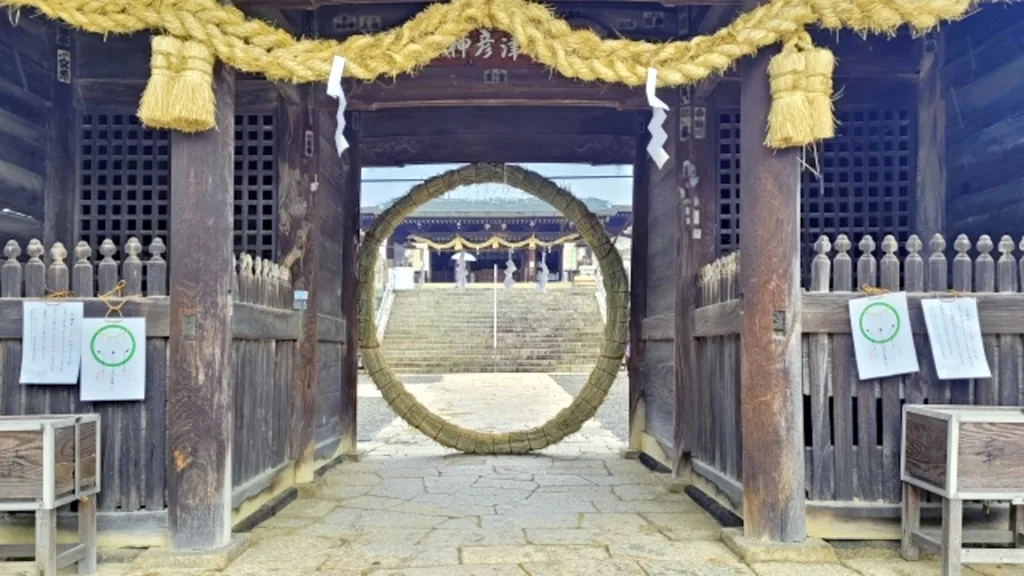
Kibitsuhiko Jinja is a shrine that refuses easy categorization. It is, at one level, the “Momotaro shrine” — and the peach-themed amulets and the statue on the approach fully embrace that identity. But beneath that accessible surface lies a site of genuine historical and spiritual depth: a sacred mountain with roots in prehistoric ritual, a solar-aligned architecture that predates written records of its own design, a cultural property of extraordinary intactness, and a legend whose ethical ambiguity — hero or invader? demon or civilizer? — continues to generate serious historical debate. For travelers willing to spend a half-day or more in the Kibiji area, the return on that investment is considerable. Hotel Granvia Okayama, directly connected to Okayama Station, makes an excellent operational base: with a JR pass and the Kibi Line, the shrine is under twenty minutes away, and the surrounding circuit of Kibitsu Jinja, Yagui-no-Miya, and Kinojō can be completed in a full day of unhurried exploration.