



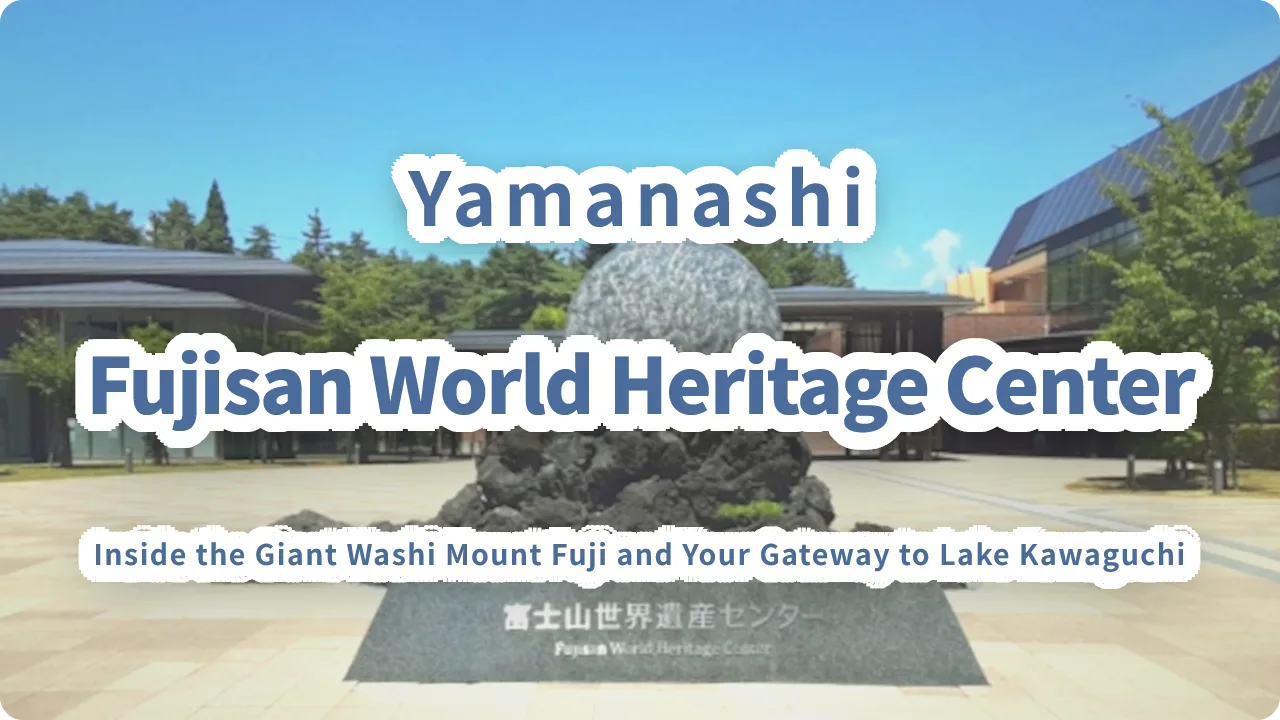
Travel insights from a tour conductor — today’s destination: the Yamanashi Prefectural Fujisan World Heritage Center, a free museum near Lake Kawaguchi built to explain why Mount Fuji became a UNESCO World Cultural Heritage site.
When Mount Fuji was inscribed on the UNESCO World Heritage List in June 2013, it wasn’t for its shape or its height. It went in as a cultural site — “Fujisan, Sacred Place and Source of Artistic Inspiration” — and the Yamanashi Prefectural Fujisan World Heritage Center exists to unpack exactly what that means. The centerpiece is impossible to miss: Fugaku 360, a 15-meter model of the mountain built entirely from washi paper, lit to shift through dawn, daylight, dusk and starlight as you walk a full circle around it. It’s the kind of exhibit that turns “we saw Mount Fuji” into “we understood Mount Fuji.”
Admission is free, and the center sits right by the Fuji Subaru Line entrance, just 300 meters from the Kawaguchiko Interchange. That makes it an easy stop whether you’re heading up to the fifth station for a climb, touring the Fuji Five Lakes, or simply looking for something worthwhile to do on a cloudy day when the mountain itself refuses to show its face.
| Item | Details |
|---|---|
| Name | Yamanashi Prefectural Fujisan World Heritage Center |
| Hours | 9:00 a.m.–5:00 p.m. (8:30 a.m.–6:00 p.m. in July–August; 9:00 a.m.–4:30 p.m. in December–February) |
| Closed | The North Building is open year-round; the South Building closes on the fourth Tuesday of each month |
| Address | 6663-1 Funatsu, Fujikawaguchiko-machi, Minamitsuru-gun, Yamanashi |
| Getting there | 5-minute bus ride from Kawaguchiko Station, then a 1-minute walk from the “Fujisan World Heritage Center” stop; 300 m from the Kawaguchiko IC on the Chuo Expressway |
Before You Go: There Are Two “Fujisan World Heritage Centers”
Here’s the mix-up that trips up more visitors than anything else about this place: there are two facilities in Japan called “Fujisan World Heritage Center,” and they’re an hour’s drive apart. This article covers the Yamanashi Prefectural Fujisan World Heritage Center, on the northern, Lake Kawaguchi side of the mountain. The other one, the Shizuoka Fujisan World Heritage Center, sits in Fujinomiya on the southern side and is run by a completely different prefecture, with its own building and its own exhibits. If you’re mapping this out on your phone, search with “Yamanashi” included in the name, or you may well end up on the wrong side of the mountain.
The other detail worth locking in before you go is the South Building’s closure day. The North Building never closes, but Fugaku 360 lives in the South Building, which shuts on the fourth Tuesday of every month. If seeing that washi Fuji is the whole point of your visit, double-check your date isn’t a fourth Tuesday. Budget around an hour for the exhibits themselves — this is a stop to pair with a day of lake sightseeing or a climb, not a full day out on its own.
Why Fujisan Is a Cultural Site, Not a Natural One
There’s a genuinely interesting backstory behind this museum’s existence. Mount Fuji’s original bid for UNESCO status aimed for natural heritage status. It didn’t work. As striking as Japan’s tallest peak is, similar stratovolcanoes exist elsewhere in the world, and demonstrating “outstanding universal value” on natural grounds alone proved a hard case to make.
What tipped the scales was the mountain’s relationship with the people who’ve lived in its shadow for over a thousand years. Fujisan became an object of worship long before it became a tourist destination — feared as a source of eruptions, then reimagined through Asama faith as a deity to be honored, drawing pilgrims who climbed it as an act of devotion through the Fuji-kō pilgrimage tradition and its guide-priests, the oshi. At the same time, the mountain fed something else entirely: art. Katsushika Hokusai’s “Thirty-Six Views of Mount Fuji” carried its silhouette to audiences who’d never set foot in Japan, and generations of painters and poets since have returned to it as their defining subject. Those two threads — sacred object and artistic wellspring — are what earned Fujisan its listing in June 2013, alongside 24 other component sites that include shrines, pilgrimage routes and the Fuji Five Lakes themselves.
The Yamanashi Center grew directly out of that recognition. Its North Building started life in 1984 as the Fuji Visitor Center. The South Building came later, opening on June 22, 2016, to carry the cultural-heritage storyline the original building never had room for — and since April 2019, both buildings have been free to enter. It’s not just a museum; it also functions as a research and conservation hub for the mountain, which makes it something closer to Fujisan’s official front door than a typical sightseeing stop.
Fugaku 360: A Mountain Made of Paper That Changes With the Light
Stand in the middle of the South Building and you’re facing the reason most people come here: Fugaku 360, a 1:1,000-scale model of Mount Fuji, 15 meters long, built entirely from washi paper. The paper’s texture picks up shadow in a way that mimics the mountain’s actual ridgelines, and because you can walk all the way around it, you get angles on Fuji that no photograph from the ground ever gives you.
The real draw, though, is the lighting. Over the course of a few minutes, the installation cycles through a full day and a full year — a rose-gold dawn, the flat blue of midday, a fading amber dusk, then a night sky version lit by a synthetic starfield, all set to ambient sound. Stand there long enough and you watch the mountain’s entire emotional range play out in miniature. The piece won a Cool Japan Award in 2017, and it’s become something of a magnet for overseas visitors precisely because it fuses old-world papercraft with genuinely modern staging.
The South Building doesn’t stop at the model. Its surrounding galleries dig into both halves of the mountain’s UNESCO citation — the pilgrimage culture and Asama-faith relics on one side, and Fuji’s outsized influence on Japanese art on the other, including the woodblock prints of Hokusai and Hiroshige that made the mountain internationally recognizable. Picking up the center’s “Fuji Guide” app before you start gives you narrated context at each stop, so you can move through the galleries at your own pace instead of on a fixed tour schedule.
The North Building: Where Fujisan’s Geology Meets Trip Planning
The North Building — the original Fuji Visitor Center in its earlier life — takes a different angle entirely: the natural history of how Fujisan came to look the way it does. High-definition screen displays and hands-on exhibits walk through the volcano’s formation, the eruptions that shaped it, and how the surrounding landscape, from the Aokigahara forest to the Fuji Five Lakes, took form around it. Pairing the North Building’s natural-history angle with the South Building’s cultural one gives you the full picture the UNESCO listing is actually built on.
It’s also where the practical side of a visit lives. The North Building houses a JNTO-certified Category 2 tourist information center stocked with material on the wider Fuji Five Lakes area, plus an on-site restaurant and a gift shop stacked with Fuji-themed souvenirs worth browsing before you leave. The grounds span roughly 27,600 square meters, and a nature trail winds through the property outside — worth a walk if the weather’s cooperating.
Free guided tours led by certified Fujisan World Heritage Guides run through the center as well, and they’re worth timing your visit around if you want the stories behind the exhibits rather than just the exhibits themselves. Given the location right at the Fuji Subaru Line entrance, the center doubles as a natural staging point during climbing season for anyone gathering last information before heading up to the fifth station — making it a stop worth working in whether you’re here to look at the mountain or climb it.

Nearby: What’s Within a Short Drive
The Melody Road
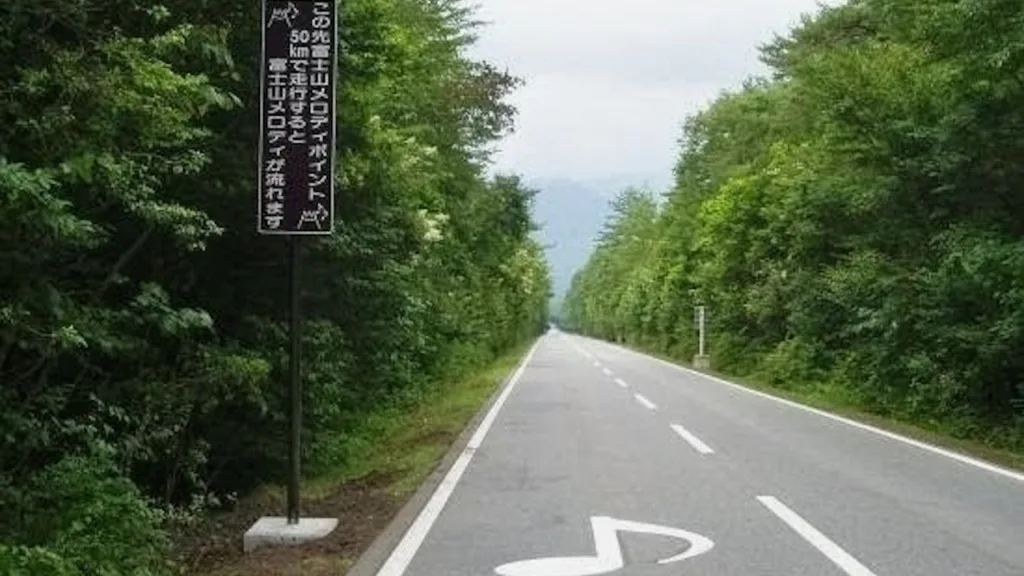
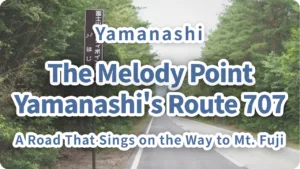
On the very same road that runs from the center up toward the Fuji Subaru Line tollgate, a stretch of Prefectural Route 707 has grooves cut into the pavement that turn tire noise into music. Drive it at 50 km/h and “Fuji no Yama,” a well-known children’s song about the mountain, rises up out of the road itself — Yamanashi’s first project of its kind, with about 20 seconds of melody heading up and a different verse heading back down. Turn the stereo down as you pull away from the center and listen for it; it’s a small, easy detour that turns the final stretch toward the mountain into part of the experience.
Fuji-Q Highland
About a 5-minute drive away, right by the Kawaguchiko Interchange, Fuji-Q Highland is one of Japan’s most talked-about amusement parks, known worldwide for coasters like Fujiyama that put you face-to-face with Mount Fuji at speed. Families traveling with younger kids will find a gentler counterpart in the on-site Thomas Land section. Pairing an hour of cultural context at the World Heritage Center with an afternoon of adrenaline here makes for a genuinely well-rounded day.
Lake Kawaguchi
Head about 5 minutes north and you hit the shoreline of Lake Kawaguchi, one of the Fuji Five Lakes. From the northern shore, Fuji rises directly across the water, and on still mornings the lake turns into a mirror for the “upside-down Fuji” reflection photographers chase. Boat cruises, art museums and lakeside cafés line the shore, and the view shifts with the seasons — cherry blossoms in spring, lavender in early summer, foliage in autumn. Lake Kawaguchi is itself one of the UNESCO component sites, so this is where the abstract history you just read about turns into scenery you can stand in front of.
Mt. Fuji Panoramic Ropeway
About a 7-minute drive to the eastern shore of Lake Kawaguchi brings you to the Mt. Fuji Panoramic Ropeway, long known by its older name, the Kachi Kachi Yama Ropeway, after the Japanese folktale set on this mountain. A roughly 3-minute ride up Mt. Tenjo delivers you to an observation deck with a sweeping view of Fuji and the lake together, dotted with rabbit and raccoon-dog statues from the folktale. Having just learned how Fuji shaped generations of painters, it’s worth standing here for a minute and understanding exactly why.
The Yoshida Tainai Tree Molds
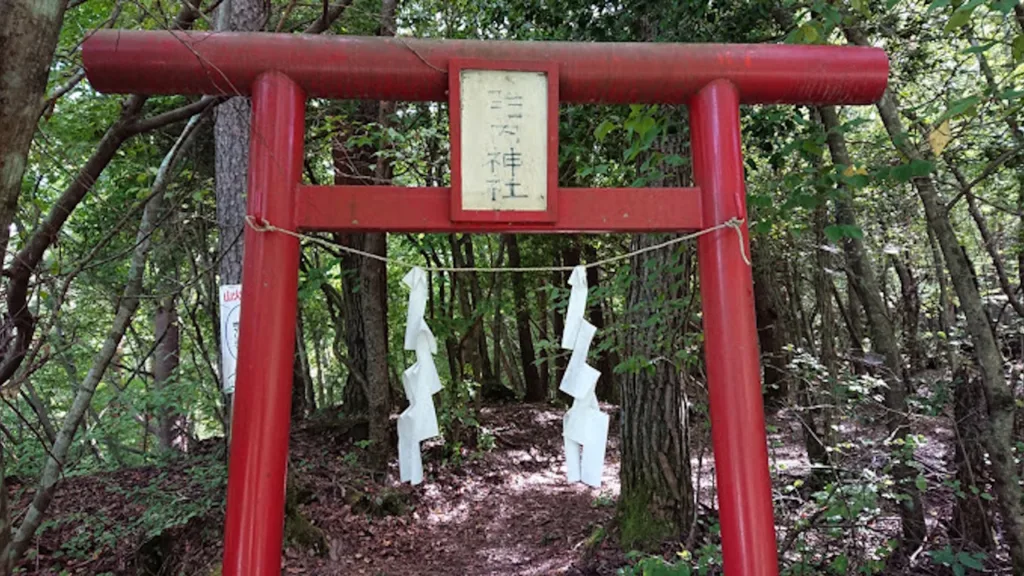
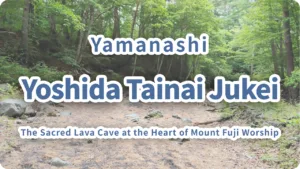
When Mount Fuji erupted in 937 CE, lava flowing down the slope engulfed a stand of trees, cooled around them, and left behind a cave-like hollow inside — a lava tree mold whose twisting interior earned it the name “tainai,” meaning womb. Followers of the Fuji-kō pilgrimage faith once purified themselves here before climbing the mountain, and together with more than 60 similar molds scattered nearby, the site is designated a Japanese National Natural Monument and listed as a component asset of Fujisan’s UNESCO inscription. The interior stays closed to the public year-round except for one day, April 29, during the annual Yoshida Tainai Festival. It’s roughly a 10-minute drive from the Kawaguchiko Interchange followed by a 30-minute walk from Nakanochaya, with no parking on site, so it rewards visitors willing to treat it as a quiet forest pilgrimage rather than a quick photo stop.
Where to Stay Near the Fujisan World Heritage Center
Fujikawaguchiko is thick with Fuji-view hot spring resorts and lakeside hotels. Here are three well-reviewed options within easy reach of the center.
Highland Resort Hotel & Spa
Sitting right next to the Kawaguchiko Interchange, about a 5-minute drive from the center, this has been the official hotel of Fuji-Q Highland since it opened in 1986. Rooms face the mountain directly, and guests get free access to the adjoining Fujiyama Onsen hot spring plus early entry to the amusement park next door. The breakfast buffet, mixing Japanese and Western dishes, draws consistent praise — a solid base if you’re combining the World Heritage Center with a day at Fuji-Q.
THE KUKUNA
A lakefront resort where every single room looks out over Lake Kawaguchi. The rooftop open-air bath, Ozora-no-Yu, is the standout feature — positioned so the bathwater and the lake surface appear to merge into one continuous view of Fuji. The Terrace in the Sky wing takes it further, with rooms that come with their own private open-air baths, so you can take in the view without leaving your room at all. Dinner leans Western with a half-buffet format built around seasonal, local ingredients.
Ubuya
Ubuya markets itself as a ryokan for celebrating life’s milestones, and it’s designed that way from the ground up — every guest room, along with the large and open-air baths, faces Mount Fuji across the lake. It’s a popular choice for anniversaries, 60th-birthday celebrations, and other family occasions, with wagyu steak and shabu-shabu dinner options that get particularly strong reviews. It’s roughly a 10-minute drive from the World Heritage Center, making it a comfortable base for exploring the Lake Kawaguchi side of the area.
Why Travel This Route With a Tour Conductor
A visit to the Fujisan World Heritage Center works well enough as a solo add-on to a Lake Kawaguchi trip, but the wider itinerary around it — bus transfers from Kawaguchiko Station, ropeway timing, matching a Fuji-Q Highland visit against South Building closure days, coordinating hotel check-in with a multi-stop day — is where a dedicated tour conductor earns their keep.
A tour conductor’s role is itinerary management, not sightseeing narration: keeping your transfers, timings and reservations running smoothly across a multi-stop day, stepping in immediately if a bus is delayed or a booking needs to shift, and bridging language gaps at ticket counters, restaurants and hotel front desks where English isn’t always spoken. That’s a genuinely different job from guiding you through the exhibits — it’s about making sure nothing on the logistics side gets in the way of your day, so a rained-out morning or a missed connection doesn’t cost you the whole afternoon.
If you’d rather hand off the transfers, timing and language logistics of a Mount Fuji day trip and focus purely on the mountain in front of you, tours.e-stay.jp connects you with a dedicated tour conductor for exactly this kind of itinerary.

In Summary
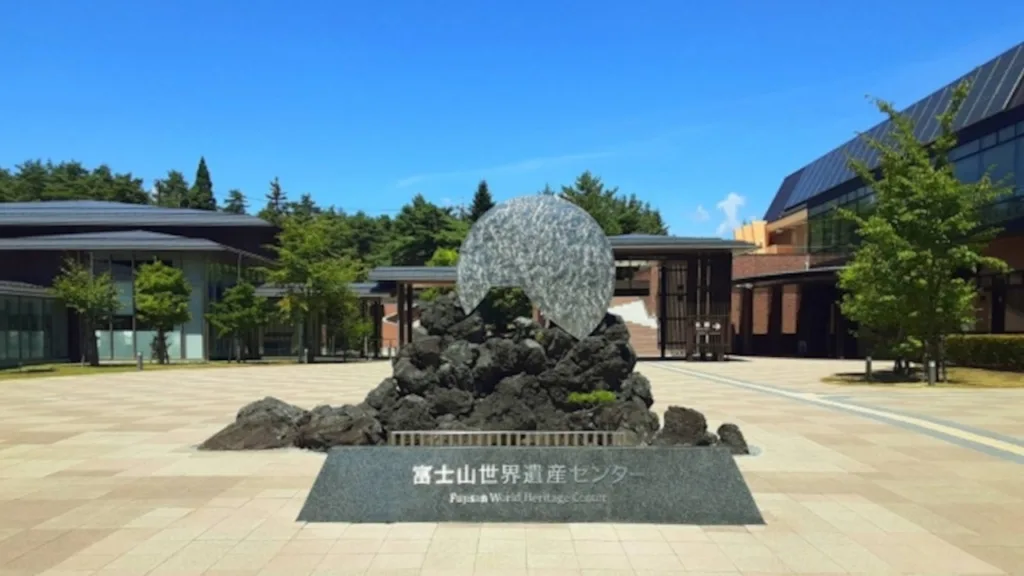
The Yamanashi Prefectural Fujisan World Heritage Center turns “Fujisan, Sacred Place and Source of Artistic Inspiration” from a UNESCO label into something you can actually walk through — a giant washi rendering of the mountain, galleries on faith and art, and a natural-history counterpart next door, all for free admission a few hundred meters from the highway. Keep the Yamanashi/Shizuoka mix-up in mind, dodge the South Building’s fourth-Tuesday closure, and it slots easily into a Lake Kawaguchi itinerary.
For where to stay, THE KUKUNA makes a strong base — every room looks out across the lake toward the mountain you just spent an hour learning about, which is about as good a way as any to close out the day.